To save content items to your account,
please confirm that you agree to abide by our usage policies.
If this is the first time you use this feature, you will be asked to authorise Cambridge Core to connect with your account.
Find out more about saving content to .
To save content items to your Kindle, first ensure no-reply@cambridge.org
is added to your Approved Personal Document E-mail List under your Personal Document Settings
on the Manage Your Content and Devices page of your Amazon account. Then enter the ‘name’ part
of your Kindle email address below.
Find out more about saving to your Kindle.
Note you can select to save to either the @free.kindle.com or @kindle.com variations.
‘@free.kindle.com’ emails are free but can only be saved to your device when it is connected to wi-fi.
‘@kindle.com’ emails can be delivered even when you are not connected to wi-fi, but note that service fees apply.
Since the late 1980s, Northern Ireland has seen a radical electoral shift away from the historically dominant parties in the Catholic and Protestant blocs – the Social Democratic and Labour Party (SDLP) and Ulster Unionist Party (UUP), respectively – towards the traditionally more ‘extreme’ parties – Sinn Fein and the Democratic Unionist Party (DUP). This change in aggregate support has been accompanied by increasing differences between generations as older cohorts of UUP and SDLP supporters have been replaced by newer cohorts of DUP and Sinn Fein partisans. This is not a result of increased polarisation in values and attitudes (whether overtly political or simply communal intolerance) among younger cohorts who are, if anything, slightly more moderate than their forbears. Rather, this results from the changing political context in which new generations have been socialised – in particular the expanded choice sets facing voters as they have reached voting age. This in turn has positive implications for the consolidation of devolved democratic governance.
Why do some people stably identify with a party while others do not? This study tests whether and how the direction, stability and strength of party identification are associated with big five personality traits, using panel data from a representative sample of German citizens. First, the study confirms that personality traits are related to identification with different political parties. Second, it moves beyond previous research by showing that personality traits are related to the strength and variation in party identification over time. The implications of the study for the classical perspectives on party identification, as well as the personality and politics literature, are discussed.
Government formation in multi‐party systems often requires coalition negotiations and finding common ground among coalition partners. Supporters of parties involved in the government formation process face a trade‐off when evaluating such bargaining processes: on the one hand, voters usually prefer seeing their party being in government rather than in opposition; on the other hand, negotiations require coalition compromises that they might dislike. In this paper, we study voters’ willingness to accept policy compromises during government formation processes. We argue that voters’ acceptance of policy compromises depends on both the strength of their party attachment and the importance they assign to the issue at stake during the coalition negotiations. Not giving in on important issues is key, especially for supporters of challenger parties, who hold strong policy preferences on a selected number of issues. To test these expectations, we collected original survey data immediately after the Spanish general election in November 2019. The results show support for the hypothesized effects, shed light on the pressure potential coalition partners face during government formation and help explain the failures of government formation attempts in increasingly polarized societies.
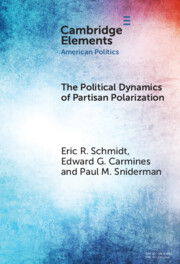
This is a study of the dynamics of partisan polarization in the United States. It has three objectives: (1) to identify and explain why some Republicans and Democrats – but not others – have polarized, particularly over the last twenty years; (2) to demonstrate that they have done so not on this or that issue but systematically, programmatically – domain versus issue sorting; and (3) to bring into the open profound asymmetries in polarization between the two parties, not least that Republicans polarized early and thoroughly on issues of race, while Democrats in the largest number stayed neutral or even conservative until only recently. Emerging from the reasoning and results is a revised theory of party identification that specifies the conditions under which ordinary Republicans and Democrats can become ideological partisans – real-life conservatives and liberals in their behavior – in the choices they make on candidates, policies, and parties.
This chapter develops two main arguments to account for the surprising longevity of Fujimorismo in Peru. First, although Alberto Fujimori did not invest resources in party-building during his authoritarian government (1990–2000), he developed populist appeals that contributed to the formation of a political identification with Fujimorismo. Second, the second-generation leader of Fujimorismo, Alberto’s daughter Keiko, has been trying to convert this nascent partisanship into a resource for party institutionalization ever since her first presidential campaign in 2011.
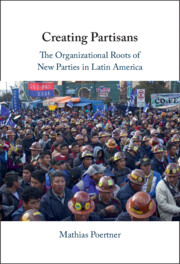
Why are some new political parties successful at creating mass partisanship and engendering stable electoral support, while most fail to take root in society and disappear quickly? Creating Partisans unveils the secrets behind successful political parties, taking a deep dive into the formation and success of new political parties in Latin America. Based on extensive fieldwork and using a multi-method approach, the book explores how different mobilization strategies sway voters to support new parties. While prior studies have focused on the various types of direct appeals parties make to voters, Creating Partisans reveals that it is organizationally mediated appeals – those that engage voters through locally-based civil society organizations – that can secure electoral support more effectively and can create lasting partisan attachments. From indigenous organizations to informal sector unions, new types of societal organizations play a critical mediating role in shaping electoral outcomes and fostering long-term partisan loyalties in young democracies.
This chapter summarizes the book’s main argument and places it in the broader context of the literatures on party building, electoral mobilization, and partisanship. It outlines the book’s broad theoretical approach that combines insights from social psychology (in particular, drawing on social identity and self-categorization theory) with a historical institutionalist framework.
This chapter first develops a theoretical framework on the behavioral dynamics behind voters’ responses to different mobilization strategies and their different effects on voter preferences and party identification. It then goes on to explore why these different strategies are available to new parties in the first place. It develops a theoretical model that focuses on the period before a new party contests its first major election to show how the intra-elite dynamics during these founding moments shape early on which mobilization strategies the party adopts.
This chapter explores the resulting party identification in the three cases. Drawing on original and existing survey data, it shows that membership in organizations that regularly support a new party is strongly associated with whether a voter develops an attachment to the party. Further analysis of the poster experiments suggests that the frequency of attending organization meetings is associated with the robustness of the attachment. Additional analyses of the natural experiment reveal that repeated organizational expressions of support over multiple years help new parties gain new followers. It then compares and contrasts this organizationally mediated path to partisanship (organizational cultivation), which can account for the development of robust partisan attachments to the MAS and MORENA, with an alternative path to partisanship that can yield party identification even for parties without organically linked organizational allies. In the case of Alianza PAIS, which could not rely on organizational cultivation through organically linked organizations, partisan attachments have developed in direct response to voters’ evaluations of the party’s performance.
To what extent does race predict vote choice in the array of American elections? How does the impact of race compare with class, gender, age, and other demographic factors? And how has racially polarized voting changed in the face of the growing diversity of the American electorate? After demonstrating an increasingly close connection between race and the vote, this chapter seeks to explain the link between race and vote choice. Although we note that a series of nonracial factors account for some of the racial divide in the vote, research also clearly shows that racial considerations and increasing concerns about immigration greatly shape both sides of the vote. We also focus on the rise of nonpartisanship among the minority population and on the role that parties have played in the past and could play in the future in incorporating immigrants.
Thousands of Latin Americans migrate to the United States every year. This article seeks to understand how immigrants’ premigration political experiences influence the acquisition of party identification upon arrival in the United States. This research proposes that premigration political experiences influence the acquisition of party identification among Latino immigrants in the United States. Utilizing data from the 2016 Collaborative Multiracial Post-Election Survey (CMPS) and Proyecto Élites Parlamentarias Latinoamericanas (Latin American Parliamentary Elites Project), this paper analyzes how the ideology of the government in power in the immigrants’ country of origin influences party identification among Latino immigrants in the United States. Employing multinomial regression analysis, I demonstrate that the ideology of governments in power in Latin American countries when Latinos migrate influences the party identification of those immigrants in the United States. The results of this study contribute to the conversations on premigration experiences and challenge the applicability of classical theories of party identification for immigrants.
Populist supporters have been found to take cues from populist incumbents. Yet, little is known about how they incorporate party cues in their political beliefs when populists are in office. This research note argues that (1) citizens who identify with populist parties engage in partisan motivated reasoning – that is, they are driven by the desire to be consistent with their partisan allegiances – and that (2) they engage in partisan motivated reasoning more intensely than their non-populist counterparts because populist party cues strongly prompt them to process biased information. Drawing on data from the European Social Survey, it is evidenced that populist supporters express much warmer economic views when their parties hold power. Warm economic views are also found to increase significantly more in accordance with strength of partisanship and exposure to political information for populist supporters than for non-populist supporters when their respective parties govern. Results highlight a mechanism by which populist incumbents are likely to remain attractive despite their poor economic record. They have implications for our understanding of the mainstreaming of populist parties in Europe.
This article brings three decades of broadly consistent survey data on survey respondents’ feelings about the parties as evidence of affective polarization. It also presents evidence about policy differences among the parties and makes an explicit link between elite and mass data with multilevel modelling. The article shows that affective polarization is real and also demonstrates its connection to the ideological landscape. But it also shows that conceptual categories originating in the United States must be adapted to Canada's multiparty system and to the continuing contrasts between Quebec and the rest of Canada. It suggests that accounts of Canada's twentieth-century party system may not apply to the twenty-first century.
Among US states with party registration, many allow the unaffiliated to choose either the Democratic or Republican primary. States with these semi-closed rules thus provide an option to voters with greater choice than registering with a single political party. Using the synthetic control method, I find that the introduction of semi-closed primaries is associated with growth in unaffiliated registration. However, the likelihood of unaffiliated registration is not even across the electorate in semi-closed states. I show that it is most common where a voter’s party is not competitive and the access unaffiliated registration provides to the strong party’s primary is valuable. Consistent with this instrumental motive, unaffiliated voters in semi-closed states use their freedom of choice to vote in the primary of the stronger party in the electorate. This leads to significant crossover voting among unaffiliated voters who do not identify with that party such as Democrats in red states or Republicans in blue states. These findings show the unintended consequences of electoral institutions and find primary crossover voting is more common under some circumstances than others.
Macropartisanship is a measure of aggregate trends in party identification in the mass public that allows researchers to track partisanship dynamically. In previous research, macropartisanship was found to vary in concert with major political events and forces like presidential approval and the economy. However, studying macropartisanship as an aggregate trend assumes that group dynamics within the measure are equivalent. We present a series of new measures of macropartisanship using Stimson’s (2018) dyad ratio approach disaggregated by race and ethnicity. We detail the creation of measures for White, Latino, and Black macropartisanship from 1983 to 2016 using more than 500 surveys from CBS News and CBS/New York Times. The resulting data collection is publicly available and can be downloaded in monthly, quarterly, or yearly format. Our initial analysis of these data show that thinking about macropartisanship as a single aggregate measure masks important and significant variation in our understanding of party identification. Change in the measures are uncorrelated. Latino macropartisanship is more volatile and responds more to economic conditions, Black macropartisanship is very stable and has become more Democratic in response to increased polarization, while White macropartisanship has become less responsive to economic conditions as has become more Republican as Republicans have moved to the right.
When do voters punish corrupt politicians? Heterogeneous views about the importance of corruption can determine whether or not increased information enhances accountability. If partisan cleavages correlate with the importance voters place on corruption, then the consequences of information may vary by candidate, even when voters identify multiple candidates as corrupt. We provide evidence of this mechanism from a field experiment in a mayoral election in Brazil where a reputable interest group declared both candidates corrupt. We distributed fliers in the runoff mayoral election in São Paulo. Informing voters about the challenger's record reduced turnout by 1.9 percentage points and increased the opponent's vote by 2.6 percentage points. Informing voters about the incumbent's record had no effect on behavior. We attribute this divergent finding to differences in how each candidate's supporters view corruption. Using survey data and a survey experiment, we show that the challenger's supporters are more willing to punish their candidate for corruption, while the incumbent's supporters lack this inclination.
Illustrates how secularism is a potent predictor of public opinion that has, heretofore, been undetected. The chapter then digs deeper into the relationship between secularism, nonreligiosity, and politics. By employing the panel version of the Secular America Study that ran from 2010 to 2012 we test whether political views are more likely to lead to secular orientations or the other way around. The results show a backlash: politics drives people away from religion. But they also show that secularism drives political views, even on issues far removed from questions related to church and state. Secularists are firmly planted in the progressive wing of the Democratic Party.
Our research speaks to the ongoing debate over the extent and severity of partisan political divisions in American society. We employ behavioral experiments to probe for affective polarization using dictator, trust, and public goods games with party identification treatments. We find that subjects who identify politically with the Democratic or Republican Party and ideologically as liberals and conservatives display stronger affective biases than politically unaffiliated and ideological moderates. Partisan subjects are less altruistic, less trusting, and less likely to contribute to a mutually beneficial public good when paired with members of the opposing party. Compared to other behavioral studies, our research suggests increasing levels of affective polarization in the way Americans relate to one another politically, bordering on the entrenched divisions one commonly sees in conflict or post-conflict societies. To overcome affective polarization, our research points to inter-group contact as a mechanism for increasing trust and bridging political divides.
Scholars have long studied the influence of parties on citizens’ policy preferences. Experiments conducted outside Canada have convincingly shown that the cues offered by political parties can influence people’s attitudes. However, the most prominent study of party cue effects in Canada finds weak effects, concluding that Canadian parties are less influential because they are less clearly ideological than parties elsewhere. We propose that parties are actually more influential than they appear because party cue effects partly depend on variables other than partisanship, notably attitudes toward the cue-giver. This is especially true in countries like Canada with multi-party systems. We show that attitudes toward parties are not clearly reflected in partisanship in Canada. We then show that more specific measures of party and leader attitudes better account for how experimental participants react to cues than does party identification alone.