To save content items to your account,
please confirm that you agree to abide by our usage policies.
If this is the first time you use this feature, you will be asked to authorise Cambridge Core to connect with your account.
Find out more about saving content to .
To save content items to your Kindle, first ensure no-reply@cambridge.org
is added to your Approved Personal Document E-mail List under your Personal Document Settings
on the Manage Your Content and Devices page of your Amazon account. Then enter the ‘name’ part
of your Kindle email address below.
Find out more about saving to your Kindle.
Note you can select to save to either the @free.kindle.com or @kindle.com variations.
‘@free.kindle.com’ emails are free but can only be saved to your device when it is connected to wi-fi.
‘@kindle.com’ emails can be delivered even when you are not connected to wi-fi, but note that service fees apply.
How did the songs of Pindar solicit the language of Greek polytheism? How could their words generate ritual knowledge and provoke experience? Pindar was long recognised as a master of piety and an authority on divine matters, and his poems remained privileged points of reference for thinking ritual occasions like festivals, the sanctuaries where they were held, and ritual types like sacrifice. Focusing on sacrifice, this chapter looks at the ritual language produced by Pindaric poetry, rather than the one it reflects, and its inscription in the ritual archive of Greek culture. It is concerned with the poet’s enduring role as an agent in the dynamic system of Greek polytheism. After a brief survey of the prominence of sacrifice in the Pindaric biographical tradition, different aspects of the sacrifices found in the poems of Pindar are reviewed and illustrated through case studies, most notably passages from Pythian 5, Isthmian 4, and Olympian 10.
The essay explores pilgrimage to the sanctuary of Dodona, in Epirus, through a phenomenological lens, aiming to reconstruct the experience of ancient pilgrims. The study highlights the significance of landscape, movement, and motivation, on the basis that Dodona’s natural features and architectural layout deeply influenced pilgrims’ perceptions. The phenomenological approach draws on landscape archaeology, analyzing human interaction with sacred spaces. The analysis examines not only motivations behind oracular activity, but also other purposes, such as attending the Naia festival, and emphasizes the interplay of visibility and movement as pilgrims approached the sanctuary. Although reconstructing individual experiences is challenging, common patterns in collective behavior, such as rituals, processions, and religious practices, offer insights into the ancient pilgrimage experience. In short, the study uses literary, epigraphic, and material evidence to discuss how Dodona’s sacred landscape shaped its visitors’ religious and emotional experiences, contributing to a broader understanding of Greek pilgrimage traditions.
Scholars trained in disciplines like anthropology, history, law, political science, and sociology helped to give rise to the field of law and society over the past two generations. What theories does law and society offer those disciplines in return, and are scholars in those fields looking back to law and society? To answer these questions, this article, which introduces a symposium celebrating the 60th anniversary of the Law & Society Review, brings together scholarship across disciplines to share the possible future influence of law and society on the disciplines. This theoretical and forward-looking inquiry invites us all to reflect upon law and society’s contributions over the past two generations and to consider what law and society will contribute to the next generation of interdisciplinary – and disciplinary – scholarship.
This chapter highlights those displaced by the American War for Independence. In the first part this chapter explores the conceptualization of the refugee in the American context and terminology as well as the war’s varied character, notions of charity, the complexity of sickness and the differing refugee experiences of White, Black, and Native American, Patriot, Loyalist, or neither. I underscore the complexity of the refugee experience and its contrary character. In the second part this chapter highlights the refugee diaspora in a global context to form a global picture. From North America out into the rapidly expanding British empire, I explore where refugees went and what became of them. I investigate the complex ways these migrants shaped the places they traveled to and what the long-lasting effects of these journeys were. In so doing this chapter underscores the wider connections and global repercussions engendered by the refugee element in this influential war.
The Old Testament book of Samuel is an intriguing narrative that offers an account of the origin of the monarchy in Israel. It also deals at length with the fascinating stories of Saul and David. In this volume, John Goldingay works through the book, exploring the main theological ideas as they emerge in the narratives about Samuel, Saul, and David, as well as in the stories of characters such as Hannah, Michal, Bathsheba, and Tamar. Goldingay brings out the key ideas about God and God's involvement in the lives of people, and their involvement with him through prayer and worship. He also delves into the mystery and complexity of human persons and their roles in events. Goldingay's study traces how God pursues his purpose for Israel and, ultimately, for the world in these narratives. It shows how this pursuit is interwoven with the realities of family, monarchy, war, love, ambition, loss, failure, and politics.
Chapter four examines the Muses, the sole female divinities who are regularly depicted as musicians in the surviving visual material. The ambiguity inherent to their representation, where it is never clear whether they are goddesses or human women, allows for their bodies to become visual forms capable of taking on multiple identities. Laferrière considers the images within their original contexts, including the domestic sphere, the cemetery, the sanctuary, and the symposium, to examine how the images invited their viewers to imagine the sounds of divine music and what effect this visualized music had upon the viewing audience. In each instance, she argues that the depictions of the Muses respond to the spaces in which they are encountered, so that their visual interpretation becomes inherently multivalent and malleable. When representations of the Muses are considered within a range of possible contexts of use, the vases make a powerful statement about the Muses: not only may they appear in any context or work through any female figure, but as divinities who are flexible in their visual representation, the Muses become visual forms capable of taking on multiple identities.
This chapter looks at the distribution of epichoric alphabets across the whole Aegean Basin, to the different styles of letter shapes used for writing the Greek language according to city of origin. The whole distribution is considered, and in comparing this to models used in previous generations the case is made that the situation is so complex that it cannot so easily be sketched out on a simple map. In focusing on case studies from sanctuaries and harbours, the long-held view is confirmed that these were places of hyper-connectivity, with communities and individuals competing for status – but that network analysis marks these patterns even more acutely. A wider point about data modelling is also made in this chapter. Depending on how representative one considers the data to be, very different patterns can be drawn (and very different conclusions can be reached).
This chapter investigates how Faulkner uses the figure of eyes as inkwells in his depiction of Temple Drake in his sensationalist 1931 novel Sanctuary where she is raped with a corncob by an impotent gangster. The ink represents the various narratives men imagine themselves drawing from her – she is either too sexual or not sexual enough, the victim of a crime or its instigator. Faulkner wrote Requiem for a Nun (1951) as a sequel to Sanctuary that in many ways recapitulates this sadism, but he suggests the possibility that Temple herself could achieve a new kind of agency as a paperback writer in the manner of Faulkner penning these salacious novels and eventually profiting from them. The topic of masculinity in Faulkner’s work is also fraught terrain. In Soldiers’ Pay (1926), Margaret Powers surprises the young Robert Saunders swimming naked; his body, the narrator says, looked like the color of old paper. This marks on Robert’s body a female gaze. Throughout his career, Faulkner wrestled with the idea that writing connotes effeminacy over and against masculine action, but spiritually and physically strong women become connected with writing in ways that defy a strict gender binary.
Accurate identification of key welfare issues for captive elephants could improve standards and help in the development of a welfare index. In the absence of adequate scientific information on the relative importance of key issues, the views of a range of stakeholders were sought using adaptive conjoint analysis. Fifteen key welfare issues were identified by experts, and three to six Levels of each, representing common husbandry practices. In order of declining importance, 224 stakeholders rated the issues as enclosure substrate > group size > healthcare > enrichment > chaining > enclosure type > exercise provision > enclosure size > interaction with keeper > enclosure environment > keeper knowledge/experience > diet > contact method with keeper > display duration > enclosure security. Enclosure size was considered more important by scientists and keepers than zoo directors/managers and animal welfare organisation representatives. Animal welfare organisation representatives rated enclosure security higher than scientists. Keeper husbandry methods and ability of elephants to be active were two principal components in responses. Three principal groups of respondents were identified: scientists/veterinarians focusing more on conditions for the elephants and less on interaction with the public; keepers, focusing on keeper contact method, feeding and knowledge of elephants; and a group with mainly animal welfare organisation representatives/zoo directors focusing on enclosure security. It is concluded that there are some differences between stakeholders in their recognition of the most important welfare issues for elephants in zoos. However, recognising that a diversity of informed opinion is necessary to adequately devise welfare standards, an index of elephant welfare in zoos is proposed, based on the relative merits of different husbandry practices and the importance of the different issues.
This chapter draws an outline how scholars from myriad disciplines (including law, anthropology, political science, history, geography, international relations, philosophy, psychology and economics), UN institutions and refugees approach and understand the notion of refuge. I also highlight the discrepancies between these ideas and the reality. I ask the gender question by exploring what women are seeking when they search for refuge as well as the nature of refuge sought by children and refugees with disabilities. I show that the concept of refuge is a robust one. There are different approaches to theorising refuge, but there is a shared understanding that it has restorative, regenerative and palliative functions that address refugees’ past, present and future. Refuge operates as a response to the particular dilemmas of those in need of protection and is variously expressed as a remedy, right, duty, process and status. It has a broad and flexible scope that responds to the specific needs of women, children and refugees with disabilities. The threshold for adequate refuge is a high one, encompassing much more than mere survival. However, many people who seek protection find themselves in places where the conditions may be comparable to or worse than the places they fled.
This chapter argues that human and environmental sanctuary, operating within liberalism, is a constituent aspect of US colonialism, not an exception from it. The chapter offers a cultural genealogy of sanctuary as a justificatory logic of US settler expansion through a reading of Terry Tempest Williams’ memoir, Refuge: An Unnatural History of Family and Place (1991). Against this, the chapter turns away from the canon of white American nature writing in order to center literary and material practices of survival that do not depend on international, colonial orders of protection. Here, the chapter reads Joan Naviyuk Kane’s collections of poems, The Straits (2105) and Milk Black Carbon (2017), written in the aftermath of the King Island Diaspora, as poetic and social experiments in thinking beyond colonial state sanctioned modalities of safety, return, and kinship.
The Phoenician island-city of Motya, off the west coast of Sicily, has long been a focus of archaeological research. Earlier excavations identified a large rectangular basin interpreted, by analogy with Carthage, as a ‘kothon’ or artificial inner harbour. Recent investigations of this feature, however, lead the author to a new interpretation. Rather than a harbour, the so-called ‘Kothon’ is revealed as a sacred freshwater pool at the centre of a monumental circular sanctuary hosting three large temples. The pool, watched over by a statue of Ba'al, also served as a surface for observing and mapping the movement of stars, as emphasised by the alignment of structures and features positioned around the sacred enclosure.
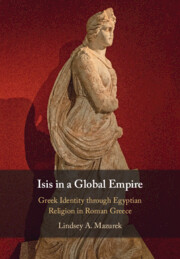
In Isis in a Global Empire, Lindsey Mazurek explores the growing popularity of Egyptian gods and its impact on Greek identity in the Roman Empire. Bringing together archaeological, art historical, and textual evidence, she demonstrates how the diverse devotees of gods such as Isis and Sarapis considered Greek ethnicity in ways that differed significantly from those of the Greek male elites whose opinions have long shaped our understanding of Roman Greece. These ideas were expressed in various ways - sculptures of Egyptian deities rendered in a Greek style, hymns to Isis that grounded her in Greek geography and mythology, funerary portraits that depicted devotees dressed as Isis, and sanctuaries that used natural and artistic features to evoke stereotypes of the Nile. Mazurek's volume offers a fresh, material history of ancient globalization, one that highlights the role that religion played in the self-identification of provincial Romans and their place in the Mediterranean world.
Numerous scholars have argued that in Luke-Acts the location of sacred space or divine presence passes from the Jerusalem temple to Jesus, Christian believers, or both; in Acts, this transfer is understood as integral to the universal mission. The present article argues that such studies overlook the important motif of heaven as temple, which plays a role in Jesus’ trial and crucifixion and the Stephen and Cornelius episodes. Using Edward Soja's spatial theory, previous studies’ binary categorisation of temple space is critiqued. The heavenly temple disrupts and reconstitutes understandings of sacred space, and thus undergirds the universal spread of the Way.
This chapter develops an argument about what is wrong with captivity beyond its impact on animal well-being. It proposes a discussion of the harms that denying liberty and dignity creates. Zoos, companion animals, and sanctuaries are discussed as sites of captivity.
In chapter nine the focus is entirely on de-escalation, which compared to the discussion about escalation, is rather under-theorised presently. The starting point form the Cold War ideas on how conflict is supposed to de-escalate, followed by a treatment of the literature on the restraints of terrorism and insurgency whether self-imposed or not. Two hypotheses related to de-escalation are formulated based on the literature about de-legitimation and norm convergence and about an inability shift to continue the conflict, in the shape of a loss of foreign support and defection. The vignette in this chapter is the Chechen independence movement.
The first chapter is concerned with the roles of Hyperborea in hymns and sanctuaries. It brings together fragments of Archaic and Classical material related to the great sanctuaries of Apollo at Didyma, Delphi and Delos and explores the uses of the distant North in the positioning of all three sites. It looks at how the interaction of ritual and commemoration could instrumentalise boreal remoteness to frame divine presence in sanctuaries that claimed a certain centrality. The first, introductory section of that chapter revisits the themes of divine arrival and absence through the lenses of cosmography. The second section is focused on an inscribed bone tablet from the northern Black Sea, an object consecrated to Apollo of Didyma. The third section, focused on the traces of Alcaeus' hymn to Apollo, analyses the poem's story of Apollo's arrival to Delphi from Hyperborea as a cosmographic document. The fourth and final section of the first chapter looks at the Delian record through the traces of Olen's hymn to Eileithyia, and the important cultic presence of the Hyperborean Maidens on the island. With that hymnic material, this chapter aims to explore the challenges and illustrate the significance of studying cosmography through cult and place.
This chapter explores what visitors would have seen at the sanctuary and how its setting and built environment would have shaped their experiences at the site more broadly. It begins with an archaeologically grounded reconstruction of the sanctuary and its monuments. It then uses this reconstruction to discuss Aquae Sulis’s dual role as a classicizing, monumentalized, space, and a space outside the normal bounds of lived existence, with aspects of a pilgrimage destination.
Focused on confession, Chapter 5 opens with a vignette in which a royal justice prods a first-time criminal defendant to confess to being a horse thief. The chapter argues that medieval English culture was imbued with the practice of confession, which occurred not only in the ecclesiastical context but was also a central part of felony procedure. Moreover, it demonstrates that the priest-confessor’s art of circumstantial inquiry, designed to ensure that a person confessed his or her sins fully to receive the appropriate penance, was adapted and adopted by the king’s coroners, who undertook an inquiry into the facts underlying homicide offenses. Downplaying the English exceptionalist narrative of the diverging paths in criminal procedure in England and continental Europe after Lateran IV, the chapter emphasizes the central role played by confession in medieval English felony procedure.