To save content items to your account,
please confirm that you agree to abide by our usage policies.
If this is the first time you use this feature, you will be asked to authorise Cambridge Core to connect with your account.
Find out more about saving content to .
To save content items to your Kindle, first ensure no-reply@cambridge.org
is added to your Approved Personal Document E-mail List under your Personal Document Settings
on the Manage Your Content and Devices page of your Amazon account. Then enter the ‘name’ part
of your Kindle email address below.
Find out more about saving to your Kindle.
Note you can select to save to either the @free.kindle.com or @kindle.com variations.
‘@free.kindle.com’ emails are free but can only be saved to your device when it is connected to wi-fi.
‘@kindle.com’ emails can be delivered even when you are not connected to wi-fi, but note that service fees apply.
This study tested an expanded TBP model, which included personal norms and self-identity as cognitive variables, in a sample of current young volunteers of a general charity in the UK. Actual volunteering was measured via continued observation throughout the duration of the projects. An integrative model of sustained volunteering was proposed because some relationships did not follow the hypothesized paths. Subjective norm emerged as the exclusive determinant of sustained volunteering and also as the potential mediator of the effects of other variables over future volunteering behavior. Two focus groups with volunteers and 28 personal interviews with the coordinators of the volunteering projects were conducted to triangulate the research findings and reveal the main causes for drop-outs and non-attendance.
Understanding how suicide rates vary across age, sex, and geography is essential to designing effective prevention strategies. We examined long-term trends in suicide mortality across European countries over three decades, with a focus on age-specific trajectories.
Methods
Using the WHO mortality database, we computed annual sex- and age-specific suicide rates (10–14 to 85+ age groups) from 1990 to 2022, for the most populous European countries, and aggregated rates for the EU-27 and four geographical areas (North, West, South, and Centre-East Europe). We also calculated percentage differences across four time periods (1990–1994, 2000–2004, 2010–2014, and 2020–2022), according to data availability.
Results
Suicide rates increased with age, peaking in older individuals (85+) in most countries (e.g., 82.0/100,000 in France in 2020–2022, 77.1/100,000 in Germany among males, in 2020), except in the UK and Northern Europe, where rates peaked at middle age (∼22/100,000 at 45–49, in 2020). EU-27 suicide rates in 2020 ranged from 5.5/100,000 (age 15–19) to 58.2/100,000 (85+) among males, and from 2.6 (15–19) to 8.6/100,000 (85+) among females. Male suicide rates were 3 to 8 times higher than female rates across all ages. While overall rates declined since 1990 in most countries, youth suicide increased after 2010 in Western (e.g., +12%, girls 15–19), Southern (+24.5%, girls 15–19), and Northern (+44%, girls 15–19 and 20–24) Europe. Rates among young and middle-aged adults recently rose in Spain, the UK, and Northern Europe, while they declined in Eastern Europe after the 1990s.
Conclusions
Despite overall declines, our findings highlight marked heterogeneity in sex- and age-specific trends in suicide mortality across Europe. These patterns call for age-tailored prevention strategies that address evolving psychosocial stressors and structural determinants across the lifespan.
Violence in early dating relationships can continue into adulthood. The literature usually focuses on the negative effects of violent relationships, but rarely includes the reasons for or antecedents of such behavior. The main objectives of this study were to identify different psychosocial profiles in terms of frustration tolerance and partner dependency and how they are correlated with psychological partner violence, as well as to analyze the justifications for such violence in adolescents and young adults. A total of 69.9% of the final 1044 participants (62.1% girls; age range = 15–22) were involved in a relationship at the time of the evaluation. From a person-centered approach, latent profile analyses yielded three profiles (anxious dependent, low anxious and exclusive dependency, and low exclusive dependency). Significant differences were found between groups, except for the scores between Profiles 2 and 3 in exclusive dependency and anxious attachment between Profiles 3 and 1, with Profile 3 having the highest correlation with violence despite scoring lower in emotional dependency and exclusive dependency than Profile 1. Moreover, significant differences were found among the three groups in terms of violence in the relationship, but all three groups experienced bidirectional violence. The justifications were similar in all three groups, with the concern response being the most reported, together with jealousy in many cases. This research increases knowledge about the psychosocial factors associated with offline and online psychological violence in young couples and allows us to deeply examine the motives that young people express to justify violence in their relationships.
The section’s final chapter examines the relation between philosophy, poetry, and criticism, revisiting a number of concepts introduced in previous chapters, including the development of a historical imagination and of organicist ideas of nature and culture, the new interest in aesthetics as a moral source, and the rise of sensibility as a challenge to disembodied reason. All of these contributed to a sense of crisis inherent to Enlightenment itself. It first reads the English poets Thomas Gray and Edward Young, traditionally seen as precursors of European Romanticism, alongside Kant’s First Critique to show how the philosopher sought to save reason from Hume’s scepticism by making it the product of a shared knowledge based on nature rather than book learning. the chapter then explains how the notion of ideas as historically and linguistically mediated emerged out of Vico, Rousseau, and Kant, giving particular attention to the Genevan philosopher’s social thought. The last part examines the Kant-Herder controversy, which brought to a crisis key tensions in late-Enlightenment culture between critical reason and a direct, lyrical insight into natural causality. The latter was dismissed by Kant as a dangerous form of ‘genius-cultism’ that lent itself to revolutionary fanaticism.
Chapter 4 explores Kant’s theory of genius. The chapter avoids the well-discussed question about whether or why Kant denied that scientific activity requires or displays genius. It instead asks whether, in Kant’s view, genius can produce original nonsense. Is taste a component of genius, or does taste impose constraints on genius as if from the outside? The chapter maintains that Kant takes up two distinct conceptions of genius, the thin and the thick. Both conceptions can be found in Kant’s early thoughts about genius. When the two notions are retained in the third Critique, it creates internal tensions.
Japá is a Yoruba word that translates as ‘run away’. The word has become part of young Nigerian’s lexicon, defining the desire that many have to experience a new life abroad. Perceptions are that much of the country is looking to leave but the number of African immigrants is vastly overestimated. The share of Africans living abroad has barely increased since the 1960s. In 2017 of the 258 million international migrants worldwide, around 14 per cent of the total were African, equal to just under 3 per cent of the continent’s population. In the same year, 61 million international migrants were European, constituting almost 12 per cent of the population. In the main it is talented Nigerians that are leaving the country. Nigeria sends the largest number of African students abroad – some 95,000 – and ranks fifth in the world in terms of overall number of students in foreign study. Those that do leave continue to have a significant impact on their home nation, not least financially. For four consecutive years, official remittances from diaspora Nigerians have exceeded the country’s oil revenues. And many young African migrants are now seeking to return home and be part of the continent’s renaissance.
Young Nigerians feel the world is progressing towards a better future. New and transformational forces – including access to technology and growing urbanisation – are reshaping lifestyles, life choices, economic opportunities, values and culture. For the Soro Soke generation, leveraging the Fourth Industrial Revolution is not about copying traditional approaches from the West but conceiving, creating and delivering entirely new, pan-African opportunities. Entrepreneurial at heart, this generation is focused on turning problems into business opportunities and does so with a sense of social justice. This cohort evidences a real sense of community. It has a ‘we’re in this together’ mentality that encompasses everything from improving wealth and opportunity, to accessing power and even breaking down gender stereotypes. Young Nigerians recognise the need for change and social media is empowering them to speak out and realise that change. In the search for equality, security and more opportunity, they are using social media to disrupt the status quo and fight for better governance. This generation stands at the brink of materialising a demographic dividend that is set to change not only the quality of their opportunities but also to reposition the continent’s place in global affairs.
Japá is a Yoruba word that translates as ‘run away’. The word has become part of young Nigerian’s lexicon, defining the desire that many have to experience a new life abroad. Perceptions are that much of the country is looking to leave but the number of African immigrants is vastly overestimated. The share of Africans living abroad has barely increased since the 1960s. In 2017 of the 258 million international migrants worldwide, around 14 per cent of the total were African, equal to just under 3 per cent of the continent’s population. In the same year, 61 million international migrants were European, constituting almost 12 per cent of the population. In the main it is talented Nigerians that are leaving the country. Nigeria sends the largest number of African students abroad – some 95,000 – and ranks fifth in the world in terms of overall number of students in foreign study. Those that do leave continue to have a significant impact on their home nation, not least financially. For four consecutive years, official remittances from diaspora Nigerians have exceeded the country’s oil revenues. And many young African migrants are now seeking to return home and be part of the continent’s renaissance.
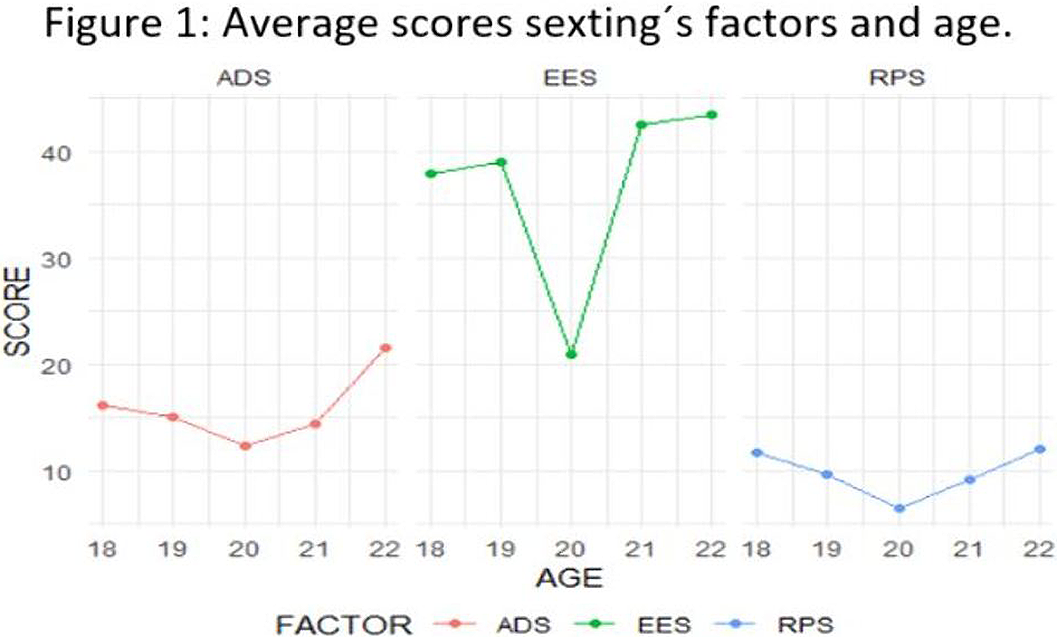
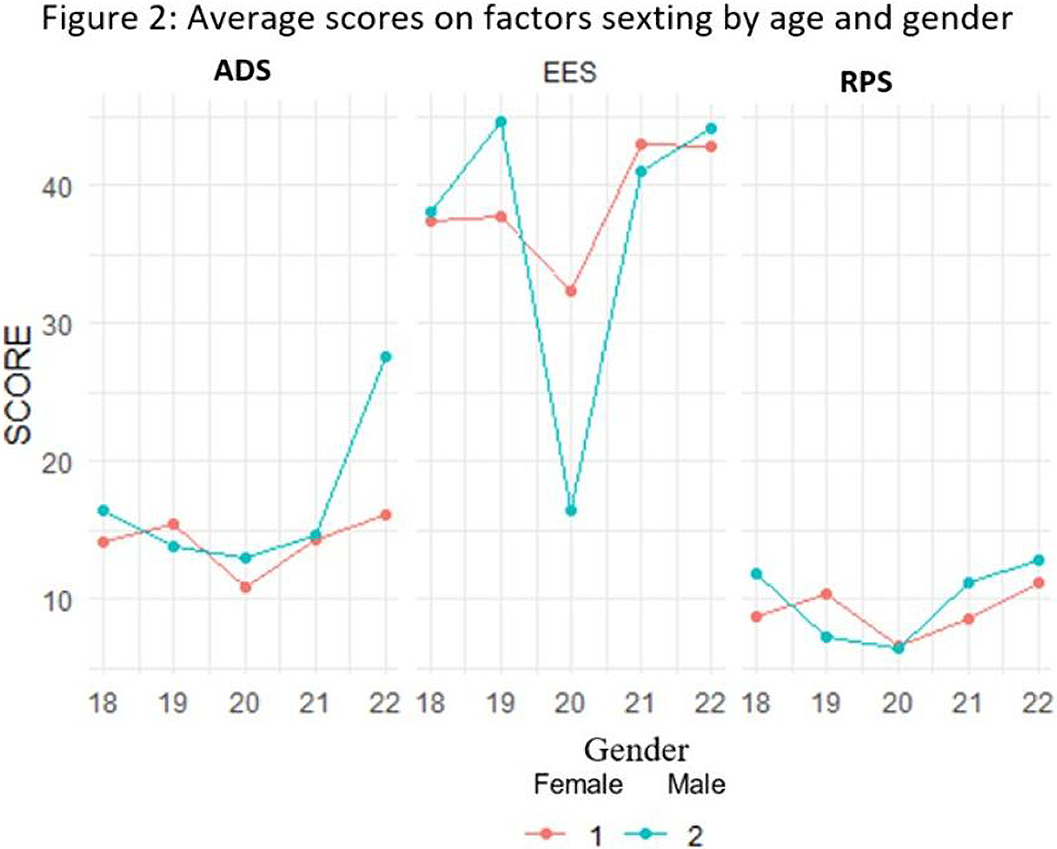
Sexting is sending / forwarding erotic-sexual content voluntarily through technological devices and / or the internet. (Fleschler-Peskin, 2013). Real Participation (RPS), Active Disposition (ADS) and Emotional Expression (EES) was studied.
Objectives
Compare sexting in two groups of participants: female and male
Methods
Comparison of data means measured by the Cronbach alpha sexting behavior scale α = 0.92, (Chacon-Lopez, et al, 2016). Sample N = 900 (447 female and 453 male)
Results
The ADS and RPS decrease between 18 to 20 years old and increase between 20 to 22 years old. EES decreases when increasing age, except in 20 years old. Applying multiple regression analysis, control variable sex and reference group age 18 old, presents statistically significant difference, excepting 19 years old in EES and 22 years old in RPS. (Figure 1)
Comparing age and gender, ADS men present higher levels than women, excepting 19 years old. EES and RP, no significant differences are observed. Comparing women’s mean show lower AD levels than men with Cohen’s effect size d = 0.62, (Cohen, 1988). Related to PRS averages, women present lower levels than men without statistically significant differences. Comparing means, women show lower ADS levels than men effecting d Cohen d = 0.46, (Cohen, 1988). (Figure 2)
Conclusions
Evidence difference between men and women, in ADS and EES, without pattern associated with age, young men and women sexting
Anthracycline-related cardiomyopathy is of concern in children treated for acute myeloid leukemia (AML). Risk is dose-dependent, increasing with higher doses. We aim to highlight the risk of early-onset cardiotoxicity with low-cumulative anthracycline dose in a young Omani boy with AML. We conclude in the presence of other known risk factors for cardiac dysfunction, there is probably no risk-free anthracycline dose.
This chapter explores ageism and prejudice against age as revealed in our language. We look at childism/adultism, middle age, and intergenerational battles of Boomers vs. Millennials. We discuss the way we talk about growing older. We investigate stereotypes and negative attitudes toward age and ageing, ageism in the workplace, and consider ageism as an intersectional form of discrimination that will ultimately affect us all.
Rapid eye movement (REM) sleep behavior disorder (RBD) and REM sleep without atonia (RWA) have assumed much clinical importance with long-term data showing progression into neurodegenerative conditions among older adults. However, much less is known about RBD and RWA in younger populations. This study aims at comparing clinical and polysomnographic (PSG) characteristics of young patients presenting with RBD, young patients with other neurological conditions, and normal age-matched subjects.
Methods:
A retrospective chart review was carried out for consecutive young patients (<25 years) presenting with clinical features of RBD; and data were compared to data from patients with epilepsy, attention deficit hyperactivity disorder (ADHD), and autism, as well as normal subjects who underwent PSG during a 2-year-period.
Results:
Twelve patients fulfilling RBD diagnostic criteria, 22 autism patients, 10 with ADHD, 30 with epilepsy, and 14 normal subjects were included. Eight patients with autism (30%), three with ADHD (30%), one with epilepsy (3.3%), and six patients who had presented with RBD like symptoms (50%) had abnormal movements and behaviors during REM sleep. Excessive transient muscle activity and/or sustained muscle activity during REM epochs was found in all patients who had presented with RBD, in 16/22 (72%) autistic patients, 6/10 (60%) ADHD patients compared to only 6/30 (20%) patients with epilepsy and in none of the normal subjects.
Conclusion:
We observed that a large percentage of young patients with autism and ADHD and some with epilepsy demonstrate loss of REM-associated atonia and some RBD-like behaviors on polysomnography similar to young patients presenting with RBD.
To determine the awareness of cardiovascular risk factors among university students in Turkey.
Background:
Cardiovascular disease (CVD) is the leading cause of death in developed countries. The use of tobacco products and unhealthy diet are prominent habits that increase the risk of CVD.
Methods:
Healthy university students (n = 2450) aged between 18 and 22 years in Istanbul filled out the questionnaire about the awareness of CVD risk factors and participated in this cross-sectional study. They were asked several questions with regard to the importance of CVD risk factors.
Findings:
The leading responses for men and women were, respectively, high cholesterol (58.3; 72.3%), stress (58.8; 71.8%), hypertension (50; 64.2%), smoking (53.1; 58.7%), obesity (46.8; 64.3%), diabetes (41.7; 52.7%), inactivity (43.3; 47.8%), and CVD in family history (31.8; 44.4%). Unhealthy diet (9.7; 15.3%), exposure to second-hand cigarette smoking (24.4; 34%), and poor socioeconomic status (22.6; 22.3%) were also considered to be important. The study also revealed that men disregard the risk factors more frequently. Another comparison between body mass index groups revealed that obese subjects gave significantly lower importance to cardiovascular risk factors.
Conclusion:
Observations indicate that awareness levels of CVD risk factors have to be improved among university students. It is emphasized that primary healthcare workers are very important in the screening of CVD risk factors in an opportunistic and systematic way and in providing consultancy on changing risky behaviors (diet, smoking, etc.). Therefore, it is of utmost importance that primary healthcare workers make interventions to reduce the risk level by determining the CVD risk.
Young Onset Dementia (YOD), defined by first symptoms of cognitive or behavioral decline occurring before the age of 65 years, is relatively rare compared to dementia of later onset, but it is associated with diagnostic difficulty and heavy burden on affected individuals and their informal carers. Existing health and social care structures rarely meet the needs of YOD patients. Internet-based interventions are a novel format of delivering health-related education, counseling, and support to this vulnerable yet underserved group.
Methods:
The RHAPSODY (Research to Assess Policies and Strategies for Dementia in the Young) project is a European initiative to improve care for people with YOD by providing an internet-based information and skill-building program for family carers. The e-learning program focuses on managing problem behaviors, dealing with role change, obtaining support, and looking after oneself. It will be evaluated in a pilot study in three countries using a randomized unblinded design with a wait-list control group. Participants will be informal carers of people with dementia in Alzheimer's disease or behavioral-variant Frontotemporal degeneration with an onset before the age of 65 years. The primary outcome will be caregiving self-efficacy after 6 weeks of program use. As secondary outcomes, caregivers’ stress and burden, carer health-related quality of life, caring-related knowledge, patient problem behaviors, and user satisfaction will be assessed. Program utilization will be monitored and a health-economic evaluation will also be performed.
Conclusions:
The RHAPSODY project will add to the evidence on the potential and limitations of a conveniently accessible, user-friendly, and comprehensive internet-based intervention as an alternative for traditional forms of counseling and support in healthcare, aiming to optimize care and support for people with YOD and their informal caregivers.
Three individuals of small, young giant squid Architeuthis dux were caught in or near Japanese coastal waters during April–June 2013. The first occurrence of a young individual of 140.8 mm dorsal mantle length with a total weight of 44.81 g was recorded on the coast off Uchinoura, Kagoshima, Kyushu Island, southern Japan. The remaining two young individuals, both measuring 332.0 mm in dorsal mantle length with total weights of 390.63 and 356.95 g respectively, were caught on the coast off Hamada, Shimane, south-western Sea of Japan. Most morphological traits of all the specimens were consistent with those of A. dux, which was supported by further genetic analysis. Here we present some morphological traits of young giant squids with morphometric data and photographs.
Sudden cardiac death in the young is a relatively uncommon but marked event usually related to congenital diseases or anomalies. Despite the prevalence of each condition being variable, most common causes include primary myocardial diseases and arrhythmic disorder, frequently with inheritance pattern. Sudden cardiac death is usually preceded by symptoms, thus making personal and family history fundamental for its prevention. Nevertheless, in more than 50% of cases, sudden cardiac death is the first manifestation of the disease. In this review, we describe the different causes of sudden cardiac death, their incidence, and currently used preventive strategies.
The aim of the present study was to provide evidence of validity of the Brief Resilient Coping Scale for use in Spanish young population. A total of 365 university students responded to the Spanish version of the BRCS as well as to other tools for measuring personal perceived competence, life satisfaction, depression, anxiety, negative and positive affect, and coping strategies. Confirmatory factor analysis confirmed the unidimensional structure of the scale. Internal consistency reliability and temporal stability through Cronbach’s alpha and test-retest correlations, respectively, were comparable to those found in the initial validation of the tool. The BRCS showed positive and significant correlations with personal perceived competence, optimism, life satisfaction, positive affect (p < .01), and some coping strategies (p < .05). Significant negative correlations were observed with depression, anxiety and negative affect. (p < .01). Multiple regression analysis with stepwise method showed that positive affect, negative affect, optimism and problem solving explained 41.8% of the variance of the BRCS (p < .001). The Spanish adaptation of the BRCS in a young population is satisfactory and comparable to those of the original version and with the Spanish version adapted in an elderly population. This supports its validity as a tool for the assessment of resilient coping tendencies in young people who speak Spanish and offers researchers and professionals interested in this area of study a simple tool for assessing it.
Neurofibromatosis is an autosomal dominant multi-system genetic disorder. Extra-cardiac vascular manifestations of neurofibromatosis have been previously described in many reports. However, coronary arterial involvements have been rarely described. A 17-year-old girl with neurofibromatosis presented to our institute with subacute myocardial infarction. Coronary angiogram revealed an aneurysm with thrombus in the left anterior descending artery.
