To save content items to your account,
please confirm that you agree to abide by our usage policies.
If this is the first time you use this feature, you will be asked to authorise Cambridge Core to connect with your account.
Find out more about saving content to .
To save content items to your Kindle, first ensure no-reply@cambridge.org
is added to your Approved Personal Document E-mail List under your Personal Document Settings
on the Manage Your Content and Devices page of your Amazon account. Then enter the ‘name’ part
of your Kindle email address below.
Find out more about saving to your Kindle.
Note you can select to save to either the @free.kindle.com or @kindle.com variations.
‘@free.kindle.com’ emails are free but can only be saved to your device when it is connected to wi-fi.
‘@kindle.com’ emails can be delivered even when you are not connected to wi-fi, but note that service fees apply.
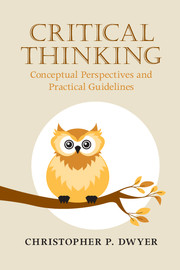
Dwyer's book is unique and distinctive as it presents and discusses a modern conceptualization of critical thinking – one that is commensurate with the exponential increase in the annual output of knowledge. The abilities of navigating new knowledge outputs, engaging in enquiry and constructively solving problems are not only important in academic contexts, but are also essential life skills. Specifically, the book provides a modern, detailed, accessible and integrative model of critical thinking that accounts for critical thinking sub-skills and real-world applications; and is commensurate with the standards of twenty-first-century knowledge. The book provides both opportunities to learn and apply these skills through a series of exercises, as well as guidelines on how critical thinking can be developed and practised, in light of existing psychological research, which can be used to enhance the experience of critical thinking training and facilitate gains in critical thinking ability.
It is a narrow mind that cannot look at subjects from various points of view.
(George Eliot 1994/1871, p. 54)
Reasoning as a basis for judgment and decision making is a keystone of modern Western culture. Modern society aims to educate an intellectually mature citizenry that overcomes fallacies, biases, superstition, and adherence to unquestioned authority. One offshoot of this emphasis on reasoning is the critical thinking movement that emerged in the 1960s in the philosophy of education. This movement responded to the observation that even well-educated people possessed inadequate reasoning skills (Pritchard 2014). Philosophers argued that one objective of school and college education should be the training of critical thinking. Students should be able to form beliefs or to make decisions by proper reasoning. These proficiencies can be applied to the subjects taught at school and be transferred to everyday life (see Fisher 2011). Critical thinking goes beyond the reasoning abilities examined in cognitive psychology: It relies not on descriptions of how people actually think but on prescriptions for how they should think. Such prescriptions cannot be determined by empirical research because they derive from norms and values that are beyond scientific scrutiny; they are therefore often neglected in scientific discourse (see Wecker 2013 for an interesting discussion on prescriptive statements in education).
In this chapter, the main focus will be on the prescriptive part of critical thinking because critical feeling serves similar objectives to critical thinking. It is necessary to unveil the objectives of critical thinking and why it is insufficient to serve these purposes. Together with the next chapter (on the psychology of feelings), this discussion will set the stage to introduce critical feeling. In this chapter, I first consider critical thinking as a skill and examine its strengths before looking at how critical thinking may serve values. At the end of the chapter, I discuss the neglect of feelings in critical thinking and why critical thinking is not enough.
Critical thinking as a skill
Critical thinking has been defined as “correct assessing of statements” (Ennis 1962, p. 83) and as “reasonable, reflective thinking that is focused on deciding what to believe or do” (Fisher 2011, p. 4). Critical thinking is thinking because it utilizes reasoning capacities and abilities to decide what to believe and what to do.
The ability to respond critically to any text is a learnt ability which needs some innate ability before it can be developed. That is, critical thinking is a variegated talent, linked to intelligence and curiosity, which is hard-wired into the human brain but is not always fostered equally. We are all different according to aspects of biology, intelligence and personality. Likewise, we are all different according to our experience of being encouraged to use these natural abilities. Indeed, there is even some evidence that critical thinking is an ability that is only really developed at all after the teenage years. This idea is consistent with other theories of literacy, which state that there must be an inherent ability to decode language before it can be developed, and that any form of literacy is incremental. That means that each layer of literacy builds on previous levels, and that we must be cognitively ready for each stage. Critical literacy is, therefore, a higher level of literacy which builds on foundational forms of literacy. We need to be able to decode language systems at the semiotic, denotational and connotational levels in order to produce sense. Once we produce this meaning through textual reception, we can start to definitively question what we are being told, building on whatever latent critical ability we already have.
Higher education touts critical thinking as both a key educational objective and a learning outcome. Yet, as we know, there is no single approach for defining or presenting critical thinking. In this chapter, we identify and discuss an additional problem: Ten paradoxes that surround the teaching, learning, and application of critical thinking skills. We believe by making educators and other readers of this chapter aware of these paradoxes, we can help them to overcome the associated pedagogical challenges resulting from them. Indeed, after explaining each paradox, we suggest ways for psychology educators to lead their students toward greater understanding of critical thinking. Such discussions promote these critical thinking experiences as the sort of desirable difficulty opportunities teachers should routinely build into their courses. In turn, teachers of critical thinking as process and outcome need to assess their practices in order to demonstrate their efficacy and, when needed, update their efforts.
The Common Core Standards are permeated by a concern for critical thinking: critical reading, the analysis of documents, editing for meaning, defining problems, solving problems, searching for order, and conceptual understanding. This emphasis is to be applauded, but questions arise not only about how to teach critical thinking but, more basically, about how to define its scope and application over a wide range of human activity. Must everyone learn to apply critical thinking to the foundations of mathematical operations? Must everyone become capable of using critical thinking in reading historical or scientific documents? And how is critical thinking related, if it is, to the moral dimension of life?
SOME BACKGROUND
Although philosophers and educators have long agreed on the importance of critical thinking, they have engaged in lively debates about how to define and teach it. Some forty years ago the debate centered on whether critical thinking is field dependent or a subject/skill that can be taught on its own. Those who argued for its field dependence pointed out – rightly, I think – that one can hardly think critically in an area about which one has no knowledge. One can hardly criticize a taxonomy of flowering plants, for example, if one knows nothing about plants. Similarly, it would be difficult to argue the merits of a political proposal if one knows little about the purpose of the proposal and the context in which it is proposed.
However, strong counterarguments have been made for the centrality of logic in all forms of critical thinking, and symbolic logic can be taught without reference to a specific subject or field outside it. Certainly, all students should become familiar with the basic form of a syllogism: If all birds can fly and robins are birds, we may conclude that robins can fly. As a math teacher, I learned that many students find logic in both words and symbols fascinating and useful.
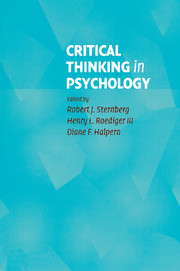
Good scientific research depends on critical thinking at least as much as factual knowledge; psychology is no exception to this rule. And yet, despite the importance of critical thinking, psychology students are rarely taught how to think critically about the theories, methods, and concepts they must use. This book shows students and researchers how to think critically about key topics such as experimental research, statistical inference, case studies, logical fallacies, and ethical judgments. Using updated research findings and new insights, this volume provides a comprehensive overview of what critical thinking is and how to teach it in psychology. Written by leading experts in critical thinking in psychology, each chapter contains useful pedagogical features, such as critical-thinking questions, brief summaries, and definitions of key terms. It also supplies descriptions of each chapter author's critical-thinking experience, which evidences how critical thinking has made a difference to facilitating career development.
Outstanding among the intellectual virtues treasured in the ancient world were knowledge and wisdom. Knowledge was needed for cases in which the required decisions could be made by rational means, such as the relationship between cause and effect or between means and end. But wisdom was necessary for cases that were rationally undecidable and where what had to be relied on instead were Solomonic judgments.
In highly stable, tradition-bound societies, knowledge was often conceived of as a stockpile of truths transmitted from the older to the younger generations. It was thought of as a body of eternal verities, perennially applicable to an unchanging world. In times of change, however, traditional knowledge was likely to become inapplicable or obsolete. What was emphasized instead were intellectual flexibility and resourcefulness. Wisdom was cultivated, by the Stoics and others, in preparation for whatever might happen, whether for good or for ill.
We no longer divide things up the way the ancients did. With modern experimental science, the mountains of knowledge accumulated in the past are no longer looked upon with awe. And the notion of wisdom seems more remote than ever.
On the other hand, we are ready to acknowledge that past experience is not always a reliable guide to the future, with the result that judgments of probability must be made.
Chapter 8 presents ways one might enhance their critical thinking, particularly through training. Specifically, training is discussed with respect to instructional design, assessment strategy, active learning, ‘student’ demographics and presentation style. The issue of not having access to such training is also discussed, as are ways in which individuals without such access can work to enhance their critical thinking.
Good scientific research depends on critical thinking at least as much as factual knowledge; psychology is no exception to this rule. And yet, despite the importance of critical thinking, psychology students are rarely taught how to think critically about the theories, methods, and concepts they must use. This book shows students and researchers how to think critically about key topics such as experimental research, statistical inference, case studies, logical fallacies, and ethical judgments.
Oh, this ‘sublime silence of eternity’ in which so many screams have faded away unheard. It rings within me so strongly that I have no special corner of my heart reserved for the ghetto: I am at home wherever in the world there are clouds, birds and human tears.
Rosa Luxemburg, at the end of her life
The previous chapter identified where a critical theory of security should start: a global political context in which ‘so many screams have faded away unheard’. A radically different world politics is conceivable, though its complete achievement may ultimately elude humankind. International politics must become the art of the impossible, for the alternative is almost too unpleasant to contemplate. With this in mind, the present chapter begins to sketch a map of sites of ideas to help create the political conditions for a more secure future. These ideas are not to be found in the national ghettos of realism, but in the cosmopolitan spirit of the unfinished work of the Enlightenment.
Critical global theorising
His attitude toward the world was neither positive nor negative, but radically critical.
Hannah Arendt on Gotthold Lessing
The theoretical framework developed in this book derives from a body of thought I call critical global theorising. These ideas, for the most part, were inspired by the Enlightenment, a profoundly significant episode in world history that took place primarily in Europe in the eighteenth century, though its key ideas were not exclusive to Europe at that time in origin or relevance.
This chapter employs Psaltis’s genetic social psychological theory to trace the evolution of my research on youth’s critical understanding of conflict and violence. First, I discuss my research on critical thinking and relate it to an ontogenetic perspective on the cognitive challenges that students face in understanding interpersonal conflicts and social controversies. This is illustrated with an analysis of an ostracism incident in a middle school in the US. I explain the limitations I faced with the cognitive approach, as it could not account for how identities or social asymmetries informed students’ critical thinking. The second section explains how the previous quandary led me to adopt a discursive approach that situated students’ performance in their relational and social contexts. I discuss the similarities between this work and the microgenetic perspective, offering examples from a revised analysis of the ostracism incident and from a case study on an online discussion about racism and police brutality among American high school students. Last, I introduce my current research on the narrative normalization and de-normalization of violence, and apply it to the memory and history of violence in the Spanish Basque Country. I draw parallels with a sociogenetic perspective that focuses on the societal level in which collective narratives are produced, disseminated, disputed, and transformed.
This chapter reflects on the current emphasis placed by government and universities on graduate skills, in the face of considerable uncertainties about what these might involve and how they might be developed. One of the key areas of graduate skill development which tertiary students are meant to experience during their university degrees is their transformation into critical thinkers (Rigby, n.d.; ACER, n.d.; Moore and Hough, 2007; DEEWR, 2011; Chan et al., 2002). We note that accounts of critical thinking as a desirable skill for these students are inclined to constitute critical thinking as having an indeterminate meaning. The literature on critical thinking and university education further suggests that this inexactitude leads students to not understand or be unclear about critical thinking. The ‘problem’ in terms of graduate skill development is deemed to lie in students' failure to grasp its meaning, which results in their failure to develop this important graduate skill in spite of its value to them. We wish to provide an alternative approach that is rather at odds with the ‘student deficit’ approach employed in much of the literature. In order to outline this alternative approach we draw upon the findings of a survey and focus groups carried out in 2011 amongst transition students at the University of Adelaide — specifically, students of first-year Politics courses.
In discussing effective means of regulating the sentiments and the behavior associated with them, Adam Smith emphasized the importance of conversation:
Society and conversation are the most powerful remedies for restoring the mind to its tranquility, if at any time, it has unfortunately lost it; as well as the best preservatives of that equal and happy temper which is so necessary to self-satisfaction and enjoyment. (TMS, 23)
This emphasis on the importance of conversation fits in well with Smith's account of the moral development of children, especially insofar as it focuses on the socialization of children outside the immediate confines of the home. Smith does not provide details of how moral conversation among children might go. However, this chapter offers an extended sample from conversations I have had with a group of students with whom I had a number of meetings beginning when they were 10-to 11-year-old 5th graders.
I met weekly with this group some years ago in an after-school program during the regular school year. For our last session, we discussed ideas related to reciprocity. Although the word “reciprocity” was not used in that conversation (or in any of our previous ones), it was the basic notion under consideration in this final session.
In one guise or another, reciprocity is commonly regarded to be a fundamental moral value. For example, it is a pivotal notion moral and religious traditions that invoke some form of the Golden Rule. In the case of Thomas Reid, some understanding and acceptance of reciprocity is a necessary condition for being a moral agent. It is also at the heart of Adam Smith's notion of an “impartial spectator.” Reciprocity can take on many forms. For example, in social relations reciprocity might be understood generally as “returning in kind.” But this could include concerns as various as a fair exchange of goods, paying one's debts, returning favors, wanting to “get even,” or trying to teach someone a lesson.
Sessions with my group of 5th graders typically began with a reading and discussion of short passages from Matthew Lipman's Harry Stottlemeier's Discovery and further ideas to which this gave rise. However, often we were still in the heat of discussion when it was time for a session to conclude.
In this book, distinguished theorists and researchers in psychology have explored the role of critical thinking in psychology. The conclusion I come to is that critical thinking is critical in and to psychology. In this final chapter, I summarize some of the “critical” lessons readers can learn from having read the book.
HOW YOU SAY IT IS OFTEN AT LEAST AS IMPORTANT AS WHAT YOU SAY
Our parents socialize us into the importance of putting things in a positive and constructive way, and of saying things in the “right” way. These skills should be part of our socialization in psychology as well. For example, Halpern (Chapter 1, this volume) points out that although two questions – “Do you favor or oppose allowing students and parents to choose a private school to attend at public expense?” and “Do you favor or oppose allowing students and parents to choose any school, public or private, to attend using public funds?” – essentially ask the same thing, the percentages of respondents responding in favor of vouchers differed by 22%, depending on how the question was asked. Similarly, Schwarz (Chapter 4, this volume) shows that how survey questions are framed has an enormous impact on how they are answered. Even using a scale of −5 to +5 versus 0 to 10 had a large impact – a difference of 21% – in the way a question about success in life was answered.
While most programmes in neuroscience are understandably built around imparting foundational knowledge of cell biology, neurons, networks and physiology, there is less attention paid to critical perspectives on methods. This book addresses this gap by covering a broad array of topics including the philosophy of science, challenges of terminology and language, reductionism, and social aspects of science to challenge claims to explanation and understanding in neuroscience. Using examples from dominant areas of neuroscience research alongside novel material from systems that are less often presented, it promotes the general need of scientists (and non-scientists) to think critically. Chapters also explore translations between neuroscience and technology, artificial intelligence, education, and criminology. Featuring accessible material alongside further resources for deeper study, this work serves as an essential resource for undergraduate and graduate courses in psychology, neuroscience, and biological sciences, while also supporting researchers in exploring philosophical and methodological challenges in contemporary research.