To save content items to your account,
please confirm that you agree to abide by our usage policies.
If this is the first time you use this feature, you will be asked to authorise Cambridge Core to connect with your account.
Find out more about saving content to .
To save content items to your Kindle, first ensure no-reply@cambridge.org
is added to your Approved Personal Document E-mail List under your Personal Document Settings
on the Manage Your Content and Devices page of your Amazon account. Then enter the ‘name’ part
of your Kindle email address below.
Find out more about saving to your Kindle.
Note you can select to save to either the @free.kindle.com or @kindle.com variations.
‘@free.kindle.com’ emails are free but can only be saved to your device when it is connected to wi-fi.
‘@kindle.com’ emails can be delivered even when you are not connected to wi-fi, but note that service fees apply.
Motor Conversion Disorders (also called Functional Movement Disorders, FMD) are a group of neuropsychiatric conditions characterized by neurological symptoms of altered voluntary motor function that cannot be explained by typical neurological diseases or other medical conditions. In the last decade, several hypotheses have been formulated with respect to their pathophysiology, and a major line of research, trying to integrate psychological, cognitive, and neurobiological factors, focused on the subjective experience that patients feel of their own bodies. However, no study has, so far, directly investigated their Body Schema (the implicit sensorimotor representation of one’s own body) and its plasticity.
Objectives
To investigate the Body Schema in patients with FMD through a paradigm specifically designed to assess their perceived body metrics, through a spatial estimation of body parts length, and to compare their results with the ones obtain on a group of healthy control subjects (HC)
Methods
10 patients with FMD and 11 HC underwent the Forearm Bisection Task, aimed at assessing perceived body metrics, which consists in asking the subject, blindfolded, to repeatedly point at the perceived middle point of their dominant forearm with the index finger of their contralateral hand, and a psychometric assessment for anxiety, depression, alexithymia, and tendency to dissociation.
Results
FMD patients bisected their forearm more proximally (with an increased shift towards their elbow equal to 7.5%) with respect to HC; average bisection point was positively associated with anxiety levels in the whole sample, and with the tendency to dissociation in the FMD group.
Conclusions
FMD patients seem to perceive their forearm as shorter than HC do, which might suggest an alteration of their Body Schema. The Body Schema can go through short- and long-term plastic changes in the life course, mainly related to the use of each body segment; we speculate that, despite FMD being a disorder of functional nature, characterized by variability and fluctuations in symptomatology, the lack of sense of agency over a body part might be interpreted by the nervous system as disuse and hence influence the Body Schema, as deficits of organic aetiology do.
Schizotypal personality is a condition suffered by 4% of the population. It is defined by presenting interpersonal, behavioral and perceptual features similar to the clinical features of psychotic disorders, such as schizophrenia, in less intensity and dysfunctionality, but at risk of reaching psychosis.
Objectives
Presentation of a clinical case about a patient with premorbid schizotypal personality traits presenting with an acute psychotic episode.
Methods
Literature review on association between schizotypal personality and psychosis.
Results
A 57-year-old woman with a history of adaptive disorder due to work problems 13 years ago, currently without psychopharmacological treatment, goes to the emergency room brought by the emergency services due to behavioral alteration. She reports that “her husband and son wanted to sexually abuse her”, so she had to run away from home and has been running through the streets of the town without clothes and barefoot.
Her husband relates attitude alterations and extravagant behaviors of years of evolution, such as going on diets of eating only bread for 40 days or talking about exoteric and religious subjects, as believing that the devil got inside her husband through a dental implant. He reports that these behaviors have been accentuated during the last month. She has also created a tarot website, and has even had discussions with several users. She is increasingly suspicious of him, has stopped talking to him and stays in his room all day long, with unmotivated laughter and soliloquies.
It was decided to admit him to Psychiatry and risperidone 4 mg was started. At the beginning, she was suspicious and reticent in the interview. As the days went by, communication improved, she showed a relaxed gesture and distanced herself from the delirious ideation, criticizing the episode.
Conclusions
In recent years, there has been increasing interest in understanding the association between schizotypy and serious mental disorder. Several theories understand schizotypy as a natural continuum of personality that reveals genetic vulnerability and that can lead to psychotic disorder when added to precipitating factors. Other theories define schizotypy as a “latent schizophrenia” where symptoms are contained and expressed in less intensity.
Around 20% evolves to paranoid schizophrenia or other serious mental disorders. It is complex to distinguish between those individuals in whom schizotypy is a prodrome and those in whom it is a stable personality trait. To date, studies applying early psychotherapeutic or pharmacological interventions have had insufficient and contradictory results, and the follow-up and treatment of these individuals could be a stress factor and a stigma. Some studies are looking for reliable markers of evolution to schizophrenia in order to establish adequate protocols for detention, follow-up and treatment.
Yoga has been demonstrated to have a range of beneficial effects on individuals with substance use disorders, including opioid use disorders. We initiated a randomized clinical trial to find out the efficacy of add-on yoga among patients with opioid dependence stabilized on treatment to find out whether it led to improvement in sleep and quality of life. However, the rate of enrolment into the study was quite low.
Objectives
In this interim analysis, we present the preliminary data on the reasons for non-enrolment in the yoga trial.
Methods
The single-centre trial involved 1:1 randomization of patients with opioid dependence stabilized on medications (naltrexone or buprenorphine) for a period of at least 4 weeks into two groups (add-on yoga or wait-list control). The yoga included asanas and panchakosha meditation, taught for a period of 7 days and to be practiced by the participants for a period of 12 weeks. We recorded the reasons for non-participation among those who did not participate and asked them questions about their views on yoga.
Results
Of the 310 patients recruited between August 2022 and July 2023 (99.7% male, mean age 34 years, 56.5% married), 255 (82.3%) could not be enrolled in the trial. The most common reasons for non-enrolment were not having time for training (n = 206, 80.8%), not having time for doing yoga (n = 180, 70.6%), not having a smartphone for continued training or contact (n = 31, 12.2%), distance from the center (n = 17, 5.5%) do not feel the need for yoga (n = 16, 5.2%), injury or disability (n = 9, 3.5%), old age or medical condition (n = 7, 2.7%), already doing gym exercises (n = 7, 2.7%), nature of job (n = 5, 2.0%), do not have knowledge of yoga (n = 5, 2.0%), and do not think yoga would be useful (n = 4, 1.6%). Among those who could not be enrolled, 35.1% reported doing yoga sometime in the past, and 21.6% reported that at least one of the family members did yoga. When asked whether they would be interested if yoga was available online, 16 (5.2%) responded ‘yes’ and 45 (14.5%) responded ‘maybe’.
Conclusions
Expressed time constraints may be an important factor deterring patients with opioid dependence from engaging in yoga as an add-on yoga. There are other reasons as well that may deter patients from such an intervention. The findings should be seen in the light of the limitation of a single medically oriented center, and patients already stabilized on treatment.
Response to antipsychotic medications (AP) is subjected to a wide and unpredictable variability and efforts were directed to discover predictive biomarkers to personalize treatment. Electroencephalography abnormalities in subjects with schizophrenia were reported, as well as a pattern of EEG changes induced by APs
Objectives
The aim of this review is to provide a synthesis of the EEG features that are related to APs efficacy, including both pre-treatment signatures and changes induced by APs during treatment.
Methods
A systematic review of English articles using PubMed, PsychINFO and the Cochrane database of systematic reviews was undertaken in april 2023. Additional studies were added by hand-search. Studies having as an endpoint the relationship between AP-related clinical improvement and electroencephalographic features were included. Heterogeneity prevented a quantitative synthesis.
Results
Out of 1232 records screened, 22 studies were included in a final qualitative synthesis. Included studies evaluated resting-state and task-related power spectra, functional connectivity, microstates and epileptic abnormalities. At pre-treatment EEG, the most relevant predictors of a poor response were a change in theta power compared to healthy control, a high alpha power and connectivity, a diminished beta power in resting-state. Considering EEG during treatment, an increased theta power, a reduced beta-band activity, an increased alpha activity, a decreased coherence in theta, alpha and beta-band were related to a favorable outcome.
Conclusions
EEG is promising as a method to create a predictive biomarker for response to APs; further investigations are warranted to harmonize and generalize the contradictory results of reviewed studies.
Anxiety is one of the most common Mental Health diagnosis in underage population. We decided to study if there was any variable that would lead us to a specific treatment indication using the MASC (Multidimensional Anxiety Scale for Children).
Objectives
Prevalence of psychiatric disorders and comorbidities in an underage population.
Possible association between MASC questionnaire scores and the indication for pharmacological and/or psychological treatment.
Methods
This is a descriptive, observational, retrospective, quantitative study with data from patients between June 2016 and 2023. Inclusion criteria: 3-18 year-old-spanish-speakers who met criteria for a ICD-11 disorder. Exclusion criteria: absence of legal representatives, intellectual disability. Variables: Age, sex, psychiatric family history, ICD-11 diagnosis, treatment indication and MASC’s subscales (physical symptoms, harm avoidance, social anxiety and separation anxiety). Statistical analyzes were performed with STATA-15 program, using as independent variables MASC questionnaire, and dependent ones the indication treatment and diagnosis.
Results
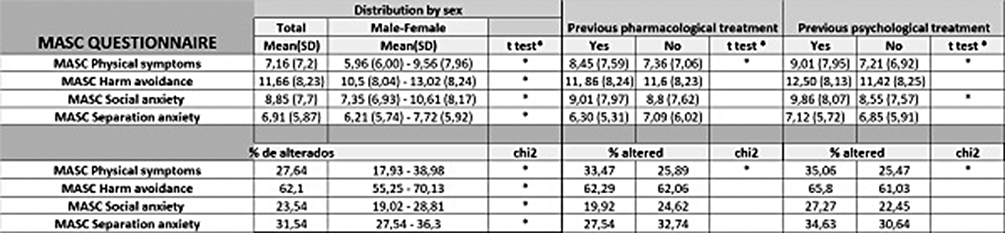
The sample contains 1024 patients, with a mean age of 12 (SD 4.028). Table 1 shows that the most frequent diagnosis is ADHD, with combined presentation with a prevalence of 22.27%, followed by Anxiety Disorders, without differentiating by subtypes (17.93%). It also shows that Defiant and Oppositional Disorder is the most prevalent comorbidity (9.66%) followed by Anxiety Disorder not specified (4.99%). Table 2 stands that there are significantly higher scores in all MASC subscales in those patients who do have prior psychiatry family history. We founf in Table 3 statistically significant differences were found between the score on the Physical Symptoms subscale based on whether the patient was undergoing previous treatment, both pharmacological (8.45 vs. 7.59) and psychological treatment (9.01 vs. 7.95) compared to those who were not (pharmacological 7.36 vs. 7.06), psychological (7.21 vs. 6.92). All these data have been adjusted.
Image:
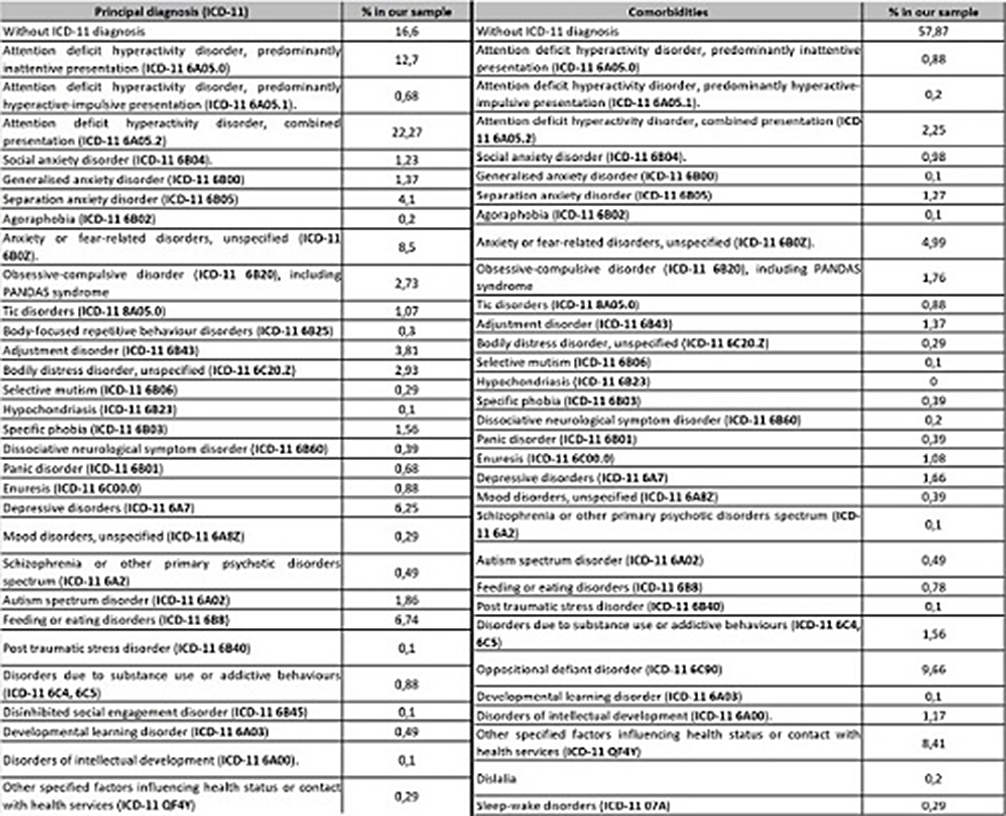
Image 2:
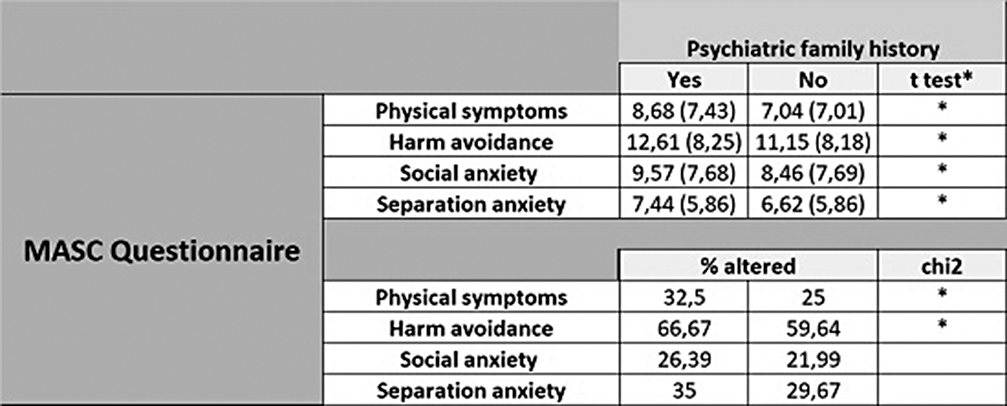
Image 3:
Conclusions
Anxiety disorders are the most common form of Mental Disorder in young people, with a global prevalence of 6.5% (Rapee et al.2023). However, in our sample the most common one is ADHD as our center is specialized in it. We found that the most prevalent one was Oppositional Defiant Disorder, as it is the most frequent comorbidity of ADHD (Vallejo-Valdivielso et al,2019; Faraone et al,2021). The increase of one point in the Physical Anxiety subscale increases the probability of indicating pharmacological treatment, which could be explained because of how functional limitation these symptoms cause. The increase in all the subscales of the MASC implies an increase in the probability of an indication for psychological treatment as it is the gold-standard treatment for anxiety in children.
Depressive disorders represent the main cause of disability in the world, due to its prevalence, its impact on the patient’s quality of life and its role as one of the main risk factors for suicide. Current antidepressant treatments can take weeks to take effect and months to achieve response and remission.It is estimated that up to 30% of patients with major depressive disorder (MDD) are resistant to antidepressant treatment, in addition, approximately 30-45% of patients with depression do not achieve an adequate response to the first antidepressant treatment.According to the STAR*D study, the more lines of treatment are required, the lower remission rates are estimated, as well as higher relapse rates during the follow-up phase.With the appearance of intranasal dosage esketamine allows the release directly to the central nervous system, the mechanism of action of esketamine is based on the antagonism of the NMDA receptor, which entails the modulation of the excitatory transmission of glutamate and the release of BDNF,activating neurotrophic signaling and synaptogenesis.
Objectives
The objective is to expose the response after treatment with intranasal esketamine in a case of resistant depression.
Methods
A 55-year-old female patient, diagnosed with resistant recurrent depressive disorder.The patient had undergone treatment with different therapeutic lines with antidepressants, and potentiations with antipsychotics, observing little response in the current episode, for which reason we evaluated the indication of intranasal Esketamine. Scales: MADRS (Montgomery Asberg Depression rating scale) =37, Hamilton Depression Scale=25, PHQ-9=20, indicating severe depression.
Results
After starting treatment with intranasal esketamine, an early response was observed. After the first month of treatment, mild depression was scored at MADRS=10 and moderate depression at Hamilton=14, PHQ-9=12, and at week 14 of treatment, it was scored mild depression in both MADRS and Hamilton. Intranasal 56mg esketamine plus 20mg escitalopram, 30mg mirtazapine and 5mg aripiprazole.
Conclusions
Intranasal esketamine offers a rapid reduction in depressive symptoms maintained over time, reducing the risk of relapse and with a favorable tolerability profile, so its use in depression resistant to treatment presents a great advance.
juvenile chronic depression is characterized by high prevalence, difficulties in diagnosis, nosological qualification and prognostic assessment. According to epidemiological data, the frequency of these conditions ranges from 1.5% to 3% in the general population (Gutiérrez-Rojas et al. Braz. J. Psychiatr 2020; 42 657-672), and among all depressions in adolescence, a chronic course develops in about 20% of cases (Blanco C., 2010 et al. The J clinical psychiatry 2010; 71(12) 6501). Due to the polymorphism of the clinical picture and the peculiarities of juvenile ontogenesis, difficulties arise in nosological and prognostic assessment.
Objectives
to study the long-term prognosis of chronic depression, depending on the variant of its course.
Methods
Catamnestic examination was performed on 64 patients of adolescent age (16-25 years), for chronic depressive state lasting more than two years (F31.3, F31.4, F32 (except F32.3), F33 (except F33.3), F34, F34.1, F21, F20 according to ICD-10). The duration of the catamnesis is more than 10 years. The PSP scale was used for psychometric assessment.
Results
when analyzing the ten-year course of juvenile chronic depression, three variants were identified: regredient (23.4%), monotonous (35.9%) and progredient (40.6%). The regredient course was characterized by a marked reduction or disappearance of psychopathological disorders with the formation of further remission with a high level of functioning in all spheres of life and complete social and labor adaptation (81-100 points on the PSP scale). The monotonous course was characterized by low variability and insignificant dynamics of individual manifestations throughout the disease with the preservation or some decrease in the level of educational and labor adaptation with the restoration of previous social contacts and a fairly high quality of life (scores 61-80 on the PSP scale). The progressive course was characterized by the gradual addition of new psychopathological disorders, or the aggravation of existing ones, patients had a distinct decrease in educational, labor and social adaptation (scores 50-31 on the PSP scale) or complete maladaptation of all spheres of life (scores <40 on the PSP scale).
Conclusions
The high incidence of progressive and monotonous course in juvenile chronic depression, contributing to a decrease in the level of functioning of patients, indicates the importance of timely detection of these conditions and the need for careful selection of therapy.
There is an increasing rate of treatment resistance in severe psychiatric disorders (SPDs), which indicates the necessity for finding new therapeutic interventions, because of the significant negative impact these disorders have on the patient’s quality of life, functionality, and other important parameters. In clinical practice, SPDs are estimated to represent up to 30-60% of all diagnosed cases. Schizophrenia spectrum disorders (SSD), major depressive disorder (MDD), and bipolar disorders (BDs) are associated with lower response to a large variety of therapeutic approaches. In this context, new technologies should be considered for SPDs, and non-invasive neuromodulation techniques can be explored as add-ons to ongoing therapeutic interventions.
Objectives
A literature review was conducted to detect the available evidence to support recommendations for neuromodulation techniques in SPDs.
Methods
Three electronic databases (PubMed, Cochrane, Google Scholar) were searched for papers corresponding to the keywords “treatment-resistant psychiatric disorders” and “neuromodulation” or “electroconvulsive therapy” (ECT) or “transcranial magnetic stimulation” (TMS) or “transcranial direct current stimulation” (tDCS), published from the beginning of the respective databases up to July 2023.
Results
After the initial search, 1258 papers surfaced, but only 72 remained to be included in the analysis, after filtering them according to the inclusion and exclusion criteria. TMS may improve both depressive and manic symptoms, but also reports of polarity changes were found, indicating the need for careful monitoring of treatment-emergent affective switches (TEAS). TMS may also improve cognitive functions, although not sufficient evidence was found to support this observation clearly. The efficacy of temporoparietal TMS in schizophrenia has not been proven with certainty, although this intervention may improve positive symptoms. ECT was an effective and well-tolerated intervention for severe mood episodes, SSD, and BDs. Depressive symptoms responded to tDCS in bipolar/monopolar patients, but reports of TEAS in the BDs population have been reported.
Conclusions
Non-invasive neuromodulation techniques may represent an efficient option in patients with SPD, but more good-quality trials are needed before this recommendation is formulated in clinical guidelines.
The transgression of the law can be a deliberate act by a lucid adult, but it can also be the result of a deficiency in judgment and discernment due to lack of age or insanity. Psychiatric expertises are more and more solicited in the penal field with the objective of identifying the causal link between mental illness and the criminal act.
Objectives
The objective of this work was to give an overview of the subjects expertised, the offences and the pathologies encountered through the report of a psychiatric expertise activity in criminal law.
Methods
It is a retrospective descriptive study carried out on the criminal psychiatric expertises made for a forensic act in the psychiatric department of Mahdia during the period from January 1, 2003 to March 30, 2022.
Results
In total, we collected 101 defendants. The average age of our study population was 35±12.07 years. The majority of our study sample was male (98%), from an urban area (50%). 46.6% had primary education and only 11.2% had higher education. The defendants were single in 57.8% of the cases, and almost half (45.7%) had no occupation. Two-thirds of the accused (61.2%) had experienced emotional deprivation at a young age. The problematic use of psychoactive substances was found in 10.3%, as well as alcohol consumption in 46.6%. Moreover, 39.7% of the patients had a personal psychiatric history and 19% had been incarcerated at least once. The forensic acts were mostly against people (62.9%) dominated by physical aggression (33.6%) followed by homicide or its attempt in 19% of the cases. The majority of patients were not related to their victims (62.1%). The nosographic diagnosis found was a personality disorder in 32.75% of cases, followed by schizophrenic disorders in 22.4% of cases.
Conclusions
Psychiatric expertise is a useful, complex and noble clinical act. Determining the predictive factors of a possible acting out allows to specify the objectives of interventions aiming at limiting the acts of violence, hospitalizations and incarcerations of patients suffering from mental disorders.
Pediatric Bipolar Disorder (BPD) is a chronic psychiatric disorder that alters normal and psychological development processes among patients. Although cognitive deficits in BPD have identified in recent studies, little is known about the developmental trajectory of these deficits. DMDD is a newly defined diagnosis included in the DSM-V. Since it added a new dimension to the clinical spectrum but few studies conducted on DMDD, there are some conflicting discussions in the literature about how to distinguish this disorder from other childhood psychiatric disorders and how to treat it.
Objectives
The aim of this study was to determine the phenomenological and neuropsychological differences between children and adolescents with a diagnosis of BPD (Pediatric Bipolar Disorder), DMDD (Disruptive Mood Dysregulation Disorder), and children and adolescents who are genetically at high risk for Bipolar Disorder (BD), and healthy controls (HCs) who do not have any psychiatric diagnosis, to investigate endophenotypes that may be predictive for BD.
Methods
Our study sample consists of four groups, the BPD group (n=30), the Risk group (n=25), the DMDD group (n=36), and the Healthy Control group (n=29). All participants were evaluated by the “Kiddie Schedule for Affective Disorders and Schizophrenia for School-Age Children—Now and Lifetime Pattern (K-SADS-PL)”. “Young Mania Rating Scale/Parent Form (YMRS-ABF), Conner’s Parent Rating Scale (CPRS-48), Child and Adolescent Behavior Rating Scale (CBCL)” scales were filled by parents, and “Child Depression Inventory (CDI), Youth Self-Report Form for 11-18 Years Olds (YSR)” scales were filled by children and adolescents. Neurocognitive test battery was applied to each participant: Continuous Performance Test (CPT), Wisconsin Card Sorting Test (WCST), Stroop Color and Word Test (SCWT), Trait Making Test A and B sections (TMT-A/B), California Verbal Learning Test-Child version (CVLT-C).
Results
While it was determined that the cases in the BPD and DMDD groups performed significantly worse in CPT, SCWT, CVLT-C, TMT A/B tests compared to healthy controls, it was found that the subjects in the Risk group performed worse at the CPT test than healthy controls. In addition, the cases in the BPD, Risk and DMDD groups reported more clinical and behavioral problems than the healthy controls.
Conclusions
There is a significant deterioration in the areas of continuous attention, processing speed, cognitive flexibility, response prevention, verbal memory and working memory in the BPD and DMDD groups, and in the continuous attention area in the Risk group compared to healthy controls. Prospective follow-up and imaging studies using larger samples and a larger neurocognitive test battery in the future will better reveal the neuropsychological characteristics of the BPD, Risk and DMDD groups.
Persistent negative symptoms of schizophrenia are generally considered difficult to treat or treatment resistant. A large number of investigational drugs developed and or tested for the treatment of persistent negative symptoms failed to show efficacy leading to pessimism in treatment and disinvestment in treatment research of negative symptoms.
Objectives
1. To demonstrate, that available treatment methods – both pharmacological and non-pharmacological - are in fact effective for the treatment of negative symptoms of schizophrenia 2. To shortly summarize new drug research in this field.
Method
Review of research data.
Results
The overall estimate for the placebo effect had a medium effect size, with a Cohen’s d value of 0.6444 (SE = 0.091).1 The estimates for the placebo effect were similar in the add-on and monotherapy studies. Amisulprid was superior to placebo, cariprazine was superior to risperidone, and “direct comparisons of antipsychotics in patients with predominant negative symptoms indicated no significant difference between amisulpride and olanzapine and between asenapine and olanzapine…”2. Various nonpharmacological interventions improved negative symptoms in randomized controlled trials relative to treatment as usual (e.g. social skills training, music therapy, non-invasive brain stimulation, mindfulness, and exercise-based interventions) 3 There is a progress in research with non-dopaminergic agents for the treatment of negative symptoms (e.g. pimavanserin, roluperidon, ulotaront).
Conclusions
For medication classes other than antipsychotics and antidepressants, we found no reliable support for evidence-based recommendations for using these agents in the treatment of negative symptoms in clinical practice. Effect sizes for psychosocial interventions range from small to moderate. The use of placebo has shown a clinically significant positive effect on negative symptoms, a finding that warrants further research and provides a sense of optimism regarding potential therapeutic benefits.
1. Czobor, P., Kakuszi, B. and Bitter, I., 2022. Placebo response in trials of negative symptoms in schizophrenia: a critical reassessment of the evidence. Schizophrenia Bulletin, 48(6), pp.1228-1240. 2. Czobor, P., Bitter I. Pharmacologic treatment of negative symptoms: Focus on efficacy. In: Bitter I. (ed): Managing Negative Symptoms of Schizophrenia, Oxford University Press, 2020, p. 67
2. Savill, M. Psychosocial/non-pharmacologic treatment of negative symptoms: focus on efficacy. In: Bitter I. (ed): Managing Negative Symptoms of Schizophrenia, Oxford University Press, 2020, p. 87
Dual pathology, characterized by the simultaneous presence of substance use disorders and psychiatric disorders, is a topic of growing interest in the scientific community. In particular, obsessive-compulsive disorder (OCD) is a common comorbid psychiatric condition in patients with substance use disorders.
Objectives
To evaluate the efficacy of rTMS on comorbid disorder symptoms by applying specific protocols for OCD and substance use disorder in a clinical case of dual pathology.
Methods
Case Description: A 36-year-old male diagnosed with OCD and habitual cocaine use (an average of 6 times per month). Previous unsuccessful attempts to quit substance use. Undergoing psychotherapy and psychopharmacological treatment for OCD since the age of 22 with no significant clinical improvement.
Methodology: The severity of OCD was quantified before and after the intervention using the Yale-Brown Obsessive Compulsive Scale (YBOCS). To assess addictive behavior, the Maudsley Addiction Profile (MAP) was used. During the intervention period, the occurrence of substance use was recorded based on the patient’s and family members’ reports. The intervention involved the administration of an rTMS protocol tailored to the specific case, consisting of the simultaneous application, using a double-cone coil, of rTMS at 20Hz over the right dorsomedial prefrontal cortex (DMPFC) at an intensity of 100% of the resting motor threshold (RMT) to treat OCD symptoms, followed by intermittent theta burst stimulation (TBS) over the left DMPFC at an intensity of 120% of the RMT to address substance addiction. The patient received a total of 30 sessions at a rate of one session per day, five days a week, for six weeks.
Results
Results: The results showed an improvement in the total score on the YBOCS scale, decreasing from a value of 26 in the pre-intervention assessment to 16 in the post-intervention assessment, representing a reduction of more than 35% from pre- to post-intervention, meeting response criteria. Thus, there was a decrease in both obsessive and compulsive symptoms, with reduced associated distress and increased control. Additionally, throughout the intervention, there was a gradual decrease in substance use, decreasing from an average of 6 monthly instances before treatment initiation to a total of 1 in the month the treatment ended.
Conclusions
Conclusions: This unique case study represents a therapeutic window for the treatment of patients with comorbid disorders, demonstrating promising preliminary benefits of the combined rTMS intervention for both conditions, especially in the field of addictions.
The comorbidity between depression and anxiety is a common occurrence. The DSM-5 introduced the “anxious distress” (AD) specifier that can be applied to any depressive episode – both in major depressive disorder (MDD) and bipolar disorder (BD) – when symptoms such as feelings of tension, restlessness, difficulty concentrating, and fear that something awful may happen or to lose control are present. Longitudinal data showed that the AD specifier may be an effective predictor of chronicity, time to remission, and functional disability in depressive disorders. In addition, evidence on AD proved its association with increased depressive symptom severity.
Objectives
Available literature seems to suggest that AD occurs in a specific subgroup of patients, thus enabling a peculiar clinical profile to be outlined. To expand knowledge in this field, we performed a cross-sectional study aimed at identifying clinical correlates of AD in people with major depressive episodes.
Methods
Adult people admitted to two psychiatric inpatient units in the northern area of the Metropolitan City of Milan from May 2020 to December 2022 were screened for a major depressive episode and relevant specifiers using the Structured Clinical Interview for DSM-5 (SCID-5). Data on socio-demographic and clinical variables were collected. The severity of depressive and manic symptoms was assessed using the Montgomery–Åsberg Depression Rating Scale (MADRS) and Young Mania Rating Scale (YMRS), respectively. Univariate comparisons between participants with and without AD were conducted, and two multiple logistic regression models were arranged to investigate the association between AD and candidate explanatory variables.
Results
We included 206 inpatients with a major depressive episode (mean age =48.4 ± 18.6 years; males = 38.8%), of whom 155 diagnosed with MDD and 51 with BD. AD was present in 137 participants (66.5%). Mixed features (p=0.049), higher YMRS scores (p=0.004), psychotic features (p<0.05), and a diagnosis of MDD (p<0.05) were found to be associated with AD in the multiple logistic regression analysis.
Conclusions
Notwithstanding some limitations, such as the cross-sectional design and the inclusion of inpatient only, our study highlights the association of AD with mixed and psychotic features, as well as with MDD. Clinical implications of these results include the possible contribution in delineating a specific symptom profile in people with AD during a major depressive episode.
Emotional dysregulation are considered early manifestations of neuropsychiatric disorders. Recent research has shown that a threatened preterm labour (TPL) represents an adverse prenatal event that involves temperament disturbances, even in absence of prematurity. Thus, full-term TPL infants at 6 months of age are characterized by lower positive affect, higher negative affect, and worse emotional regulation relative to a full-term non-TPL control group.
Objectives
The aim of this study is to explore the predictors of change of emotional infant competences.
Methods
This prospective cohort study recruited mothers who suffered from a TPL. Infants’ temperament assessment was performed at 6 and 30 months of age using the Rothbart Behaviour Questionnaires, examining positive affectivity/surgency, negative emotionality, and orienting and emotional regulatory capacity. A regression model was carried out, including gestational age at birth, maternal anxiety trait, maternal history of psychological traumas, prenatal and postnatal maternal depression, anxiety, and cortisol as well as parenting stress as predictors.
Results
Increased positive affectivity was related with lower paternal stress (p = .044). Maternal history of trauma and parenting stress was associated with increased negative emotionality (p = .037 and p = .045, respectively). Increased emotional regulation disturbance was linked to low gestational age at birth (p < .001), higher postnatal depression (p = .002), higher prenatal anxiety at TPL diagnosis (p = .039) and higher postnatal anxiety (p = .008).
Conclusions
Therefore, maternal previous traumas, maternal psychopathology from pregnancy to postpartum as well as parenting stress should be considered in psychological treatment to improve infant’s emotional competences and prevent subsequent neuropsychiatric disorders.
Major depressive disorder (MDD) is a tremendous global disease burden and the leading cause of disability worldwide. Unfortunately, individuals diagnosed with MDD typically experience a delayed response to traditional antidepressants and many do not adequately respond to pharmacotherapy, even after multiple trials. The critical need for novel antidepressant treatments has led to a recent resurgence in the clinical application of psychedelics, and intravenous ketamine, which has been investigated as a rapid-acting treatment for treatment resistant depression (TRD) as well acute suicidal ideation and behavior. However, variations in the type and quality of experimental design as well as a range of treatment outcomes in clinical trials of ketamine make interpretation of this large body of literature challenging.
Objectives
This umbrella review aims to advance our understanding of the effectiveness of intravenous ketamine as a pharmacotherapy for TRD by providing a systematic, quantitative, large-scale synthesis of the empirical literature.
Methods
We performed a comprehensive PubMed search for peer-reviewed meta-analyses of primary studies of intravenous ketamine used in the treatment of TRD. Meta-analysis and primary studies were then screened by two independent coding teams according to pre-established inclusion criteria as well as PRISMA and METRICS guidelines. We then employed metaumbrella, a statistical package developed in R, to perform effect size calculations and conversions as well as statistical tests.
Results
In a large-scale analysis of 1,182 participants across 51 primary studies, repeated-dose administration of intravenous ketamine demonstrated statistically significant effects (p<0.05) compared to placebo-controlled as well as other experimental conditions in patients with TRD, as measured by standardized clinician-administered and self-report depression symptom severity scales.
Conclusions
This study provides large-scale, quantitative support for the effectiveness of intravenous, repeated-dose ketamine as a therapy for TRD and a report of the relative effectiveness of several treatment parameters across a large and rapidly growing literature. Future investigations should use similar analytic tools to examine evidence-stratified conditions and the comparative effectiveness of other routes of administration and treatment schedules as well as the moderating influence of other clinical and demographic variables on the effectiveness of ketamine on TRD and suicidal ideation and behavior.
Cancer patients, namely breast cancer survivors, are highly vulnerable to psychological morbidity. Noninvasive interventions are incentivized to promote the mental health and quality of life of cancer survivors. Recent studies provided evidence supporting the use of meditation as a promising adjuvant tool for improving the mental health and quality of life of cancer survivors.
Objectives
The present study aims to carry out a clinical trial to evaluate the effects of an online group of meditation program of Kundalini Yoga on breast cancer women, through a longitudinal and randomized research design, in the following variables: psychological morbidity, self-compassion, spirituality, and quality of life.
Methods
This study had the participation of 35 participants distributed randomly for 3 equivalent groups (N=11 EG, N=13 ACG, N=11 PCG), with the diagnosis of breast cancer, aged between 34 and 78 years.
The sample of women with breast cancer was randomly selected from a breast cancer support association.
The protocol was applied online individually on pre-test, post-test, and 1-month follow-up moments, in 3 comparison groups: 1) the Experimental Group(EG), who practiced yoga Kundalini meditation; 2) the Active Control Group(ACG) that practiced relaxation; 3) the waiting list Passive Control Group(PCG). Intervention sessions were carried out for the EG and the ACG, in an online format, lasting about 30 minutes, weekly, for 8 weeks. Statistical analyses were considered at a 0.05 significance level. All analyses were performed with IBM SPSS, version 27.
Results
The results showed that the group that did yoga kundalini meditation (EG) had benefits, unlike the control groups, in the variables of emotional functioning, global spiritual well-being, and personal well-being. There were statistically significant differences in the overall self-compassion score when comparing the 3-time points in all groups. The sub-scale of self-kindness and transcendental well-being shows an increase significantly between the 3 moments in the active control group. The passive control group performed significantly worse over time in the self-kindness.
Conclusions
Based on preliminary results, the Experimental Group (EG) exhibited improvements in Self-Compassion, Spirituality, and Emotional Functioning (as evaluated by the QLQ C-30) following eight consecutive weeks of online Kundalini Yoga Meditation practice. These findings contribute to the growing body of evidence supporting meditation’s potential to enhance life quality and spiritual well-being in individuals with breast cancer. These preliminary findings suggest that further research in this promising field is warranted.
Post-traumatic stress disorder (PTSD) and personality disorders are highly comorbid. There is some evidence that trauma-focused treatment normalises activation in brain areas involved in the fear circuit and regions involved in emotion regulation in people with PTSD. Although we assume that working mechanism of personality disorder treatments relies on improving emotion regulation and associated brain regions, there is as of yet little evidence of neurobiological effects of personality treatment on people with PTSD and comorbid PD.
Objectives
To 1) study the effect of trauma-focused and/or trauma-focused and personality disorder treatment n brain activation in participants with PTSD and comorbid personality disorders and 2) relate change in brain activation to symptom improvement.
Methods
Participants with PTSD and comorbid borderline and/or cluster c personality disorders from the PROSPER-trials (Prediction and Outcome Study for PTSD and personality disorders) were randomized to either trauma-focused treatment (TFT) or TFT with personality disorder treatment (TFT+PT). Brain activation was measured with an emotional face task during functional magnetic resonance imaging scanning before and after treatment. Regions of interest for the analyses were the amygdala, dorsal ACC, insula, ventromedial prefrontal cortex (PFC), ventrolateral PFC and dorsolateral PFC. Bayesian multilevel analyses were conducted to analyze change in brain activation. Clinical measures were clinician-administered PTSD severity, self-rated emotion regulation problems, depression severity and dissociation severity.
Results
We included 42 participants with a pre- and posttreatment scan (24 with TFT, 18 TFT+PT). Analyses on the pre-post data are currently being run and will be presented in April.
Conclusions
This is one of the first studies to conduct functional MRI analyses on treatment in participants with both PTSD and personality disorders.
Cardiovascular diseases (CVD) were the cause of 40% of all deaths in Slovenia in 2016, and are the seventh most common cause of visits to the general practitioner. The prevalence of depression in people with CVD is high and is a strong predictor of mortality and additional cardiac events. In patients with coronary artery disease, depressive symptoms contribute to a lower quality of life and to physical limitations.
Objectives
The purpose of this study was to translate the Cardiac Depression Scale into Slovenian (S-CDS) and to assess its psychometric properties on Slovenian patients with heart disease.
Methods
After obtaining the consent from the original authors, the Cardiac depression scale was translated by three bilingual Slovenian native speakers with medical knowledge. Afterwards, they worked jointly to reach consensus on one version, which was then back-translated (Slovenian to English) by two independent English translators unfamiliar with the original version. The original authors approved the final draft. The S-CDS was then applied to a total of 272 patients with heart disease that underwent elective coronary angiography. At the same time the Spielberger Stait Anxiety Inventory (STAI-S) and the Center for Epidemiologic Studies Depression Scale-20 (CES-D) were used. An exploratory and confirmatory factor analysis, internal consistency, test–retest reliability and concurrent validity were performed.
Results
The total scale had Cronbach’s alpha 0.92 and test–retest reliability 0.71. Six factors were confirmed by the exploratory factor analysis, accounting for 60.88% of total variance. A two and one factor solution indicated by the confirmatory factor analysis had acceptable goodness-of-fit measures. A one factor solution was kept, considering a high correlation between the two factors and the theoretical background in previous studies. A moderate to strong correlations were confirmed by concurrent validation against the CES-D and the STAI-S.
Conclusions
The S-CDS with 25 questions is a reliable and valid instrument for measuring depressive symptoms in Slovenian patients with heart disease.
The decline in fertility is one of the major problems worldwide that could affect family structure. Many studies have been conducted to assess attitudes toward fertility and childbearing around the world, but there’s a lack of research about that in Saudi Arabia (SA). The study aims to assess women’s attitudes toward fertility and childbearing in SA and to investigate its association with sociodemographic, medical, and psychological factors.
Objectives
Aim of the Study: The purpose of the study is to assess women’s attitudes toward fertility and childbearing in Saudi Arabia and to investigate its association with sociodemographic, medical and psychological variables.
Specific Objectives:
1. To assess women’s attitudes toward fertility and childbearing in Saudi Arabia.
2. To investigate association between attitudes toward childbearing with sociodemographic characteristics in Saudi Arabia.
3. To investigate association between attitudes toward childbearing with medical and psychiatric history in Saudi Arabia.
4. To investigate association between attitudes toward childbearing with the childbearing preferences in Saudi Arabia.
Methods
This cross-sectional study of a convenient sample of 2172 women in SA in Dec 2022 and Jan 2023. Data were collected through a survey link that contains:1)Sociodemographic data, 2) medical and psychiatric history, 3) childbearing preference and 4) the Arabic version of the Attitudes toward Fertility and Childbearing Scale (AFCS). Data were analyzed by SPSS 25 ;We described the variables in means ± SD or percentage as appropriate. Student’s t-test and ANOVA were performed to analyze differences between the components and background characteristics.
Results
Individuals in the age group of 18-25 years (25.54± 9.08, p<0.001), unmarried (25.23 ± 8.87, p<0.001), and diagnosed with a psychiatric disorder (24.76 ±9.51, p<0.002) scored lower in importance of future of childbearing. In terms of hindrance at present and childbearing preparation, individuals in the age group of 18-25 years (25.66 ± 8.66, p<0.001) (18.53 ± 5.08, p<0.001) respectively, unmarried (25.71± 8.58, p<0.001) (18.46 ± 5.08, p<0.001) respectively, and students (25.92 ± 8.82, p<0.001) (18.55 ± 5.15, p=0.001) respectively were more likely to score high. Participants who had not made a decision about having children (9.36±3.32, p<0.001) scored lower in the female identity domain.
Conclusions
In conclusion, the findings of this study indicate that the younger age group (18-25 years) and those with psychiatric illnesses scored lower in the importance for future of childbearing compared to women of older age group (36-49 years ) and those without psychiatric illnesses. On the other hand, college students showed more concerns related to childbearing hindrance and preparation.
Children who have undergone an oncological process and have received treatment with chemotherapy or radiotherapy on the central nervous system may have significant neurocognitive sequelae. Some video games have shown neurocognitive benefits in people with impairments in different areas, such as attention or memory.
Objectives
This work aims to demonstrate the benefit of a video game-based training program to improve the neurocognitive profile in a child survivor of cancer.
Methods
The patient is a 9-year-old female who was diagnosed with acute lymphoblastic leukemia at the age of 4 years. She received routine treatment of this disease by chemotherapy, including high-dose chemotherapy (with blood-brain barrier crossing) and intrathecal chemotherapy. She is currently 3 years after the end of treatment.
The Continuous Performance Test 3 (CPT-3) (sustained attention/vigilance) was administered before and after a multifaceted training program consisting of playing 3 video games for 12 weeks, as follows: a brain-training game (4 days per week, 7-12 minutes per day), a skill-training game (2 days per week, 10 minutes per day) and an exergaming game (2 days per week, 10 minutes per day).
Results
Prior to intervention, the patient had 3 atypical z-scores on the CPT-3 (z scores: mean = 0, S.D. = 1), with a pattern compatible with ADHD (omissions z = 1.2; hit reaction time z = 3.4; hit reaction time block change z = 1.2). After intervention, she had only an atypical z-score (hit reaction time z = 3.6), with a pattern compatible with slowing, without ADHD.
Conclusions
The neuropsychological evaluation of this patient showed an improvement in his attentional pattern on the CPT-3 after the video game-based training.
