To save content items to your account,
please confirm that you agree to abide by our usage policies.
If this is the first time you use this feature, you will be asked to authorise Cambridge Core to connect with your account.
Find out more about saving content to .
To save content items to your Kindle, first ensure no-reply@cambridge.org
is added to your Approved Personal Document E-mail List under your Personal Document Settings
on the Manage Your Content and Devices page of your Amazon account. Then enter the ‘name’ part
of your Kindle email address below.
Find out more about saving to your Kindle.
Note you can select to save to either the @free.kindle.com or @kindle.com variations.
‘@free.kindle.com’ emails are free but can only be saved to your device when it is connected to wi-fi.
‘@kindle.com’ emails can be delivered even when you are not connected to wi-fi, but note that service fees apply.
This chapter focuses on variation in Sesotho which is an aspect of Sesotho that has received very little attention from scholars due to the dominance of the prescriptive approaches. Generally, the language has been treated as a static monolithic whole that does not have varieties. The general practice has been to treat any deviation from the prescribed forms as the ‘corruption’ of the language (Rapeane 1997). The situation has further been complicated by the misconception that variation in Sesotho is based along the lines of the clans. A search on variation in Sesotho brings up names such as Sefokeng variety, Sekwena variety, Setaung variety and even Sephuthi variety, all of which are based on the misconception that there are clusters of Bafokeng, Bakwena, Bataung and Baphuthi who speak their own varieties of Sesotho language.
As the next sections will show, variation does exist in Sesotho. However, the divisions of Sesotho-speaking people into clans is not a major contributory factor. The sections will show that there are different factors, such as the spatial setting, that have played a role in shaping the language spoken by each group of the Sesotho-speaking community.
The Standard and the Non-Standard Varieties of Sesotho
The first variation in Sesotho is the one that exists between the standard variety and the non-standard varieties. The standard variety is the one used in education, government, business and other formal settings.
There are currently two orthographies used for writing Sesotho, namely, the Lesotho orthography and the South African orthography. The two Sesotho orthographies have evolved from the Sotho-Tswana orthography introduced in the 19th century by the European missionaries and explorers. The introduction of a single orthography for the different Sotho-Tswana languages and dialects by the missionaries and the explorers was influenced by their perception of the Sotho-Tswana groups as members of one nation, variously referred to as the Batswana or Basotho and of the languages spoken by these groups as closely related dialects – alternatively referred to as Setswana or Sesotho (Archbell 1837; Bleek 1858; Casalis 1841). The following remark from Archbell (1837, 82) demonstrates how the 19th century missionaries and scholars viewed the different Sotho-Tswana groups and their languages:
the principal dialects of Sichuana at the present known to us are the Sirolong, spoken by the Borolongs [sic], Sitlapi, spoken by the Batlapees, Sisutu, spoken by the Basutas, Sitlokua, spoken by the Batlokuas, Sioanketsi, spoken by the Baoanketsi.
Seemingly, the belief of the Sotho-Tswana people as members of one nation and of their languages as closely related dialects was held by some of the Bantu-speaking communities as well. Bleek's (1858, 111) observation that “the Betshuana are called Abesutu or Abasutu by the Zulus” shows that, similar to the missionaries, the Zulus regarded all Sotho-Tswana languages as members of one nation.
This chapter continues with the descriptions of the languages that emerged during different times after the migration from West Africa and whose emergence eventually led to the development of Sesotho. The chapter focuses on the ancestor of the Sotho-Twana languages, Proto-Sotho (PS), which gave birth to the dialect that would eventually become Sesotho around the 1400s (cf. Auer 1977). Further, the chapter explores the issues surrounding the birth of the language and the features that it adopted after its birth.
The Formation of Proto-Sotho
Proto-Sotho branched off from Proto-South Eastern Bantu (PSEB) in the second half of the first millennium AD (Ehret 1972). Proto-Sotho was born after PSEB differentiated into several offshoots whose descendants currently form some members of Zone S of the Bantu languages. This means that PSEB existed for only about 500 years before it could differentiate into its offshoots.
The differentiation of PSEB into several offshoots was triggered by the same factor that had led to the formation of Eastern Bantu (EB) and PSEB, namely, the separation of its speakers from each other. As the result of the separation of PSEB speakers around 500 AD, new dialects were formed which would eventually evolve into the ancestor of Chopi, the ancestor of GiTonga, the ancestor of the Nguni languages, the ancestor of the Sotho-Tswana languages, the ancestor of Tsonga and the ancestor of Venda (Ehret 2008).
Pentecostal charismatic churches that preach prosperity gospel in Zimbabwe have attracted a youthful membership. In the context of a deeply uncertain economic future, young Pentecostal Christians devise performativity strategies for optimizing their chances of converting prosperity gospel into material prosperity. These strategies include sartorial elegance in adorning counterfeit suits, the performance of obedience, and the use of social media technologies. The picture that emerges is a complex and at times contradictory one in which the potential realization of upward spiritual and social mobility rests, ultimately, on the transformative and volatile nature of value. Data for this project was collected in Harare through ethnographic research and interviews over a year-long period.
This article proposes that, based on the evolution of international investment law and investment arbitration, umbrella clauses are substantially implicated in the interpretation of Chinese concession loan agreements in Nigeria. So far, the outcome of the oversight functions of the National Assembly of Nigeria indicates that umbrella clauses have not been considered a significant legal issue in the negotiation of these agreements. With the growing use of Chinese concession loan agreements in Nigeria, this article offers a historical analysis that should be a guide to organs of government, policy advisers and others charged with the sourcing and negotiation of concession loans for development projects in Nigeria. The article makes the case that a proper understanding of the evolution of umbrella clauses is germane to the negotiation and interpretation of these agreements, compared to standard immunity clauses that appear to have overtaken in the debate about these loans in Nigeria.
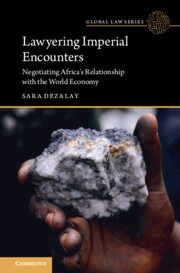
Lawyering Imperial Encounters revisits the relationship between the African continent and global capitalism since the 19th century Scramble. Focused on sites of imperial encounters – in London, Paris, Abidjan, Bujumbura, Kinshasa, Johannesburg or the Hague, it provides an unprecedented account of the correlation between the legacy of legal imperialism and British hegemony, and the uneven and unequal expansion of finance and global justice in the current rush for Africa's 'green' minerals. Tracking the role played by legal intermediaries to negotiate and justify Africa's practical and symbolic subaltern position in the global economy, it demonstrates the interconnectedness between political, legal and economic change in capitalism's cores and its so-called peripheries. Embracing the global turn in sociology, history and legal scholarship, it rubs against the functionalist account of global value chains as engines of development. It also constitutes a powerful postcolonial critique of law's double-bind - as both enabler and bulwark against domination.
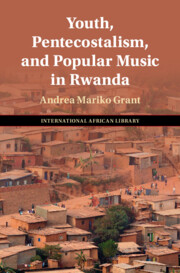
Youth, Pentecostalism, and Popular Music in Rwanda offers fascinating insight into the lived experiences of young people in Rwanda through ethnographic analysis of the ambiguities and ambivalences that have accompanied the country's rapid post-genocide development. Andrea Mariko Grant considers how Pentecostalism and popular music offer urban young people ways to craft themselves and their futures; to imagine alternative ways to 'be' Rwandan and inhabit the city in the post-genocide era. Exploring the idiom of the heart – and efforts to transform it – this book offers a richly nuanced perspective of urban young people's everyday lives, their aspirations and disappointments, at a political moment of both great promise and great constraint. Rather than insist on a resistance-dominance binary, Grant foregrounds the possibilities of agency available to young people, their ability to make 'noise', even when it may lead to devastating consequences.
This chapter explores how academics and textbook authors created Ghana’s foundation story from the heavily politicised narratives of Ghana’s first president, Kwame Nkrumah, and his Convention Peoples Party. It argues that empathy for successful political parties exhibited by first generation Africanists bequeathed to the present a grand narrative fraught with teleology because of its emphasis on anti-colonialism as a recurrent and unchanging problematic. The scholars failed to see a calculated engagement with global ideas and a simultaneous choice made by numerous Gold Coast thinkers to chart intellectual and political projects within the context of the possibilities and constraints of their time. The intellectuals are presented in a hierarchy from proto, cultural, conservative, to radical anti-colonial nationalists, thereby affirming the preeminence of tmuch-vaunted radicals. Recalled this way, the intellectuals’ projects remain distorted and misrepresented. Fortunately, a consideration of the intellectuals’ transnational dialogic encounters within a cosmopolitan prism presents a fuller picture.
The commemoration on 6 March 2007 of the fiftieth anniversary of Ghana’s emergence from eighty years of British colonial rule exposed not only a bitter national divide over whom to credit with the nation’s founding, but also the possibility that a flawed ‘Grand Narrative’ of Ghana’s modern history is the source of this abiding threat to national unity. In marking the Golden Jubilee, the government of the day, led by President John Kufuor of the New Patriotic Party (NPP), honoured heroes of both the national and continental struggles for independence. On the national level, the NPP chose to celebrate the collective known in Ghanaian historical folklore as ‘The Big Six’, the leadership of the post-World War II United Gold Coast Convention (UGCC) nationalist movement.
This chapter examines Kenya's use of debt-based financial statecraft, revealing an uneven track record. It first describes how the Kenyan government diversified its portfolio of external finance with both international bonds and Chinese loans. Drawing on interviews with government and donor officials, the chapter then shows Kenya's mixed success in extracting bargaining leverage from its new sources of finance. While the Kenyan government achieved increased flexibility from donors on governance issues, it encountered greater resistance on financial management practices. The chapter highlights that donors' strategic interests in their relationship with Kenya encouraged them to be more flexible when Kenya diversified its portfolio of external finance, but that their concerns about accountability and use of funds led them to be more stringent on issues of financial management.
This paper examines the fissures within recent decolonial debates, arguing for the privileging of alternative narratives from formerly colonized groups and a shift away from centring colonialism. It calls for the recognition of decolonial struggles whose histories run deep and the need to link the struggles with indigeneity, its poetics of relations, and connectedness. Therefore, decoloniality requires thinking and doing and paying attention to social and economic well-being of hitherto marginalized indigenous communities, while giving due recognition to their poetics of relationality, reciprocity, and conviviality. Drawing on the example of #RhodesMust Fall movement in South Africa, it raises difficult questions around ownership, agency, while pointing to cracks that this contemporary movement surfaced, in spite of its claim to decoloniality.