To save content items to your account,
please confirm that you agree to abide by our usage policies.
If this is the first time you use this feature, you will be asked to authorise Cambridge Core to connect with your account.
Find out more about saving content to .
To save content items to your Kindle, first ensure no-reply@cambridge.org
is added to your Approved Personal Document E-mail List under your Personal Document Settings
on the Manage Your Content and Devices page of your Amazon account. Then enter the ‘name’ part
of your Kindle email address below.
Find out more about saving to your Kindle.
Note you can select to save to either the @free.kindle.com or @kindle.com variations.
‘@free.kindle.com’ emails are free but can only be saved to your device when it is connected to wi-fi.
‘@kindle.com’ emails can be delivered even when you are not connected to wi-fi, but note that service fees apply.
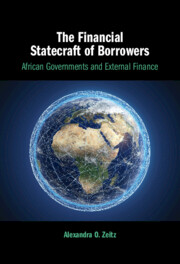
As China rises to prominence as a global lender, what impact does this have on borrowing countries? In a context of deepening global financial integration and rising powers, this book examines how developing countries, specifically in sub-Saharan Africa, can use borrowing relationship to their advantage. Alexandra O. Zeitz reveals how these countries, once reliant on traditional donors, may now leverage Chinese loans and international sovereign bonds to enhance their bargaining power in aid negotiations – a strategy she terms the “financial statecraft of borrowers.” Grounded in extensive interviews with senior officials from recipient countries and donor agencies in Ethiopia, Ghana, and Kenya, and complemented by statistical analysis of aid agreements, The Financial Statecraft of Borrowers offers a comprehensive understanding of how aid relationships are changing along with the shifting landscape of international finance.
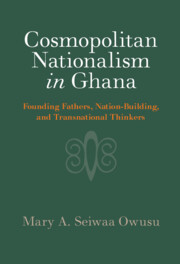
Nineteenth and twentieth-century West African writer-intellectuals harnessed their Atlantic networks to explore ideas of race, regeneration, and nation-building. Yet, the ultimately cosmopolitan nature of these political and intellectual pursuits has been overlooked by dominant narratives of anti-colonial history. In contrast, Cosmopolitan Nationalism in Ghana uses cosmopolitanism as a primary theoretical tool, interrogating the anti-colonial writings that prop up Ghana's nationalist history under a new light. Mary A. Seiwaa Owusu highlights the limitations of accepted labels of nationalist scholarship and confirms that these writer-intellectuals instead engaged with ideas around the globe. This study offers a more complex account of the nation-building project, arguing for the pivotal role of other groups and factors in addition to Kwame Nkrumah's leadership. In turn, it proposes a historical account which assumes a cosmopolitan setting, highlights the centrality of debate, and opens a vista for richer understandings of Ghanaians' longstanding questions about thriving in the world.
The conclusion of Money, Value, and the State reflects on the rise of a neoliberal government of value. The architecture of political economy for postcolonial Kenya, Tanzania, and Uganda—their currency management, agrarian credit, export monopolies, and price controls—was similar to how many other nation-states managed capitalism, exerted sovereignty, and cultivated citizenship in the postwar decades. And like many other parts of the world, by the late-1970s, the government of value in East Africa was challenged by new models of determining worth. The neoliberal proviso to “get prices right” targeted the legitimacy of the moneychanger state: instead of controlling the conversion between currencies and managing exchange rates, central banks would delegate power to commercial firms. It was likewise a call to eliminate state monopolies on the valuation of export crops and other commodities in favor of merchants’ power to set prices. Yet, instead of merely being a project of marketisation, neoliberalism was always a theory of state power and the ethos of citizenship. As structural adjustment was imposed—haltingly, imperfectly—by international creditors and their East African partners, the problematic of price continued to imply far more than the value of a commodity. It was a call to revalue the relationship among people and between citizens and states. As a result, the state government of value has not disappeared--it has been disavowed by central banks and bureaucracies that dismiss popular claims-making in favor of serving the sovereignty of capital.
If political independence provided Africans more latitude in how to pursue economic sovereignty, it hardly settled the matter of how it should be institutionalized. Debates about currency, for instance, persisted in East Africa after formal decolonization, and only in 1965-66 was the colonial money replaced by money issued by the independent states. This chapter traces the unexpected trajectory of decolonization, including the persistence of the imperial East African Currency Board. Decisions about the postcolonial monetary regimes were delayed, in part, by the machinations of British officials who tried to protect the racial capitalism of East Africa from the challenge of African independence. Yet, the establishment of national currencies and central banks was also delayed by Africans’ own commitment to supranational linkages, including an East African common market and currency. This chapter shows that the fortunes of a proposed East African Federation rose and fell on the dynamics of uneven and combined development in the region. And, finally, it examines how the central banking model adopted by postcolonial leaders reinforced the dependence of their nations on the accumulation of foreign currencies. The “moneychanger state,” in which postcolonial governments intermediated between domestic and foreign currencies, was critical to their own survival and ideas about development. Ultimately, though, it was the rural cultivators who would bear the burden of maintaining national solvency, a material reality that spurred a productivist ideology in which merit was revealed through earning export value.
By the second decade of independence, Uganda’s economy groaned under the pressures of domestic misrule and international turbulence. This chapter traces the variety of popular and state reactions as price inflation and commodity shortages came to prevail. Some Ugandans experienced shortages as an affront to their ethical expectations about merit and redistribution; they accused their compatriots of misdeeds and demanded their government better manage the economy. In response, large domains of economic life were criminalized as the state tried to redirect trade toward avenues more easily taxed or regulated, including through an Economic Crimes Tribunal that indicted innumerable Ugandans. Yet, smuggling, hoarding, and overcharging proved especially bedeviling to the state, Drawing on a range of police investigations, trial records, and petitions, this chapter details the sorts of opportunistic exchanges and engagements that characterized Uganda in the 1970s, an improvisational mix of dissidence and claims-making, acquiescence and rebuke that radically challenged sovereignty and citizenship.
For many postcolonies, a national currency—like a constitution, flag, or passport—was a necessary accompaniment to independence. Money and credit were more than potent symbols of decolonization; they were means of constituting a new political order. This Introduction argues that the monetary regimes established in Kenya, Uganda, and Tanzania aimed to remake their independent societies, turning savings, loans, and other financial instruments into the infrastructure of citizenship and statecraft. These instruments tried to create a “government of value” in which personal interest and collective advance were aligned through mechanisms that were simultaneously ethical and economic, cultural and political. They did so because colonial subjects experienced empire as not only political domination but also a constraint on economic liberties. Yet, the ensuing decolonization was at best partial, not least because the value of national currencies depended on the accumulation of foreign money. Moreover, the independent political economy of East Africa created new inequalities and divisions. Struggles over money, credit, and commodities would animate a series of struggles between bankers and bureaucrats, farmers and smugglers in the coming decades. By detailing the notion of the “moneychanger state,” this chapter provides the conceptual frameworks to understand these conflicts in new ways.
This chapter reconstructs the ethical ambiguities and popular anxieties that emerged during a spectacular period of coffee smuggling in the 1970s, centered in Chepkube village near the border of Kenya and Uganda. The criminalized trade provided residents with newfound wealth and consumptive possibility; magendo, as it was known, also was a stark challenge to the Ugandan state’s ability to monopolize the valuation of its most important export. However, participants’ unease did not reflect the illegality of magendo. Rather, the excessive and rapid riches acquired through coffee smuggling challenged prevailing ideas of propriety, respectability, and morality. In other words, existing ideas about how proper value should be morally produced—through laborious effort and familial networks—were undermined by the sudden revaluation of coffee. Smuggling is a form of arbitrage, a style of economic action premised on the capitalization on disjunctures of jurisdiction, of measurement, and of appearance. Magendo participants actively worked to produce such differences in order to acquire wealth; yet arbitrage generated an ambiguous mix of desire and disdain. Based on oral histories and fieldwork on both sides of the border, this chapter reveals how the careful orchestration of social relations and material goods is at the heart of valuation, and it emphasizes how popular valuation practices change and conflict with state projects of governing value and defining citizenship.
Beginning in the late colonial period, banking and money became a central interface between the state and its subjects, with Ugandans demanding greater access to credit. In the years after independence, the government responded to expectations of commercial liberty by using savings and loans to turn colonial subjects into credible citizens—dutiful producers of export value whose personal “banking habit” would serve the nation as a whole. Whether through the Bank of Uganda’s national currency or the Uganda Commercial Bank’s vans circling the countryside, economic citizenship tried to sidestep the nation’s lack of affective solidarities by weaving together monetary ties. For many, this was welcome, but simultaneously, these financial interdependencies limited exchange across territorial borders. As a result, some people—among them, Asians, migrants, and residents of the border regions—were cast as suspicious subverters of the nation-state. Rather than a question of merely inclusion or exclusion, this chapter shows that postcolonial citizenship worked through “enforced membership,” as national currency imposed inclusion within the state’s monopoly on valuation, sometimes with violent implications (as in the case of the 1972 expulsion of Ugandan Asians).
In 1967, Tanzania nationalized many foreign companies as part of the Arusha Declaration’s effort to create socialism and self-reliance. Among the most important were the dominant British banks that shaped investment and exported capital. Building on transcripts, private diaries, correspondence from Barclays Bank, as well as other sources, this chapter analyses how politically independent Tanzania endeavored to remake finance. Economic self-determination depended, in part, on the negotiations between Barclays and Tanzania over how much compensation government would pay for the 1967 expropriation. At stake was not merely a final price; instead, the struggle for economic sovereignty depended on the ability to determine the accounting protocols through which price would be calculated and even to define the bundle of different assets that would be subject to valuation. It was on these technicalities that postcolonial statecraft depended, meaning formulas and figures were imbued with political importance and ethical significance. Yet, ultimately, Tanzania found its authority to govern value was stymied by the enduring inequalities of the global capitalist order.