To save content items to your account,
please confirm that you agree to abide by our usage policies.
If this is the first time you use this feature, you will be asked to authorise Cambridge Core to connect with your account.
Find out more about saving content to .
To save content items to your Kindle, first ensure no-reply@cambridge.org
is added to your Approved Personal Document E-mail List under your Personal Document Settings
on the Manage Your Content and Devices page of your Amazon account. Then enter the ‘name’ part
of your Kindle email address below.
Find out more about saving to your Kindle.
Note you can select to save to either the @free.kindle.com or @kindle.com variations.
‘@free.kindle.com’ emails are free but can only be saved to your device when it is connected to wi-fi.
‘@kindle.com’ emails can be delivered even when you are not connected to wi-fi, but note that service fees apply.
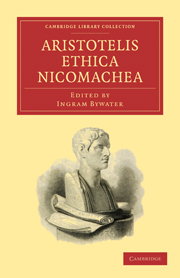
Ingram Bywater (1840–1914) first published his edition of Aristotle's Nicomachean Ethics in 1890. His reconstruction of the Greek text is based on a careful weighing of the Greek manuscript evidence, Latin translations, the witness of early commentators and his own thorough knowledge of Aristotle's language and style. Bywater's choice of readings introduced many important alterations to the text given in previous editions; his preference for manuscripts Kb and Lb and for the commentary of Aspasius, represented by Heylbut's edition (1889), explains many of these changes. Select readings of the most important witnesses are given in a critical apparatus. Bywater's edition has been widely used by scholars and students of the Greek text of Nicomachean Ethics and a number of important translations have been based on it. The edition's carefully compiled index of key Greek words, arranged according to usage, has proved an indispensable tool to generations of Greek students.
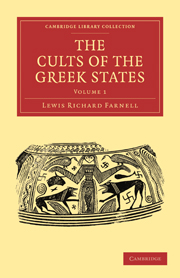
Lewis Richard Farnell's five-volume The Cults of the Greek States, first published between 1896 and 1909, disentangles classical Greek mythology and religion, since the latter had often been overlooked by nineteenth-century English scholars. Farnell describes the cults of the most significant Greek gods in order to establish their zones of influence, and outlines the personality, monuments, and ideal types associated with each deity. He also resolutely avoids the question of divine origins and focuses instead on the culture surrounding each cult, a position which initially drew some criticism, but which allowed him more space to analyse the religious practices themselves. Written to facilitate a comparative approach to Greek gods, his work is still regularly cited today for its impressive collection of data about the worship of the most popular deities. Volume 1 covers the Aniconic age, the Iconic age, and the cults of Cronos, Zeus, Hera and Athena.
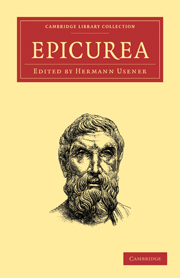
Hermann Karl Usener (1834–1905) published his monumental Epicurea in 1887. The volume is a collection of Epicurean texts and citations from a wide range of classical authors including Arrian, Cicero, Diodorus, Euripides, Plato and Seneca. The volume includes critical texts of Epicurus' most important letters: Letter to Menoeceus, Letter to Herodotus and Letter to Pythocles, preserved by the third-century compiler Diogenes Laertius. The letters give important summaries of Epicurus' philosophy. Usener's pioneering work represented the first attempt to deal critically with the manuscript traditions behind Epicurean texts. His reconstructions of the texts included in this volume are based on a thorough understanding of the trajectories of textual transmission. Each text is supported by a detailed critical apparatus, and another apparatus records manuscript glosses and scholia. This work provided for the first time accurate and reliable texts for the critical study of Epicureanism.
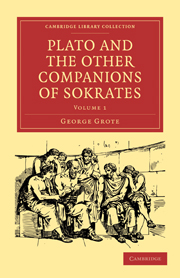
Best known for his influential History of Greece, the historian and politician George Grote (1794–1871) wrote this account of Plato's dialogues as a philosophical supplement to the History. First published in 1865 and written in dialogic form, Grote's account of Plato's works includes substantial footnotes and marginalia. This first volume focuses on Plato's early and transitional dialogues, all of which feature Socrates. It also includes a preface to the whole project which discusses the meaning and importance of philosophy itself, and extensive introductory material on pre-Socratic philosophy, the life of Plato and history of the Platonic canon. With three volumes each running to over six hundred pages, Grote's scholarship is formidably comprehensive. The publication of Plato and the Other Companions of Sokrates confirmed him as one of the greatest authorities on Plato in the nineteenth century.
Best known for his influential History of Greece, the historian and politician George Grote (1794–1871) wrote this account of Plato's dialogues as a philosophical supplement to the History. First published in 1865 and written in dialogic form, Grote's account of Plato's works includes substantial footnotes and marginalia. This second volume covers the transitional and middle dialogues including Gorgias and Symposium, as well as some of the later works. Grote includes apocryphal works, as he relied on the order and classification of Plato's works specified by the ancient Greek scholar Thrasyllus of Mendes. With three volumes each running to over six hundred pages, Grote's scholarship is formidably comprehensive. The publication of Plato and the Other Companions of Sokrates confirmed him as one of the greatest authorities on Plato in the nineteenth century.
Lewis Richard Farnell's five-volume The Cults of the Greek States, first published between 1896 and 1909, disentangles classical Greek mythology and religion, since the latter had often been overlooked by nineteenth-century English scholars. Farnell describes the cults of the most significant Greek gods in order to establish their zones of influence, and outlines the personality, monuments, and ideal types associated with each deity. He also resolutely avoids the question of divine origins and focuses instead on the culture surrounding each cult, a position which initially drew some criticism, but which allowed him more space to analyse the religious practices themselves. Written to facilitate a comparative approach to Greek gods, his work is still regularly cited today for its impressive collection of data about the worship of the most popular deities. Volume 4 focuses on the cults of Poseidon and Apollo.
In Aristotle's teleological view of the world, natural things come to be and are present for the sake of some function or end (for example, wings are present in birds for the sake of flying). Whereas much of recent scholarship has focused on uncovering the (meta-)physical underpinnings of Aristotle's teleology and its contrasts with his notions of chance and necessity, this book examines Aristotle's use of the theory of natural teleology in producing explanations of natural phenomena. Close analyses of Aristotle's natural treatises and his Posterior Analytics show what methods are used for the discovery of functions or ends that figure in teleological explanations, how these explanations are structured, and how well they work in making sense of phenomena. The book will be valuable for all who are interested in Aristotle's natural science, his philosophy of science, and his biology.
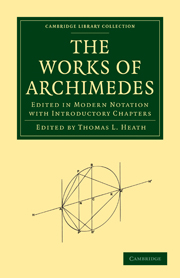
Archimedes lived in the third century BC, and died in the siege of Syracuse. Together with Euclid and Apollonius, he was one of the three great mathematicians of the ancient world, credited with astonishing breadth of thought and brilliance of insight. His practical inventions included the water-screw for irrigation, catapults and grappling devices for military defence on land and sea, compound pulley systems for moving large masses, and a model for explaining solar eclipses. According to Plutarch however, Archimedes viewed his mechanical inventions merely as 'diversions of geometry at play'. His principal focus lay in mathematics, where his achievements in geometry, arithmetic and mechanics included work on spheres, cylinders and floating objects. This classic 1897 text celebrates Archimedes' achievements. Part 1 places Archimedes in his historical context and presents his mathematical methods and discoveries, while Part 2 contains translations of his complete known writings.
Dr Brandwood's book presents a factual and critical account of the more important of the various attempts that have been made to establish the order of composition of Plato's dialogues by analysing his diction and prose style. Plato's literary activity covered fifty years and there is almost no direct evidence, either external or internal, to help in establishing the relative order of his writings. Until the middle of the nineteenth century people were dependent on personal interpretation of the probable line of development of Plato's thought and doctrines, but then a less subjective method was discovered, which relied instead on the observation of changes in Plato's prose style. Dr Brandwood examines the investigations of each scholar individually, checking the correctness of the methodology and the accuracy of the statistics, before arriving at fairly definite conclusions of his own, at least as far as the works of Plato's middle and old age are concerned.
Edward Meredith Cope (1818–1873) was an English scholar of classics who served as Fellow and Tutor at Trinity College, Cambridge. One of the leading Greek specialists of his time, Cope published An Introduction to Aristotle's Rhetoric in 1867. Though now considered a 'standard work', that Introduction was intended as merely the first part of a full critical edition of the Rhetoric, which was left incomplete on Cope's death in 1873. Cope's manuscripts were collected and edited by John Edwin Sandys, and published in this three-volume set in 1877. Cope's analysis represented an important advance in the modern interpretation of this foundational text on the art of persuasion. Volume 2 contains the Greek text of Book 2 together with a commentary on Aristotle's views concerning the place of emotion and logic within the discipline.
James Gow's A Short History of Greek Mathematics (1884) provided the first full account of the subject available in English, and it today remains a clear and thorough guide to early arithmetic and geometry. Beginning with the origins of the numerical system and proceeding through the theorems of Pythagoras, Euclid, Archimedes and many others, the Short History offers in-depth analysis and useful translations of individual texts as well as a broad historical overview of the development of mathematics. Parts I and II concern Greek arithmetic, including the origin of alphabetic numerals and the nomenclature for operations; Part III constitutes a complete history of Greek geometry, from its earliest precursors in Egypt and Babylon through to the innovations of the Ionic, Sophistic, and Academic schools and their followers. Particular attention is given to Pythagorus, Euclid, Archimedes, and Ptolemy, but a host of lesser-known thinkers receive deserved attention as well.
W. W. Buckland's highly regarded magisterial work of 1908 is a scholarly and thorough description of the principles of the Roman law with regard to slavery. Chapters systematically address, in Buckland's words, 'the most characteristic part of the most characteristic intellectual product of Rome'. In minute detail, Buckland surveys slaves and the complexity of the position of the slave in Roman law, describing how slaves are treated both as animals and as free men. He begins by outlining the definition of 'slave', their characteristics and conditions, giving examples of particular cases and describing for the reader the sorts of work a Roman slave might do. Carefully and comprehensively referenced throughout, this is a general survey of an important aspect of Roman law by a renowned Cambridge academic, which retains its status as an enduring classic.
Published in Cambridge in 1864, H. A. J. Munro's two-volume critical edition of the Roman poet Lucretius' De Rerum Natura ('On the Nature of the Universe'), represents one of the finest contributions to classical scholarship of the nineteenth century. Lucretius' didactic poem, written in hexameters, is divided into six books and explains Epicurean cosmology. Munro's edition was conceived in response to that of the German philologist Karl Lachmann, who had published an edition of Lucretius in 1850. Munro began working on Lucretius in 1849 at which time he collated a range of manuscripts from European libraries. His first edition of the poem appeared in 1860. This revised edition followed in 1864 complete with an introduction, translation, and commentary. The first volume contains all six books of Lucretius' poem in Latin with an English translation.
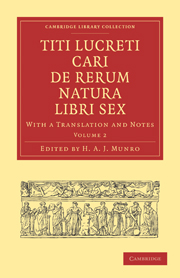
Published in Cambridge in 1864, H. A. J. Munro's two-volume critical edition of the Roman poet Lucretius' De Rerum Natura ('On the Nature of the Universe'), represents one of the finest contributions to classical scholarship of the nineteenth century. Lucretius' didactic poem, written in hexameters, is divided into six books and explains Epicurean cosmology. Munro's edition was conceived in response to that of the German philologist Karl Lachmann, who had published an edition of Lucretius in 1850. Munro began working on Lucretius in 1849 at which time he collated a range of manuscripts from European libraries. His first edition of the poem appeared in 1860. This revised edition followed in 1864 complete with an introduction, translation, and commentary. Volume 2 contains Munro's explanatory notes and the index.
This chapter investigates Aristotle's application of his theory of natural teleology in the actual explanations he provides in the biological treatises. My discussion draws mainly on the heuristics and explanations Aristotle displays in De Partibus Animalium II–IV, but I complement this account where appropriate or necessary with examples from the other biological treatises.
I shall first, in section 4.1, provide some introductory remarks about the organization of De Partibus Animalium books II–IV and Aristotle's basic heuristic strategies for the formulation of predominantly teleological explanations. In section 4.2, I turn to those cases in books II–IV where Aristotle's usual heuristic strategies prove insufficient and where he engages in a series of inferences building upon the postulation of a teleological principle, such as “nature does nothing in vain,” before or while formulating the actual explanation. I argue that these principles are part of Aristotle's method of discovery and that they function predominantly as heuristic tools for the identification of causally relevant features when these are not immediately discernible. Note that I am not making the claim here that Aristotle's entire theory of natural teleology serves a heuristic function; instead I suggest that his use of teleological principles is best characterized as serving such a function. I take it that the (final) causes these principles help discover are all non-eliminable features of the biological world, which are realized through the goal-directed actions of the formal natures of animals.
The Physica forms Aristotle's most fundamental treatise in his studies of natural science. In this treatise, Aristotle investigates the principles and causes of all things that have a nature – that is, of all things that have an internal principle of change and rest – with the purpose of generating knowledge of natural phenomena (Ph I.1, 184a10–16). In the course of doing so, Aristotle defines a large number of key notions of his natural philosophy, such as motion and change, space and time, matter and form, causal explanation, luck and spontaneity, teleology and necessity. The conceptual apparatus and framework laid out in the Physica are consequently applied and reshaped for the inquiries into the more specific and more complex segments of the natural world, written down in Aristotle's other natural treatises.
Final causes and natural teleology figure especially prominently in the second book of the Physica, where Aristotle defines his concept of nature, introduces his theory of four types of cause or causal explanation, and discusses the kinds of cause operative in art and nature. In this chapter, I shall focus on Aristotle's first argument in defense of natural teleology against his materialist predecessors (in Ph II.8, 198b16–199a8), which raises an important aporia about the role of teleology, necessity, and chance in the proper explanation of natural phenomena. The main purpose of this chapter is to provide an interpretation of this argument, which will build upon a distinction I draw between primary and secondary types of teleology.
Why do organisms reproduce? Why do birds have wings? Why do neither snakes nor stars have feet? And why do most of the hoofed life-bearing animals have horns (but not all of them)?
For Aristotle, questions such as these go to the heart of natural philosophy, which is the study of the coming to be and presence of beings that have their own internal principle of change and rest. Throughout his lifetime, Aristotle was deeply committed to investigating and explaining natural phenomena, which is reflected all through the surviving treatises on natural philosophy. Among these, Aristotle's Physica is most fundamental. In this treatise, Aristotle lays out the general theoretical framework for his natural philosophy, defining notions such as nature, motion, causation, place, and time. In the other treatises, Aristotle explores more specific problems related to the study of natural beings, such as coming to be and passing away (in De Generatione et Corruptione), the nature and motion of the elements (in De Generatione et Corruptione and the second part of the De Caelo), the motions and features of the heavenly bodies (in the first part of the De Caelo), atmospheric causes and changes (in the Meteorologica), the notion of soul and its dependence on natural bodies (in De Anima), and finally, the causes of the coming to be and presence of living beings and of their parts and motions (in the biological works).