To save content items to your account,
please confirm that you agree to abide by our usage policies.
If this is the first time you use this feature, you will be asked to authorise Cambridge Core to connect with your account.
Find out more about saving content to .
To save content items to your Kindle, first ensure no-reply@cambridge.org
is added to your Approved Personal Document E-mail List under your Personal Document Settings
on the Manage Your Content and Devices page of your Amazon account. Then enter the ‘name’ part
of your Kindle email address below.
Find out more about saving to your Kindle.
Note you can select to save to either the @free.kindle.com or @kindle.com variations.
‘@free.kindle.com’ emails are free but can only be saved to your device when it is connected to wi-fi.
‘@kindle.com’ emails can be delivered even when you are not connected to wi-fi, but note that service fees apply.
Let us discuss poetry in general and its species. We must discuss what each species of poetry can do, how plots should be put together to produce a fine piece of work, the number and nature of the component parts and everything else that belongs to the same field of enquiry. Let us begin in the natural way, with first principles.
Epic, tragedy, comedy, dithyramb and most music for the pipe or the lyre are all, in general, types of imitation. They differ from each other in three ways: in the media used, in the objects of imitation, and in the mode or manner of imitation. Some people use colours and shapes to make imitative likenesses of various things (some achieve this through art, others through practice), while others use the voice as the medium of imitation. Similarly all the arts I have mentioned use rhythm, words and melody as the media of imitation, either separately or together. For example, music for the pipe or the lyre and any other arts that can produce the same effect, such as music for pan-pipes, use only melody and rhythm, while dancing uses rhythm by itself, without melody, for dancers imitate characters, emotions and actions by the rhythm of their movements. To date there is no general name for the arts which use only unaccompanied words or just words and metre, whether a mixture of metres or one particular type of metre.
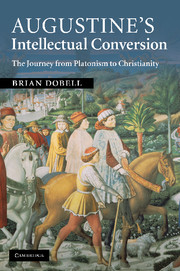
This book examines Augustine's intellectual conversion from Platonism to Christianity, as described at Confessions 7.9.13–21.27. It is widely assumed that this occurred in the summer of 386, shortly before Augustine's volitional conversion in the garden at Milan. Brian Dobell argues, however, that Augustine's intellectual conversion did not occur until the mid-390s, and develops this claim by comparing Confessions 7.9.13–21.27 with a number of important passages and themes from Augustine's early writings. He thus invites the reader to consider anew the problem of Augustine's conversion in 386: was it to Platonism or Christianity? His original and important study will be of interest to a wide range of readers in the history of philosophy and the history of theology.
Although a great deal has been written on Plato's ethics, his cosmology has not received so much attention in recent times and its importance for his ethical thought has remained underexplored. By offering accounts of Timaeus, Philebus, Politicus and Laws X, the book reveals a strongly symbiotic relation between the cosmic and human sphere. It is argued that in his late period Plato presents a picture of an organic universe, endowed with structure and intrinsic value, which both urges our respect and calls for our responsible intervention. Humans are thus seen as citizens of a university that can provide a context for their flourishing even in the absence of good political institutions. The book sheds light on many intricate metaphysical issues in late Plato and brings out the close connections between his cosmology and the development of his ethics.
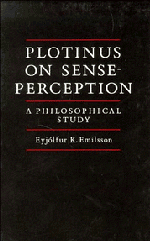
This book is a philosophical analysis of Plotinus' views on sense-perception. It aims to show how his thoughts were both original and a development of the ideas of his predecessors, in particular those of Plato, Aristotle and the Peripatetics. Special attention is paid to Plotinus' dualism with respect to soul and body and its implications for his views on the senses. The author combines a historical approach to his subject, setting Plotinus' thought in the context of thinkers who preceded and succeeded him, with a proper analysis of his ideas and, where appropriate, of those from which they derived.
I don't know what effect my accusers have had on you, Athenians, but they were speaking so persuasively that I myself almost forgot who I am. And yet they said virtually nothing that's true.
(Plato, Apology 17a1–4)
At the 2001 Sixth Annual Arizona Colloquium in Ancient Philosophy, in a prefatory remark before commencing with the reading of his paper, Charles Kahn announced that he thinks that scholars everywhere should simply give up talking about “the philosophy of Socrates.” These are the accusations as we understand them: “Socratic studies invents a bogus philosopher by the name of Socrates and it does so by means that are completely at odds with proper historical or hermeneutical technique. In doing so, Socratic studies corrupts the minds of students and scholars.” On the basis of such accusations, Kahn and other critics of Socratic studies would condemn to death the research program to which many scholars, including us, have devoted their work for many years.
In this book we propose to offer a new interpretation of a central aspect of the philosophy of Socrates. This project, plainly, presumes that there is something to which “the philosophy of Socrates” refers. If recent critics are correct, however, our project is groundless and ill-conceived from the start; there is no “Socratic philosophy,” no “Socratic moral psychology,” no “Socratic motivational intellectualism” to interpret, either in novel or standard ways.
In the Gorgias, we find an encounter between Socrates and Polus, a young follower of the sophist, Gorgias. Polus is impressed with rhetoric because he thinks a person skilled in rhetoric will be able to do whatever he wants – even to the point of becoming a tyrant who can kill off his enemies, or exile them, at will. But Socrates remains unimpressed, for although he allows that tyrants may do such things, thinking they are best, he points out that what we think is best for us is not necessarily what is really best for us. What we want, however, is what is really best for us.
SOCRATES: Now didn't we agree that we want, not those things that we do for the sake of something, but that thing for the sake of which we do them?
POLUS: Yes, very much so.
SOCRATES: Hence, we don't simply want to slaughter people, or exile them from their cities and confiscate their property as such: we want to do these things if they are beneficial, but if they're harmful we don't. For we want the things that are good, as you agree, and we don't want those that are neither good nor bad, nor those that are bad.
(468b8–c7)
Socrates' view on this issue is certainly not supported by ordinary talk about the connection between desire and action (in English or in ancient Greek), which is probably one reason why Polus seems to remain suspicious of Socrates' conclusions, even as he finds himself agreeing at each step in the arguments that lead to them.
Contrasting Socratic with Platonic moral psychology
At the very beginning of this book, we defended distinguishing the Platonic Socrates of the so-called “early” or “Socratic” dialogues from the Socrates who speaks in what are called the “middle” dialogues. Developmentalists, generally, understand the “Socrates” of the middle dialogues to speak for Plato, whereas they take the “Socrates” of the early period either to present an earlier version of Plato's views, or to be Plato's more or less accurate representation of the historical Socrates (or both). This book provides further evidence for developmentalism – which, for the sake of convenience, we have characterized as making a distinction between Socrates and Plato, although, as we said earlier, we are not actually committed to the view that the “Socrates” of whom we speak is the historical philosopher by that name. But the evidence we have provided for the distinction remains somewhat unclear, especially because in one very important respect we have actually made the distinction we claim to be supporting somewhat more subtle and less vivid than it is in the standard accounts of Socratic moral psychology we have criticized. In standard accounts, recall, Socrates recognized no place at all in explanations of voluntary human behavior for appetites and passions. The only factors that play any role, in that view, are the desire – one shared equally by all people, good and bad – for our own benefit, and the cognitive states by which one judges courses of action as beneficial, detrimental, or neutral.
Installing beliefs, or inculcating the right habits?
In the last three chapters, we noted several passages in Plato's early or Socratic dialogues in which Socrates assigns an explanatory role to appetites and passions, and several others in which he proposes ways to manage these psychic forces properly. Such passages call for a complete re-evaluation of Socrates' moral psychology, we have argued, by which Socrates' intellectualism can be explained in such a way as to maintain some explanatory role for the appetites and passions.
In this chapter, we propose to extend our reconstruction of Socrates' moral psychology by focusing on what it means for Socratic education. We begin with a review of how the traditional account of Socratic intellectualism is committed to viewing Socrates' conception of education strictly in terms of changes in belief, whether by inculcating the right beliefs in early education, or by forcing a re-evaluation of one's beliefs in the light of inconsistencies revealed by Socratic examination. We argue, on the contrary, that a complete account of Socratic education must also recognize a role for the proper management of appetites and passions, and we explicate how Socrates would understand that role. We go on to sketch what the more complete Socratic education would be like, in regard to the appetites and passions. The upshot of our study, we claim, is a new and more adequate picture of Socrates' conception of education.
At Apology 30c7–e1, Socrates cautions his jurors about the risk they face. The risk Socrates himself faces is obvious but, as he explains it, the danger he faces is far less grave than the one the jurors may inflict upon themselves:
Rest assured that if you kill me – since I am the person I say I am – you wouldn't harm me more than you harm yourselves. Neither Meletus nor Anytus could do anything to harm me; it isn't even possible. For I don't think it's divinely sanctioned for a better man to be harmed by a worse. Doubtless, he could kill me, or send me into exile, or take away my rights, and doubtless he and others also think these things are great evils. But I don't. In fact, I think that what he's doing now – trying to kill a man unjustly – is a much greater evil. Athenians, at this point I'm far from making this defense on my behalf, as one might think, but instead I'm making it on yours, so that by condemning me you don't make a terrible mistake regarding the gift the god has given you.
Now, the claim that trying to kill a man unjustly is a greater evil than being killed unjustly may seem simply obvious from a moral point of view.
Of the many paradoxical positions attributed to Socrates in Plato's early dialogues, two are perhaps most closely associated with the philosopher. The first is the “prudential paradox,” which states that no one ever acts contrary to his knowledge of what is best for him or even contrary to a concurrently held all-things-considered belief about what is best for him, and the second is the “moral paradox,” according to which no one voluntarily does what is unjust. Seeing why Socrates would have held these positions in spite of their obvious conflict with common sense will allow us to understand better a number of issues at the heart of the ethical epistemology and psychology we find in Plato's early dialogues and to deepen our understanding of that philosophy. Because the moral paradox depends crucially on the prudential, we shall focus in this chapter on the prudential paradox, and will turn to the moral paradox in the next chapter.
The prudential paradox
The best-known attribution of the prudential paradox to Socrates outside the pages of Plato can be found in Aristotle's Nicomachean Ethics:
Some say that if he has knowledge of how to act rightly, he cannot be akratic; for, as Socrates thought, it would be strange for a man to have knowledge and yet allow something else to rule him and drag him about like a slave. For Socrates was entirely opposed to this view and held that there is no such thing as akrasia; for he thought that no one with the right belief does what is contrary to the best, but if a man does so, it is through ignorance.[…]
As we said in the Preface to this book, references to Socrates' “intellectualism” may either refer to his intellectualism about the nature of virtue or to his intellectualism about human motivation. The two forms of intellectualism are, indeed, connected in Socratic philosophy, though as we have now shown, scholars have not interpreted the motivational side of this connection correctly. In this chapter, we will consider how our new interpretation of Socrates' motivational intellectualism is related to his virtue intellectualism.
Any attempt to clarify Socrates' motivational and virtue intellectualism must at some point come to terms with his position regarding Socrates' well-known claim that all virtue is really nothing but a kind of knowledge – knowledge of good and evil. And, because it is the same knowledge that constitutes each of the several virtues, in some sense all of the virtues turn out to be the same. This is Socrates' famous view of the “unity of the virtues,” which will be the main focus of the first part of this chapter. Our conclusions regarding the sense in which the virtues are the same and the sense in which they are distinguishable has not changed appreciably since we first advanced it in 1994. We believe that the discussion is worth revisiting here because in the intervening years a number of important studies have appeared that make far clearer than we did exactly what challenges a successful account of the unity of the virtues must meet.
Disputes about the place of the Gorgias within Socratic and Platonic philosophy
One of the dialogues we identified as included within the “relevant dialogues” group is the Gorgias. But, as we indicated in the Preface, one very important passage in the Gorgias has been recently challenged as “un-Socratic” on other grounds, and if this challenge cannot be dissolved, then we may not use this passage as evidence for our interpretation of Socratic moral psychology. Contrary to the claims of most other scholars recently, however, we believe the passage is, in fact, entirely consistent with what Socrates says elsewhere on the topic of moral psychology, and we hope our many references to this passage elsewhere in this book make a sufficient case for this claim. But in order to complete our case for using the Gorgias as extensively as we do, we must also defend the passage – in which Socrates tells Callicles a myth of the afterlife – as entirely compatible with Socratic philosophy in other ways.
In the Gorgias, Polus and then Callicles recommend rhetoric to Socrates on the ground that, without skill in persuasive speech, Socrates will be at the mercy of anyone who might wish to drag him into court and have him put to death. At the end of the dialogue, however, Socrates turns the tables on Callicles by telling him a “very fine account” (mala kala logos, 523a1) of why the worst thing that can happen to one is to arrive in Hades with a soul filled with wrongdoings (522e3–4), which will leave him dizzy and speechless when he is put on trial before the judges in the afterlife (526e4–527a4).
The term “Socratic intellectualism” has come commonly to be used to describe either of two somewhat related features of Socratic philosophy, which may be called “virtue intellectualism” and “motivational intellectualism.” Socrates is generally, though perhaps not universally, regarded as a virtue intellectualist because he believed that all virtue is in some sense constituted by a certain kind of knowledge. In this respect, Socrates differs from Plato and Aristotle, who recognized aspects to virtue that were non-cognitive, such as having one's appetites or passions in the proper order. Socrates is generally, though, again, perhaps not universally, regarded as a motivational intellectualist because he believed that all human actions are in some way directly or immediately the result of what those acting think is best for them. Socrates' moral psychology is “intellectualist” because he is committed to the view that every ethical failure involves some cognitive failure, for each ethical failure is the direct product of some false belief about what is good for the agent of the failure.
In most of this book we use “Socratic intellectualism” to refer to motivational intellectualism. Although we take up virtue intellectualism in the penultimate chapter, our primary goal is to articulate and defend a more or less new conception of Socratic motivational intellectualism. We can only say that it is “more or less new” because we are not the first to present an alternative to what had been the received view.