To save content items to your account,
please confirm that you agree to abide by our usage policies.
If this is the first time you use this feature, you will be asked to authorise Cambridge Core to connect with your account.
Find out more about saving content to .
To save content items to your Kindle, first ensure no-reply@cambridge.org
is added to your Approved Personal Document E-mail List under your Personal Document Settings
on the Manage Your Content and Devices page of your Amazon account. Then enter the ‘name’ part
of your Kindle email address below.
Find out more about saving to your Kindle.
Note you can select to save to either the @free.kindle.com or @kindle.com variations.
‘@free.kindle.com’ emails are free but can only be saved to your device when it is connected to wi-fi.
‘@kindle.com’ emails can be delivered even when you are not connected to wi-fi, but note that service fees apply.
Some time early in the first century, Philo and Antiochus, the two leading philosophers of the Athenian Academy, had a serious philosophical falling out. Philo advocated an externalist epistemology, holding that it was reasonable to suppose that things could be known, even though they could not, individually, be known to be known; Antiochus responded that the only way one could know that one knew anything was by knowing of some particular thing that one knew it; and thus (according to Cicero: Acad. 2.44, 111) strayed perilously close to Stoic dogmatism. Neither option appealed to their colleague Aenesidemus:
The Academics, particularly those of today, sometimes adopt Stoic doctrines, and are, in truth, really Stoics quarrelling with Stoics. And they are dogmatic about many things; for they introduce virtue and vice, and posit good and bad, truth and falsity, persuasive and unpersuasive, existent and non-existent; and they firmly distinguish many other things as well; and, he [sc. Aenesidemus[ says, it is only in regard to the cataleptic impression that they differ from them [sc. the Stoics[.
(1: Photius, Bibl. 170a14-22 = 71C(9) LS)
Our knowledge of Aenesidemus is sadly restricted. For his views, we are indebted principally to a précis of his Pyrrhonian Discourses from Photius of Byzantium’s library catalogue (from which 1 above is excerpted). As for direct references, Sextus refers to him by name some fifteen times (but some of these are problematic: see below, section IV), Diogenes a few times more; and that’s about it.
The Pyrrhonian Modes are argument schemata for general use against dogmatism. We have records of two main lists of Modes, the Ten and the Five, which were used at various times in the history of ancient scepticism, either independently or in some sort of systematic connection. These Modes use strategies with ancient roots in such thinkers as Protagoras, Democritus, Plato, and Aristotle, but users of the Modes were not committed to positions held by those thinkers. They were compiled long after Pyrrho (the Ten probably by Aenesidemus and the Five by a shadowy figure named Agrippa) during the first phase of the Pyrrhonian revival. In addition, we have a list of eight causal Modes attributed to Aenesidemus.
The second and final phase of Pyrrhonism occupies most of the works of Sextus Empiricus (apart from Against the Ethicists, M 11). Although he has different strategies from Aenesidemus, he lays out the Ten Modes in some detail and makes extensive use of the Five. His account of the Ten is sometimes at odds with his general practice, and this is most likely due to his use of sources from the first phase of the revival.
Besides Sextus (PH 1.36–163), we have two main sources for the Ten Modes: Diogenes Laertius (9.78–88) and Philo of Alexandria (On Drunkenness 169–202), both of whom seem to have a source independent of Sextus. Diogenes is just reporting what he knows, whereas Philo appropriates eight of the Modes for his own purpose and leaves out the other two (the Third and Ninth in the list according to Sextus). Brief mentions by Aristocles and Herrenius do not add to our understanding.
This book is a continuation of The Heads of Religious Houses: England and Wales 940–1216, edited by David Knowles, C. N. L. Brooke and Vera London, which itself is reissued with substantial addenda by Professor Brooke. This present volume continues the lists from 1216 to 1377. In this period further record sources have been provided by episcopal registers, governmental enrolments, court records, and so on. Full references are given for establishing the dates and outline of the career of each abbot or prior, abbess or prioress, when known. The lists are arranged by order: the Benedictine houses (independent, dependencies and alien priories); the Cluniacs; the Grandmontines; the Cistercians; the Carthusians; the Augustinian canons; the Premonstratensians; the Gilbertine order; the Trinitarian houses; the Bonhommes; and the nuns. An introduction discusses the nature, use and history of the lists and examines critically the sources on which they are based.
Pyrrho’s (365/60-275/70 BC) name has carried great weight in the history of philosophy ever since it was attached to one of the two main branches of ancient scepticism. Traditionally, Pyrrho’s own philosophy has been interpreted as the early version of the more sophisticated philosophy recorded by Aenesidemus and preserved in the writings of Sextus Empiricus. This traditional view is not, however, unchallenged, and in recent years alternative interpretations have been offered that suggest a dogmatic Pyrrho, whose position would be incompatible with that of later Pyrrhonian sceptics, although having enough in common with it to serve as its distant historical source.
To what extent is the appropriation of Pyrrho by the later sceptics legitimate? It is important for an appraisal of Pyrrho’s place in the history of scepticism to ascertain which insights, if any, were common to Pyrrho and the later Pyrrhonists. But the contours of Pyrrho’s philosophy are blurred; the evidence is scant and subject to conflicting interpretations. Perhaps the situation was not a great deal better in the first century BC, when Aenesidemus introduced Pyrrhonism as radical scepticism, as opposed to the mitigated scepticism of the Academy, or in the late second century AD, when Sextus was at work. Their references to Pyrrho are cautious and hardly exegetical. Later accounts often emphasise his admirable state of mind, variously called indifference (adiaphoria), impassivity (apatheia), and tranquility (ataraxia). Sextus claims to call his scepticism “Pyrrhonian” “from the fact that Pyrrho appears to us to have attached himself to scepticism more vigorously and conspicuously than anyone before him” (PH 1.7).
Sextus Empiricus, the best known to us of the Pyrrhonian sceptics and the only one whose works have survived substantially intact, was, as his name indicates, a member of the Empirical school of medicine. Other evidence also points to a close and long-sustained relation between medical Empiricism and Pyrrhonian scepticism. Diogenes Laertius' list of Pyrrhonists includes at least three Empiricists apart from Sextus himself: Menodotus, Theodas, and Sextus' student, Saturninus (9.115-16). Some of the others may also have been Empiricists, and there are figures not included on DL’s list who seem to have been members of both schools.
In his Outline of Empiricism (Subfiguratio empirica), where he adopts the point of view of an Empiricist (Deichgräber [20[ 43, 20- 22), Galen maintains that the Empiricist is to medicine as the Pyrrhonist is to the whole of life (82, 28 et seq.), and he criticizes Menodotus harshly for failing to live up to the ideal represented by Pyrrho, whom he (Menodotus himself) had held up to his fellow Empiricists as a model (84, 13 et seq.). Sextus mentions empirical forms of the arts with approval: grammar (M 1.49-53, 61); astronomy, navigation, and farming (M 5.1-2). He wrote a work on Empirical medicine (M 1.61), which is not extant, and his surviving works contain many expressions of sympathy for the Empiricists and their ideas (PH 2.246, 254; M 5.104; M 8.191, 288, 291).
When I first wrote a paper about the difference between Academic and Pyrrhonist Sceptics a long time ago, I was less interested in the differences than in the commonalities. My point was to get away from the Humean distinction between moderate Academics and radical Pyrrhonists. I argued that both were radicals - not, as they came to be seen in early modern times, dogmatists who denied the possibility of knowledge more or less generally, but in the ancient sense of having no philosophical doctrines. They used the same method of arguing for and against any given thesis or belief, declaring the debate undecided, and suspending judgement. The “mitigated” sceptic, who believes that nothing can be known though one may have more or less well-founded opinions, was a figure invented by Carneades in order to refute the dogmatists' objection that suspension of judgement on all matters will make life impossible. Ironically, this figure later became the model of modern versions of scepticism.
Up to this point I still think I was right - at least as far as the early sceptical Academics Arcesilaus and Carneades were concerned. Arcesilaus argued that, given their conception of knowledge and wisdom, the Stoics themselves ought to suspend judgement on all matters. Carneades offered an alternative epistemology to counterbalance the impressive Stoic theory. But these philosophers did not maintain that they were right and the Stoics wrong, or that one should accept their own proposal. The only salient difference that seemed to me to be left between those Academics and their Pyrrhonist successors was the curious claim of the Pyrrhonists that their so-called “way of life” would lead to the goal that other Hellenistic schools were also endorsing – tranquility.
If the sceptic holds nothing to be true, his dogmatic opponent argues, he is not able to act. This is the core of the famous Apraxia challenge, arguably the best known anti-sceptical argument in antiquity. Several versions of this argument figure in ancient scepticism. At least for the most part, these arguments rely on core assumptions of Stoic epistemology and theory of action: that we have impressions (phantasiai), some of which are practical, i.e. prescribe an action as to be done, and that we either assent to our impressions or not. In assenting to an impression, we hold something to be true. For fools (i.e. almost everyone), this amounts to having an opinion. For the wise person, every instance of holding something to be true is a piece of knowledge. In the case of practical impressions, assent (sunkatathesis) is further identified with impulse (hormê). If there are no external impediments, impulse sets off action.
The sceptic’s explanation of his actions most importantly consists in his response to the Apraxia challenge, and more particularly, in his critical engagement with the Stoic claim that, in action, we assent and thus hold something to be true. Our interpretation of his response to the Apraxia challenge, however, relates to a broader framework of questions. First, how closely does the sceptic’s life resemble ordinary life? Are the sceptic’s actions, in the end, like everybody’s actions? Secondly, does the sceptic consider his way of life as an attempt at living well? Is suspension of judgement, perhaps, a safer road to happiness than adherence to a (potentially false) philosophical account of what is good and bad?
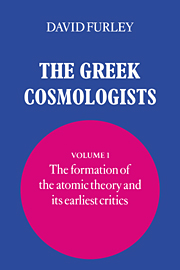
This first volume takes the story from its beginnings in Ionian philosophy as far as the formation of the Atomic Theory and the first criticisms of it by Plato and Aristotle. The second volume will describe the cosmology of Plato and Aristotle, the attempt by Epicurean opponents to revive Atomism and later developments of the debate in classical philosophy and science up to the sixth century of our era. Both are accessible to anyone interested in the history of science and philosophy, even if they have no specialized knowledge of Greek philosophy and no Greek; but professional scholars too will find much of importance to them.
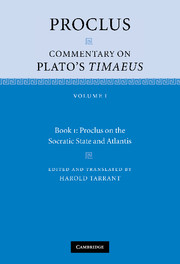
Proclus' Commentary on Plato's dialogue Timaeus is arguably the most important commentary on a text of Plato, offering unparalleled insights into eight centuries of Platonic interpretation. This edition offers the first new English translation of the work for nearly two centuries, building on significant recent advances in scholarship on Neoplatonic commentators. It provides an invaluable record of early interpretations of Plato's dialogue, while also presenting Proclus' own views on the meaning and significance of Platonic philosophy. The present volume, the first in the edition, deals with what may be seen as the prefatory material of the Timaeus. In it Socrates gives a summary of the political arrangements favoured in the Republic, and Critias tells the story of how news of the defeat of Atlantis by ancient Athens had been brought back to Greece from Egypt by the poet and politician Solon.
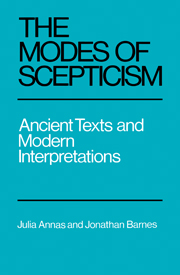
The Modes of Scepticism is one of the most important and influential of all ancient philosophical texts. The texts made an enormous impact on Western thought when they were rediscovered in the 16th century and they have shaped the whole future course of Western philosophy. Despite their importance, the Modes have been little discussed in recent times. This book translates the texts and supplies them with a discursive commentary, concentrating on philosophical issues but also including historical material. The book will be of interest to professional scholars and philosophers but its clear and non-technical style makes it intelligible to beginners and the interested layman.
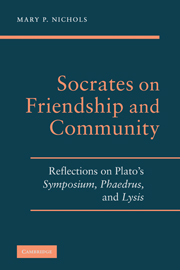
In Socrates on Friendship and Community, Mary P. Nichols addresses Kierkegaard's and Nietzsche's criticism of Socrates and recovers the place of friendship and community in Socratic philosophizing. This approach stands in contrast to the modern philosophical tradition, in which Plato's Socrates has been viewed as an alienating influence on Western thought and life. Nichols' rich analysis of both dramatic details and philosophic themes in Plato's Symposium, Phaedras, and Lysis shows how love finds its fulfilment in the reciprocal relation of friends. Nichols also shows how friends experience another as their own and themselves as belonging to another. Their experience, she argues, both sheds light on the nature of philosophy and serves as a standard for a political life that does justice to human freedom and community.
It has long been thought that the ancient Greeks did not take mechanics seriously as part of the workings of nature, and that therefore their natural philosophy was both primitive and marginal. In this book Sylvia Berryman challenges that assumption, arguing that the idea that the world works 'like a machine' can be found in ancient Greek thought, predating the early modern philosophy with which it is most closely associated. Her discussion ranges over topics including balancing and equilibrium, lifting water, sphere-making and models of the heavens, and ancient Greek pneumatic theory, with detailed analysis of thinkers such as Aristotle, Archimedes, and Hero of Alexandria. Her book shows scholars of ancient Greek philosophy why it is necessary to pay attention to mechanics, and shows historians of science why the differences between ancient and modern reactions to mechanics are not as great as was generally thought.
Aristotle's De Anima is the first systematic philosophical account of the soul, which serves to explain the functioning of all mortal living things. In his commentary, Ronald Polansky argues that the work is far more structured and systematic than previously supposed. He contends that Aristotle seeks a comprehensive understanding of the soul and its faculties. By closely tracing the unfolding of the many-layered argumentation and the way Aristotle fits his inquiry meticulously within his scheme of the sciences, Polansky answers questions relating to the general definition of soul and the treatment of each of the soul's principal capacities: nutrition, sense perception, phantasia, intellect, and locomotion. The commentary sheds light on every section of the De Anima and the work as a unit. It offers a challenge to earlier and current interpretations of the relevance and meaning of Aristotle's highly influential treatise.
This book is the first to offer a detailed analysis of Aristotelian and Kantian ethics together, in a way that remains faithful to the texts and responsive to debates in contemporary ethics. Recent moral philosophy has seen a revival of interest in the concept of virtue, and with it a reassessment of the role of virtue in the work of Aristotle and Kant. This book brings that re-assessment to a new level of sophistication. Nancy Sherman argues that Kant preserves a notion of virtue in his moral theory that bears recognisable traces of the Aristotelian and Stoic traditions, and that his complex anthropology of morals brings him into surprising alliance with Aristotle. She develops her argument through close readings of major texts by both Aristotle and Kant, illustrating points of congruence and contrast.
How does Plato view his philosophical antecedents? Plato and his Predecessors considers how Plato represents his philosophical predecessors in a late quartet of dialogues: the Theaetetus, the Sophist, the Politicus and the Philebus. Why is it that the sophist Protagoras, or the monist Parmenides, or the advocate of flux, Heraclitus, are so important in these dialogues? And why are they represented as such shadowy figures, barely present at their own refutations? The explanation, the author argues, is a complex one involving both the reflective relation between Plato's dramatic technique and his philosophical purposes, and the very nature of his late philosophical views. For in these encounters with his predecessors we see Plato develop a new account of the principles of reason, against those who would deny them, and forge a fresh view of the best life - the life of the philosopher.