To save content items to your account,
please confirm that you agree to abide by our usage policies.
If this is the first time you use this feature, you will be asked to authorise Cambridge Core to connect with your account.
Find out more about saving content to .
To save content items to your Kindle, first ensure no-reply@cambridge.org
is added to your Approved Personal Document E-mail List under your Personal Document Settings
on the Manage Your Content and Devices page of your Amazon account. Then enter the ‘name’ part
of your Kindle email address below.
Find out more about saving to your Kindle.
Note you can select to save to either the @free.kindle.com or @kindle.com variations.
‘@free.kindle.com’ emails are free but can only be saved to your device when it is connected to wi-fi.
‘@kindle.com’ emails can be delivered even when you are not connected to wi-fi, but note that service fees apply.
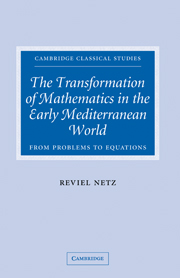
The transformation of mathematics from ancient Greece to the medieval Arab-speaking world is here approached by focusing on a single problem proposed by Archimedes and the many solutions offered. In this trajectory Reviel Netz follows the change in the task from solving a geometrical problem to its expression as an equation, still formulated geometrically, and then on to an algebraic problem, now handled by procedures that are more like rules of manipulation. From a practice of mathematics based on the localized solution (and grounded in the polemical practices of early Greek science) we see a transition to a practice of mathematics based on the systematic approach (and grounded in the deuteronomic practices of Late Antiquity and the Middle Ages). With three chapters ranging chronologically from Hellenistic mathematics, through late Antiquity, to the medieval world, Reviel Netz offers an alternate interpretation of the historical journey of pre-modern mathematics.
Can philosophy enable us to lead better lives through a systematic understanding of our human nature? John Cottingham's thought-provoking 1998 study examines the contrasting approaches to this problem found in three major phases of Western philosophy. Starting with the attempts of Plato, Aristotle and the Stoics and Epicureans to cope with the recalcitrant forces of the passions, he moves on to examine the fascinating and hitherto little-studied moral psychology of Descartes, and his effort to integrate the physical and emotional aspects of our humanity into a rational blueprint for fulfilment. He concludes by analysing the insights of modern psychoanalytic theory into the human predicament, arguing that philosophy neglects them at its peril if it hopes to come to terms with the complex relationship between reason and the emotions. Lucid in exposition and unusually wide-ranging in scope, Philosophy and the Good Life provides a challenging perspective on moral philosophy and psychology for students and specialists alike.
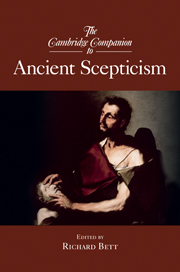
This volume offers a comprehensive survey of the main periods, schools, and individual proponents of scepticism in the ancient Greek and Roman world. The contributors examine the major developments chronologically and historically, ranging from the early antecedents of scepticism to the Pyrrhonist tradition. They address the central philosophical and interpretive problems surrounding the sceptics' ideas on subjects including belief, action, and ethics. Finally, they explore the effects which these forms of scepticism had beyond the ancient period, and the ways in which ancient scepticism differs from scepticism as it has been understood since Descartes. The volume will serve as an accessible and wide-ranging introduction to the subject for non-specialists, while also offering considerable depth and detail for more advanced readers.
This full-length study of Plato's dialogue Phaedrus, now in paperback, is written in the belief that such concerted scrutiny of a single dialogue is an important part of the project of understanding Plato so far as possible 'from the inside' - of gaining a feel for the man's philosophy. The focus of this account is on how the resources both of persuasive myth and of formal argument, for all that Plato sets them in strong contrast, nevertheless complement and reinforce each other in his philosophy. Not only is the dialogue in its formal structure a dovetail of myth and argument, but the philosophic life that it praises is also shaped by an acknowledgement of the limitations of argument and the importance of mythical understanding. By means of this correlation of form and content Plato invites his readers, through the very act of reading, to take a first step along the path of the philosophical life.
Julie K. Ward examines Aristotle's thought regarding how language informs our views of what is real. First she places Aristotle's theory in its historical and philosophical contexts in relation to Plato and Speusippus. Ward then explores Aristotle's theory of language as it is deployed in several works, including Ethics, Topics, Physics, and Metaphysics, so as to consider its relation to dialectical practice and scientific explanation as Aristotle conceived it.
Behind the superficial obscurity of what fragments we have of Heraclitus' thought, Professor Kahn claims that it is possible to detect a systematic view of human existence, a theory of language which sees ambiguity as a device for the expression of multiple meaning, and a vision of human life and death within the larger order of nature. The fragments are presented here in a readable order; translation and commentary aim to make accessible the power and originality of a systematic thinker and a great master of artistic prose. The commentary locates Heraclitus within the tradition of early Greek thought, but stresses the importance of his ideas for topical theories of language, literature and philosophy.
The problems which Christians faced in the second-century world, with its variety of religious beliefs, have a close relation to those which confront them today. The new religion was presented with a range of external threats and criticism which evoked a vigourous, fundamental and imaginative response. The arguments of this most creative period of Christian thought were of a more general and philosophical kind than the discussions of dogmatic issues in the fourth and fifth centuries, and are properly regarded as the beginning of Christian philosophy, though this does not of course imply the emergence of a 'system' or a uniformly philosophical level of writing. Professor Osborn's method in this book, derived from analytic philosophy, is to elucidate specific questions which occupied four major writers from different centres of early Christianity: Justin, Irenaeus, Tertullian and Clement of Alexandria. Is there one God and can one speak of him? Is man free and has he any link with God? Why has a good God made a world in which evil is so evident? Has history a meaning? Who is Jesus Christ?
Archimedes was the greatest scientist of antiquity and one of the greatest of all time. This book is Volume I of the first authoritative translation of his works into English. It is also the first publication of a major ancient Greek mathematician to include a critical edition of the diagrams and the first translation into English of Eutocius' ancient commentary on Archimedes. Furthermore, it is the first work to offer recent evidence based on the Archimedes Palimpsest, the major source for Archimedes, lost between 1915 and 1998. A commentary on the translated text studies the cognitive practice assumed in writing and reading the work, and it is Reviel Netz's aim to recover the original function of the text as an act of communication. Particular attention is paid to the aesthetic dimension of Archimedes' writings. Taken as a whole, the commentary offers a groundbreaking approach to the study of mathematical texts.
Ancient Greek scepticism has an inherently practical character; in this respect it is unlike some of its modern counterparts, but typical of ancient Greek philosophy. This practical aspect is explicit in the Pyrrhonist tradition, all of whose leading members emphasized the tranquility (ataraxia) the sceptical outlook supposedly engendered, by contrast with the mental turmoil associated with a dogmatic outlook. But it is apparent in the Academic tradition as well. Both Arcesilaus and Carneades are reported to have offered means by which it would be possible, consistently with sceptical suspension of judgement, to engage in choice and action of a recognizably human type; and in both cases these strategies are described as capable of generating happiness (eudaimonia - Sextus, M 7.158, 184), which ancient Greek ethics generally took to be the mark of a well-lived human life. The Greek sceptics, therefore, have their eye on the question whether and how scepticism can be lived; and so one can speak, in a broad sense, of an ethical dimension that is always in the background in Greek scepticism, whatever the topic under discussion at any given time. However, it is also true that the topics discussed by the sceptics are sometimes themselves ethical. That is, they have to do, precisely, with how to live one’s life; they concern such matters as the good and the bad, justice, or the goal (telos) of human life. In what follows, I focus mostly on the treatment of these issues in Sextus Empiricus, for whom our evidence, here as elsewhere, is by far the best.
In a ground-breaking paper, Myles Burnyeat brings into focus what is surely, from a contemporary standpoint, the most striking difference between the scepticism found in Sextus Empiricus' Outlines of Pyrrhonism and that which animates Descartes' Meditations: Sextus' failure to pose in full generality the sceptical problem concerning our knowledge of the external world. For while Sextus and Descartes both question our capacity for knowing the real natures of things, Descartes goes beyond this “essential” scepticism to pose an “existential” problem: how do we know that the external world even exists?
What accounts for this difference? A tempting answer, in part Burnyeat’s own, contrasts the practical concerns of Sextus with the theoretical orientation of Descartes. Pyrrhonian scepticism is a way of life: the sceptic lives adoxastos (conventionally rendered “without belief”), letting his actions be guided by natural capacities and acquired habits rather than reasoned judgements. Conceiving scepticism as a way of living in the world, Sextus can hardly doubt the world’s very existence. By contrast, Descartes treats scepticism as a mere methodological device, to be taken seriously only in the context of inquiries into “first philosophy,” a context in which all practical concerns are temporarily set aside. Freed from practical constraint, Descartes can push scepticism to an unprecedented extreme.
This volume focuses on scepticism as it was understood and practised in the ancient Greek and subsequently the ancient Greco-Roman world. The title of the volume is therefore less than ideal. “Ancient” should not in general be used as a shorthand for “ancient Greek” or “ancient Roman,” as if the rest of the world did not exist. And there is a particular reason for unease in this case, seeing that a plausible case can be made for regarding some figures and movements in ancient Indian philosophy as sceptical. For this reason I originally proposed “Ancient Greek Scepticism” as the title. But it was correctly pointed out that some important figures to be discussed - most obviously Cicero - were definitely not Greek, and that it is by no means certain even that Sextus Empiricus, the one Pyrrhonist sceptic of whom we have substantial surviving writings, was Greek. My second proposal, “Greco-Roman Scepticism,” was in turn subject to quite reasonable criticism on grounds of its unfamiliarity. So with some reluctance I had to agree that “Ancient Scepticism” was the best title available.
The sceptical philosophers and traditions to be discussed are, then, firmly located in the history of Western philosophy. And it is of course also true that scepticism has been a topic of central importance in modern Western philosophy at least since Descartes, and continues to excite widespread interest today. But “scepticism” means rather different things in the two periods.
Arcesilaus initiated a sceptical phase in the Academy after taking over in c. 268 BCE. He was motivated in part by an innovative reading of Plato’s dialogues. Where his predecessors found positive doctrines to be systematically developed, he found a dialectical method of arguing and the sceptical view that nothing can be known (akatalêpsia, De Or. 3.67, see DL 4.28, 4.32). He also advanced this conclusion in opposition to the ambitious system of the Stoics, claiming further that the appropriate response to the pervasive uncertainty generated by his method is the suspension of judgement (epochê).
Arcesilaus' dialectical method was practiced without significant modification in the Academy until Carneades, who became head sometime before 155 BCE. Carneades both continued and strengthened Arcesilaus' method (ND 1.11, Acad. 2.16, see also Acad. 1.46, and Eusebius, Praep. evang. 14.7.15). Sextus marks the change by referring to Plato’s Academy as Old, Arcesilaus' as Middle, and Carneades' as New (PH 1.220).
Since the main interpretative issues regarding both Arcesilaus and Carneades depend on the concepts of akatalêpsia and epochê, we must try to determine what they mean, how they are related, and what attitude the Academics take towards them – i.e. in what sense, if any, are these their sceptical doctrines?
Scepticism was first formulated and endorsed by two different schools or groups, the Academics in the third century BC and the Pyrrhonist sceptics in the first century BC. It is, properly speaking, a product of the Hellenistic period. However, it is sometimes assumed that earlier philosophy was marked by a naïve complacency about whether knowledge is really possible. According to this view, philosophers in the classical period may have asked what knowledge is, but not whether knowledge is even possible at all.
This is mistaken for two reasons. First, earlier thinkers anticipated many of the arguments employed by Hellenistic sceptics. “Sceptical” arguments were in the air from the period of the Presocratics on, although not in the form of a well-defined position, but in the form of certain loosely related ideas and arguments. And they did not go unnoticed; the potentially destructive force of these “sceptical” arguments was appreciated by philosophers like Plato, Aristotle, and Democritus. Their formulation of the problems confronting the possibility of knowledge, together with their responses and attempts at defusing those problems, would inspire and anticipate many of the debates between sceptics and their opponents in the Hellenistic period.
It is always difficult to determine when an institution begins a process of decline, and philosophical institutions are no exception to this rule. What one can say, in the case of the Academy, is that the exceptionally long and brilliant scholarchate of Carneades - he was head of the school for several decades before leaving voluntarily in 137 BCE - marked the high point of the sceptical Academy, while at the same time revealing the fault-lines that would lead to its division, and then to its disappearance. There are several reasons for this two-sided legacy.
(a) Like his predecessor Arcesilaus, Carneades had not himself written any philosophical work. Oral teaching lends itself more than any other to contradictory interpretations. Carneades had a disciple, Zeno of Alexandria, who took notes during his courses, notes in which the master could at no time recognize his own thinking. One may imagine that what was true for Zeno (in some sense Carneades' secretary) was all the more so for his other students, whose divergent notes must have given rise to disputes. It is not impossible that Carneades himself had incited a certain rivalry among his followers, like that which Cicero reports in Orator 51: he used to say that Clitomachus said the same things as him, but that Charmadas said them in the same way as he did.
“Having said this much against the principles of music as well, basing ourselves effectively on factual data (pragmatikôs), at this point we bring to an end our disquisition against the objects of instruction in the liberal arts (mathêmata).” These are the closing lines of the compact set of treatises Sextus Empiricus devotes to the demolition of the so-called liberal arts (M 1-6, or more precisely: M 1, Against the Grammarians; M 2, Against the Rhetoricians; M 3, Against the Geometers; M 4, Against the Arithmeticians; M 5, Against the Astrologers; M 6, Against the Musicians ). Before confronting problems of some importance concerning the placing of this work and its type of scepticism, it is worth at least touching on two questions.
The first has to do with whether or not it is possible to attribute to Sextus an already systematized version of the “canon” of liberal arts, divided into a trivium (grammar, rhetoric, dialectic) and a quadrivium (arithmetic, geometry, astronomy, music).
The history of the transmission, recovery and posthumous influence of ancient scepticism is a fascinating chapter in the history of ideas. An extraordinary collection of philosophical texts and some of the most challenging arguments ever devised were first lost, then only partly recovered philologically, and finally rediscovered conceptually, leaving Cicero and Sextus Empiricus as the main champions of Academic and Pyrrhonian scepticism respectively. This chapter outlines what we know about this shipwreck and what was later salvaged from it. It cannot provide many details, given its length. And, being a review, it does not try to solve the many puzzles and mysteries still unsolved. But, as an introduction, it does seek to give a general idea of what happened to ancient scepticism in the long span of time occurring between Augustine and Descartes. It covers a dozen centuries of Western philosophy, so a few generalizations, some schematism and a good degree of abstraction from specific information will be inevitable.
LATE ANTIQUITY AND THE MIDDLE AGES
Our story begins with a dramatic loss of memory, roughly in the fourth century. By the time Augustine was writing Contra Academicos, Academic scepticism, transmitted in Latin, had become the brand of scepticism known to philosophers and theologians, at the expense of Pyrrhonism in general and Sextus Empiricus’ Greek texts in particular. There may still be some sporadic references to the Pyrrhonians at the beginning of the fifth century, but it is significant that the word academicus had become synonymous with sceptic, a linguistic use that will remain unchanged until the seventeenth century.
Ancient scepticism, in its most radical forms, calls into question the place of beliefs, or at least beliefs of a certain kind, in the best life. For the Academic scepticism of Arcesilaus consists in part in the claim that one ought not to have any beliefs at all. And Pyrrhonian scepticism, as Sextus Empiricus describes it in his Outlines of Pyrrhonism, is a way of life characterized above all by the absence of beliefs of a certain kind. Some of the most difficult problems in the interpretation of ancient scepticism are the result of the ancient sceptic’s claim that one ought not to have any beliefs at all or that he himself does not have any beliefs of a certain kind. Here I consider two of these problems. Ordinarily a person claims that p - that it is raining, that the wine is corked, that his wife will be at the party - because he believes that p, and in claiming that p he expresses his belief that p. In the first part of the chapter I examine whether, and how, Arcesilaus can claim that one ought not to believe anything without thereby doing just what he is claiming one ought not to do, namely, believing something. According to Sextus Empiricus the Pyrrhonian sceptic is someone who lacks not all beliefs but all beliefs of a certain kind. In the Outlines of Pyrrhonism Sextus relies on a distinction he does not explicate between beliefs of the kind the Pyrrhonian sceptic, in virtue of his scepticism, lacks and beliefs of the kind his scepticism permits him to have. In the second and longer part of this chapter I try to make sense of this distinction and to identify those beliefs that are, and those beliefs that are not, compatible with Pyrrhonian scepticism.
Sextus Empiricus, who surely lived in the second and third centuries CE, is one of those rare Greek philosophers whose works we have more or less complete in the form in which he wrote them. Before the great commentaries and treatises of the Neo-Platonists at the end of antiquity, this is hardly the case except for Plato, Epictetus, Marcus Aurelius, and Plotinus. But should we place Sextus in such illustrious company? If his work had not been preserved, our knowledge of ancient scepticism would be much more limited; but, leaving aside the fact that he is an irreplaceable source, is Sextus “an obscure and unoriginal Hellenistic writer,” as Richard Popkin says? Or, on the contrary, did he introduce original elements into the philosophical debate of his time?
Of the life of Sextus Empiricus we know virtually nothing. We know that he was a doctor (he tells us himself, M 1.260, PH 2.238) and Diogenes Laertius lists him as the penultimate head of the sceptical school. It seems that Sextus wrote some works that are now lost. He refers to his own Medical Treatises (M 7.202); one wonders whether or not this is the same work as the Empiric Treatises cited in M 1.62. The other books of his that Sextus himself appears to cite are probably ways of referring to passages from the works that have survived. But that leaves us three works of his that seem (more or less) complete.
This bibliography has two aims: to provide details of all scholarly works referred to in the essays in this volume, and to offer a comprehensive (though not exhaustive) survey of scholarship in the area. With respect to the latter goal, given the likely readership of this volume, there is a bias towards scholarship in English. For a number of reasons, there is also a bias towards works published in roughly the last thirty years. The bibliography is organized into sections, as shown in the Table of Contents below. Some works might naturally belong in more than one section. In some cases this is explicitly indicated: at the end of some sections, a short list of relevant works listed in other sections is appended. But it would be impossible to do this in every case, and so it should be borne in mind that the divisions are not foolproof. Nonetheless, this layout is intended, and may be expected, to be more useful than a single long list with no thematic divisions.