To save content items to your account,
please confirm that you agree to abide by our usage policies.
If this is the first time you use this feature, you will be asked to authorise Cambridge Core to connect with your account.
Find out more about saving content to .
To save content items to your Kindle, first ensure no-reply@cambridge.org
is added to your Approved Personal Document E-mail List under your Personal Document Settings
on the Manage Your Content and Devices page of your Amazon account. Then enter the ‘name’ part
of your Kindle email address below.
Find out more about saving to your Kindle.
Note you can select to save to either the @free.kindle.com or @kindle.com variations.
‘@free.kindle.com’ emails are free but can only be saved to your device when it is connected to wi-fi.
‘@kindle.com’ emails can be delivered even when you are not connected to wi-fi, but note that service fees apply.
The Panagia Houses, one of the building complexes at Mycenae, located to the south-west of the Citadel, were interpreted by the excavators as a group of three independent units. They were constructed and occupied during the Late Helladic (LH) IIIB phase, with two main phases distinguishable in the archaeological record, followed by a reoccupation phase. Careful analysis of the archaeological data published by Mylonas-Shear, which focused on the arrangement of individual units, formality of layout, access and movement patterns, and visibility, suggests that the group should be interpreted rather as a single complex, developed during the period of the maximum expansion of the settlement. The building was gradually expanded to form an extended household, with primary living space surrounded by a number of additional rooms for storage, work and habitation. It was composed of a rectangular main unit, surrounded by an extension formed around a small inner courtyard. The movement between the two levels was organised through a system of connected rooftops, with trapdoors and staircases ensuring access to the various rooms of the complex. During the LH IIIB2 Early phase, Mycenae was hit by a devastating earthquake. Much of the town was left in ruin, but the Panagia Houses were rebuilt, although in a smaller form, with the main unit abandoned and the courtyard inside the extension transformed into the main room of the complex. The status of the complex probably changed, but it was still inhabited by a middle-class family, who possessed a number of valuables and took part in the palatial mobilisation system. The household probably suffered in a widespread fire which destroyed Mycenae at the end of LH IIIB. Its remains were then used as two small dwellings by the survivors of the catastrophe. The history of the complex reflects the changing vicissitudes of the Lower Town of Mycenae.
The aim of this study is to estimate the minimum prevalence of intestinal parasites in the population of Roman London through analysis of pelvic sediment from 29 third- to fourth-century burials from the 1989 excavations of the western cemetery at 24–30 West Smithfield, 18–20 Cock Lane and 1–4 Giltspur Street (WES89). Microscopy was used to identify roundworm eggs in 10.3 per cent of burials. We integrate these results with past palaeoparasitological work in the province of Britannia to explore disease, hygiene and diet. The most commonly found parasites (whipworm and roundworm) were spread by poor sanitation, but other species caught from animals were also present (fish tapeworm, beef/pork tapeworm and liver flukes). Parasite diversity was highest in urban sites. The health impacts of these infections range from asymptomatic to severe.
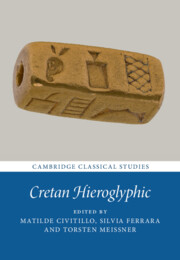
Nearly 4000 years ago a hieroglyphic script was used on Crete which predates Linear A and Linear B, indeed any other writing in Europe, but remains undeciphered since its discovery at the beginning of the twentieth century. This is the first comprehensive account of this script, which is analysed by the leading experts through an array of lenses, including archaeology, philology, palaeography, cognitive studies and decipherment theory, in order to showcase its importance in the history of writing. The book takes a broad approach to writing, understanding it not solely or even mainly as a visual tool to convey language, but primarily as a social and cultural phenomenon rooted in agency, materiality, and semiotics. The volume will provide an invaluable tool for scholars and will facilitate further research. This title is also available as Open Access on Cambridge Core.
This chapter traces the origin of the Romanization framework: that is, how the discourse on Romanization sprang up and has taken root in early twentieth century scholarship. Professionalization of the discipline mixed with the deep-rooted gentlemanly tradition stirred new dynamics. Views on Roman imperialism ranged from those of British imperial civil servants to those of American professional academics; approaches varied from the old gentlemanly tradition of exemplary history to new professional academics’ critical history; and evaluations diverged from admiration to disapproval. Despite wide-ranging differences, none escaped from their own social, economic, and political surroundings shaped by European and American imperialism. The comparisons between the ancient Roman Empire and the contemporary British, French, and American empires, either overtly or covertly, underpinned the works of the time.
Where do we go from here? In practical terms with regard to the history of Roman Empire, how can we rewrite it? How do we use postcolonial thought to rewrite the narrative of Roman imperialism and to reframe Romanization? And what value does it hold? Does it matter to the contemporary audience? Can it make intellectual and moral interventions, and if so, what kinds of intervention? To make historical interventions on Romanization, to write a projective past of Roman imperialism, and to narrate repressed histories of the colonized and migrants can interrupt the present and negotiate a different future. Historical intervention on Roman imperialism, I believe, can revise the current sense of ownership of classical antiquity and can provide a better and wider structural lens on how on how to link the ancient past with the present.
Does postcolonial studies present a theoretical framework appropriate to Romanization studies? Does Romanization studies have evidence appropriate for postcolonial theories? Even though postcolonial theories did not stem from ancient Roman imperialism per se, they provide a heuristical tool to destabilize the discourse that has sustained imperial systems through history. They help Roman historians and archaeologists to reach a deeper understanding of the dynamic process of imperial discourses and to deconstruct the imperial discourses built through the complex layers of histories. This chapter does not deliver an exhaustive analysis or a landscape overview of postcolonial studies according to a certain order of significance or thematic categorization as is the common practice in the discipline, for example, along the triad of Said-Bhabha-Spivak or along the axis of theoretical and materialist approaches. Instead, here I explore postcolonial ideas which have influenced and reoriented Romanization studies.
The discourse on Romanization took a turn. Influential thoughts from Marxism, the Annales school, and the cliometrics revolution to poststructuralism and postcolonialism travelled and infiltrated Romanization studies. This not only helped to enrich the discourse, but it allowed the posing of meaningful questions. Applying contemporary studies on social structures, economic forces, and cultural politics, historians and archaeologists were able to gradually raise questions concerning the traditional models of parallel discourse, defensive imperialism, and civilizing Romanization. This chapter discusses key works of the Early Adopters, from Dyson, Finley, and Harris to Millett and Woolf to trace the course of postcolonial ideas that travelled to the Romanization discourse. It illustrates how the postwar generation of historians and archaeologists has enriched the Romanization discourse with social, economic, and cultural histories and started to question the imperialist epistemology upon which the discourse on Romanization was built.
The framework of ‘Romanization’ developed by Haverfield in 1905 - that Romans ‘civilized’ their imperial subjects, particularly those in ‘barbarian’ western provinces - remains hegemonic, notwithstanding multiple revisionist attempts. It has been reasserted, rejected, or modified, but still frames the debate. Yet, the postcolonial project to decolonize the production of historical knowledge has prompted some scholars to seek fresh approaches and to rewrite the history of Roman imperialism. This book asks: what is the value of postcolonialism in the discourse on Romanization? How has it influenced the discourse on Romanization thus far? Can postcolonialism move the discourse on Romanization forward? Borrowing Said’s concept of travelling ideas, this book undertakes a comparative study between the point of departure and the point(s) of arrival of travelling ideas of postcolonialism to understand their path and impact in the discourse on Roman imperialism and Romanization.
In the multi-ethnic and multi-cultural fabric of major cities in the post-colonial world, postcolonialism presented fresh possibilities for new history. It allowed Roman historians and archaeologists to reflect upon and break through the imperialist historiography of Roman history and to reach out to the intellectual discourse of the postcolonial age. Three prominent scholars who reoriented Romanization studies in the twenty-first century, Webster, Hingley, and Mattingly, turned their attention to the lower strata of the colonial power structure, the colonized and silent Other outside the hegemonic system of power and knowledge/truth – that is, the subaltern – and presented their alternative paradigms in postcolonialist vocabulary: creolization, globalization, and discrepant experiences, respectively. Pushing epistemological boundaries to the subaltern Other in the Roman Empire, they exposed Romano-centric and Eurocentric epistemologies underlying the paradigm of Romanization itself.
This short contribution presents an enigmatic clay mould recovered from a tile kiln in Vindolanda's North Field. This complete mould contains an impression of Apollo in bust form, but its exact use is unclear. This paper presents the mould and discusses its potential use for the manufacture of ceramic figurines. Found in an industrial area of the site, its discovery also provides valuable evidence for craft production along this frontier and hints at a largely unknown provincial industry.