Refine search
Actions for selected content:
179458 results in Earth and Environmental Sciences
Multiphase magmatism and crustal reworking in the Álamo Complex (Central Iberian Zone): evidence from geochemistry and zircon U-Pb geochronology
-
- Journal:
- Geological Magazine / Volume 163 / 2026
- Published online by Cambridge University Press:
- 12 January 2026, e5
-
- Article
-
- You have access
- Open access
- HTML
- Export citation

Super-resolution reconstruction of turbulent flows from a single Lagrangian trajectory
-
- Journal:
- Journal of Fluid Mechanics / Volume 1026 / 10 January 2026
- Published online by Cambridge University Press:
- 12 January 2026, A46
-
- Article
- Export citation
-
We studied the reconstruction of turbulent flow fields from trajectory data recorded by actively migrating Lagrangian agents. We propose a deep-learning model, track-to-flow (T2F), which employs a vision transformer as the encoder to capture the spatiotemporal features of a single agent trajectory, and a convolutional neural network as the decoder to reconstruct the flow field. To enhance the physical consistency of the T2F model, we further incorporate a physics-informed loss function inspired by the framework of physics-informed neural network (PINN), yielding a variant model referred to as T2F+PINN. We first evaluate both models in a laminar cylinder wake flow at a Reynolds number of $\textit{Re} = 800$ as a proof of concept. The results show that the T2F model achieves velocity reconstruction accuracy comparable to that of existing flow reconstruction methods, while the T2F+PINN model reduces the normalised error in vorticity reconstruction relative to the T2F model. We then apply the models in turbulent Rayleigh–Bénard convection at a Rayleigh number of $Ra = 10^{8}$ and a Prandtl number of $\textit{Pr} = 0.71$. The results show that the T2F model accurately reconstructs both the velocity and temperature fields, whereas the T2F+PINN model further improves the reconstruction accuracy of gradient-related physical quantities, such as temperature gradients, vorticity and the $Q$ value, with a maximum improvement of approximately 60 % compared to the T2F model. Overall, the T2F model is better suited for reconstructing primitive flow variables, while the T2F+PINN model provides advantages in reconstructing gradient-related quantities. Our models open a promising avenue for accurate flow reconstruction from a single Lagrangian trajectory.


Linear stability analysis of magnetoconvection in finite-sized systems: competition between spatial confinement and magnetic field
-
- Journal:
- Journal of Fluid Mechanics / Volume 1027 / 25 January 2026
- Published online by Cambridge University Press:
- 12 January 2026, A6
-
- Article
- Export citation
-
We present a linear stability analysis of two-dimensional magnetoconvection considering the effects of spatial confinement (characterised by the aspect ratio $\varGamma$) and magnetic field (characterised by the Hartmann number $\textit{Ha}_{i=x,y,z}$ with subscript representing its direction). It is found that when the magnetic field is perpendicular to the convection domain ( $y$-direction), it does not affect the onset of convection due to zero Lorentz force. With a magnetic field in the $z$ (vertical) or $x$ (horizontal) directions, the onset of convection is delayed, resulting in a larger critical Rayleigh number $Ra_c$ for the onset of convection. We outline phase diagrams showing the dominating factors determining $Ra_c$. When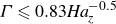 $\varGamma \leqslant 0.83\textit{Ha}_z^{-0.5}$ for vertical and $\varGamma \leqslant 0.66\textit{Ha}_x^{-1.01}$ for horizontal magnetic field, $Ra_c$ is mainly determined by the geometrical confinement with $Ra_c=502\varGamma ^{-4.0}$. When $\varGamma \geqslant 2^{1/6}\pi ^{1/3}\textit{Ha}_z^{-1/3}$ for vertical and $\varGamma \geqslant 5$ for the horizontal magnetic field, $Ra_c$ is mainly determined by the magnetic field with $Ra_c=\pi ^2\textit{Ha}^2$. In the intermediate regime, both the magnetic field and spatial confinement determine $Ra_c$, and a horizontal magnetic field is found to suppress convection more than a vertical magnetic field. In addition, under a horizontal magnetic field, there exists a subregime characterised by $Ra_c = 9.9\,\varGamma ^{-2.0} \textit{Ha}_x^2$, which is explained by a theoretical model. The magnetic field also modifies the length scale $\ell$. For a vertical magnetic field, $\ell$ decreases with increasing $\textit{Ha}_z$, following $\ell =2^{1/6}\pi ^{1/3}\textit{Ha}^{-1/3}$. For a horizontal magnetic field, when $\varGamma \lt 0.62\textit{Ha}_x^{0.47}$, the flow is a single-roll structure with $\ell$ being the width of the domain. The study thus shed new light on the interplay between magnetic field and spatial confinement.


Collective effects of neighbouring melting ice objects
-
- Journal:
- Journal of Fluid Mechanics / Volume 1027 / 25 January 2026
- Published online by Cambridge University Press:
- 12 January 2026, A10
-
- Article
-
- You have access
- Open access
- HTML
- Export citation
-
We present a study on the melting dynamics of neighbouring ice bodies by means of idealised simulations, focusing on collective effects, with the goal of obtaining fundamental insight into how collective interactions influence the melting of ice. Two neighbouring (vertically or horizontally aligned), square-shaped and equally sized ice objects (size of the order of centimetres) are immersed in quiescent fresh water at a temperature of ${20}\,^\circ \textrm {C}$. By performing two-dimensional direct numerical simulations, and using the phase-field method to model the phase change, the collective melting of these objects is studied. When the objects are horizontally aligned, no significant influence of the neighbouring object on the melting time is observed. On the other hand, when vertically aligned, although the melting of the upper object is mostly unaffected, the melting time and the morphology of the lower ice body strongly depends on the initial inter-object distance. We report that the melting of the bottom object can be enhanced by more than 10 %, or delayed more than 20 %, displaying a non-monotonic dependence on the initial object size. We show that this behaviour results from a non-trivial competition between layering of cold fluid, which lowers the heat transfer, and convective flows, which favour mixing and heat transfer. For this melting in mixed convection, we were able to collapse our data onto a single curve.

Caught somewhere in time: The radiocarbon sequence of the Iron Age occupation in Largo de Santa Cruz do Castelo (Lisbon, Portugal)
-
- Journal:
- Radiocarbon / Volume 68 / Issue 2 / April 2026
- Published online by Cambridge University Press:
- 12 January 2026, pp. 246-263
- Print publication:
- April 2026
-
- Article
-
- You have access
- Open access
- HTML
- Export citation

Particle dispersion in supersonic particle-laden jets
-
- Journal:
- Journal of Fluid Mechanics / Volume 1027 / 25 January 2026
- Published online by Cambridge University Press:
- 12 January 2026, A1
-
- Article
-
- You have access
- Open access
- HTML
- Export citation
-
Particle-laden supersonic jets are often encountered in advanced engineering applications where a comprehensive control of particle dispersion is crucial. Although particle dispersion has been extensively studied in the past, the local mechanisms that cause the radial particle transport, such that particles leave the jet core, remain unclear in supersonic jets. To this end, we conduct a direct numerical simulation of a confined low Reynolds number, perfectly expanded supersonic jet carrying four different-sized particles. Here, particles and gas are simulated with Lagrangian and Eulerian approaches, and the fluid–particle energy and momentum exchange is modelled with two-way coupling. The initial Stokes number of these particles ranges between $1.5$ and $6.0$. We found that each particle size has a specific axial location, $x_r$, where they start travelling radially. This location is defined by a local Stokes number of approximately ${\textit{St}}^* \approx 0.6$; the delay in particles’ response to the local eddies in a supersonic flow causes their ${\textit{St}}^*$ to drop below unity. The local turbulent structures formed by the jet promote the radial transport of the particles that have similar characteristic time scales. Despite two-way momentum coupling, particles and gas influence each other via different mechanisms. For the considered range of ${\textit{St}}$, particles dominantly influence the fluctuating velocity component of the gas, while gas mainly affects the mean velocity component of the particles. Moreover, the particles’ reaction to the compressibility effects is a direct function of particle inertia, where the probability of finding larger particles in a high-density gradient and dilatation region is higher.


How common are oxygenic photosynthesis and large coal deposits on exoplanets?
-
- Journal:
- International Journal of Astrobiology / Volume 25 / 2026
- Published online by Cambridge University Press:
- 12 January 2026, e1
-
- Article
-
- You have access
- Open access
- HTML
- Export citation
When the levee breaks: experimentally testing dinosaur and mammal bone transport in unsteady flows
-
- Journal:
- Paleobiology / Volume 52 / Issue 2 / May 2026
- Published online by Cambridge University Press:
- 12 January 2026, pp. 299-314
-
- Article
-
- You have access
- Open access
- HTML
- Export citation

Data-driven detached-eddy simulations based on explicit algebraic stress expressions for turbulent flows
-
- Journal:
- Journal of Fluid Mechanics / Volume 1027 / 25 January 2026
- Published online by Cambridge University Press:
- 12 January 2026, A5
-
- Article
- Export citation
-
This work proposes a data-driven explicit algebraic stress-based detached-eddy simulation (DES) method. Despite the widespread use of data-driven methods in model development for both Reynolds-averaged Navier–Stokes (RANS) and large-eddy simulations (LES), their applications to DES remain limited. The challenge mainly lies in the absence of modelled stress data, the requirement for proper length scales in RANS and LES branches, and the maintenance of a reasonable switching behaviour. The data-driven DES method is constructed based on the algebraic stress equation. The control of RANS/LES switching is achieved through the eddy viscosity in the linear part of the modelled stress, under the $\ell ^2-\omega$ DES framework. Three model coefficients associated with the pressure–strain terms and the LES length scale are represented by a neural network as functions of scalar invariants of velocity gradient. The neural network is trained using velocity data with the ensemble Kalman method, thereby circumventing the requirement for modelled stress data. Moreover, the baseline coefficient values are incorporated as additional reference data to ensure reasonable switching behaviour. The proposed approach is evaluated on two challenging turbulent flows, i.e. the secondary flow in a square duct and the separated flow over a bump. The trained model achieves significant improvements in predicting mean flow statistics compared with the baseline model. This is attributed to improved predictions of the modelled stress. The trained model also exhibits reasonable switching behaviour, enlarging the LES region to resolve more turbulent structures. Furthermore, the model shows satisfactory generalization capabilities for both cases in similar flow configurations.

FLM volume 1025 Cover and Front matter
-
- Journal:
- Journal of Fluid Mechanics / Volume 1025 / 25 December 2025
- Published online by Cambridge University Press:
- 12 January 2026, p. f1
-
- Article
-
- You have access
- Export citation

Near-bed velocity law and bed shear stress in vegetated flows
-
- Journal:
- Journal of Fluid Mechanics / Volume 1026 / 10 January 2026
- Published online by Cambridge University Press:
- 12 January 2026, A47
-
- Article
- Export citation
-
By generating drag and turbulence away from the bed, aquatic vegetation shapes the mean and turbulent velocity profile. However, the near-bed velocity distribution in vegetated flows has received little theoretical or experimental attention. This study investigated the near-bed velocity profile and bed shear stress using a coupled particle image velocimetry and particle tracking velocimetry system, which enabled the acquisition of flow-field measurements at very high spatial and temporal resolution. A viscous sublayer with a linear velocity profile was present, but this sublayer thickness was much smaller in vegetated flows than in bare flows with the same channel velocity. However, the dimensionless viscous sublayer thickness was the same in vegetated and bare flows, $z_v^+ = z_v \langle u_*\rangle / \nu = 6.1 \pm 0.7$. In addition, in vegetated flow, the horizontally averaged velocity profile above the viscous sublayer did not follow the classic logarithmic law found for bare beds. This deviation was attributed to the violation of two key assumptions in the classic Prandtl mixing length theory. By modifying the mixing length theory for vegetated conditions, a new theoretical power law profile for near-bed velocity was derived and validated with velocity data from both the present and previous studies, with mean percent errors of 4.9 % and 7.8 %, respectively. Using the new velocity law, the spatially averaged bed shear stress (and friction velocity) can be predicted from channel-average velocity, vegetation density and stem diameter, all of which are conveniently measured in the field.

Convection–evaporation of water in a large aspect ratio layer
-
- Journal:
- Journal of Fluid Mechanics / Volume 1027 / 25 January 2026
- Published online by Cambridge University Press:
- 12 January 2026, A2
-
- Article
- Export citation
-
We present an experimental study of convection–evaporation of a pool of water evaporating into a quiescent atmosphere. The temperature difference between the bottom of the pool and the surrounding air, as well as the water layer’s aspect ratio $\varGamma$, are systematically varied. Compared with classical Rayleigh–Bénard convection (RBC), this configuration involves a free-surface mechanical upper boundary and a mixed thermal upper boundary in contact with a poorly conducting air layer: evaporation extracts latent heat from the liquid and injects lighter vapour into the air, while radiation adds further cooling. As a result, neither temperature nor heat flux is fixed at the water–air interface, but they are instead strongly coupled. To characterise the respective contributions of convection, evaporation and radiation, we perform three sets of experiments: convection–evaporation, evaporation without bottom heating and convection without evaporation. High-resolution infrared imaging reveals multiple scales of convection at the surface: small hot plumes, cold sheet-like plumes and a large-scale circulation. The latter is constrained by the tank geometry for $\varGamma \lesssim 12$, but several turbulent superstructures develop for larger $\varGamma$. This is reminiscent of RBC but with different temperature statistics, due to the mixed boundary condition. Scaling laws are derived for interfacial transfers and mean surface temperature. Evaporation dominates heat extraction, accounting for 60 %–70 % of the flux, while radiation contributes 15 %–20 %. The release of vapour further enhances coupling between the liquid and air layers. When evaporation is blocked, radiation becomes dominant (70 %–80 %).These results have important implications for industrial and natural systems.


Time-domain analysis of an ice shelf in a bounded domain
-
- Journal:
- Journal of Fluid Mechanics / Volume 1026 / 10 January 2026
- Published online by Cambridge University Press:
- 12 January 2026, A44
-
- Article
-
- You have access
- Open access
- HTML
- Export citation
Exploring the diversity within EANA and AbGradE as mirror of the European astrobiology community
-
- Journal:
- International Journal of Astrobiology / Volume 25 / 2026
- Published online by Cambridge University Press:
- 12 January 2026, e2
-
- Article
-
- You have access
- Open access
- HTML
- Export citation

Seeking Global Climate Justice
- Paths Lost and Found
-
- Published online:
- 09 January 2026
- Print publication:
- 09 April 2026
-
- Book
-
- You have access
- Open access
- Export citation

Quantisation of free-surface waves in a hollow vortex with surface tension
-
- Journal:
- Journal of Fluid Mechanics / Volume 1026 / 10 January 2026
- Published online by Cambridge University Press:
- 09 January 2026, A48
-
- Article
- Export citation

Dynamics of the velocity fluctuations in sedimenting suspensions of rigid fibres
-
- Journal:
- Journal of Fluid Mechanics / Volume 1026 / 10 January 2026
- Published online by Cambridge University Press:
- 09 January 2026, A49
-
- Article
- Export citation
-
We use direct numerical simulations to investigate fluid–solid interactions in suspensions of rigid fibres settling under gravity in a quiescent fluid. The solid-to-fluid density ratio is $\mathcal{O}(100)$, while the Galileo number ( $ \textit{Ga}$) and fibre concentration ( $n\ell_{\kern-1.5pt f}^3$) are varied over the ranges $ \textit{Ga} \in [180, 900]$ and $n\ell_{\kern-1.5pt f}^3 \in [0.36, 23.15]$; $\ell_{\kern-1.5pt f}$ denotes the fibre length and $n$ the number density. At high $ \textit{Ga}$ and/or low $n\ell_{\kern-1.5pt f}^3$, fibres cluster into gravity-aligned streamers with elevated concentrations and enhanced settling velocities, disrupting the flow homogeneity. As $ \textit{Ga}$ increases and/or $n\ell_{\kern-1.5pt f}^3$ decreases, the fluid-phase kinetic energy rises and the energy spectrum broadens, reflecting enhanced small-scale activity. The flow anisotropy is assessed by decomposing the energy spectrum into components aligned with and transverse to gravity. Vertical fluctuations are primarily driven by fluid–solid interactions, while transverse ones are maintained by pressure–strain effects that promote isotropy. With increasing $ \textit{Ga}$, nonlinear interactions become more prominent, producing a net forward energy cascade toward smaller scales, punctuated by localised backscatter events. Analysis of the local velocity gradient tensor reveals distinct flow topologies: at low $ \textit{Ga}$, the flow is dominated by axisymmetric compression and two-dimensional straining; at high $ \textit{Ga}$, regions of high fibre concentration are governed by two-dimensional strain, while voids are associated with axisymmetric extension. The fluid motion is predominantly extensional rather than rotational.


Capturing the motion of a pair of elastic capsules in a shear flow: emergent nonlinear hydrodynamic ordering
-
- Journal:
- Journal of Fluid Mechanics / Volume 1026 / 10 January 2026
- Published online by Cambridge University Press:
- 09 January 2026, A50
-
- Article
-
- You have access
- Open access
- HTML
- Export citation
Impact of monsoon waves on the deposition of chitin tubes of polychaetes along the central-eastern Arabian Sea
-
- Journal:
- Journal of the Marine Biological Association of the United Kingdom / Volume 105 / 2025
- Published online by Cambridge University Press:
- 09 January 2026, e140
-
- Article
- Export citation

Localised inter-scale energy cascades in free-surface turbulence
-
- Journal:
- Journal of Fluid Mechanics / Volume 1026 / 10 January 2026
- Published online by Cambridge University Press:
- 09 January 2026, A51
-
- Article
- Export citation
