Refine search
Actions for selected content:
212897 results in Engineering
5 - Light Sources, Displays, and Detectors
- from Theme I - Introducing Light
-
- Book:
- Pedrottis' Introduction to Optics
- Published online:
- 15 April 2025
- Print publication:
- 31 October 2024, pp 192-236
-
- Chapter
- Export citation
E. Integrated Testlet Lookup Table
-
- Book:
- Pedrottis' Introduction to Optics
- Published online:
- 15 April 2025
- Print publication:
- 31 October 2024, pp 942-943
-
- Chapter
- Export citation
Theme V - Advanced Topics
-
- Book:
- Pedrottis' Introduction to Optics
- Published online:
- 15 April 2025
- Print publication:
- 31 October 2024, pp 683-684
-
- Chapter
- Export citation
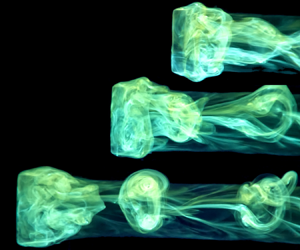
Effects of surface roughness on the drag coefficient of finite-span cylinders freely rolling on an inclined plane
-
- Journal:
- Journal of Fluid Mechanics / Volume 998 / 10 November 2024
- Published online by Cambridge University Press:
- 31 October 2024, A39
-
- Article
-
- You have access
- Open access
- HTML
- Export citation
-
We present an experimental investigation aimed at understanding the effects of surface roughness on the time-mean drag coefficient ( $\bar {C}_{D}$) of finite-span cylinders ( $\text {span/diameter} = \text {aspect ratio}$, $0.51 \le AR \le 6.02$) freely rolling without slip on an inclined plane. While lubrication theory predicts an infinite drag force for ideally smooth cylinders in contact with a smooth surface, experiments yield finite drag coefficients. We propose that surface roughness introduces an effective gap ( $G_{eff}$) resulting in a finite drag force while allowing physical contact between the cylinder and the plane. This study combines measurements of surface roughness for both the cylinder and the plane panel to determine a total relative roughness ( $\xi$) that can effectively describe $G_{eff}$ at the point of contact. It is observed that the measured $\bar {C}_{D}$ increases as $\xi$ decreases, aligning with predictions of lubrication theory. Furthermore, the measured $\bar {C}_{D}$ approximately matches combined analytical and numerical predictions for a smooth cylinder and plane when the imposed gap is approximately equal to the mean peak roughness ( $R_p$) for rough cylinders, and one standard deviation peak roughness ( $R_{p, 1\sigma }$) for relatively smooth cylinders. As the time-mean Reynolds number ( $\overline {Re}$) increases, the influence of surface roughness on $\bar {C}_{D}$ decreases, indicating that wake drag becomes dominant at higher $\overline {Re}$. The cylinder aspect ratio ( $AR$) is found to have only a minor effect on $\bar {C}_{D}$. Flow visualisations are also conducted to identify critical flow transitions and these are compared with visualisations previously obtained numerically. Variations in $\xi$ have little effect on the cylinder wake. Instead, $AR$ was observed to have a more pronounced effect on the flow structures observed. The Strouhal number ( $St$) associated with the cylinder wake shedding was observed to increase with $\overline {Re}$, while demonstrating little dependence on $AR$.
$AR$.


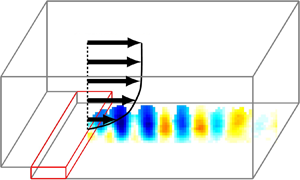
Influence of porous material on the flow behind a backward-facing step: experimental study
-
- Journal:
- Journal of Fluid Mechanics / Volume 998 / 10 November 2024
- Published online by Cambridge University Press:
- 31 October 2024, A31
-
- Article
-
- You have access
- Open access
- HTML
- Export citation
9 - Orthogonal Frequency-Division Multiplexing
-
- Book:
- Digital Communications
- Published online:
- 22 November 2024
- Print publication:
- 31 October 2024, pp 344-385
-
- Chapter
- Export citation
5 - State Equivalence, State Reduction
- from Part I - Lectures on Basics with Examples
-
- Book:
- Time-Variant and Quasi-separable Systems
- Published online:
- 24 October 2024
- Print publication:
- 31 October 2024, pp 73-86
-
- Chapter
- Export citation
9 - The Kalman Filter as an Application
- from Part I - Lectures on Basics with Examples
-
- Book:
- Time-Variant and Quasi-separable Systems
- Published online:
- 24 October 2024
- Print publication:
- 31 October 2024, pp 136-153
-
- Chapter
- Export citation
4 - Waves
- from Theme I - Introducing Light
-
- Book:
- Pedrottis' Introduction to Optics
- Published online:
- 15 April 2025
- Print publication:
- 31 October 2024, pp 164-191
-
- Chapter
- Export citation
B. Mathematical Formulas
-
- Book:
- Pedrottis' Introduction to Optics
- Published online:
- 15 April 2025
- Print publication:
- 31 October 2024, pp 913-915
-
- Chapter
- Export citation
12 - Reflection and Transmission at Surfaces
- from Theme III - A Vector Field Approach to Light
-
- Book:
- Pedrottis' Introduction to Optics
- Published online:
- 15 April 2025
- Print publication:
- 31 October 2024, pp 447-472
-
- Chapter
- Export citation
26 - Optics of the Eye
- from Theme V - Advanced Topics
-
- Book:
- Pedrottis' Introduction to Optics
- Published online:
- 15 April 2025
- Print publication:
- 31 October 2024, pp 886-910
-
- Chapter
- Export citation
7 - Inner Operators and External Factorizations
- from Part I - Lectures on Basics with Examples
-
- Book:
- Time-Variant and Quasi-separable Systems
- Published online:
- 24 October 2024
- Print publication:
- 31 October 2024, pp 95-114
-
- Chapter
- Export citation
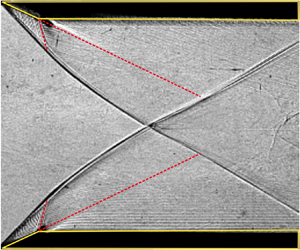
Regular reflection to Mach reflection (RR–MR) transition in short wedges
-
- Journal:
- Journal of Fluid Mechanics / Volume 998 / 10 November 2024
- Published online by Cambridge University Press:
- 31 October 2024, A38
-
- Article
-
- You have access
- Open access
- HTML
- Export citation
-
Regular reflection (RR) to Mach reflection (MR) transitions ( ${\rm RR}\leftrightarrow {\rm MR}$) on long wedges in steady supersonic flows have been well studied and documented. However, in a short wedge where the wedge length is small, the transition prediction becomes really challenging owing to the interaction of the expansion fan emanating from the trailing edge of the wedge with the incident shock and the triple/reflection point. The extent of this interaction depends on the distance between the wedge trailing edge and the symmetry line (Ht). This distance is a geometric combination of the distance of the wedge leading edge from the symmetry line $(H)$, the wedge angle ( $\theta$) and the wedge length $(w)$. In the present study, we used the method of characteristics to model the complete wave interactions which accurately predicted shock curvatures and the reflection configurations for all ranges of the incoming flow Mach number. In the case of short wedges, the transition criterion strongly depends on the wedge length, which can be so adjusted even to eliminate the ${\rm RR}\rightarrow {\rm MR}$ transitions till the wedge angle reaches the no-reflection domain. Transition lines for both the detachment criterion and von Neumann criterion are also drawn to investigate the dual solution domain, and the reflection configurations were verified experimentally for the first time on short wedges. By using proper input configuration parameter ( $w/H$), various types of shifts in the dual solution domain for short wedges are studied and categorised into three types, namely Type I, Type II and Type III.


Crystal structure and Hirshfeld surface analysis of pinaverium bromide dihydrate
-
- Journal:
- Powder Diffraction / Volume 40 / Issue 1 / March 2025
- Published online by Cambridge University Press:
- 31 October 2024, pp. 82-88
-
- Article
- Export citation
2 - Equivalent Complex Baseband Signals
-
- Book:
- Digital Communications
- Published online:
- 22 November 2024
- Print publication:
- 31 October 2024, pp 26-53
-
- Chapter
- Export citation
3 - Understanding Optical Instruments
- from Theme I - Introducing Light
-
- Book:
- Pedrottis' Introduction to Optics
- Published online:
- 15 April 2025
- Print publication:
- 31 October 2024, pp 103-163
-
- Chapter
- Export citation
3 - LTV (Quasi-separable) Systems
- from Part I - Lectures on Basics with Examples
-
- Book:
- Time-Variant and Quasi-separable Systems
- Published online:
- 24 October 2024
- Print publication:
- 31 October 2024, pp 41-58
-
- Chapter
- Export citation
Appendix B - Short Introduction to Channel Coding
-
- Book:
- Digital Communications
- Published online:
- 22 November 2024
- Print publication:
- 31 October 2024, pp 419-453
-
- Chapter
- Export citation
15 - Polarization in Practice
- from Theme III - A Vector Field Approach to Light
-
- Book:
- Pedrottis' Introduction to Optics
- Published online:
- 15 April 2025
- Print publication:
- 31 October 2024, pp 544-572
-
- Chapter
- Export citation
