Refine search
Actions for selected content:
212897 results in Engineering
Contents
-
- Book:
- Time-Variant and Quasi-separable Systems
- Published online:
- 24 October 2024
- Print publication:
- 31 October 2024, pp v-x
-
- Chapter
- Export citation
Dynamics and control of a high-altitude balloon with slung load
-
- Journal:
- The Aeronautical Journal / Volume 128 / Issue 1330 / December 2024
- Published online by Cambridge University Press:
- 31 October 2024, pp. 2856-2878
-
- Article
- Export citation
D. Answers to Selected Questions
-
- Book:
- Pedrottis' Introduction to Optics
- Published online:
- 15 April 2025
- Print publication:
- 31 October 2024, pp 925-941
-
- Chapter
- Export citation
Theme III - A Vector Field Approach to Light
-
- Book:
- Pedrottis' Introduction to Optics
- Published online:
- 15 April 2025
- Print publication:
- 31 October 2024, pp 445-446
-
- Chapter
- Export citation
10 - Fraunhofer Diffraction
- from Theme II - A Scalar Field Approach to Light
-
- Book:
- Pedrottis' Introduction to Optics
- Published online:
- 15 April 2025
- Print publication:
- 31 October 2024, pp 372-404
-
- Chapter
- Export citation
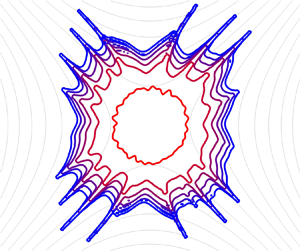
A general model for spin coating on a non-axisymmetric curved substrate
-
- Journal:
- Journal of Fluid Mechanics / Volume 998 / 10 November 2024
- Published online by Cambridge University Press:
- 31 October 2024, A32
-
- Article
-
- You have access
- Open access
- HTML
- Export citation
Frontmatter
-
- Book:
- Pedrottis' Introduction to Optics
- Published online:
- 15 April 2025
- Print publication:
- 31 October 2024, pp xxii-xxii
-
- Chapter
- Export citation
6 - Elementary Operations
- from Part I - Lectures on Basics with Examples
-
- Book:
- Time-Variant and Quasi-separable Systems
- Published online:
- 24 October 2024
- Print publication:
- 31 October 2024, pp 87-94
-
- Chapter
- Export citation
8 - Interferometry and Multilayer Films
- from Theme II - A Scalar Field Approach to Light
-
- Book:
- Pedrottis' Introduction to Optics
- Published online:
- 15 April 2025
- Print publication:
- 31 October 2024, pp 296-344
-
- Chapter
- Export citation
22 - Holography
- from Theme V - Advanced Topics
-
- Book:
- Pedrottis' Introduction to Optics
- Published online:
- 15 April 2025
- Print publication:
- 31 October 2024, pp 781-799
-
- Chapter
- Export citation
8 - Inner−Outer Factorization
- from Part I - Lectures on Basics with Examples
-
- Book:
- Time-Variant and Quasi-separable Systems
- Published online:
- 24 October 2024
- Print publication:
- 31 October 2024, pp 115-135
-
- Chapter
- Export citation
3 - Digital Pulse-Amplitude Modulation
-
- Book:
- Digital Communications
- Published online:
- 22 November 2024
- Print publication:
- 31 October 2024, pp 54-111
-
- Chapter
- Export citation
Appendices
-
- Book:
- Digital Communications
- Published online:
- 22 November 2024
- Print publication:
- 31 October 2024, pp 386-500
-
- Chapter
- Export citation
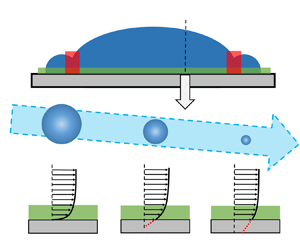
Progressive evolution of the viscous dissipation mechanism from the macroscale to the nanoscale
-
- Journal:
- Journal of Fluid Mechanics / Volume 998 / 10 November 2024
- Published online by Cambridge University Press:
- 31 October 2024, A21
-
- Article
- Export citation
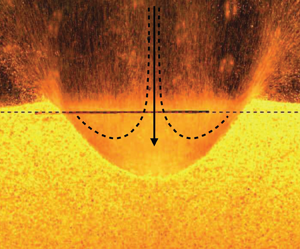
Air-jet impact craters on granular surfaces: a universal scaling
-
- Journal:
- Journal of Fluid Mechanics / Volume 998 / 10 November 2024
- Published online by Cambridge University Press:
- 30 October 2024, A29
-
- Article
-
- You have access
- Open access
- HTML
- Export citation
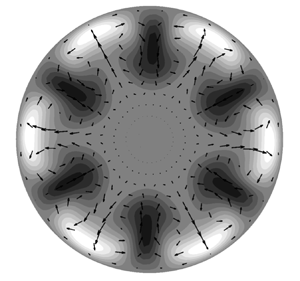
Nonlinear evolution of vortical disturbances entrained in the entrance region of a circular pipe
-
- Journal:
- Journal of Fluid Mechanics / Volume 998 / 10 November 2024
- Published online by Cambridge University Press:
- 29 October 2024, A19
-
- Article
- Export citation
-
The nonlinear evolution of free-stream vortical disturbances entrained in the entrance region of a circular pipe is investigated using asymptotic and numerical methods. Attention is focused on the low-frequency disturbances that induce streamwise elongated structures. A pair of vortical modes with opposite azimuthal wavenumbers is used to model the free-stream disturbances. Their amplitude is assumed to be intense enough for nonlinear interactions to occur inside the pipe. The formation and evolution of the perturbation flow are described by the nonlinear unsteady boundary-region equations in the cylindrical coordinate system, derived and solved herein for the first time. Matched asymptotic expansions are employed to construct appropriate initial conditions and the initial–boundary value problem is solved numerically by a marching procedure in the streamwise direction. Numerical results show the stabilising effect of nonlinearity on the intense algebraic growth of the disturbances and an increase of the wall-shear stress due to the nonlinear interactions. A parametric study is carried out to evince the effect of the Reynolds number, the streamwise and azimuthal wavelengths, and the radial length scale of the inlet disturbance on the nonlinear flow evolution. Elongated pipe-entrance nonlinear structures (EPENS) occupying the whole pipe cross-section are discovered. EPENS with $h$-fold rotational symmetry comprise $h$ high-speed streaks positioned near the wall, and $h$ low-speed streaks centred around the pipe core. These distinct structures display a striking resemblance to nonlinear travelling waves found numerically and observed experimentally in fully developed pipe flow. Good agreement of our mean-flow and root mean square data with experimental measurements is obtained.


Analysis of group evaporation characteristics of droplet clusters in an evaporating spray
-
- Journal:
- Journal of Fluid Mechanics / Volume 998 / 10 November 2024
- Published online by Cambridge University Press:
- 29 October 2024, A26
-
- Article
-
- You have access
- Open access
- HTML
- Export citation
-
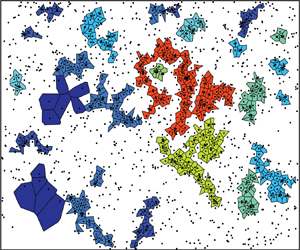
Droplet clustering in sprays refers to the dynamic evolution of highly concentrated regions due to the preferential accumulation of the polydisperse droplets in the turbulent airflow entrained by the spray. In the current study, we aim to experimentally investigate the collective vaporization of the droplets in droplet clusters in an air-assisted acetone spray characterized by the Group number, $G$. The magnitude of $G$ depends on the cluster length scale and interdroplet spacing, and it indicates the vaporization mode that may vary from the isolated mode ( $G \ll 1$) to external group mode ( $G \gg 1$). The droplet measurements were obtained under atmospheric conditions at different axial and radial locations within the spray. Application of the Voronoi analysis to particle image velocimetry images of the spray droplets facilitated the identification and characterization of the droplet clusters, which allowed the measurement of $G$ for each cluster. The results highlighted that multiscale clustering of the evaporating droplets leads to multimode group evaporation of the clusters (characterized by a wide range of $G$: 0.001–10). The trend of interdroplet spacing versus cluster area allowed the classification of the droplet clusters into small-scale clusters (which are of the order of the Kolmogorov length scale) and large-scale clusters (that scale with the large-scale turbulent eddies), that are found to exhibit distinct group evaporation behaviour. A theoretical model is invoked to correlate $G$ with the droplet evaporation rate for individual clusters, and some interesting observations are identified, which are explained in the paper.


Melting of olive oil in immiscible surroundings: experiments and theory
-
- Journal:
- Journal of Fluid Mechanics / Volume 998 / 10 November 2024
- Published online by Cambridge University Press:
- 29 October 2024, A18
-
- Article
-
- You have access
- Open access
- HTML
- Export citation
-
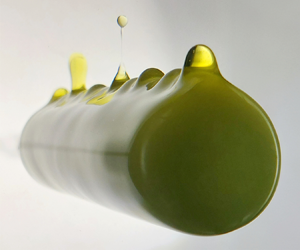
We report on the melting dynamics of frozen olive oil in quiescent water for Rayleigh numbers up to $10^9$. The density difference results in an upward buoyancy-driven flow of liquid oil forming a thin film around the frozen oil. We experimentally investigate flat, cylindrical and spherical shapes and we derive theoretical expressions for the local film thickness, velocity and the local melt rate for these three canonical geometries. Our theoretical models predict the correct order of magnitude and the correct scaling as compared with our experimental findings.

Robotic safe adaptation in unprecedented situations: the RoboSAPIENS project
-
- Journal:
- Research Directions: Cyber-Physical Systems / Volume 2 / 2024
- Published online by Cambridge University Press:
- 29 October 2024, e4
-
- Article
-
- You have access
- Open access
- HTML
- Export citation
Interactions between a toroidal bubble and a free surface
-
- Journal:
- Journal of Fluid Mechanics / Volume 998 / 10 November 2024
- Published online by Cambridge University Press:
- 29 October 2024, A28
-
- Article
- Export citation
-
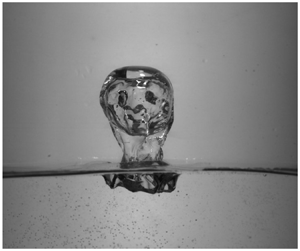
Toroidal bubbles (TBs) represent cases of vortex rings with a gas–liquid interface where a gas vortex ring is encased within a liquid vortex ring, and can serve as effective media for mass conveyance, process mixing, noise reduction and reaction regulation. In this study, we carry out a systematic study on the interaction between a TB and a free surface. According to the high-speed photographic images from the experiments, we identify strong and weak interactions in terms of the normalized maximum free surface deformation $h_{max}^*$. Then, we perform numerical simulations based on the volume of fluid (VOF) method in the OpenFOAM platform. Based on both the experimental and the numerical results, we conclude that the Froude number, $Fr$, determines the main characteristics during the interaction process. The TB–free surface interaction is essentially the interaction between the liquid vortex ring enveloping the TB and the free surface, supplemented by the TB's complex behaviour. Next, we establish the scaling law of $h_{max}^*$ based on the energy balance condition. Based on this, we provide the critical $Fr$ and the slenderness of the TB, $\eta$, for identifying the strong and weak interactions, and a parametric plot of the interactions in terms of $Fr$ and $\eta$.


