To save content items to your account,
please confirm that you agree to abide by our usage policies.
If this is the first time you use this feature, you will be asked to authorise Cambridge Core to connect with your account.
Find out more about saving content to .
To save content items to your Kindle, first ensure no-reply@cambridge.org
is added to your Approved Personal Document E-mail List under your Personal Document Settings
on the Manage Your Content and Devices page of your Amazon account. Then enter the ‘name’ part
of your Kindle email address below.
Find out more about saving to your Kindle.
Note you can select to save to either the @free.kindle.com or @kindle.com variations.
‘@free.kindle.com’ emails are free but can only be saved to your device when it is connected to wi-fi.
‘@kindle.com’ emails can be delivered even when you are not connected to wi-fi, but note that service fees apply.
The appendix defines the data model used throughout the book and describes what can best be called an algorithmic design specification, that is, the functional and graphical characterization of an algorithm, chosen so that it can be translated to a computer architecture (be it in soft- or in hardware). We follow hereby a powerful “data flow model” that generalizes the classical signal flow graphs and that can be further formalized to generate the information necessary for the subsequent computer system design at the architectural level (i.e., the assignment of operations, data transfer and memory usage). The model provides for a natural link between mathematical operations and architectural representations. It is, at the same token, well adapted to the generation of parallel processing architectures.
This work introduces a novel compact ultra-wideband (UWB) antenna designed for wearable applications, employing a bioinspired structure and machine learning (ML) techniques to achieve exceptional performance in the 3.10–10.42 GHz range. The antenna is fabricated by positioning conductive fabric on a polydimethylsiloxane polymer of 1 mm thickness to augment high flexibility and durability. Additionally, it pioneers integrating a complete ground plane to mitigate back radiation toward the human body, presenting a compact (35.5 × 30.5 × 1 mm3) UWB antenna design compliant with IEEE 802.15.6 standards. The design methodology includes using bandwidth enhancement techniques such as chamfering edges, slots, and adding stubs in the feed, along with applying ML to optimize the antenna’s dimensions for desired return loss characteristics. The proposed antenna demonstrates exceptional resilience to human body loading and physical deformation. The simulation and measurement results have good agreement. The K-nearest neighbour method beat the other ML algorithms maximum accuracy of 99.62% to predict the S11. According to the author’s best knowledge, this is the first compact UWB antenna with full ground specified by IEEE.802.15.6 with ML reported.
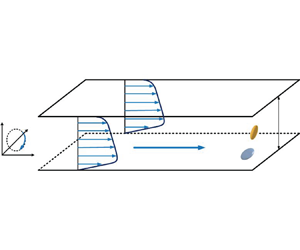
The orientation dynamics of inertialess prolate and oblate spheroidal particles in a directly simulated spanwise-rotating turbulent channel flow has been investigated by means of an Eulerian–Lagrangian point-particle approach. The channel rotation and the particle shape were parameterized using a rotation number Ro and the aspect ratio λ, respectively. Eleven particle shapes 0.05 ≤ λ ≤ 20 and four rotation rates 0 ≤ Ro ≤ 10 have been examined. The spheroidal particles retained their almost isotropic orientation in the core region of the channel, despite the significant mean shear rate set up by the Coriolis force. Irrespective of channel rotation rate Ro, rod-like spheroids tend to align in the streamwise direction, while disk-like particles are oriented in the wall-normal direction. These trends were accentuated with increasing departure from sphericity λ = 1. The changeover from the isotropic orientation mode in the centre to the highly anisotropic near-wall orientation mode commenced further away from the suction-side wall with increasing Ro, whereas the particle orientations on the pressure side of the rotating channel remained essentially unaffected by Ro. We observed that the alignments of the fluid rotation vector with the Lagrangian stretching direction were similarly unaffected by the imposed system rotation, except that the de-alignment set in deeper into the core at high Ro. This contrasts with the well-known substantial impact of system rotation on the velocity and vorticity fields. Similarly, slender rods and flatter disks were aligned with the Lagrangian stretching and compression directions, respectively, for all Ro considered, except in the vicinity of the walls. The typical near-wall de-alignment extended considerably further away from the suction-side wall at high Ro. We conjecture that this phenomenon reflects a change in the relative importance of mean shear and small-scale turbulence caused by the Coriolis force. Preferential particle alignment with Lagrangian stretching and compression directions are known from isotropic and anisotropic turbulence in inertial reference systems. The present results demonstrate the validity of this principle also in a non-inertial system.
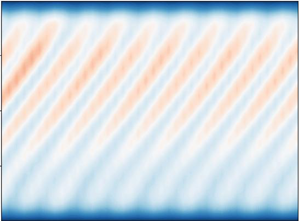
We use direct numerical simulations to study convection in rotating Rayleigh–Bénard convection in horizontally confined geometries of a given aspect ratio, with the walls held at fixed temperatures. We show that this arrangement is unconditionally unstable to flow that takes the form of wall-adjacent convection rolls. For wall temperatures close to the temperatures of the upper or lower boundaries, we show that the base state undergoes a Hopf bifurcation to a state comprised of spatiotemporal oscillations – ‘wall modes’ – precessing in a retrograde direction. We study the saturated nonlinear state of these modes, and show that the velocity boundary conditions at the upper and lower boundaries are crucial to the formation and propagation of the wall modes: asymmetric velocity boundary conditions at the upper and lower boundaries can lead to prograde wall modes, while stress-free boundary conditions at both walls can lead to wall modes that have no preferred direction of propagation.
The chapter shows how classical interpolation problems of various types (Schur, Nevanlinna–Pick, Hermite–Fejer) carry over and generalize to the time-variant and/or matrix situation. We show that they all reduce to a single generalized constrained interpolation problem, elegantly solved by time-variant scattering theory. An essential ingredient is the definition of the notion of valuation for time-variant systems, thereby generalizing the notion of valuation in the complex plane provided by the classical z-transform.
In practice, sometimes an estimate of the carrier phase for coherent signal reception is not possible with sufficient accuracy or carrier phase synchronization is not possible at all, in particular, in situations of very fast varying channel conditions (e.g., Doppler effect due to fast-moving transmitters or receivers). For such scenarios, digital transmission schemes have to be applied which are robust to non-perfect carrier frequency and carrier phase estimation. To that end we consider differential PSK which can tolerate phase errors and, to some amount, frequency errors. Then, schemes, which does not require phase (and frequency) synchronization at all, so-called non-coherent demodulation schemes, are developed and analyzed in detail.
This chapter introduces a different kind of problem, namely direct constrained matrix approximation via interpolation, the constraint being positive definiteness. It is the problem of completing a positive definite matrix for which only a well-ordered partial set of entries is given (and also giving necessary and sufficient conditions for the existence of the completion) or, alternatively, the problem of parametrizing positive definite matrices. This problem can be solved elegantly when the specified entries contain the main diagonal and further entries crowded along the main diagonal with a staircase boundary. This problem turns out to be equivalent to a constrained interpolation problem defined for a causal contractive matrix, with staircase entries again specified as before. The recursive solution calls for the development of a machinery known as scattering theory, which involves the introduction of nonpositive metrics and the use of J-unitary transformations where J is a sign matrix.
This chapter presents an alternative theory of external and coprime factorization, using polynomial denominators in the noncommutative time-variant shift Z rather than inner denominators as done in the chapter on inner–outer theory. “Polynomials in the shift Z” are equivalent to block-lower matrices with a support defined by a (block) staircase, and are essentially different from the classical matrix polynomials of module theory, although the net effect on system analysis is remarkably similar. The polynomial method differs substantially and in a complementary way from the inner method. It is computationally simpler but does not use orthogonal transformations. It offers the possibility of treating highly unstable systems using unilateral series. Also, this approach leads to famous Bezout equations that, as mentioned in the abstract of Chapter 7, can be derived without the benefit of Euclidean divisibility methods.
A general view on digital modulation schemes beyond the concept of PAM is developed. This is required as many important modulation formats (e.g., digital frequency modulation) do not fall under the umbrella of PAM. To that end, the separation between the operations of coding and modulation is unambiguously defined. The key tool for the analysis and synthesis of transmission schemes is the representation of signals in a signal space. The concept is introduced and discussed in detail. Based on this view, methods for optimum coherent and non-coherent signal reception for any kind of general digital modulation scheme are derived. The principles of maximum-likelihood detection and maximum-likelihood sequence detection are discussed.