Refine search
Actions for selected content:
212897 results in Engineering
Real-time bremsstrahlung detector as a monitoring tool for laser–plasma proton acceleration
-
- Journal:
- High Power Laser Science and Engineering / Volume 12 / 2024
- Published online by Cambridge University Press:
- 29 October 2024, e57
-
- Article
-
- You have access
- Open access
- HTML
- Export citation
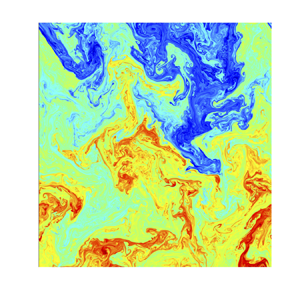
Two-dimensional Rayleigh–Bénard convection without boundaries
-
- Journal:
- Journal of Fluid Mechanics / Volume 998 / 10 November 2024
- Published online by Cambridge University Press:
- 29 October 2024, A27
-
- Article
-
- You have access
- Open access
- HTML
- Export citation
-
We study the effects of Prandtl number $\mathit {Pr}$ and Rayleigh number $\mathit {Ra}$ in two-dimensional Rayleigh–Bénard convection without boundaries, i.e. with periodic boundary conditions. For Prandtl numbers in the range $10^{-3} \leqslant \mathit {Pr} \leqslant 10^2$, the viscous dissipation scales as $\epsilon _\nu \propto \mathit {Pr}^{1/2}\mathit {Ra}^{-1/4}$, which is based on the observation that enstrophy $\langle {\omega ^2}\rangle \propto \mathit {Pr}^0 \mathit {Ra}^{1/4}$, and the Nusselt number tends to follow the ‘ultimate’ scaling $\mathit {Nu} \propto \mathit {Pr}^{1/2}\mathit {Ra}^{1/2}$ for all values of $\mathit {Pr}$ considered. The inverse cascade of kinetic energy forms the power-law spectrum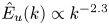 $\hat {E}_u(k) \propto k^{-2.3}$, which is close to $k^{-11/5}$ proposed by the Bolgiano–Obukhov (BO) scaling. The potential energy flux is not constant, in contrast to one of the main assumptions underlying the BO phenomenology. So, the direct cascade of potential energy forms the power-law spectrum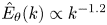 $\hat {E}_\theta (k) \propto k^{-1.2}$, which deviates from the expected $k^{-7/5}$. Finally, at $\mathit {Pr} \to 0$ and $\infty$, we find that the dynamics is dominated by vertically oriented elevator modes that grow without bound, even at high Rayleigh numbers and with large-scale dissipation present.


FLM volume 997 Cover and Front matter
-
- Journal:
- Journal of Fluid Mechanics / Volume 997 / 25 October 2024
- Published online by Cambridge University Press:
- 29 October 2024, p. f1
-
- Article
-
- You have access
- Export citation
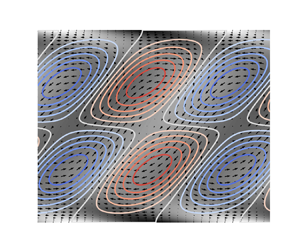
Linear stability analysis of oblique Couette–Poiseuille flows
-
- Journal:
- Journal of Fluid Mechanics / Volume 998 / 10 November 2024
- Published online by Cambridge University Press:
- 29 October 2024, A25
-
- Article
-
- You have access
- Open access
- HTML
- Export citation
-
We perform a detailed numerical study of modal and non-modal stability in oblique Couette–Poiseuille profiles, which are among the simplest examples of three-dimensional boundary layers. Through a comparison with the Orr–Sommerfeld operator for the aligned case, we show how an effective wall speed succinctly characterizes modal stability. Large-scale parameter sweeps reveal that the misalignment between the pressure gradient and wall motion is, in general, destabilizing. For flows that are sufficiently oblique, the instability is found to depend exclusively on the direction of wall motion and not on its speed, a conclusion supported, in part, by the perturbation energy budget and the evolution of the critical layers. Closed forms for the critical parameters in this regime are derived using a simple analysis. From a non-modal perspective, pseudoresonance is examined through the resolvent and the $\epsilon$-pseudospectra. An analysis of the unforced initial value problem shows that the maximum energy gain is highly dependent on both the magnitude and direction of the wall velocity. However, the strongest amplification is always achieved for configurations that are only weakly skewed. Finally, the optimal perturbations appear to develop via a lift-up effect enhanced by an Orr-like mechanism, the latter driven by cross-flow shear.

The Nusselt number of a hot sphere levitated by a volatile pool
-
- Journal:
- Journal of Fluid Mechanics / Volume 998 / 10 November 2024
- Published online by Cambridge University Press:
- 28 October 2024, A22
-
- Article
-
- You have access
- Open access
- HTML
- Export citation
-
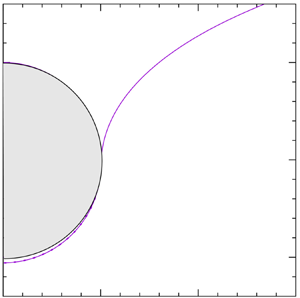
When placed at the surface of a volatile liquid, a sphere of hot dense non-volatile material remains suspended until it cools sufficiently. The duration of this ‘inverse Leidenfrost’ phenomenon depends on the Nusselt number $Nu$ of the sphere, itself determined by flow in the film of vapour separating particle and liquid. It is shown that provided the Nusselt number is large, it can be calculated numerically using only the Laplace relation and the equations governing the thin film; patching to a solution for the outer thick film is not necessary. This method is demonstrated by using it to determine $Nu$ for a sphere sufficiently small that in the governing equations, the acceleration due to gravity is negligible except where multiplied by the density of the sphere. Numerical results giving $Nu$ as a function of a dimensionless measure of sphere weight are supplemented with analysis showing that, when the weight is of the order of the maximum supportable by surface tension alone, the film consists of a spherical bubble cap bounded by its contact rim. The solutions for these regions are coupled: although the apparent contact angle $\chi$ for the cap is determined within the rim, its value depends on the flow rate arriving from the cap as well as on the additional evaporation from the rim. The latter acts to reduce $\chi$ from the value it would otherwise have, thereby reducing the thickness of the entire cap. For the example treated here, the value of $Nu$ is doubled by this mechanism.


Scaling laws for Rayleigh–Bénard convection between Navier-slip boundaries
-
- Journal:
- Journal of Fluid Mechanics / Volume 998 / 10 November 2024
- Published online by Cambridge University Press:
- 28 October 2024, A24
-
- Article
-
- You have access
- Open access
- HTML
- Export citation
-
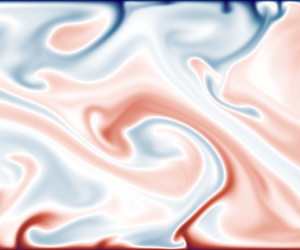
We consider the two-dimensional Rayleigh–Bénard convection problem between Navier-slip fixed-temperature boundary conditions, and present a new upper bound for the Nusselt number ( ${\textit {Nu}}$). The result, based on a localization principle for the Nusselt number and an interpolation bound, exploits the regularity of the flow. On one hand our method yields a shorter proof of the celebrated result of Whitehead & Doering (Phys. Rev. Lett., vol. 106, 2011, 244501) in the case of free-slip boundary conditions. On the other hand, its combination with a new, refined estimate for the pressure gives a substantial improvement of the interpolation bounds in Drivas et al. (Phil. Trans. R. Soc. A, vol. 380, issue 2225, 2022, 20210025) for slippery boundaries. A rich description of the scaling behaviour arises from our result: depending on the magnitude of the Prandtl number ( ${\textit {Pr}}$) and slip length, our upper bounds indicate five possible scaling laws (where ${\textit {Ra}}$ is the Rayleigh number): ${\textit {Nu}}\sim (L_s^{-1}\,{\textit {Ra}})^{{1}/{3}}$, ${\textit {Nu}}\sim (L_s^{-2/5}\,{\textit {Ra}})^{{5}/{13}}$, ${\textit {Nu}}\sim {\textit {Ra}}^{{5}/{12}}$, ${\textit {Nu}}\sim {\textit {Pr}}^{-1/6}(L_s^{-4/3}\,{\textit {Ra}})^{{1}/{2}}$ and ${\textit {Nu}}\sim {\textit {Pr}}^{-1/6}(L_s^{-1/3}\,{\textit {Ra}})^{{1}/{2}}$.


From biodesigners to designers in lab: testing the nuances of an emerging profession through autoethnography
-
- Journal:
- Research Directions: Biotechnology Design / Volume 2 / 2024
- Published online by Cambridge University Press:
- 28 October 2024, e20
-
- Article
-
- You have access
- Open access
- HTML
- Export citation
Crystal structure of cariprazine dihydrochloride, C21H34Cl2N4OCl2
-
- Journal:
- Powder Diffraction / Volume 40 / Issue 1 / March 2025
- Published online by Cambridge University Press:
- 28 October 2024, pp. 89-93
-
- Article
-
- You have access
- Open access
- HTML
- Export citation
Geometrical analysis of naturally grown timber for the design of load-bearing structures
-
- Journal:
- Research Directions: Biotechnology Design / Volume 2 / 2024
- Published online by Cambridge University Press:
- 28 October 2024, e19
-
- Article
-
- You have access
- Open access
- HTML
- Export citation
Sampling volumes in powder diffraction experiments
-
- Journal:
- Powder Diffraction / Volume 40 / Issue 1 / March 2025
- Published online by Cambridge University Press:
- 28 October 2024, pp. 44-56
-
- Article
-
- You have access
- Open access
- HTML
- Export citation
GNSS interference detection: Methodology utilising ADS-B NACp indicator and GPS almanac data
-
- Journal:
- The Aeronautical Journal / Volume 129 / Issue 1331 / January 2025
- Published online by Cambridge University Press:
- 28 October 2024, pp. 206-223
-
- Article
- Export citation
Transition flight of a concept of lifting-wing quadcopter
-
- Journal:
- The Aeronautical Journal / Volume 129 / Issue 1332 / February 2025
- Published online by Cambridge University Press:
- 28 October 2024, pp. 411-431
-
- Article
- Export citation

Onset of global instability in a premixed annular V-flame
-
- Journal:
- Journal of Fluid Mechanics / Volume 998 / 10 November 2024
- Published online by Cambridge University Press:
- 28 October 2024, A23
-
- Article
- Export citation

Continuum Thermodynamics and Material Modelling
-
- Published online:
- 25 October 2024
- Print publication:
- 13 June 2024
-
- Textbook
- Export citation

Exploration on flutter mechanism of a damaged transonic rotor blade using high-fidelity fluid–solid coupling method
-
- Journal:
- Journal of Fluid Mechanics / Volume 998 / 10 November 2024
- Published online by Cambridge University Press:
- 25 October 2024, A15
-
- Article
- Export citation

A numerical study on the oscillatory dynamics of tip vortex cavitation
-
- Journal:
- Journal of Fluid Mechanics / Volume 998 / 10 November 2024
- Published online by Cambridge University Press:
- 25 October 2024, A13
-
- Article
- Export citation
-
In this paper, we numerically study the mechanism of the oscillatory flow dynamics associated with the tip vortex cavitation (TVC) over an elliptical hydrofoil section. Using our recently developed three-dimensional variational multiphase flow solver, we investigate the TVC phenomenon at Reynolds number $Re = 8.95 \times 10^5$ via dynamic subgrid-scale modelling and the homogeneous mixture theory. To begin, we examine the grid resolution requirements and introduce a length scale considering both the tip vortex strength and the core radius. This length scale is then employed to non-dimensionalize the spatial resolution in the tip vortex region, the results of which serve as a basis for estimation of the required mesh resolution in large eddy simulations of TVC. We next perform simulations to analyse the dynamical modes of tip vortex cavity oscillation at different cavitation numbers, and compare them with the semi-analytical solution. The breathing mode of cavity surface oscillation is extracted from the spatial-temporal evolution of the cavity's effective radius. The temporally averaged effective radius demonstrates that the columnar cavity experiences a growth region followed by decay as it progresses away from the tip. Further examination of the characteristics of local breathing mode oscillations in the growth and decay regions indicates the alteration of the cavity's oscillatory behaviour as it travels from the growth region to the decay region, with the oscillations within the growth region being characterized by lower frequencies. For representative cavitation numbers $\sigma \in [1.2,2.6]$, we find that pressure fluctuations exhibit a shift of the spectrum towards lower frequencies as the cavitation number decreases, similar to its influence on breathing mode oscillations. The results indicate the existence of correlations between the breathing mode oscillations and the pressure fluctuations. While the low-frequency pressure fluctuations are found to be correlated with the growth region, the breathing mode oscillations within the decay region are related to higher-frequency pressure fluctuations. The proposed mechanism can play an important role in developing mitigation strategies for TVC, which can reduce the underwater radiated noise by marine propellers.


Rapidly rotating radiatively driven convection: experimental and numerical validation of the ‘geostrophic turbulence’ scaling predictions
-
- Journal:
- Journal of Fluid Mechanics / Volume 998 / 10 November 2024
- Published online by Cambridge University Press:
- 25 October 2024, A9
-
- Article
-
- You have access
- Open access
- HTML
- Export citation

On the kinetics of internal gravity waves beyond the hydrostatic regime
-
- Journal:
- Journal of Fluid Mechanics / Volume 998 / 10 November 2024
- Published online by Cambridge University Press:
- 25 October 2024, A17
-
- Article
- Export citation

Melting and solidification in periodically modulated thermal convection
-
- Journal:
- Journal of Fluid Mechanics / Volume 998 / 10 November 2024
- Published online by Cambridge University Press:
- 25 October 2024, A10
-
- Article
-
- You have access
- Open access
- HTML
- Export citation
Highway digital twin-enabled Autonomous Maintenance Plant: a perspective
- Part of
-
- Journal:
- Data-Centric Engineering / Volume 5 / 2024
- Published online by Cambridge University Press:
- 25 October 2024, e24
-
- Article
-
- You have access
- Open access
- HTML
- Export citation
