To save content items to your account,
please confirm that you agree to abide by our usage policies.
If this is the first time you use this feature, you will be asked to authorise Cambridge Core to connect with your account.
Find out more about saving content to .
To save content items to your Kindle, first ensure no-reply@cambridge.org
is added to your Approved Personal Document E-mail List under your Personal Document Settings
on the Manage Your Content and Devices page of your Amazon account. Then enter the ‘name’ part
of your Kindle email address below.
Find out more about saving to your Kindle.
Note you can select to save to either the @free.kindle.com or @kindle.com variations.
‘@free.kindle.com’ emails are free but can only be saved to your device when it is connected to wi-fi.
‘@kindle.com’ emails can be delivered even when you are not connected to wi-fi, but note that service fees apply.
In arid and semiarid coastal areas, freshwater resources are scarce and are frequently affected by salinization processes. The aim of this work is to evaluate the influence of Late Quaternary climatic events on the hydrogeologic characteristics conditioning the distribution of fresh, brackish, and saline ground water in the Holocene and Pleistocene beach ridges in coastal aquifers of northern Patagonia. To achieve this, geologic, geomorphological, geophysical, hydrochemical, and isotopic studies were carried out, which allowed the identification of the hydrolithologic characteristics controlling groundwater salinity in a context of Quaternary geologic–geomorphological–climatic evolution. In Pleistocene beach ridges, it was recognized that the formation of calcretes in an arid period after Marine Isotope Stage (MIS) 5e conditioned the permeability of superficial sediments, strongly decreasing infiltration rates. During the Holocene, beach ridges were deposited and sea water entered the Pleistocene ridges. Subsequently, with the sea-level drop and wetter climatic conditions, rainwater began to infiltrate, recharging the aquifers and displacing seawater, allowing development of freshwater lenses. However, freshwater lenses only developed in Holocene ridges due to the lower permeability of Pleistocene ridges, which determines that in these geoforms, sea water cannot be displaced by rainwater, and therefore groundwater is brackish to saline.
Large stratovolcanoes in the Cascade Range have high equilibrium-line altitudes that support glaciers whose Holocene and latest Pleistocene advances are amenable to dating. Glacier advances produced datable stratigraphic sequences in lateral moraines, which complement dating of end moraines. New mapping of glacial deposits on Mount Rainier using LIDAR and field observations supports a single latest Pleistocene or early Holocene advance. Rainier R tephra overlies deposits from this advance and could be as old as >11.6 ka; the advance could be of Younger Dryas age. Radiocarbon ages on wood interbedded between tills in the lateral moraines of Nisqually, Carbon, and Emmons glaciers and the South Tahoma glacier forefield suggest glacier advances between 200 and 550 CE, correlative with the First Millennium Advance in western Canada, and during the Little Ice Age (LIA) beginning as early as 1300 CE.
These results resolve previous contradictory interpretations of Mount Rainier's glacial history and indicate that the original proposal of a single pre-Neoglacial cirque advance is correct, in contrast to a later interpretation of two advances of pre- and post-Younger Dryas age, respectively. Meanwhile, the occurrence of the pre-LIA Burroughs Mountain Advance, interpreted in previous work as occurring 3–2.5 ka, is questionable based on inherently ambiguous interpretations of tephra distribution.
Prehistoric and historic iron metallurgy in the Holy Cross Mountains in central Poland developed along with human Przeworsk Culture activity (during the Roman period) and within the boundaries of the Old-Polish Industrial District (OPID) during the Middle Ages and during recent centuries. At the Świślina catchment, there are many archaeological sites showing intense prehistoric metallurgical activity. The later medieval and modern iron industry was significantly smaller. At the Doły Biskupie site, slags and microscopic iron spherules (hammerscales) were found in alluvia. The microscopic spherules separation method (MSS) enabled analysis of these small artefacts created during iron ore smelting and forging. Iron spherules were detected in floodplain sediments, which are characterized by increased content of trace elements. The presence of these artefacts in shallow sediment layers in the confluence section of the river may be an indicator of archaeologically confirmed prehistoric metallurgical activity in the catchment area. Study of these residues enabled an attempt to reconstruct the river valley environment during the prehistoric and historical period. The MSS method can be used to detect iron spherules in alluvia in other river catchments, confirming the presence of yet-undiscovered bloomery sites.
Reconstructing the Mid-Holocene climate change in arid and semiarid areas can help predict regional moisture availability and resultant lake evolution and vegetation changes due to future warming. Here, we present a sediment core (YLH15A) from Moon Lake in the Tengger Desert, arid and semiarid China. Based on robust accelerator mass spectrometry 14C dating and multiproxy analyses (pollen, grain size, elements, and total organic carbon), we reconstructed regional climate changes since 7.6 cal ka BP. The climate was generally dry from 7.6 to 2.8 cal ka BP, as indicated by the dried-up lake, strong aeolian activities, and no vegetation, except for a short-term wet interval between 5.4 and 4.9 cal ka BP. The generally dry climate shifted after 2.8 cal ka BP, which is suggested by expanded steppe desert/steppe and increased vegetation cover; it was also accompanied by lake development, which was likely related to increased groundwater recharge originating from regional precipitation and temporary floods from adjacent mountain areas. Our results reveal a prolonged dry Mid-Holocene and relatively wet Late Holocene that are basically consistent with climatic records from the central–east Asian arid and hyperarid areas. The prolonged dry climate in the arid and hyperarid areas is likely to be related to high evaporation triggered by high temperatures during the Middle Holocene.
Connecting changes in erosion and vegetation is necessary for predicting topographic and ecologic change in thawing permafrost landscapes. Formerly periglacial landscapes serve as potential analogs for understanding modern permafrost landscape change, yet compared to paleoenvironmental records at these sites, less is known about concurrent geomorphic processes, particularly their rates and relationships to climate change. Here, we target sediments preserved in a central Appalachian peat bog to reconstruct sedimentation across the last deglacial warming. We use ground-penetrating radar and geochemistry of cored bog sediments to quantify sedimentation timing, style, and provenance. Using 14C dating of sedimentary and geochemical shifts, we connect depositional changes to global climate and local vegetation change. We show that deglacial warming promoted deep soil disturbances via solifluction at ca. 14 ka. In contrast, relatively wetter conditions from ca. 10–9 ka promoted shallow disturbance of hillslopes via slopewash, which corresponds to a time of vegetation change. Our results highlight climate-modulated erosion depth and processes in periglacial and post-periglacial landscapes. The existence of similar erosion and vegetation records preserved regionally implies these dynamics were pervasive across unglaciated Appalachian highlands, aiding in reconstructing erosion responses to warming at a resolution with implications for predicting high-latitude landscape responses to disturbance.
The concept of a loess transportation surface portends that saltating sands deflate silt/dust and send them into suspension. This process continues until a topographic barrier stops the saltating sand, allowing loess deposits to accumulate downwind. This paper reports on loess transportation surfaces in west-central Wisconsin, USA. During the postglacial period, cold, dry conditions coincided with strong northwesterly winds to initiate widespread saltation of freely available sands, deflating any preexisting loess deposits. Large parts of the study area are transportation surfaces, and lack loess. Loess deposits were only able to accumulate at “protected” sites—downwind from (east of) topographic barriers, such as isolated bedrock uplands and the north-to-south flowing Black River. Loess in locations from these barriers is thicker (sometimes >5 m) than would be expected, and in places has even accumulated above preexisting loess deposits. For example, downwind (east) of the Black River, most of the low-relief landscape is covered with ≈40–70 cm of silty loess, even though it is many tens of kilometers from the initial loess source. Upwind of the river, on the transportation surface, the low-relief landscape is only intermittently mantled with thin, scattered deposits of silty-sandy eolian sediment, and generally lacks loess.
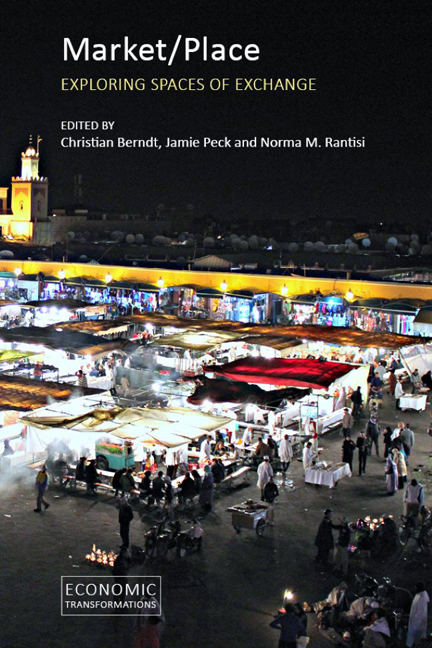
The term 'market' originally portrayed a public space for economic transactions but the term has since evolved into an abstract and disputed idea. Despite modern markets seemingly omnipresent nature, their specific geographies have undergone relatively little analysis.
This collection of new essays rediscovers the physical space that markets inhabit and explore how the impact of political, social and economic factors determine the shape of a particular market space. The essays present new research from the fields of geography, economics, political economy and planning and provide valuable case study material to show how markets are contested, constructed and placed. Rather than separate markets from the surrounding society and state, these essays connect markets to their wider context and showcase how economic geography can combine with other disciplines to throw new light on spaces of exchange.
Accessing and retaining adequate housing can be a major challenge for low-income city residents, particularly women trying to escape domestic abuse. Focusing on housing struggles amidst urban poverty, this article explores a specific kind of gender-based violence – violation of women's property rights – recognised by Latin American legal systems as ‘patrimonial violence against women’. Drawing on qualitative research in Brazil, this article shows how women are likely to experience gendered evictions and dispossession, and why patrimonial violence against women remains largely misunderstood and underreported, despite legal progress. The discussion expands current understandings of the interplay between gender, violence (explicit or otherwise) and the reproduction of asset inequalities.
Kent, with its long coastline and its important geopolitical position close to London and continental Europe, and on major trading routes between Britain and the wider world, has had a very significant maritime history. This book covers a wide range of topics relating to that history from the earliest times to the present day. It sets Kent's varied coastline and waters in their geological and geographical context, showing how erosion and sediment deposition have contributed to the changing nature of maritime activities and populations. It examines Kent's strategic role in the defence of the country with the development and redevelopment of coastal defences, including four naval dockyards. It goes on to consider the supporting industries which grew up around the coastline, those which supplied raw materials and agricultural products from the county's hinterland, and its wider national and international trading links. It also discusses the diverse coastal communities of Kent and how they have changed in response to the demands of defence, trade, and changing population and migration patterns. In addition, the book includes detailed case studies which explore particular subject areas as exemplars of the major themes covered by the book.
Part III outlined the weaknesses of the measures that were intended to ensure paymaster accountability and the challenges that the crown faced in gathering the information that would have better enabled it to control the activities of the trésoriers. Part IV argues that a mismatch between the navy's funding needs and the structure of its financing mechanism developed over the course of the seventeenth century. It investigates the organisational expedients that were deployed by the crown in managing the office of trésorier as both purchasable property and as a means of mobilising private access to credit. Chapter Nine begins by considering the long-term consequences of efforts to improve the effectiveness of the naval treasury in the first half of the seventeenth century, particularly during the ministry of Cardinal Richelieu when he built his power base in maritime affairs. In doing so, the chapter principally draws upon the archival research of Henri Legohérel and Alan James, but it examines the ramifications of their findings in the light of the naval treasury's eventual failure in the War of the Spanish Succession. Chapter Ten then outlines the pattern of office ownership that was encouraged during Louis XIV's reign and examines how the naval treasury developed in a way that was incompatible with the demands of funding the navy when it mobilised for war in the 1690s. The consequence of treating the office of trésorier as a marketable investment was that the French navy came to rely on the financial strength of only one trésorier until 1692, and that the financial rewards of acting as trésorier were structured in a way that secured office values but failed to indemnify officeholders against the rising costs of naval warfare.
The cumulative effects of overspending and underfunding, as well as the extent to which the trésoriers were limiting payments according to their personal financial situations, caused the navy to become cash-flow insolvent over the course of 1707 to 1709. The diminishing levels of liquidity had disastrous consequences for naval procurement, and the inability to acquire essential materials translated short-term funding issues into years of operational paralysis. Procurement was a lengthy and complex process that drained the trésoriers’ cash and involved an extensive network of suppliers who relied on a schedule of regular payments in advance of delivery. This was particularly the case in the arms industry, where cash was needed to finance large capital investments. For example, a munitions order with the St Gervais foundry, which supplied Toulon's arsenal with 73 cannons, required 72 per cent of its value acquitted at least four to five months before the first consignment of cannons was delivered in October 1706. However, as the trésoriers had to devote a disproportionate amount of resources and time to addressing unsettled debts from previous exercices, the navy could no longer afford or keep up with these upfront payments and regular disbursements that contractors required. Increasing interruptions in the settlement of procurement bills damaged suppliers’ confidence and created further dysfunction: for instance, in two comparable deliveries of hemp from Auvergne to Nantes and Rochefort during the exercices of 1705 and 1706, the delay between the initial and final payments of the orders grew from nine to 22 months. Moreover, when the suppliers were paid, they increasingly received illiquid credit instruments that became untradeable as faith in the trésoriers’ credit eroded. Contractors thereafter sought cash guarantees or the ability to bypass the trésoriers and deal directly with the crown's revenue agents, but as these demands became prohibitive, naval administrators were left unable to sign many suppliers to new contracts, even with the enticement of price increases. This left the navy in an ‘unfortunate state’, as Pontchartrain described the situation in the spring of 1707, and contributed to a precipitous drop in procurement spending, which fell 44 per cent from 9.6 million l. to 5.4 million l. between 1705 and 1707.
The availability of cash to the navy was significantly reduced during the exercice of 1707.
This chapter provides an essential overview of the wider financial environment in which the French navy was administered under Louis XIV. In outlining Louis XIV's financial position, it focuses attention on the reasons behind increased military expenditure between 1701 and 1713 and investigates how overspending affected France's revenue-raising system. While the monarchy's financial position was unsustainably leveraged to the point of collapse to meet the costs of war, Louis XIV's revenue-raising system demonstrated a degree of adaptability and resilience in finding ways to shift the burden of debt onto fiscal stakeholders and corporate bodies. However, reliance on fiscal and financial intermediaries in the crown's taxation and expenditure systems would lead to a power imbalance between the state and its agents as office-holders engaged in increasingly risky practices to meet the crown's fiscal demands and spending needs. The chapter gives further evidence for Guy Rowlands's recent corrective that the French monarchy's fiscal problems were expenditure-driven rather than the issue being a limited revenue-raising capacity, thus providing a more accurate context to Louis XIV's growing inability to fund his navy.
Costs of War, 1701–13
The prolonged nature and geographic extent of Louis XIV's military mobilisations over the course of the Nine Years’ War and the War of the Spanish Succession inflicted enormous financial strain upon France, burdening the monarchy with accumulated debts of at least 1.5 billion l., as estimated by a printed état de dépense (statement of expenses) in 1721. In addition, the capital invested by provincial and Parisian elites in interest-bearing offices would have likely stood at a net 666 million l. in 1721 after 454 million l. worth of liabilities were wiped out following the suppression of certain offices and augmentations de gages in the years surrounding the Chambre de justice in 1716. The crown's total financial liabilities in 1720 therefore stood at an estimated 2.2 billion l., which represented a nine-fold increase on debt levels in 1683, assessed at 240 million l. at the time of Jean-Baptiste Colbert's death. Unsurprisingly, the debt amassed during the final decades of Louis's reign was overwhelmingly generated by military expenses, with the naval treasury and the army's financing arm, the Extraordinaire des Guerres, accounting for at least 51 per cent of total expenditure, reaching nearly 3.5 billion l. between 1689 and 1707, according to Forbonnais's figures.