To save content items to your account,
please confirm that you agree to abide by our usage policies.
If this is the first time you use this feature, you will be asked to authorise Cambridge Core to connect with your account.
Find out more about saving content to .
To save content items to your Kindle, first ensure no-reply@cambridge.org
is added to your Approved Personal Document E-mail List under your Personal Document Settings
on the Manage Your Content and Devices page of your Amazon account. Then enter the ‘name’ part
of your Kindle email address below.
Find out more about saving to your Kindle.
Note you can select to save to either the @free.kindle.com or @kindle.com variations.
‘@free.kindle.com’ emails are free but can only be saved to your device when it is connected to wi-fi.
‘@kindle.com’ emails can be delivered even when you are not connected to wi-fi, but note that service fees apply.
This article explores how Protestants defended the co-existence of multiple translations of the Bible into English in Elizabethan England. The matter of biblical plurality is considered through the prism of the debates surrounding bible translation which occurred throughout the 1580s between the Catholic translator of the Bible into English, Gregory Martin (c. 1542–1582), and the English Protestant polemicist William Fulke (1537/8–1589). It is contended that this debate, which has tended to be cast as a storm in a teacup, reveals how Protestants responded, innovatively, to the publication of the Catholic English New Testament. Attention is paid to how Martin attacked the existence of the many different Protestant English bible translations in circulation and, reciprocally, how Fulke defended them. This study of the Martin and Fulke debate thereby unsettles some long-standing assumptions about the combative relationship between different versions of the English Bible and it points, instead, to ways in which contemporaries might have seen the plurality of translations as spiritually and polemically advantageous. Fulke's arguments help us to comprehend how, prior to early seventeenth-century attempts to restrict the existence of multiple English bibles, some Elizabethans responded to, and even defended, the plurality of English bible translations which had come to exist.
During the French Revolution, thousands of revolutionaries and royalists fled the turmoil in French islands. Many went to nearby islands, from which they could observe events. Situated between Martinique and Guadeloupe, Dominica had a majority French population and a long history of connection with its French neighbors. This article uses the case of Dominica to explore the effects of the French Revolution on a non-French island in the Eastern Caribbean. From the start, its proximity to the French islands led to its entanglement in revolutionary politics. It was the first British island to receive refugees, and the influx of people of all racial, social, and political backgrounds into Dominica posed challenges for island officials. Officials had to determine on what terms to admit emigrants, whether they posed a threat to the colony, and how to feed and house them. They also worried about the influences of foreigners and revolutionary ideas on their own disaffected free and enslaved populations. This article argues that Dominica's location, heterogeneous population, and internal instability allowed it to become a node for regional migration and information networks that embroiled it in the turmoil that engulfed its neighbors and ultimately threatened British control of the island.
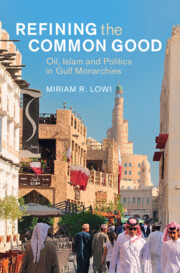
How has Islam as a set of beliefs and practices shaped the allocation of oil revenues in Arab Gulf monarchies? In turn, how has oil wealth impacted the role of Islamic doctrine in politics? Refining the Common Good explores the relationship between Islamic norms and the circulation of oil wealth in Gulf monarchies. The study demonstrates how both oil (revenues) and Islam (as doctrine) are manipulated as tools of state power, and how religious norms are refined for the sake of achieving narrow secular interests. Miriam R. Lowi examines different institutionalized practices financed by hydrocarbon revenues and sanctioned, either implicitly or explicitly, by Islam, and uses evidence from Kuwait, Qatar, Oman and Saudi Arabia to show how these practices are infused with political purpose. The dynamic relationship between oil wealth and Islamic doctrine is exploited to contribute to the management and control of society, and the consolidation of dynastic autocracy.
The site of Guiengola is an example of one of the settlements built by the Zapotecs during their fourteenth- to fifteenth-century migration to the Southern Isthmus of Tehuantepec. Although Guiengola is well known in the ethnohistorical record as being the place where the Mexica armies were defeated by Zapotec forces during the late fifteenth century, the full extension of the site was previously unknown. Despite evidence of a dense population at the site, it has been mistakenly characterized as a fortress for housing soldiers and troops from the nearby town of Tehuantepec. Here, I present the research of the Guiengola Archeological Project, which conducted a lidar scan and archaeological surveys between 2018 and 2023. In this article, I share a comprehensive map of Guiengola, a Postclassic Mesoamerican city. My analysis identifies a large settlement that covered 360 ha and included a walled system of fortifications, an internal road network, and a hierarchically organized city. The findings of this project expand our understanding of the variations and social divisions in the city's internal urban organization, which in turn, allow us to deepen our comprehension of the transition to the Early Colonial barrio organization of Tehuantepec.
Labor historians, particularly in the United States, have given unique attention to the International Longshore and Warehouse Union (ILWU). Emerging out of a series of tumultuous strikes on the West Coast during the early Depression years, the ILWU won trend-setting employment contracts, survived Second Red Scare-era persecution despite keeping avowedly leftwing leadership, and maintained its presence on the docks even after containerization dramatically reshaped the longshore industry. This review examines multiple recent works on the ILWU, noting new interventions—both in ILWU history and labor history, more broadly. All three reviewed works offer invaluable insight for how contemporary unions can adapt to technological changes in the workplace, foster internal democracy, and build labor power while fighting for social justice. The review concludes by offering potential avenues for further scholarly research, particularly on the nature of leftwing unionism and labor-generated alternatives to deindustrialization and workforce displacement.
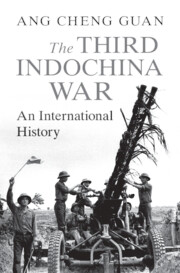
The Third Indochina War – comprised of the Vietnam-Kampuchea War from 1978 to 1990 and the brief Sino-Vietnamese War in February 1979 – has received far less scholarly attention than the earlier two Indochina Wars. Ang Cheng Guan utilises a wide range of archival and secondary material, including Vietnamese, Cambodian, Chinese, Soviet, American, British, Australian and ASEAN sources, to provide a comprehensive new analysis of the conflict. By carefully reconstructing its chronology, Ang traces the life-cycle of the war from its origins, through the conduct of military engagements, to its eventual resolution. He focuses on multiple actors simultaneously, highlighting the inter-connected perspectives of the war's major protagonists – Vietnam, Cambodia and China. In demonstrating the roles of the USSR, the US and ASEAN in both prolonging and ending the conflict, he situates the Third Indochina War fully in its Asian, global and Cold War contexts.
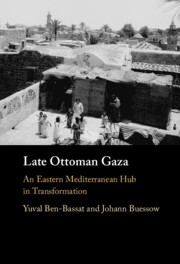
In contemporary public discourse, Gaza tends to be characterized solely as a theatre of the ongoing conflict between Israel and the Palestinians. However, little is known about Gaza's society, politics, economy, and culture during the Ottoman era. Drawing on a range of previously untapped local and imperial sources, Yuval Ben-Bassat and Johann Buessow explore the city's history from the mid-nineteenth century through WWI. They show that Gaza's historical importance extends far beyond the territory of the 'strip' since the city was an important hub for people, goods, and ideas in the Eastern Mediterranean from Antiquity until the twentieth century. Using new digital methodologies, Ben-Bassat and Buessow introduce readers to the world of Gazans from various walks of life, from the traditional Muslim elites to the commoners and minority communities of Christians and Jews. In so doing, they tell the lively story of this significant but frequently misunderstood city.
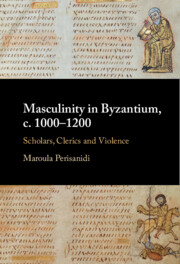
What does it mean to be a man? What makes one effeminate or manly? What renders a man 'Byzantine'? Drawing from theories of gender, posthumanism and disability, this book explores the role of learning, violence and animals in the construction of Byzantine masculinities. It foregrounds scholars and clerics, two groups who negotiated the hegemonic ideal of male violence in contrasting and unexpected ways. By flaunting their learning, scholars accumulated enough masculine capital to present more “feminine” emotional dispositions and to reject hunting and fighting without compromising their masculinity. Clerics often appear less peaceable. Some were deposed for fighting, while many others seem to have abandoned their roles to pursue warfare, demonstrating the fluidity of religious and gender identity. For both clerics and scholars, much of this gender-work depended on animals, whose entanglements with humans ranged from domination to mutual transformation.
Why did so many rulers throughout history risk converting to a new religion brought by outsiders? In his award-winning Unearthly Powers (2019), Alan Strathern set out a theoretical framework for understanding the relation between religion and political authority based on a distinction between two kinds of religion - immanentism and transcendentalism - and the different ways they made monarchy sacred. This ambitious and innovative companion volume tests and substantiates this approach using case studies from Kongo (1480–1530), Japan (1560–1614), Ayutthaya (Thailand, 1660–1690) and Hawaii (1800–1830). Through in-depth analysis of key turning points in the careers of warlords, chiefs and kings, a tapestry of unique characters and stories is brought to light. However, these examples ultimately demonstrate that global patterns of conversion can be established to illuminate the religious geography of the world today.
When confronted with the abject fear of going into battle, Civil War soldiers were expected to overcome the dread of the oncoming danger with feats of courage and victory on the battlefield. The Fire Zouaves and the 2nd Texas Infantry went to war with high expectations that they would perform bravely; they had famed commanders and enthusiastic community support. How could they possibly fail? Yet falter they did, facing humiliating charges of cowardice thereafter that cast a lingering shadow on the two regiments, despite their best efforts at redemption. By the end of the war, however, these charges were largely forgotten, replaced with the jingoistic rhetoric of martial heroism, a legacy that led many, including historians, to insist that all Civil War soldiers were heroes. Dread Danger creates a fuller understanding of the soldier experience and the overall costs and sufferings of war.
The Introduction presents the perspective and main arguments of the book. It situates the book’s subject and approach in the historiography of the social sciences, delineates how it draws on historical epistemologies, and sketches how it contributes to histories of the politics of growth.
In the course of the 1960s, mathematical modeling gradually stabilized as the primary mode of academic economic research. The Epilogue sketches the fate of “the Solow model” as it consolidated as an epistemic standard for an intellectual practice that focused on refining mathematical artifacts and using them to estimate model-relationships in any given data sets. Building on the idea that it already developed a life of its own at Solow’s desk, the Epilogue inquires into the movements and transformations of the multifarious artifact. It was adapted, extended, and reduced in relation to specific local, institutional, and strategic arrangements in planning offices, universities, and research institutions. Sketching some of its trajectories in the field of growth accounting and macroeconomic management, I wonder how the model sedimented into knowledge infrastructures and how the model’s knowledge, as precarious as it might have been, was equipped with computability, prognostic potential, and policy effectiveness.
Chapter 3 traces the establishment and distribution of hydroelectricity in the early People’s Republic. Inheriting technical personnel from the defeated Nationalist regime, the Communist government worked to create its own infrastructure. This chapter argues that the cooperation between party leaders and “experts from the old society” functioned relatively smoothly until the rise of radical Maoism in 1958. The harnessing of rivers was matched and enabled by the taming of individuals with technical expertise.