To save content items to your account,
please confirm that you agree to abide by our usage policies.
If this is the first time you use this feature, you will be asked to authorise Cambridge Core to connect with your account.
Find out more about saving content to .
To save content items to your Kindle, first ensure no-reply@cambridge.org
is added to your Approved Personal Document E-mail List under your Personal Document Settings
on the Manage Your Content and Devices page of your Amazon account. Then enter the ‘name’ part
of your Kindle email address below.
Find out more about saving to your Kindle.
Note you can select to save to either the @free.kindle.com or @kindle.com variations.
‘@free.kindle.com’ emails are free but can only be saved to your device when it is connected to wi-fi.
‘@kindle.com’ emails can be delivered even when you are not connected to wi-fi, but note that service fees apply.
Stage 7 of the journey moves to utterance meaning and to various ways of explaining how speakers communicate more than what the sentence says. It introduces the intention-and-inference-based concept of meaning in Grice’s and post-Gricean pragmatics, travelling though maxims, principles, and heuristics proposed by various scholars of this orientation. It then moves to introducing (i) approaches that advocate the ‘maximalist’, contextualist semantic content and (ii) semantic minimalism that preserves a much clearer boundary between semantics and pragmatics – suggesting ‘food for thought’ at many points in the discussion.
This stage of the journey moves to ‘things speakers do with language’ in communication, covering a broad area from the literal-non-literal distinction and approaches to metaphor, through speech acts, ending with the ‘crossroads’ with ethical and social debates, such as those to do with negotiation and joint construction of meaning, questions of accountability and commitment (also in the case of lying and misleading), as well as politeness and appropriateness, including the use of taboo and offensive language. It offers a glimpse of how these topics benefit from an interdisciplinary manner of research and pauses with ample ‘food for thought’ questions on the way.
In Stage 5, the journey moves to meaning relations within sentences, introducing such topics of quantification (including generalized quantifiers), representing events and states, temporal, aspectual, and modal distinctions in semantics, and propositional attitude reports.
Stage 4 of the journey follows with an example of how implementation of a formal metalanguage helps with, but also hinders, the analysis of meaning of natural-language expressions. In particular, it addresses operations on sentences and introduces the connectives of propositional logic, assessing the degree of fit between them and their natural-language counterparts. In the process, it addesses the question of ambiguity and/or underspecification of the latter and concludes with some ‘food for thought’ on the usefulness of a formal semantic analysis.
This first stage of the journey introduces the concept of meaning in language and discourse, discusses the advantages of studying it at the interfaces of semantics, pragmatics, and philosopy, and moves to the correlates of meaning in the mind and in the world. It also addresses the question of the appropriate unit of study – a flexible type of proposition.
This stage of the journey offers an explanation of how truth conditions and truth-value judgements can be used in understanding sentence meaning, moving on to the role of a formal metalanguage, possible worlds, and models. As ‘food for thought’, it focuses on the importance of selecting a suitable formal language, introducing some options available in the formal semantic tradition, as well as on the cognitive reality of such approaches to meaning.
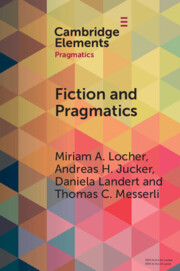
This Element outlines current issues in the study of the pragmatics of fiction. It starts from the premise that fictional texts are complex and multi-layered communicative acts which deserve attention in pragmatic research in their own right, and it highlights the need to understand them as cultural artefacts rich in possibilities to explore pragmatic effects and pragmatic theorising. The issues covered are (1) the participation structure of fictional texts, (2) the performance aspect of fictional texts, (3) the interaction between readers and viewers and the fictional texts, as well as (4) the pragmatic effects of drawing on indexical linguistic features for evoking ideologies in characterisation. This title is also available as Open Access on Cambridge Core.
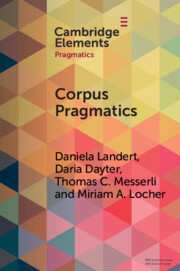
This Element discusses the challenges and opportunities that different types of corpora offer for the study of pragmatic phenomena. The focus lies on a hands-on approach to methods and data that provides orientation for methodological decisions. In addition, the Element identifies areas in which new methodological developments are needed in order to make new types of data accessible for pragmatic research. Linguistic corpora are currently undergoing diversification. While one trend is to move towards increasingly large corpora, another trend is to enhance corpora with more specialised and layered annotation. Both these trends offer new challenges and opportunities for the study of pragmatics. This volume provides a practical overview of state-of-the-art corpus-pragmatic methods in relation to different types of corpus data, covering established methods as well as innovative approaches. This title is also available as Open Access on Cambridge Core.
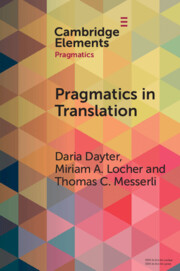
This Element addresses translation issues within an interpersonal pragmatics frame. The aims of this Element are twofold: first, we survey the current state of the field of pragmatics in translation; second, we present the current and methodologically innovative avenues of research in the field. We focus on three pragmatics issues – relational work, participation structure, and mediality – that we foreground as promising loci of research on translational data. By reviewing the trajectory of pragmatics research on translation/interpreting over time, and then outlining our understanding of the Pragmatics in Translation as a field, we arrive at a set of potential research questions which represent desiderata for future research. These questions identify the paths that can be productively explored through synergies of the linguistic pragmatics framework and translation data. In two case study chapters, we offer two example studies addressing some of the questions we identified as suggestions for future research. This title is also available as Open Access on Cambridge Core.
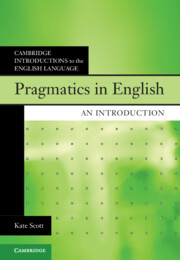
Pragmatics – the study of language in context, and of how we understand what other people say – is a core subject in English language, linguistics, and communication studies. This textbook introduces the key topics in this fast-moving field, including metaphor, irony, politeness, disambiguation, and reference assignment. It walks the reader through the essential theories in pragmatics, including Grice, relevance theory, speech act theory, and politeness theory. Each chapter includes a range of illustrative examples, guiding readers from the basic principles to a thorough understanding of the topics. A dedicated chapter examines how research is conducted in pragmatics, providing students with resources and ideas for developing their own projects. Featuring exercises, a comprehensive glossary, and suggestions for further reading, this book is accessible to beginner undergraduates, including those with no prior knowledge of linguistics. It is an essential resource for courses in English language, English studies, and linguistics.
In this chapter, we introduce the main ideas behind relevance theory. We begin by considering how it developed out of the Gricean approach to pragmatics, and we look at how it differs from that approach. Relevance theory is a cognitive pragmatic theory of how we process utterances (and information) in context. The chapter begins with a discussion of relevance and cognition, and we outline the relevance-theoretic characterisation of context. This then leads us to a definition of what it means for something to be relevant, and we introduce the two principles which drive the relevance-theoretic approach to utterance interpretation. When information is intentionally communicated (both in utterances and in other forms of communication), we say it is ostensive. Ostensive communication is, according to relevance theory, special. It raises expectations of how relevant it will be for the addressee, and this has important consequences for how we process information and how we understand utterance interpretation. We will see that this leads us to the relevance-theoretic comprehension procedure which describes how we go about processing intentionally communicated information.
In this chapter we take a closer look at figurative language from a pragmatic perspective. Figurative language is also often associated with literary language. However, as we shall see, from a pragmatic perspective, non-literal use of language extends far beyond the devices and tropes traditionally associated with rhetoric and poetry. The inferential processes that we employ to interpret metaphors, irony, and other figuratively used language, are part of a more general pragmatic system. Non-literal use of language is pervasive, and the processing of non-literal language plays a central role in utterance interpretation. We focus on metaphor, hyperbole, and irony, outlining several of the most influential pragmatic approaches to the analyses of these and starting with the Gricean account. The field of lexical pragmatics is introduced, and a range of examples are discussed to illustrate just how often we use language ‘loosely’. This approach is then applied to approximations, hyperbole, and metaphor. In the second half of the chapter, attention turns to irony, and two leading analyses are introduced and then compared: irony as pretence and irony as echoic use.
In this chapter we turn our attention to the role that pragmatics plays in the study of social interaction. When we communicate, we do not simply exchange information. We also manage relationships. As speakers, we can choose to be more or less direct, more or less formal, and more or less attentive to our hearers. The decisions that speakers make are often motivated by concern for how their hearers will react to the utterance, and by the effect that this might then have on the relationship. Perhaps the most influential work in this area of pragmatics is Brown and Levinson’s model of politeness. The first half of this chapter provides an overview of their framework and the politeness strategies that they propose. In the second half of the chapter, we discuss some recent developments that have arisen in response to Brown and Levinson’s work. These include analyses of impoliteness, consideration of how cultural variation might be incorporated into the pragmatics of interaction, and a shift to focus less on politeness and more on a broader notion of the relational work that speakers perform.