To save content items to your account,
please confirm that you agree to abide by our usage policies.
If this is the first time you use this feature, you will be asked to authorise Cambridge Core to connect with your account.
Find out more about saving content to .
To save content items to your Kindle, first ensure no-reply@cambridge.org
is added to your Approved Personal Document E-mail List under your Personal Document Settings
on the Manage Your Content and Devices page of your Amazon account. Then enter the ‘name’ part
of your Kindle email address below.
Find out more about saving to your Kindle.
Note you can select to save to either the @free.kindle.com or @kindle.com variations.
‘@free.kindle.com’ emails are free but can only be saved to your device when it is connected to wi-fi.
‘@kindle.com’ emails can be delivered even when you are not connected to wi-fi, but note that service fees apply.
Julianne House, Universität Hamburg/Hun-Ren Hungarian Research Centre for Linguistics /Hellenic American University,Dániel Z. Kádár, Dalian University of Foreign Languages/Hun-Ren Hungarian Research Centre for Linguistics/University of Maribor
In Chapter 9, we look at how the pragmatician can capture the interactional dynamics of seemingly confusing cases of aggression in mediated political settings. In mediated scenes of politics, conflict may evolve in a seemingly ad hoc way, and in order to be able to analyse such settings it is necessary to linguistically analyse exactly what is happening in them. As a case study, we present a corpus of heckling incidents, including cases such as when the previous US first lady Michelle Obama was heckled in public. We argue that while heckling appears as a ‘disorderly’ incident, manifestations of heckling can be systematically categorised into major types, which impose different ritual frames on the public speaker being heckled. Following this view, our analysis shows that heckling is a standard situation in which the participants actually follow conventional forms of behaviour.
Julianne House, Universität Hamburg/Hun-Ren Hungarian Research Centre for Linguistics /Hellenic American University,Dániel Z. Kádár, Dalian University of Foreign Languages/Hun-Ren Hungarian Research Centre for Linguistics/University of Maribor
In Chapter 3 we discuss the pitfall of following an ethnocentric view in the study of politically relevant data. We argue that it is not fruitful either to associate a particular positive or negative value with a particular country or area, or to attribute a political notion or an actor with a positive or negative value. Here we critically consider the universal validity of notions such as ‘egalitarianism’ and ‘nationalism’, which may appear at first as clearly positive or negative and as such non-controversial from a Western viewpoint. We will refer to cases in which members of non-Western linguacultures conventionally interpret these notions differently from how they are conventionally seen in the West and how they are often used in academic inquiries in a seemingly ‘neutral’ way. We argue that it is ethnocentric to dismiss linguaculturally embedded standard interpretations of such notions as ‘undemocratic’, ‘unenlightened’ and ‘autocratic’ because through such a dismissive attitude one is led to automatically associating a particular positive or negative value with a particular country or area.
Julianne House, Universität Hamburg/Hun-Ren Hungarian Research Centre for Linguistics /Hellenic American University,Dániel Z. Kádár, Dalian University of Foreign Languages/Hun-Ren Hungarian Research Centre for Linguistics/University of Maribor
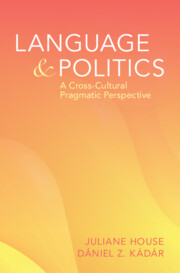
The research and teaching of language and politics has mainly been carried out in the fields of critical discourse analysis and sociolinguistics. This groundbreaking book provides a concise introduction to the field from the perspective of cross-cultural pragmatics. It introduces a strictly language-based, bottom-up and comprehensive model for analysing political data, which allows the reader to examine political and socio-political data without pre-held convictions and prejudices, avoiding many pitfalls that have lurked for a long time in the study of political language use. It is illustrated with a wealth of data and case studies drawn from many linguacultures, including Anglophone ones, China, Japan, Germany and the former Yugoslavia, and from different contexts of political language use, such as diplomacy, activism, public communication and news articles. It includes handy further reading lists, discussion points and a comprehensive glossary, making it ideal for anyone keen to know how language interacts with politics.
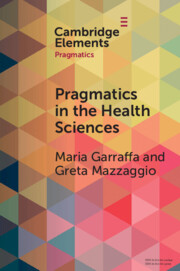
This Element aims to address a gap in the literature at the intersection of linguistics, particularly pragmatics, and health sciences, such as speech and language pathology. The first section introduces the application of pragmatics concepts in healthcare and neuroscience. Section 2 discusses the development of pragmatic abilities in childhood, focusing on pragmatic communication disorder. Section 3 reviews studies on pragmatic abilities in adolescents, adults, and clinical populations, including assessments of pragmatic skills in ageing. Section 4 broadens the scope by exploring pragmatic impairments in new populations. The final section reflects on the importance of pragmatics in healthcare practice, introducing studies on mental health and intercultural pragmatics. Each section proposes discussion points to contextualise the research within debates on health pragmatics. The Element also includes a glossary (available as online supplementary material) to assist interdisciplinary audiences in understanding clinical pragmatics terminology.
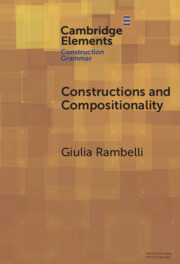
How do we understand any sentence, from the most ordinary to the most creative? The traditional assumption is that we rely on formal rules combining words (compositionality). However, psycho- and neuro-linguistic studies point to a linguistic representation model that aligns with the assumptions of Construction Grammar: there is no sharp boundary between stored sequences and productive patterns. Evidence suggests that interpretation alternates compositional (incremental) and noncompositional (global) strategies. Accordingly, systematic processes of language productivity are explainable by analogical inferences rather than compositional operations: novel expressions are understood 'on the fly' by analogy with familiar ones. This Element discusses compositionality, alternative mechanisms in language processing, and explains why Construction Grammar is the most suitable approach for formalizing language comprehension.
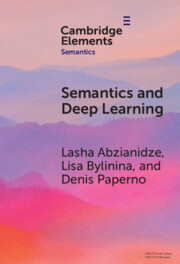
This Element covers the interaction of two research areas: linguistic semantics and deep learning. It focuses on three phenomena central to natural language interpretation: reasoning and inference; compositionality; extralinguistic grounding. Representation of these phenomena in recent neural models is discussed, along with the quality of these representations and ways to evaluate them (datasets, tests, measures). The Element closes with suggestions on possible deeper interactions between theoretical semantics and language technology based on deep learning models.
Semantic theories for natural language assume many different kinds of objects, including (among many others) individuals, properties, events, degrees, and kinds. Formal type-theoretic semantics tames this 'zoo' of objects by assuming only a small number of ontologically primitive categories and by obtaining the objects of all other categories through constructions out of these primitives. This Element surveys arguments for this reduction of semantic categories. It compares the ontological commitments of different such reductions and establishes relations between competing foundational semantic ontologies. In doing so, it yields insights into the requirements on minimal semantic ontologies for natural language and the challenges for semantic ontology engineering.
This Element gives an introduction to the emerging discipline of natural language ontology. Natural language ontology is an area at the interface of semantics, metaphysics, and philosophy of language that is concerned with which kinds of objects are assumed by our best semantic theories. The Element reviews different strategies for identifying a language's ontological commitments. It observes that, while languages share a large number of their ontological commitments (such as to individuals, properties, events, and kinds), they differ in other commitments (for example, to degrees). The Element closes by relating different language and theory-specific ontologies, and by pointing out the merits and challenges of identifying inter-category relations within a single ontology.
Religious texts played a central role in Early English, and this innovative book looks in particular at how medieval Christians used prayers and psalms in healing the sick. At first glance, the variety and multiplicity of utterances, prayers, exorcistic formulas, and other incantations found in a single charm may seem to be random and eclectic. However, this book shows that charms had distinct, logical linguistic characteristics, as well performative aspects that were shaped by their usage and cultural significance. Together, these qualities gave the texts a unique role in the early development of English, in particular its use in ritual and folklore. Arnovick identifies four forms of incantations and a full chapter is devoted to each form, arranged to reflect the lived experiences of medieval Christians, from their baptism in infancy, to daily prayer and attendance at Church celebrations, and to their Confession and anointing during grave illness.
Early medieval charms invoke the service of the Visitation of the Sick through the use of liturgical elements central to that rite, as Chapter 4 argues. Charms import the singing of psalms, sprinkling of holy water, praying of anointing and healing formulas, imposing of hands, anointing of the body, and the chanting of antiphons and litanies. Once present in charms, these and other sacred practices serve as indices of the Visitation of the Sick. When allusions to the Visitatio Infirmorum are successfully recognized or evoked, charms invoke the liturgy. Because recognition proves crucial, the question of charm participants’ familiarity with the Visitation of the Sick leads us to assess the resonance of Visitatio references through the construct of a continuum. At one end we find charms containing references to the Visitation of the Sick that seem subtle in light of their brevity or context. At the opposite end we find charms with numerous, lengthy utterances based in the sacramental rite. Over all, associations with Christ’s healing and liturgical Unction are meant to transform faithful charm participants in their time of need.
Liturgical prayer plays a significant role in Anglo-Saxon healing remedies. It is not, contrary to recent studies on prayer, “relatively rare in medical remedies” (Thomas 2020: 224). Chapter 1, “Invoking Baptism,” argues that charms borrow crucial verbal and physical components of the baptismal liturgy in order to invoke the sacrament and its celebration. The most vital of the texts gathered as incantations is the Creed, which lies at the foundation of Baptism. Alongside the Creed appears the Pater Noster, anti-demonic utterances and exorcistic gestures, water and its use for washing, and the Sign of the Cross or Triune blessing. The allusive force of these liturgical artifacts is clear and strong enough, especially when they act as a collective, to evoke the liturgy. The act of recalling the liturgy within the performance arena results in the summoning of the liturgy’s power as a force for healing. Through the manipulation of baptismal forms, charms translate Baptism’s ability to heal the soul into the ability to heal the body. While charms do not exorcize the devil or baptize people in the name of Father, Son, and Holy Spirit, as is done at Baptism, the sacrament is so essential to the people’s spiritual welfare that healers harness its associations and apply them medicinally in traditional remedies.
The praying of psalms is the subject of Chapter 2. Psalms are frequently sung in charm rituals. They are carefully prescribed to help heal human and animal illness. Acute and painful diseases, such as diarrhea and carbuncles, are treated with psalms, as is fever. Even madness and “fiend-sickness” might respond to them, it was hoped. Psalms have great resonance for the English. They lie at the core of medieval liturgies, both monastic and public. They give hope to the suffering during the Visitation of the Sick. They were offered more generally as personal prayers and as penance. Chapter two establishes the petitionary nature of the psalms used in charm remedies. It demonstrates how psalms structure and organize charm performance with regard to other incantations. Psalms serve as practical prayers, the functionality of which arises out of each psalm’s generic form. They seek God’s assistance by asking the Lord directly or indirectly for aid. Psalms that use figurative language relevant to a charm’s objective employ metaphor and simile that act as vehicles for sympathetic magic. Charms render psalm incantations as powerful medicine for those in need.
Chapter 6 explores charms’ re-purposing of liturgical texts from a theoretical perspective. The integrity of baptismal and Visitatio utterances and acts may be compromised, from a liturgical perspective, when they are reused for charm healing. The accommodations that result allow charms simultaneously to invoke those sacramental liturgies while accomplishing something different. As charms manipulate prayers and formulas extracted from liturgy for folk healing, the re-contextualization results in disparities. These prove important because they reveal the integration of ecclesiastical texts and gestures into traditional practices. When charms adapt particular liturgical texts and actions, the liturgical forms undergo a pragmatic-linguistic process of “de-institutionalization.” The loss of extra-linguistic context supports the charms’ discursive ends and reinforces its status as a distinct institution.
Chapter 5, “The Multiplier Effect,” analyzes the ways in which verbal medicines are combined to effect healing or restore property. The various and multiple utterances individual charms like Lacnunga xxix perform can be ascribed to a programmatic approach to remedy. Combination therapy relies on an agglutinative process whereby separate utterances complement one another. The resulting amalgamation is more than the sum of its parts, however, and may be attributed to the multiplier effect. Charms combine verbal medicines in order to pursue every means of supplication available to God’s people: prayer to God, prayer for saints to intervene with God on the supplicant’s behalf, and liturgical prayer through the healing ministry of the Church.