To save content items to your account,
please confirm that you agree to abide by our usage policies.
If this is the first time you use this feature, you will be asked to authorise Cambridge Core to connect with your account.
Find out more about saving content to .
To save content items to your Kindle, first ensure no-reply@cambridge.org
is added to your Approved Personal Document E-mail List under your Personal Document Settings
on the Manage Your Content and Devices page of your Amazon account. Then enter the ‘name’ part
of your Kindle email address below.
Find out more about saving to your Kindle.
Note you can select to save to either the @free.kindle.com or @kindle.com variations.
‘@free.kindle.com’ emails are free but can only be saved to your device when it is connected to wi-fi.
‘@kindle.com’ emails can be delivered even when you are not connected to wi-fi, but note that service fees apply.
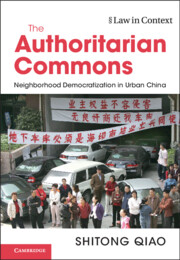
Based on six-year fieldwork across China including over 200 in-depth interviews, this book provides an ethnographic account of how hundreds of millions of Chinese homeowners practice democracy in and beyond their condominium complexes. Using interviews, survey data, and a comprehensive examination of laws, policies and judicial decisions, this book also examines how the party-state in China responds to the risks and benefits brought by neighborhood democratization. Moreover, this book provides a framework to analyze different approaches to the authoritarian dilemma facing neighborhood democratization which may increase the regime's legitimacy and expose it to the challenge of independent organizations at the same time. Lastly, this book identifies conditions under which neighborhood democratization can succeed.
Neighbourhood policing has been called the 'cornerstone of British policing' but changing demand, pressures on funding and cyclical political support mean that this approach is under considerable pressure. The book investigates whether this UK model - intended to build confidence and legitimacy - has been successful and assesses its future.
PoC has been a core part of UN peace operations for over 20 years. Between 1999 and 2021,123 the following fift een UN peace operations have been provided with a PoC mandate: UNAMSIL, the United Nations Organization Mission in the Democratic Republic of the Congo (MONUC) (which was replaced by MONUSCO in 2010126 and to which, from 2013 onwards, the Intervention Brigade was added), the United Nations Mission in Liberia (UNMIL), the United Nations Operation in Côte d’Ivoire (UNOCI), the United Nations Stabilization Mission in Haiti (MINUSTAH) (which was replaced by the United Nations Mission for Justice Support in Haiti (MINUJUSTH) (i.e. a police mission and thus not included in this study) in 2017), the United Nations Operation in Burundi (ONUB), the United Nations Mission in Sudan (UNMIS) (which was replaced by the United Nations Interim Security Force for Abyei (UNISFA) and the United Nations Mission in South Sudan (UNMISS)), the United Nations Interim Force in Lebanon (UNIFIL), the United Nations—African Union Hybrid Operation in Darfur (UNAMID), the United Nations Mission in the Central African Republic and Chad (MINURCAT), MINUSMA, and MINUSCA. In the last decades, the UN Security Council has also provided UN Member States and regional or international organisations other than the UN with an explicit mandate to protect civilians in the territory of a third State. In 2001, the UN Security Council initially provided UN Member States with an authorisation to undertake a PoC mandate in Afghanistan.
While Part II dealt with the PoC mandate as a mission-specific legal basis underlying UN (mandated) peace operations deployed to protect civilians, Part III deals with the legal regimes governing the application of the use of force to protect civilians by UN (mandated) peace forces on the ground. Practitioners are confronted with complex questions concerning the legal parameters governing the use of force in such specific PoC situations. By way of illustration, may UN (mandated) peace forces use force against rebels who, aft er entering a village and firing several rounds, start retreating but are likely to return? Is lethal force justified against rebels in retreat, and if so, under what conditions? May UN (mandated) peace forces launch pre-emptive strikes against hostile actors based on a past pattern of similar attacks, or do they need credible information that attacks will happen in the – immediate or more distant – future? Similarly, if a soldier suspects that a suicide bomber is about to detonate a bomb in a crowded camp for IDP, must he fire warning shots first or may he directly target the suspect in the crowd? Is immediate lethal force in such a situation authorised, and if so, under what conditions?
The legal regimes primarily cover the when and how of the use of force in specific PoC situations at the tactical level of the operation. While the legal regimes involved can be either international or national, this study has a particular focus on international law.
The diversity of confl icts is considerable, but most have one thing in common: they profoundly aff ect civilian populations. Civilians suff er disproportionately from targeted attacks, indiscriminate killings, summary executions, sexual slavery, and rape. Civilians are forcibly displaced or forced to join the fighting, causing massive disruption to civilian lives, and leading to loss of livelihood, hunger, and disease.
Aware of this problem, in the 1960s, the United Nations (UN) Security Council began to implicitly include the promotion of civilian protection in the mandates issued to military operations, whose overall purpose was to support the maintenance or restoration of international peace and security. In the present study, these types of operations are referred to as ‘UN (mandated) peace operations’, i.e. operations conceived to support the maintenance or restoration of international peace and security and conducted either by the UN itself (‘UN peace operations’) or by States or regional or international organisations other than the UN, including the African Union (AU), the North Atlantic Treaty Organization (NATO), and the European Union (EU) (‘UN-mandated peace operations’). An example of such an initiative by which the UN Security Council sought to alleviate human suff ering can be found in Resolution 836 (1993).
As Part I made clear, any peace operation constituting a (physical) intervention in a State needs a legal basis in international law. Such legal basis can be found in the UN Charter or in rules of customary international law relating to the use of force and the maintenance and restoration of international peace and security. In addition, every peace operation requires a mission-specific mandate which can either be issued by a competent international organisation (in principle, the UN Security Council under Chapter VII of the UN Charter) or by a host State's government inviting or consenting to a peace operation conducted on its territory. The mandate, in this context, is a source of legal authority to deploy a mission in the territory of a third State and to use force on that State's territory.
UN (mandated) peace operations covered in this book always operate based on a mandate of the UN Security Council, whether or not complemented by the consent of the host State. Since October 1999, the UN Security Council has, on almost all occasions, provided UN (mandated) peace operations with Chapter VII authorisations, which represents a significant change in UN practice. In the preamble of PoC mandates, the UN Security Council generally determines that a particular situation ‘constitutes a threat to the international peace and security’ and subsequently authorises an entire mandate (including the PoC tasks) under Chapter VII of the UN Charter.
This book has sought to answer the question of what the legal parameters are for the use of force in UN (mandated) peace operations tasked by the UN Security Council to protect civilians.
Following a series of humanitarian crises and dramatic failures of the international community to prevent mass atrocities from occurring, in 1999, the UN Security Council began adopting mandates in which it explicitly authorised UN (mandated) peace operations to ‘use all necessary means to protect civilians against the (imminent) threat of physical violence’ (by using exactly these terms or by using similar terms). Over the years, adopting PoC mandates has proven to be a ubiquitous tool eagerly used by the UN Security Council when implementing initiatives to maintain or restore international peace and security – seeking to draw particular attention to the protection of civilians. However, practice shows that many questions remain about the legality of using force within such operations. At its roots is a deep gap between international legal scholarship on the one hand and military doctrine and practice on the other. Academics are concerned with the strict legal rules as set forth by customary and conventional law, as well as general principles of law. Practitioners are concerned with the mission-specific PoC mandates and the strategic, operational, and tactical instruments that implement such a mandate.
In intersystemic cases, a court applies the law of a foreign system. Scholars have argued that the court ought to use the interpretive methodology of the foreign system’s courts. I argue against that intuitive position. First, interpretive methodology is not bound up with primary rights and duties such that it constitutes substantive law for conflict of laws purposes. Second, although interpretive methodology has epistemic value and may affect case outcomes, a given methodology might not have the same epistemic value or the same effect on outcomes for differently situated interpreters. Further, the approach that the foreign judges take to interpreting their own law is necessarily anchored to the foreign system’s rule of recognition, which is not true of the approach of external judges. Descriptive facts might align such that external interpreters would have to use the internal methodology to identify the applicable law, but that’s an empirical question the answer to which will vary from case to case.
Risk is a central concept in modern regulatory studies. In Chapter 2, the general idea of ’risk’ is introduced. The chapter helps readers grasp its scientific and practical relevance for regulation. The chapter also offers an overview of the importance of risk in scholarly work and policy-making. The chapter emphasizes the extensive and diverse nature of risk studies across different academic disciplines including ’technical’ quantitative methods and sociological critique. It explains how risk identification, risk assessment, and risk management are conventionally understood and highlights their shortcomings and complexities. Additionally, it discusses the trend of ’riskification’ – the tendency to frame a growing number of issues in the language of risk.
This chapter critically examines various kinds of ‘hybrid’ regulatory instruments, including hybrid and private regulation. It discusses multiple sources of regulatory influence, including various non-state intermediaries, and various strategies that avoid relying exclusively on the regulatory capacities of the state. The chapter closes with a brief overview of various kinds of ‘experimental regulation’, including regulatory sandboxes.
This chapter delves into the concept of legitimacy and introduces the readers to key debates on regulatory legitimacy. The concept of legitimacy has been extensively studied by scholars from various academic disciplines, including political theory, legal theory, political science, sociology and management studies. The resulting body of scholarship has, however, tended to remain in disciplinary siloes, making the study of legitimacy difficult to navigate. Chapter 11 offers first an exploration of different legitimacy claims that justify why individuals recognize an authority and its rules as legitimate. The chapter then moves to regulatory legitimacy.
Chapter 9 explores regulatory compliance, enforcement and certification. It analyses the vital role of enforcement action and how rules aimed at influencing human and institutional behaviour are translated into social reality. It draws attention to the human interaction that takes place during encounters with regulatory enforcement officials and regulators. We discuss how ‘risk-based’ approaches to regulation can be understood and operationalised. It then touches upon the investigatory powers of public regulators, and the nature, purpose and variety of regulatory sanctions. Finally, it examines the role of ‘private’ bodies and other ‘regulatory intermediaries’ in certifying that a regulatee’s activities complies regulatory standards which purport to offer consumers, as primary beneficiaries, ‘assurance’ of the quality of the resulting outputs.