To save content items to your account,
please confirm that you agree to abide by our usage policies.
If this is the first time you use this feature, you will be asked to authorise Cambridge Core to connect with your account.
Find out more about saving content to .
To save content items to your Kindle, first ensure no-reply@cambridge.org
is added to your Approved Personal Document E-mail List under your Personal Document Settings
on the Manage Your Content and Devices page of your Amazon account. Then enter the ‘name’ part
of your Kindle email address below.
Find out more about saving to your Kindle.
Note you can select to save to either the @free.kindle.com or @kindle.com variations.
‘@free.kindle.com’ emails are free but can only be saved to your device when it is connected to wi-fi.
‘@kindle.com’ emails can be delivered even when you are not connected to wi-fi, but note that service fees apply.
The microstructure characteristics of nanocrystalline magnesium-based alloy processed by cryomilling and spark plasma sintering were investigated. The as-received and cryomilled powders and the consolidated bulk material were characterized by scanning and transmission electron microscopies, x-ray diffraction, and electron dispersive spectroscopy techniques. The cryomilled powders resulted in an average grain size of 25 nm. After spark plasma sintering, a bimodal grain size distribution with coarse grains around 500 nm and fine grains of 52 nm, which is one of the smallest grain sizes reported in bulk nanostructured Mg alloys, was found. Our results suggest this novel process as a viable method to provide new opportunities for the development of nanostructured Mg-based alloys.
Thermophysical properties such as phase-transformation temperatures and enthalpy of solidification depend on the composition and on the solidification conditions. To analyze the effects of the cooling rate on these properties, three commercial magnesium alloys (AZ91D, AM60B, and AE44) have been studied. Phase-transformation temperatures and enthalpy of solidification of these alloys have been measured using differential scanning calorimetry. Solidification curves have been obtained experimentally and compared with thermodynamic calculations. For all the studied alloys, it has been found that with increasing cooling rate, liquidus temperature increases slightly, whereas solidus temperature decreases. Enthalpy of solidification increases significantly with increasing cooling rate. Finally, relationships of phase-transformation temperature and enthalpy of solidification as a function of cooling rate have been established on the basis of the general power law. Using these relationships, the phase-transformation temperature and enthalpy of solidification have been predicted at high cooling rates and compared with experimental results.
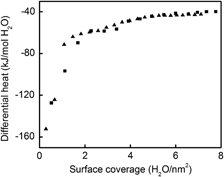
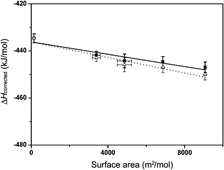
Tin dioxide (SnO2) is an important base material for a variety of gas sensors and catalysts. However, there is a lack of experimental data on the energetics of SnO2 surfaces and their water adsorption. In this work, the surface energies of anhydrous and hydrated SnO2 nanoparticles were measured by combining high-temperature oxide melt solution calorimetry and water adsorption calorimetry. The SnO2 nanoparticles were synthesized through oxidation of metallic tin using nitric acid followed by heat treatment at different temperatures to achieve surface areas ranging from 4000 to 10,000 m2·mol−1(25–65 m2·g−1). The enthalpy of the anhydrous surface is 1.72 ± 0.01 J·m−2, and that of the hydrated surface is 1.49 ± 0.01 J·m−2. The integral heat of water adsorption is −75 kJ·mol−1, with a chemisorbed maximum coverage of ∼5 H2O·nm−2. SnO2 has a lower surface energy and less exothermic enthalpy of water adsorption than the isostructural TiO2 (rutile) reported previously. This comparison suggests that the excellent sensing properties of SnO2 may be a consequence of its relatively low affinity for surface H2O molecules that compete with other gases for adsorption.
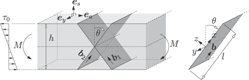
Miniaturization of components and devices calls for an increased effort on physically motivated continuum theories, which can predict size-dependent plasticity by accounting for length scales associated with the dislocation microstructure. An important recent development has been the formulation of a Continuum Dislocation Dynamics theory (CDD) that provides a kinematically consistent continuum description of the dynamics of curved dislocation systems [T. Hochrainer, et al., Philos. Mag.87, 1261 (2007)]. In this work, we present a brief overview of dislocation-based continuum plasticity models. We illustrate the implementation of CDD by a numerical example, bending of a thin film, and compare with results obtained by three-dimensional discrete dislocation dynamics (DDD) simulation.
InN thin films were grown on GaN underlayer with sapphire substrate by metalorganic vapor phase epitaxy under different growth conditions, including growth temperature, reactor pressure, and V/III ratio. X-ray diffraction and Raman scattering measurements reveal that the samples grown at different temperatures are mixed with different phases, especially at higher temperature. The calculated phonon dispersion curves of wurtzite, zinc-blende, and rocksalt structures show that the samples mainly contain wurtzite structure and small amount of zinc-blende phase, while the samples grown at 600 °C and 650 °C include a new structural phase other than the three well-known ones. This analysis demonstrates that the InN epilayer grown at 550 °C has the highest phase purity and better crystalline quality. Besides the key role of growth temperature, a relatively higher reactor pressure and lower V/III ratio are found to be more conducive to the improvement of crystalline quality, though they have a modest effect on the InN microstructure.
Nickel oxide–polypyrrole (NiO–PPy) composites for lithium-ion batteries were prepared by a chemical polymerization method with sodium p-toluenesulfonate as the dopant, Triton-X as the surfactant, and FeCl3 as the oxidant. The new composite material was characterized by Raman spectroscopy, thermogravimetric analysis, scanning electron microscopy, and field-emission scanning electron microscopy. Nanosize conducting PPy particles with a cauliflower-like morphology were uniformly coated onto the surface of the NiO powder. The electrochemical results were improved for the NiO–PPy composite compared with the pristine NiO. After 30 cycles, the capacities of the NiO and the NiO–PPy composite were about 119 and 436 mAh·g−1, respectively, indicating that the electrochemical performance of the composite was significantly improved.
We grew epitaxial SrTiO3 (STO) thin films on (001) LaAlO3 substrates via a two-step procedure using pulsed laser deposition and studied them with transmission electron microscopy in plane-view and cross-sectional samples. We found that partial misfit dislocations are the main interfacial defects, whereas planar defects are the main defects in STO films. Our results suggest that a three-dimensional island mode dominates the growth of the STO film.
A facile, efficacious, and practical multifunctional paradigm has been developed for imparting corrosion resistance to low carbon steel based on the direct in situ growth of carbon nanofibers (CNF) onto steel substrates followed by infusion of a polymer matrix. The polymer layer locks into place between the nanofibers, simultaneously preventing coating delamination and imparting unprecedented surface passivation properties. The novel hybrid nanocomposite coatings maintain structural integrity even after 30 days of exposure to saline corrosive environments, indicating unprecedented corrosion protection derived from the redox-active nature of the CNF fillers and their excellent dispersion within the polymer matrix. These remarkable coating properties are further enhanced by the strong adhesion of the host polymer to the underlying steel substrate.
The photoinduced formation of thin film structures from a Ti-alkoxide precursor (OPy)2Ti(TAP)2, where OPy = OC6H6N, TAP = OC6H2[CH2N(CH3)2]3-2,4,6, was demonstrated via direct deposition from a pyridine-based solution and by optical illumination of a solid-state spin-coated thin film of the compound. Photopatterned physical relief structures were produced using both of these deposition methods and feature sizes as small as ∼1 μm were readily achieved. Surface investigations of the material’s nanostructure revealed that films photo-deposited from solution exhibited nanometer-scale surface roughness with evenly distributed surface porosity (∼10 nm sized pores) while films produced through the illumination of spin-coated thin films exhibited, in comparison, a reduction in surface roughness. Vibrational spectra were compared with the results of quantum chemical computations (density-functional theory) of potential photoproducts in an attempt to identify and distinguish the dominant structural groups resulting from the optical processing of each precursor form (i.e., solution versus solid-state). It was determined that ultraviolet irradiation for both thin-film formation techniques resulted in a disruption of the ligand groups, facilitating the initiation of hydrolysis and condensation reactions in the films.
The decomposition mechanism of block copolymer templates inside as-synthesized mesostructured solids has been systematically studied using solid-state 1H magic angle spinning nuclear magnetic resonance spectroscopy, thermogravimetric analysis, and high-vacuum Fourier transform infrared spectrometry. It is shown that there exists hydrogen-bonding interaction between silanols and block copolymers at the inorganic–organic interface in the self-assembled as-synthesized mesostructured solids, which plays an important role in protecting the surfactants against decomposition during the high-temperature hydrothermal treatment process. Increasing silanol concentration can enhance the hydrogen-bonding interaction and thus shows better “protection” effect. Moreover, the thermal decomposition of the block copolymer in as-synthesized mesostructured solids in air commences at higher temperatures compared with that in acidic solution or in air, providing further evidence in support of the silanol protection mechanism.
The possibility and suitability of micro-Raman spectroscopy as a noncontact, in-line measurement technique for boron (B) concentration in ultrathin (20~35 nm thick) Si1–xGex layers epitaxially grown on 300 mm diameter p−-Si(100) wafers, by ultrahigh vacuum chemical vapor deposition, was investigated. Raman spectra from Si1–xGex/Si(100) wafers were measured under 363.8, 457.9, 488.0, and 514.5 nm excitation. Strong correlation was found between B content and characteristics of the Si–Si Raman peak from the Si1–xGex films. As B concentration increased from undoped to 9.1 × 10²⁰ atoms/cm3, the Si–Si Raman peak broadened and the peak height became smaller for a given Ge content. The B concentration in Si1–xGex film estimated from Raman measurement was in good agreement with secondary ion mass spectroscopy analysis results. Boron concentration as low as 8.7 × 10¹⁷ atoms/cm3 can be detected by Raman spectroscopy, which is ~30 times more sensitive than the detection limit (2.7 × 10¹⁹ atoms/cm3) of high-resolution x-ray diffraction.
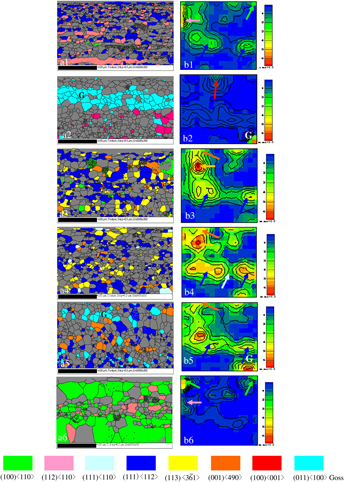
Electropulsing-induced evolution of texture during recrystallization of Fe–3%Si alloy strip was studied using electron backscattered diffraction and x-ray diffraction techniques. Under electropulsing, various textures occurred during several seconds of recrystallization in the alloy. The Goss texture (G-texture) with high energy storage developed with increasing misorientation distribution of the low-angle grain boundaries. The mechanism of the electropulsing-induced G-texture evolution was discussed from the point of view of electropulsing dynamics.
Line width and line thickness thermal strain components in passivated Al and Cu lines were observed to relax much more than the line length strain component. Although the width-to-thickness ratios were large, 3.5 and 4.4 for Al and Cu lines, respectively, the behaviors of the thermal stresses were far from the equibiaxial. Observed changes in deviatoric strains between room temperature and 190 °C for Al and 300 °C for Cu were consistent with a model in which the changes in line width and line thickness strains were simply related to changes in line length strains by the uniaxial Poisson’s ratio. Changes in line length strains were determined by the differences in metal and substrate thermal expansion coefficients and the magnitudes of temperature changes through retained elastic strain coefficients for Al of 30% for heating and for Cu of 60% for heating and 80% for cooling, with the balance accommodated by relaxation.
Cadmium selenide (CdSe) belongs to a class of important II–VI semiconductors widely used in optical, sensor, and laser materials and quantum-dot light-emitting diodes. Here we present the first direct calorimetric measurement of the surface energy of wurtzite CdSe. CdSe nanoparticles with particle size between 20 and 60 nm were prepared by a hydrothermal method without additives to control morphology, and the surface energy was derived from the drop solution enthalpies in molten sodium molybdate and from water adsorption calorimetry. The surface energy of the hydrated surface is 1.31 ± 0.26 J/m2, whereas that of the anhydrous surface is 1.65 ± 0.27 J/m2. These values are significantly lower than those for ZnO and many other oxides.
Impedance spectroscopy studies were conducted on amorphous tantalum oxide thin films prepared using pulsed-DC reactive sputtering, which were post-annealed to crystallize the films. X-ray diffraction results showed that crystallization to Ta2O5 β phase occurs for samples annealed above 650 °C, with a crystallite size of ∼40 nm. The film microstructure was studied by electron microscopy, and remnants of the columnar amorphous microstructure were found in the polycrystalline films. Complex impedance analyses revealed significant differences in dielectric behavior between the amorphous and crystalline films. Lumped circuit models were conducted on the films using resistors, capacitors, and constant phase elements. Amorphous films exhibited a single relaxation with Arrhenius activation energy of 1.1–1.3 eV. Crystallized films exhibited two relaxations with activation energies equal to 1.1 ± 0.08 and 0.6 ± 0.03 eV. The relative permittivity of the bulk crystalline grain in tantalum oxide films is close to the established permittivity of the β phase (εr = 40) of Ta2O5.
Microstructural and electrical properties of Gd-doped CeO2 (GDC; Ce0.9Gd0.1O1.95) thin films prepared by pulsed laser deposition as an electrolyte in solid-oxide fuel cells (SOFCs) were investigated. The GDC thin films were prepared on various substrates including single-crystal yttria-stabilized zirconia (YSZ) and magnesium oxide (MgO) substrates. The GDC thin-film electrolytes with different grain sizes and grain morphologies were prepared by varying the deposition parameters, such as substrate temperature, oxygen partial pressure, target repetition rate, and laser ablation energy. The microstructural properties of these films were examined using X-ray diffraction (XRD), transmission electron microscopy (TEM), and atomic force microscopy (AFM). Alternating-current (AC) and direct-current (DC) electrical measurements through in-plane method show that the electrical property of the GDC thin film strongly depends on grain size, e.g., the total conductivity of the films deposited at 700 °C (7.3 × 10⁻³ S/cm) is about 20 times higher than the ones deposited at room temperature (3.6 × 10⁻⁴ S/cm) at the measurement temperature of 600 °C.
High-concentration niobium (V)-doped titanium dioxide (TiO2) nanoparticles of the nonequilibrium chemical composition have been synthesized via Ar/O2 radio-frequency thermal plasma oxidation of mist precursor solutions with various Nb5+ concentrations (Nb/(Ti + Nb) = 0–25.0 at.%). The solubility as high as ∼25.0 at.% has not been achieved before by wet-chemical techniques. The preferable anatase formation was attained in the plasma-synthesized powders and was enhanced by the niobium doping. All the powders were heated at high temperatures (600–800 °C) to investigate their phase transformation, band gap variation, inter-particulate binding behavior, and photocatalytic stability. The transformation from anatase to rutile was effectively inhibited by increasing the Nb5+ content. The Nb5+ doping prevented the band gap of TiO2 from narrowing after the heating. At high temperatures, Nb5+ doping could not only preserve particle size but also prevent inter-particulate binding. High concentration (25.0 at.%) Nb5+ doping retained the photocatalytic performance almost invariably irrespective of being thermally treated.
Broadband spectral conversion from visible light to near-infrared radiation in Ce3+–Nd3+/Yb3+ codoped yttrium aluminum garnet is reported. Excitation, emission spectra, and decay curves have been measured to prove the energy transfer from Ce3+ to Nd3+ or Yb3+. The energy transfer efficiencies have been estimated, and the mechanisms of the energy transfer between Ce3+ and Nd3+/Yb3+ have been proposed. Ce3+–Nd3+ codoped YAG can obtain more effective emission in the desired near-infrared region (around 1100 nm) through broadband conversion, showing potential application to improve the conversion efficiency of Si solar cells.