To save content items to your account,
please confirm that you agree to abide by our usage policies.
If this is the first time you use this feature, you will be asked to authorise Cambridge Core to connect with your account.
Find out more about saving content to .
To save content items to your Kindle, first ensure no-reply@cambridge.org
is added to your Approved Personal Document E-mail List under your Personal Document Settings
on the Manage Your Content and Devices page of your Amazon account. Then enter the ‘name’ part
of your Kindle email address below.
Find out more about saving to your Kindle.
Note you can select to save to either the @free.kindle.com or @kindle.com variations.
‘@free.kindle.com’ emails are free but can only be saved to your device when it is connected to wi-fi.
‘@kindle.com’ emails can be delivered even when you are not connected to wi-fi, but note that service fees apply.
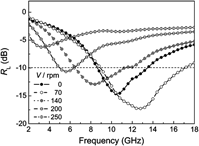
Flake-like Fe particles with controllable size and structures were achieved by modulating only the grinding speed; evidence provided by x-ray diffraction, scanning electron microscopy, resistivity measurement system, and vector network analyzer disclosed the conductivity; and microwave electromagnetic (EM) and absorbing characteristics of the resultant products strongly depended on their morphology and structure. As grinding speed (V) increases from 0 to 250 revolutions per minute (rpm), the crystalline size decreases; meanwhile, both internal strain and diameter/thickness ratio increase and the conductivity reaches the maximal value at V = 140 rpm because of the improvement of the surface conductivity. Thin flake-like Fe particles facilely obtained at high grinding speed present higher values of the permittivity and permeability than spherical particles, which are ascribed to the multiple polarizations and the natural resonance. Thus, the aforementioned products with high permeability and low cost may be promising candidates for EM compatibility materials.
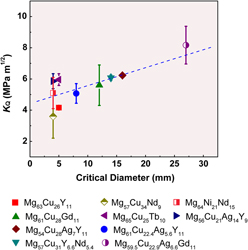
In this work, elastic properties of Mg-based bulk metallic glasses (BMGs) with different chemical compositions were investigated. By compositional tuning in the quaternary Mg–Cu–Ag–Y alloys, the Poisson’s ratio ν of 0.332 is achieved at Mg56Cu21Ag14Y9 BMG, in excess of the previously suggested critical value (ν = 0.31–0.32) for the brittle-to-tough transition in metallic glasses. With the properties of the constituent elements, the predicted values of the bulk modulus B and shear modulus μ of Mg-based BMGs are 8% and 10% greater than the measured value, respectively. Notch toughness KQ of the ten investigated Mg-based BMGs varies between 3.6 and 8.2 MPa√m. Intrinsic brittleness of Mg glass is associated with its tiny plastic zone size (in micrometer scale) and weak resistance to crack propagation. The toughness variations are lack of significant correlation with the ν or μ. Among the investigated alloys, the Mg59.5Cu22.9Ag6.6Gd11 BMG manifests a good combination of improved toughness and high glass-forming ability.
Substrate influence is a common problem when using instrumented indentation (also known as nano-indentation) to evaluate the elastic modulus of thin films. Many have proposed models to be able to extract the film modulus (Ef) from the measured substrate-affected modulus, assuming that the film thickness (t) and substrate modulus (Es) are known. Existing analytic models work well if the film is more compliant than the substrate. However, no analytic model accurately predicts response when the modulus of the film is more than double the modulus of the substrate. In this work, a new analytic model is proposed. This new model is shown by finite-element analysis to be able to accurately predict composite response over the domain 0.1 < Ef/Es < 10. Finally, the new model is used to analyze experimental data for compliant films on stiff substrates and stiff films on compliant substrates.
Controlling the grain size and morphology of cast cobalt-based components is important for optimizing a component’s in-service properties. This work investigates the role of boron on the grain size of binary cobalt–boron alloys by application of contemporary grain refinement theory. Boron solute is found to refine the width of the columnar grains but fails to promote the columnar to equiaxed transition. The lack of equiaxed grains is attributed to the thermal solidification conditions and a lack of potent nucleant particles. The refinement of the columnar grains with boron solute may be due to a growth restriction mechanism.
Microstructural investigation and thermodynamic simulation were carried out to study precipitation during the solidification of AZ31 Mg alloy containing up to 1wt% Sr. Increasing Sr content from 0.01 to 1 wt% led to the formation of an Al–Sr line compound (Al4Sr) and to the suppression of Al–Mg precipitate (β-Mg17Al12). Transmission electron microscopic (TEM) investigation and energy dispersive spectroscopic analysis on extracted precipitates revealed Mg and Zn solubility in the Al4Sr particles. It is shown that Sr content also affects the precipitation of Al–Mn precipitates. Thermodynamic calculations predict that the increase in Sr content limits the Al–Mn reaction and the precipitation of Al–Mn precipitates with low Al/Mn ratio. Microstructural investigations determined the presence of two Al–Mn precipitates (Al8Mn5 and AlMn), either in the form of large dendritic plates or small nano-scale particles in the Mg matrix. It has been calculated by the thermodynamic model and confirmed by TEM that by increasing the Sr content, solubility of Al solid decreases whereas the level of Mn increases slightly.
Hydrogen is considered by some to be a promising non-CO2-emitting energy carrier for the future. However, to realize a hydrogen economy, there are several technological barriers to overcome. Currently, safe and efficient storage of hydrogen is a bottleneck in the practical usage of hydrogen for fuels. In this article, we present a review on the first-principles computational approach in designing hydrogen storage materials with an emphasis on molecular hydrogen storage in nanostructured materials. Given the limitation of pristine nanostructures for room-temperature hydrogen storage, the strategy of decorating the backbone structure of the nanostructure with transition metal atoms in order to enhance the hydrogen adsorption energy is addressed, and the interplay between the Coulomb interactions and the so-called Kubas interaction (nondissociative weak chemisorption via electron donation and back-donation channels) has been studied. The influence of electron spin on the hydrogen binding energy, problems of metal clustering and oxidation, and the structural instability that may arise during hydrogen sorption are also discussed. We address the limitations and challenges in the development of high-capacity hydrogen storage materials and provide perspectives for how computational materials design can help cope with those problems.
The behavior of nuclear fuel in a reactor is a complex phenomenon that is influenced by a large number of materials properties, which include thermomechanical strength, chemical stability, microstructure, and defects. As a consequence, a comprehensive understanding of the fuel material behavior presents a significant modeling challenge, which must be mastered to improve the efficiency and reliability of current nuclear reactors. It is also essential to the development of advanced fuel materials for next-generation reactors. Over the last two decades, the use of density functional theory (DFT) has greatly contributed to our understanding by providing profound information on nuclear fuel materials, ranging from fundamental properties of f-electron systems to thermomechanical materials properties. This article briefly summarizes the main achievements of this first-principles computational methodology as it applies to nuclear fuel materials. Also, the current status of first-principles modeling is discussed, considering existing limitations and drawbacks such as size limitation and the added complexity associated with high temperature analysis. Finally, the future role of DFT modeling in the nuclear fuels industry is put into perspective.
The development of new materials typically requires an iterative sequence of synthesis and characterization, but high-performance computing (HPC) adds another dimension to the process: materials can be synthesized and/or characterized virtually as well, and it is often an overlapping quilt of data from these four aspects of design that is used to develop a new material. This is made possible, in large measure, by the algorithms and hardware collectively referred to as HPC. Prominent within this developing approach to materials design is the increasingly important role that quantum mechanical analysis techniques have come to play. These techniques are reviewed with an emphasis on their application to materials design. This issue of MRS Bulletin highlights specific examples of how such HPC tools are used to advance energy science research in the areas of nuclear fission, electrochemical batteries, photovoltaic energy conversion, hydrocarbon catalysis, hydrogen storage, clathrate hydrates, and nuclear fusion.
Brazil is a newcomer in science and technology (S&T) because the country woke up to this area only in the last 40 years. Brazil’s scientific community was very small until the 1960s, when full-time faculty positions at universities and graduate programs were created. Investments in graduate education and research have been consistent since the 1970s, and the country currently has about 150,000 researchers, of which 85,000 have PhD degrees. In the last 10 years, federal funds for research and development (R&D) have been increased by a factor of 10. At the same time, a robust system has been structured to support R&D and technology innovation, and the legal framework has been improved to stimulate development in companies. According to former Minister of Science and Technology Sérgio Rezende (2005–2010), a materials researcher himself, Brazil is prepared within its research centers and industry for the energy challenges ahead.
The energy science of clathrate hydrates is a rapidly expanding field, with high-performance computing (HPC) playing an ever-growing role to help understand the molecular processes and properties that drive clathrate hydrates to nucleate and grow into crystalline, amorphous, or mixed structures, their non-stoichiometric nature upon formation, the formation mechanism from homogeneous and heterogeneous nucleation, and their stability and limits of metastability. Many of the questions that HPC can help to answer about hydrates are intractable experimentally because of the difficulty of measurements at the length (nanometers) and time (nanoseconds) scales imposed by the fundamental phenomena at the molecular level. At the same time, the length and time scales that are accessible by simulations pose limitations on what can be studied (e.g., phase equilibria and metastability, nucleation mechanisms, non-stoichiometry) and how it can be studied (e.g., Monte Carlo, molecular dynamics, metadynamics, transition path sampling, thermodynamic integration). Ultimately, the energy science of clathrate hydrates will benefit from HPC by gaining insight into the detailed mechanism for formation, dissociation, and stability.
The drive to make solar energy competitive with conventional energy sources has prompted the investigation of new photoconversion technologies, often referred to as third-generation photovoltaics, which have both lower cost and improved efficiency compared to existing technologies. In that framework, nanostructured materials, such as nanocrystals, nanowires, and nanotubes, occupy a prominent place because of their potential advantages over crystalline or thin-film photovoltaics technologies—high tunability of the bandgap via size control, strong band-edge absorption coefficient, efficient multiple-exciton generation by a single photon, and possibly high up-conversion efficiency. The ability to control the size, shape, composition, and surface termination of nanostructures provides new degrees of freedom that are inaccessible in conventional solar cell architectures. At the same time, the ability to explore this vast configuration space by synthesis and characterization alone is limited, which makes computational interrogation of the electronic and optical properties of nanostructures particularly valuable. In recent years, the convergence of new algorithms and new computational capabilities has made it possible for the first time to perform accurate electronic-structure calculations for large nanostructures. This article reviews recent developments in both semi-empirical and first-principles atomistic electronic structure methods that have led to accurate predictions and to a better understanding of carrier generation, relaxation, and recombination processes in nanostructured materials.