To save content items to your account,
please confirm that you agree to abide by our usage policies.
If this is the first time you use this feature, you will be asked to authorise Cambridge Core to connect with your account.
Find out more about saving content to .
To save content items to your Kindle, first ensure no-reply@cambridge.org
is added to your Approved Personal Document E-mail List under your Personal Document Settings
on the Manage Your Content and Devices page of your Amazon account. Then enter the ‘name’ part
of your Kindle email address below.
Find out more about saving to your Kindle.
Note you can select to save to either the @free.kindle.com or @kindle.com variations.
‘@free.kindle.com’ emails are free but can only be saved to your device when it is connected to wi-fi.
‘@kindle.com’ emails can be delivered even when you are not connected to wi-fi, but note that service fees apply.
Welded joints of P92 steel subjected to creep testing at 650 °C and 70 MPa were investigated. Type IV cracking was observed in the fine-grained heat-affected zone (FGHAZ) of the welded joints by optical microscopy. It was found that with varying creep times, the number of creep voids increased at an accelerating rate and the maximum number of voids was formed in the FGHAZ. Scanning electron microscopy observations revealed that precipitates were formed in the interior of creep voids, suggesting that the nucleation of the creep voids is related to the precipitates. These creep voids then connected with each other, isolated the grain from the matrix, and formed zigzag microcracks, leading to type IV cracking. New coarse carbides—the Laves phase and Cr7C3—were precipitated during creep. These carbides can deteriorate the creep strength and stimulate the nucleation of creep voids in the FGHAZ.
Ni- and Cu-free Zr–Al–Co–Ag bulk metallic glasses (BMGs) with diameters up to 20 mm were synthesized by copper mold casting. The effects of Ag alloying on the superior glass-forming ability (GFA) of Zr–Al–Co–Ag alloys were studied based on the localized atomic structure and crystallization behavior. High-energy synchrotron radiation x-ray diffraction result reveals that Ag addition in Zr–Al–Co system results in a more homogeneous local atomic structure, which could be an origin for the improved GFA of the Zr–Al–Co–Ag alloy. Crystallization products of the Zr–Al–Co–Ag glassy alloy are more complex than those of the Zr–Al–Co glassy alloy. The Zr–Al–Co–Ag BMGs free from highly toxic elements Ni and Cu exhibited a combination of superior GFA, high compressive fracture strength over 2000 MPa, low Young’s modulus of 93 to 94 GPa, and good corrosion resistance in phosphate-buffered solution (PBS), inspiring their potential biomedical applications.
Iodine-doped CdS (I-CdS) with controllable morphologies, pure hexagonal phase, and enhanced photocatalytic activity was synthesized via a mild hydrothermal process with polyvinylpyrrolidone-iodine (PVP-I) acting as the template-directing reagent and iodine source. The morphologies of the as-prepared samples could be adjusted from irregular cone-shaped particles to uneven microspheres, further to smooth microspheres, while the crystal phases were also transformed from mixed cubic and hexagonal phases to pure hexagonal phase upon increasing the molar ratio of PVP-I to Cd2+ from 0 to 2. The iodine doping could result in red shift of the absorption edges and band gap narrowing of the I-CdS samples. Importantly, a critical point of 0.5 of molar ratio of PVP-I to Cd2+ for iodine doping was found to be necessary for obtaining a pure hexagonal phase that facilitates the improving of photocatalytic activity on the degradation of Rhodamine B in aqueous solution under visible light irradiation.
To detect the relatively strong scattering signals of the Raman scattering and the x-ray diffraction (XRD) from CdS and those from the CdS/CdTe interface, an inverted CdTe solar cell structure was prepared and a 35-nm-thick CdS film was deposited on the surface of a CdTe solar cell structure. The Raman and high-resolution XRD scattering spectra allowed us to qualitatively study the interdiffusion and its related reactions at the CdS/CdTe interface. Interdiffusion began to occur at a relatively low temperature of about 350 °C, which coincided with the CdS phase transformation from cubic to hexagonal phase. Substantial interdiffusion of S and Te occurred after heat treatment at a temperature of 550 °C, resulting in formation of S-rich and Te-rich CdSxTe1−x alloy at the CdS/CdTe interface, with S and Te atomic concentration of ∼9% and 11% diffused into the CdTe and the CdS films, respectively.
An n-body Cu–Zr–Ti potential is constructed and applied to evaluate a glass-forming composition range (GFR) of the Cu–Zr–Ti ternary system by molecular dynamics simulations using a solid-solution model, which is formed via random substitution of solvent atoms by a certain number of solute atoms. It is found that the GFR of the Cu–Zr–Ti ternary system is located within an approximate distorted quadrilateral composition region, in which the solid solutions are unstable and spontaneously collapse to form amorphous phases. The compositions of the four vertexes of the distorted quadrilateral are determined to be Cu22Zr78Ti0, Cu24Zr0Ti76, Cu56Zr0Ti44, and Cu72Zr28Ti0, respectively. In addition, the simulation results are in good agreement with the experimental observations and compatible with some empirical rules.
The kinetics of hydrogen in preparing amorphous boron carbide (a-B5C:H) thin films was studied. The hydrogen concentration of a-B5C:H thin films formed by plasma-enhanced chemical vapor deposition (PECVD) from a single-source precursor (o-B10C2H12) is ∼35–50 at.% as determined by nuclear reaction analysis. The hydrogen concentration of the a-B5C:H thin films is an exponential function of the precursor flux during the deposition. After annealing, the hydrogen concentration in the a-B5C:H thin films decreases with the increasing annealing temperature. The kinetics of hydrogen removal during annealing is controlled predominantly by its dissociation from PECVD radicals in the a-B5C:H thin films. The activation energy of about 0.14 eV is related to hydrogen dissociation from B–H bonds, but higher activation energy (∼0.44 eV) is required to strip the hydrogen atoms from C–H bonds in the thin films.
An ecofriendly process has been successfully developed to synthesize the polycrystalline silver nanopolyhedrons with a high yield at large scale. By using tannic acid in the presence of poly (vinyl pyrrolidone) (PVP), high quality silver nanopolyhedrons were obtained in an aqueous one-pot reaction without any templates or auxiliaries. The film made from the silver nanostructures exhibits an electrical conductivity higher than 104 S/cm on both rigid and flexible substrates. The supreme mechanical strength of this silver film recommends its wide application in printing and flexible electronics.
A multitarget sputtering method was applied to embed Au nanoparticles in TiO2 thin films (Au/TiO2 films) with a high concentration of Au particles (19–41 at%). The absolute values of imaginary part of the third-order nonlinear susceptibility, |Im [χ(3)]|, of the Au/TiO2 films, exhibited a peak around the localized surface plasmon resonance absorption peak (around 660 nm), and the maximum value was estimated to be 3.6 × 10⁻⁷ esu measured by the femtosecond Z-scan technique. The figure of merit, |Im [χ(3)]|/α, (α is the absorption coefficient of the film at the corresponding wavelength of the measurement) of the film was calculated to be 1.4 × 10⁻¹² esu·cm, which was larger than that of the Au/SiO2 film. This is mainly due to the local field enhancement.
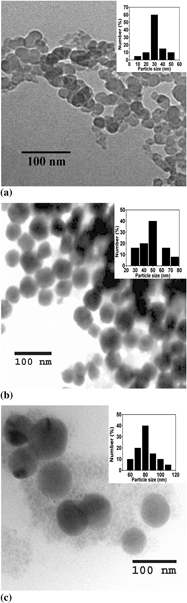
Tungsten nanoparticles (W-NPs) with average sizes ranging between 30 and 80 nm were prepared by thermolytic decomposition of tungsten hexacarbonyl in presence of a mixture of surfactants, oleic acid and oleyl amine. Fourier transform infrared spectroscopy and x-ray photoelectron spectroscopy (XPS) results reveal that the surfactants oleic acid and oleyl amine bonded to the surface of W-NP through their functional groups, which in turn render stability to the nanopowders with respect to coarsening or aggregation. XPS results also confirm that carbon is present only at the surface of the W-NPs. The as-synthesized W-NPs were amorphous, and on heat treatment at 600 °C for 1 h, the amorphous powders transform into a body-centered cubic crystalline form (α-W).
Near-infrared quantum cutting involving the conversion of one visible photon into two near-infrared photons was demonstrated in Ca0.99−xYbxWO4: Tb0.01 phosphors. From the analysis of the refinement of x-ray diffraction patterns, the suitable concentration range of Yb3+ in Ca0.99WO4: 0.01Tb3+ was determined to be 0–20%. By investigating their luminescent spectra and decay lifetimes, second-order downconversion from Tb3+ to Yb3+ were proved and the possible quantum cutting mechanism was proposed. Quantum efficiency related to Yb3+ concentration was calculated and the maximum efficiency was reached at 140.4%. Because the energy of Yb3 + 2F7/2 → 2F5/2 transition matches well with the band gap of the crystalline Si, the Ca0.99−xYbxWO4: Tb0.01 phosphors could be potentially applied in silicon-based solar cells.
The objective of this study was to identify the microstructural mechanisms controlling Ω precipitates’ contribution to the high strength and ductility of Al–Cu–Mg–Ag alloys subjected to high impact loading conditions. Three interrelated approaches were used: (i) HRTEM imaging of deformed Ω precipitates in ballistically impacted Al–Cu–Mg–Ag plates, (ii) microstructurally based finite element (FE) analysis based on specialized crystalline plasticity formulations, and (iii) molecular dynamics (MD) simulations of dislocation nucleation and emission. The FE and MD simulations detail the evolution of dislocation densities and dislocations at the Al/Ω interface, which are consistent with the experimentally observed multiplicity of shear cutting of thin Ω precipitates. Furthermore, the FE results indicate that unrelaxed tensile strains at the Al/Ω interface can inhibit localized deformation in the alloy.
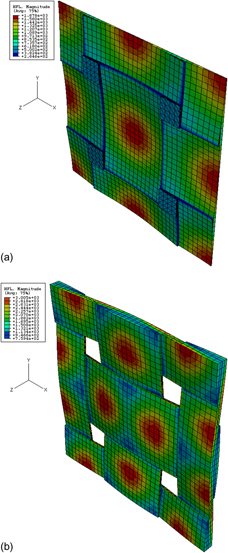
A procedure for predicting the in-plane and out-of-plane thermal conductivities of woven fabric composites through a combined approach of the representative volume element method and heat transfer analyses via finite element is presented. The representative volume element method was implemented using two unit cells established at different length scales with periodic boundary conditions. The procedure was exemplified on a plain weave glass fabric reinforced epoxy resin matrix composite. Sensitivity studies were conducted to quantify the influence of fiber volume fraction and thermal conductivity of the constituent phases on the effective thermal conductivities of the composite. The procedure, which can be implemented into commercial finite element codes, is an efficient tool for the design of woven fabric composites.
Nanoparticles of Cd1–xCuxS (x = 0–0.15) were synthesized by chemical coprecipitation using thiophenol as a capping agent. The x-ray diffraction patterns reveal that the pure and doped CdS nanoparticles are single phase with cubic zinc blende structure. The transmission electron microscopy shows the average size of the nanoparticles is about 8.5 nm. Optical absorption spectra indicate the energy gap decreases with increasing Cu2+ concentration. The broad emission peak around 520 nm is completely quenched with increasing Cu2+ content. The electron spin resonance analysis also confirms the Cu (II) ion to be doped substitutionally in CdS nanoparticles and the Lande factor of all the samples with sharp resonance is g = 2.0.
Interfacial reaction and microstructure evolution in a Zr2Al3C4 reinforced Cu composite were studied by x-ray diffraction, Raman spectroscopy, and transmission electron microscopy. Decomposition of Zr2Al3C4 was triggered by the deintercalation of Al atoms. In the initial reaction stage, depletion of Al occurred locally. ZrC and Cu platelets as well as thin twinned ZrC slices were observed inside the Zr2Al3C4 grains. In the later reaction stage, all Al atoms depleted from Zr2Al3C4 and were dissolute into the Cu matrix. The final reaction products were a Cu–Al solid solution, ZrC0.5, and highly disordered graphite, which resulted in large volume shrinkage. These experimental results provided a baseline for controlling interfacial reaction and microstructure development in Cu/Zr2Al3C4-based particle-reinforced Cu composites for optimized mechanical and electrical properties.
Strain evolution in 0.45-μm-thick, 2-μm-wide, and 100-μm-long Cu conductor lines with a passivation layer has been investigated using synchrotron x-ray microdiffraction. A moderate electromigration-current density of 2.2 × 10⁵ A/cm2 was used to minimize Joule heating in the Cu conductor lines. After 120 h of current flowing in the Cu lines at 270 °C, measurements show strain relaxation and homogenization occurring in the Cu lines with current flowing, but not in Cu conductor lines without current. Stronger interaction between electrons with Cu atoms in areas with higher strains was proposed to explain the observation.
We reported a simple and convenient method to determine the film thickness by nanoindentation tests. This method starts from the analysis of the unloading portion of the measured nanoindentation load-displacement curves according to a quadratic polynomial, P = α(h − hf)2 − P0, where P is the indentation load, P0 is the virtual load used to consider the effect of the residual contact stress, h is the indenter displacement (penetration depth), hf is the final displacement after complete unloading which should be determined by curve fitting, and α is a constant. Then the best-fit value of the parameter P0 is plotted as a function of the maximum penetration depth, hmax. Such a P0 versus hmax curve may pass through a minimum, and hmax corresponding to this minimum would be equal to the film thickness value.
Transport properties in the a-b plane of Nd0.75Sr1.25CoO4 thin film as fabricated via a pulsed laser deposition technique have been investigated by means of measurements of resistivity and thermopower, respectively, in the temperature ranges of 76-300 and 80-310 K. The thermopower of the specimen revealed a mechanism of spin-dependent scattering of the charge carriers where its conduction could be well interpreted by the small polaron hopping conduction in the nonadiabatic regime at high temperatures and the two-dimensional variable range hopping of small polarons at low temperatures. Possible mechanisms for the polaronic conduction were also discussed in the article where several physical parameters of the specimen were determined using a small polaron hopping model and a better understanding of the strongly correlated electron system was achieved.
Evolution of deformation texture in commercially pure titanium with submicron grain size (SMG) was studied using x-ray diffraction (XRD) and electron back scatter diffraction (EBSD) methods. The material was deformed by rolling at room temperature. The deformation mechanism was found to be slip dominated with a pyramidal <c + a> slip system facilitating plastic deformation. No evidence of tensile or compressive twinning was detected, as generally seen in the case of titanium with conventional microcrystalline grain size. The absence of twinning and the propensity of the pyramidal <c + a> slip system in the SMG Ti is attributed to the lack of coordinated motion of zonal partial dislocations that leads to twinning.