To save content items to your account,
please confirm that you agree to abide by our usage policies.
If this is the first time you use this feature, you will be asked to authorise Cambridge Core to connect with your account.
Find out more about saving content to .
To save content items to your Kindle, first ensure no-reply@cambridge.org
is added to your Approved Personal Document E-mail List under your Personal Document Settings
on the Manage Your Content and Devices page of your Amazon account. Then enter the ‘name’ part
of your Kindle email address below.
Find out more about saving to your Kindle.
Note you can select to save to either the @free.kindle.com or @kindle.com variations.
‘@free.kindle.com’ emails are free but can only be saved to your device when it is connected to wi-fi.
‘@kindle.com’ emails can be delivered even when you are not connected to wi-fi, but note that service fees apply.
The macroscopic electromechanical coupling properties of ferroelectric polycrystals are composed of linear and nonlinear contributions. The nonlinear contribution is typically associated with the extrinsic effects related to the creation and motion of domain walls. To quantitatively compare the macroscopic nonlinear properties of a lead zirconate titanate ceramic and the degree of domain orientation, in-situ neutron and high-energy x-ray diffraction experiments are performed and they provide the domain orientation density as a function of the external electric field and mechanical compression. Furthermore, the macroscopic strain under the application of external electrical and mechanical loads is measured and the nonlinear strain is calculated by means of the linear intrinsic piezoelectric effect and the linear intrinsic elasticity. The domain orientation density and the nonlinear strain show the same dependence on the external load. The scaling factor that relates to the two values is constant and is the same for both electrical and mechanical loadings.
A facile and efficient, one step method using high-energy ball milling (HEBM) to produce chloroalkyl-functionalized silicon nanoparticles is described. HEBM causes silicon wafers to fracture and exposes reactive silicon surfaces. Nanometer-sized, functionalized particles with alkyl-linked chloro groups are synthesized by milling the silicon precursor in presence of an ω-chloroalkyne in either hexene or hexyne. This process allows tuning of the concentration of the exposed, alkyl-linked chloro groups, simply by varying the relative amounts of the coreactants. The silicon nanoparticles formed serve as a starting point for a wide variety of chemical reactions, which may be used to alter the surface properties of the functionalized nanoparticles.
There are many challenges associated with adapting traditional nanoindentation methods to the study of compliant, hydrated biomaterials. These include issues related to surface detection, tip–sample adhesion, and fluid interactions. This study demonstrates that the nano-Johnson–Kendall–Roberts (JKR) force curve method can be used effectively in both air and water to overcome the challenges of surface detection and adhesion for nanoindentation of a compliant polymer. Indents were performed on poly(dimethyl siloxane) samples in air, water, and a detergent solution, with detergent used to reduce interfacial forces and provide baseline modulus measurements. The results demonstrated that errors due to adhesion dominated errors due to surface detection or fluid interactions and that JKR modeling could compensate for errors due to adhesion. Several JKR curve-fitting techniques were also evaluated, and all were found to result in moduli within 10% of the baseline moduli of the materials, demonstrating the robustness of this technique.
It was observed that the cement line (CL), namely the border of the osteon in cortical bone, plays an important role in bone fracture: arresting and deflecting cracks. The underlying mechanism was speculated to be that each CL behaves as a weak interface, and thus, it attracts and deflects the bone cracks due to the debonding at the CL. This speculation of a weak CL has not been experimentally verified due to the CL’s challengingly small width. In this study, nanoindentation arrays were carefully conducted to characterize the CLs in ovine and bovine femurs. We found that the modulus and hardness of the CLs are about 30% less than those of the surrounding bone tissues in both species. Thus, for the first time, we characterized the mechanical properties of the CL and verified the speculation of a weak CL, providing a quantitative/constitutive basis for the theoretical modeling of bone micromechanics involving the CL.
Thermomigration in Pb-free SnAg solder alloys is investigated during accelerated electromigration tests under 9.7 × 10³ A/cm2 at 150 °C. It is found that Cu–Sn intermetallic compounds (IMCs) migrate toward the cold end on the substrate side and, as a result, voids accumulate in the chip side for the bump with current flowing from the substrate end to the chip end. Theoretical calculations indicate that the thermomigration force is greater than the electromigration force at a thermal gradient above 400 °C/cm for this stressing condition. Copper atoms may migrate against current flow and become the dominant diffusion species. On the other hand, Ni–Sn IMCs did not migrate even under a huge thermal gradient of 1400 °C/cm. These findings provide more understanding on the thermomigration of metallization materials in flip-chip solder joints.
Silicon oxide has been widely used to encapsulate biomolecules to preserve their activity in less than ideal environments. However, there are other inorganic oxides with inherent properties that would be advantageous in creating a multifunctional material. Titanium oxide exhibits properties that have applications in areas such as electronics, energy conversion, and decontamination. Herein is reported the formation of titania coatings fabricated on polymer beads using a biomimetic approach and characterized with scanning electron microscopy and energy dispersive x-ray spectroscopy. The approach involves the use of functionalized polymer beads, which initiate oxide formation from a water-soluble titanium complex. The method was used to encapsulate the enzyme diisopropylfluorophosphatase, in situ, within the oxide matrix under buffered aqueous conditions while retaining its enzymatic activity against diisopropylfluorophosphate. In addition, the biomimetically produced titania was shown to exhibit UV-assisted degradation activity against an ethidium bromide dye, upon liberation from the coating template.
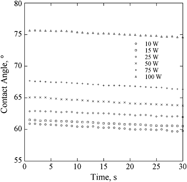
The development of novel organic polymer thin films is essential for the advancement of many emerging fields including organic electronics and biomedical coatings. In this study, the effect of synthesis conditions, namely radio frequency (rf) deposition power, on the material properties of polyterpenol thin films derived from nonsynthetic environmentally friendly monomer was investigated. At lower deposition powers, the polyterpenol films preserved more of the original monomer constituents, such as hydroxy functional groups; however, they were also softer and more hydrophilic compared to polymers fabricated at higher power. Enhanced monomer fragmentation and consequent reduction in the presence of the polar groups in the structure of the high-power samples reduced their optical band gap value from 2.95 eV for 10 W to 2.64 eV for 100 W. Regardless of deposition power, all samples were found to be optically transparent with smooth, defect-free, and homogenous surfaces.
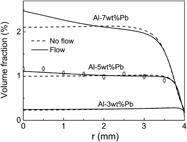
A model is developed to analyze the microstructure evolution in a continuously solidified hypermonotectic alloy. The model takes into account the common actions of the nucleation and diffusional growth/shrinkage of the minority phase droplets, the spatial phase segregation, and the convections of the melt. The microstructure formation in a continuously solidified hypermonotectic alloy is calculated. The numerical results demonstrate that the convections have great effect on the microstructure formation. The convective flow against the solidification direction causes an increase in the nucleation rate while the convective flow along the solidification direction causes a decrease in the nucleation rate of the minority phase droplets. The convections lead to a more nonuniform distribution of the minority phase droplets in the melt. It causes an increase in the size of the largest minority phase droplets and is against the obtaining of the hypermonotectic alloys with a well-dispersed microstructure.
The densification kinetics of a blend of unalloyed Ti and Al-40V master alloy powders are measured during uniaxial hot pressing under 3–10 MPa pressure for thermal cycling (860–1020 °C) or isothermal (1020 °C) conditions. Subsequent heat treatment for 4–16 h at 1020 °C results in a homogeneous Ti-6Al-4V microstructure. This process provides a low-cost alternative to hot isostatic pressing of prealloyed Ti-6Al-4V powders.
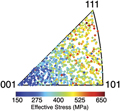
Three-dimensional image-based modeling is used to investigate the correlations between crystallographic orientation and mechanical response in a body-centered cubic (BCC) β-titanium microstructure. Statistical significance is achieved by combining the simulation data of multiple image-based crystal plasticity models. Each individual model contains ∼100 grains and is subjected to uniaxial and biaxial tensile loading conditions. Although the use of smaller sub-volumes instead of a single large representative volume may preclude accurate prediction of the global stress–strain response of the material, it is demonstrated here that the microstructural and mechanical information at the local (grain) scale can be used to establish statistically significant microstructure–property correlations. It is shown that grains with <100> orientations aligned with the loading axis experienced much smaller effective stresses and strains than those with <110> and <111> orientations aligned with the loading axis under both types of loading conditions.
Effects of tungsten (W) addition to the electroless Ni(P) under bump metallization (UBM) on the solder joint reliability were investigated by preparing Ni–xW–5P and Ni–xW–9P films. Characteristics of the NiWP films, interfacial reaction with Sn–3.5Ag solder, and the impact resistance of solder joints was investigated by conducting differential scanning calorimetry, x-ray diffraction, scanning electron microscopy, transmission electron microscopy (TEM), and drop tests. Tungsten increased the thermal stability of the film and raised the crystallization temperature, but the crystallinity decreased with the W content in the film. The drop impact resistance of the Sn–3.5Ag/Ni–xW–9P joints was improved remarkably with the W content in the UBM, which was a direct consequence of the elimination of Ni3Sn4 spalling from the UBM. Additions of W up to 16 wt.% did not suppress intermetallic compound (IMC) spalling completely, but 22 wt.% W did up to 4 reflows, which increased the number of drops to failure (Nf) from 50 to over 300. TEM study showed the presence of an amorphous (Ni,W)3P layer between Ni3Sn4 and the original Ni–22W–9P UBM.
A comprehensive investigation has been made of the solidification of nitrogen-atomized Al86Ni6Y4.5Co2La1.5, using focused ion beam, transmission electron microscopy, and other analytical means. Face-centered cubic Al2Y was identified to be the leading crystalline phase rather than crystalline Al. A new orthorhombic-structured phase was identified in partially or fully crystallized powder particles. Apart from oxygen, nitrogen was also found to be associated with the leading crystalline phase Al2Y in which nitrogen exists as substitutional Nx−. These findings facilitate the basis for understanding the unique aspects of the Al86Ni6Y4.5Co2La1.5 bulk metallic glass, including its powder preparation by gas atomization.
Ti–Si–C–N thin films were deposited onto WC-Co substrates by industrial scale arc evaporation from Ti3SiC2 compound cathodes in N2 gas. Microstructure and hardness were found to be highly dependent on the wide range of film compositions attained, comprising up to 12 at.% Si and 16 at.% C. Nonreactive deposition yielded films consisting of understoichiometric TiCx, Ti, and silicide phases with high (27 GPa) hardness. At a nitrogen pressure of 0.25–0.5 Pa, below that required for N saturation, superhard, 45–50 GPa, (Ti,Si)(C,N) films with a nanocrystalline feathered structure were formed. Films grown above 2 Pa displayed crystalline phases of more pronounced nitride character, but with C and Si segregated to grain boundaries to form weak grain boundary phases. In abundance of N, the combined presence of Si and C disturbs cubic phase growth severely and compromises the mechanical strength of the films.
Transparent and high preferential c-axis-oriented ZnO thin films doped with SiO2 have been prepared by sol–gel method using zinc nitrate and tetraethylorthosilicate as precursors, absolute ethanol as solvent, and diethanolamine as sol stabilizer. Thin film deposition was performed by spin coating technique at a spinning speed of 2000 rpm/sec on glass substrate followed by calcinations at 500 °C. The structural characteristics of the samples were analyzed by x-ray diffractometer and atomic force microscope. The optical properties were studied by an ultraviolet–visible spectrophotometer. The results show that all the prepared ZnO thin films have a compact hexagonal wurtzite structure. With the change in the amount of SiO2 dopants, the intensity of (002) peak, particle size, surface root mean square roughness, thickness, transmittance, absorbance, and the optical band gap of the ZnO–SiO2 thin films were changed as well.
Herein we report a novel, environment-friendly approach for the reduction of graphene oxide by means of incorporating visible-light sensitive TiO2 and steady state visible-light irradiation. The surface morphology and fine structure of as-prepared composites were characterized by scanning electron microscopy and atomic force microscopy, respectively. The reduction process was evidenced by variation of conductivity. In addition, some of the electrochemical properties of the resultant graphene materials have been investigated as well.