To save content items to your account,
please confirm that you agree to abide by our usage policies.
If this is the first time you use this feature, you will be asked to authorise Cambridge Core to connect with your account.
Find out more about saving content to .
To save content items to your Kindle, first ensure no-reply@cambridge.org
is added to your Approved Personal Document E-mail List under your Personal Document Settings
on the Manage Your Content and Devices page of your Amazon account. Then enter the ‘name’ part
of your Kindle email address below.
Find out more about saving to your Kindle.
Note you can select to save to either the @free.kindle.com or @kindle.com variations.
‘@free.kindle.com’ emails are free but can only be saved to your device when it is connected to wi-fi.
‘@kindle.com’ emails can be delivered even when you are not connected to wi-fi, but note that service fees apply.
The molecular structure and dynamics of carbon nanostructures is much discussed throughout the literature, mostly from the theoretical side because of a lack of suitable experimental techniques to adequately engage the problem. A technique that has recently become available is low-voltage aberration-corrected transmission electron microscopy. It is a valuable tool with which to directly observe the atomic structure and dynamics of the specimen in situ. Time series aberration-corrected low-voltage transmission electron microscopy is used to study the dynamics of single-wall carbon nanotubes in situ. We confirm experimentally previous theoretical predictions for the agglomeration of adatoms forming protrusions and subsequent removal. A model is proposed how lattice reconstruction sites spread. In addition, the complete healing of a multi-vacancy consisting of ca. 20 missing atoms in a nanotube wall is followed.
MnO nanoparticles were surface modified using two different multifunctional polymers. By introducing a PEG group, the long term stability, MRI applicability and sterile filtration could be greatly improved. Furthermore, PEGylated MnO NPs were less toxic compared to non-PEGylated NPs. The results suggest that these nanoparticles are suitable for in vivo applications.
We propose a novel concept of optical detection of thermal neutrons in a passive device that exploits transmutation of Dy-164, a dominant, naturally occurring isotope of dysprosium, into a stable isotope of either holmium Ho-165 or erbium Er-166. Combination of the high thermal neutron capture cross section of ~2,650 barns and transmutation into two other lanthanides makes Dy-164 a very attractive alternative to traditional methods of neutron detection that will be completely insensitive to gamma irradiation, thus reducing greatly the likelihood of false alarms. The optically enabled neutron detection relies on significant differences in optical properties of Dy, Ho, and Er that are not sensitive to a particular isotope, but change considerably from one element to another. While the concept applies equally well to bulk materials and to nanocrystals, nanocrystalline approach is much more attractive due to its significantly lower cost, relative ease of colloidal synthesis of high quality nanocrystals (NCs), and superior optical and mechanical properties of NCs compared to their bulk counterparts. We report on colloidal synthesis of DyF3 NCs, both doped and undoped with Ho and co-doped with Ce and Eu to enhance their optical properties. We also report on DyF3:10%Ce and DyF3:10%Eu NCs irradiated with thermal neutrons from a Cf-252 source and their optical characterization.
The combination of dwindling oil reserves and growing concerns over carbon dioxide emissions and associated climate change is driving the urgent development of routes to utilize renewable feedstocks as sustainable sources of fuels. Catalysis has a rich history of facilitating energy efficient selective molecular transformations and contributes to 90% of chemical manufacturing processes and to more than 20% of all industrial products. In a post-petroleum era catalysis will be central to overcoming the engineering and scientific barriers to economically feasible routes to bio-fuels. This article will highlight some of the recent developments in the development of solid acid and base catalysts for the transesterification of oils to biodiesel. Particular attention will be paid to the challenges faced when developing new catalysts and importance of considering the design of pore architectures to improve in-pore diffusion of bulky substrates.
Graphene reveals many extraordinary properties including extremely high room temperature carrier mobility and intrinsic thermal conductivity. Understanding how to controllably modify graphene’s properties is essential for its proposed applications. Here we report on a method for tuning the electrical properties of graphene via electron beam irradiation. It was observed that single-layer graphene is highly susceptible to the low-energy electron beams. We demonstrated that by controlling the irradiation dose one can change, by desired amount, the carrier mobility, shift the charge neutrality point, increase the resistance at the minimum conduction point, induce the “transport gap” and achieve current saturation in graphene. The change in graphene properties is due to defect formation on the graphene surface and in the graphene lattice. The changes are reversible by annealing until some critical irradiation dose is reached.
Thermo-responsive actuation (thermomechanical effects) based on nematic liquid crystal elastomers (LCEs) have become a research priority in the preparation of soft actuators. Nematic LCEs combine the anisotropic features of liquid crystal phases with the rubber elasticity of polymer network. When heated at nematic to isotropic phase transition temperature (N-to-I temp.), a uniaxial thermomechanical deformation of LCEs will undergo at nearly constant volume due to a change of LC director order. Recently, an array of the micro-sized LCE pillars related to such thermomechanical effects have been successfully constructed through a soft lithography technology (i.e., replica molding). The prepared LCE pillars are mono-dispersive and micro-sized. They also possess N-to-I temp. higher than 100°C, largely limiting the available application. By contrast, the present study will report a hexagonal array of nano-sized thermo-responsive pillar actuators that are able to contract and expand in response to temperature changes around a lower N-to-I temp. is manufactured via using reactive rod-like liquid crystal and ultraviolet nanoimprinting technology. According to atomic force microscope (AFM) observation, a hexagonal array of pillars can be easily constructed by nanoimprinting and a responsive surface with a thermo-stimuli-driven roughness change is achieved. The room-temperature AFM scans quantitatively represent the single pillar shows a diameter of ca. 270 nm and 140 nm in depth, and the pitch meaning the averaged inter-pillar distance is measured as ca. 425 nm, thus lying in a nano-sized range. Furthermore, temperature-variable AFM is also utilized to demonstrate the pillar behaves as a thermally-stimulated nano-sized actuator. In our case, when heated above N-to-I phase transition temperature (ca. 65°C), it is clearly observed that the pillar diameter is expanded in the order of over 12-15 % and then reversibly contracted in response to temperature drop.
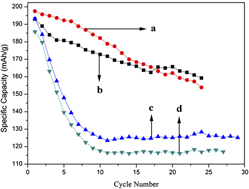
Shape control of nanocrystals has become an indispensable part in material research, such as developing new battery raw materials and synthesizing high activity catalysts. In this work, one-dimensional LiV3O8 nanorods have been fabricated by high temperature solid-state reaction using V2O5 nanowires as precursors obtained via a hydrothermal method. The as-prepared LiV3O8 nanorods were characterized by x-ray diffraction, transmission electron microscopy, scanning electron microscopy, and galvanostatic tests, compared with LiV3O8 samples synthesized by the traditional one-step solid-state method. The results show that LiV3O8 nanorods exhibited better electrochemical performance than those synthesized by the traditional method, indicating that a different shape will lead to huge distinctions in electrochemical properties. This work demonstrates that Li-insertion/deintercalation dynamics might be crystal morphology-sensitive.
In this report, we present a hot-injection strategy for the synthesis of CuInS2 (CIS) nanocrystals with hexagonal, pyramidal and nanorod shapes. For that purpose copper (I) and indium (III) acetates were dissolved in oleylamine as a high-boiling solvent. Tert-dodecanethiol (t-DDT) was used as a sulfur source. It was mixed with 1-dodecanothiol (1-DDT) and injected at a high temperature. The presence of the second dodecanethiol was necessary to control the growth of the synthesized nanocrystals. We observed a strong influence of the t-DDT amount on the morphology of the CIS nanocrystals. By the variation of the injected solution uniform CIS nanorods with different aspect ratio and size were obtained.
Mo3Ru5MPd (M = Ru, Rh, Pd) as the simulated materials for the undissolved residue in the nuclear fuel reprocessing were prepared by arc melting method. The physical properties and oxidation behavior of the alloys were evaluated from viewpoint of the safety and economy in the reprocessing. The electrical resistivity, ρ, of Mo3Ru5RhPd was shown to be 0.8 μΩm at room temperature. On the other hand, the ρ values of samples without Rh were marked at 0.4 μΩm. The thermal properties of the each sample had the different thermal transfer characteristics. In particular, although the thermal conductivities of Mo3Ru5RhPd and Mo3Ru5Pd2 samples show almost the same value, the lattice thermal conductivities of both samples showed different values. Oxidation behavior was analyzed using the thermogravity(TG) and differential thermal analyses(DTA). The TG curve of each sample by oxidation showed different results. These results indicate that the simulated materials of the alloys without Rh: Mo-Ru-Pd were not appropriate to simulate the thermophysical characteristics of the typical simulated materials with undissolved residue Mo-Ru-Rh-Pd alloys. Therefore, in the spent nuclear fuel reprocessing, the mock test of reprocessing without to use Rh is difficult to carry out.
Strain engineering in composition-controlled Si-Si/Ge nanocluster multilayers with high germanium content (~ 50%) is achieved by varying thicknesses of Si/SiGe layers and studied by low temperature photoluminescence (PL) measurements. The PL spectra show reduction in strained silicon energy bandgap and a splitting presumably associated with partial removal of heavy hole-light hole degeneracy in SiGe valence band. Time-resolved PL measurements performed under different excitation wavelengths show dramatically different PL lifetimes, ranging from ~ 2 μs to 10 ns and an unusually high PL quantum efficiency. The results are explained by using the Si/SiGe interface recombination model, which is supported by ultra-high resolution transmission and analytical electron microscopy measurements.
Light-induced metastability of amorphous/microcrystalline (micromorph) silicon tandem solar cell, in which the microcrystalline bottom cell was deposited in a single-chamber system, has been studied under a white light for more than 1000 hours. Two different light-induced metastable behaviors were observed. The first type was the conventional light-induced degradation, where the open-circuit voltage (Voc), fill factor (FF), and short-circuit current density (Jsc) were degraded, hence the efficiency was degraded as well. This phenomenon was observed mainly in the tandem cells with a bottom cell limited current mismatch. The second type was with a light-induced increase in Voc, which sometimes resulted in an increase in efficiency. The second type of light-induced metastability was observed in the tandem cells with a top cell limited current mismatch. The possible mechanisms for these phenomena are discussed.
Polyaniline is one of the most studied conducting polymers and its properties have been used in many sensor applications including gas sensors and pH sensors. In this work, we present a method that is able to embed a conducting polyaniline film in a desired pattern onto a nonconducting polymer matrix. We have developed an embedded polyaniline film on a polydimethylsiloxane (PDMS) matrix using a cast molding technique. The polyaniline film was grown by electrochemically polymerizing polyaniline from an electrolyte containing sulfuric acid and aniline monomer. A three-electrode cell system was used with a standard Ag/AgCl reference electrode, a gold auxiliary electrode, and a patterned gold working electrode. After the polyaniline film was formed on the patterned working electrode, PDMS was poured atop and cured. Cured PDMS was then debonded along with the polyaniline film embedded on the PDMS layer or block. The gold layer of the working electrode can be patterned using a photolithography steps so that the designed pattern can be transferred by the polyaniline growth on the working electrode. The greenish color of the polyaniline film indicated that the embedded polyaniline was in the conducting state (emeraldine salt form) and the conductivity of the polyaniline has also been verified by applying a DC voltage across the film and measuring the current through the polyaniline layer. The measured conductivity of the PANi layer at room temperature was in the range of 4.5 ~ 4.6 S/m. The advantage of this technique is that the PDMS matrix holds the polyaniline in place while allowing the polyaniline film to undergo reversible doping/dedoping chemistry when electrolyte solution comes into contact with the surface of the film. The developed technology can be used for various chemical sensor applications, for example, a pH sensor or gas sensors where a flexible and all-polymer apparatus is needed.
Graphene grown by Chemical Vapor Deposition (CVD) on nickel subsrate is oxidized by means of oxygen plasma and UV/Ozone treatments to introduce bandgap opening in graphene. The degree of band gap opening is proportional to the degree of oxidation on the graphene. This result is analyzed and confirmed by Scanning Tunnelling Microscopy/Spectroscopy and Raman spectroscopy measurements. Compared to conventional wet-oxidation methods, oxygen plasma and UV/Ozone treatments do not require harsh chemicals to perform, allow faster oxidation rates, and enable site-specific oxidation. These features make oxygen plasma and UV/Ozone treatments ideal candidates to be implemented in high-throughput fabrication of graphene-based microelectronics.
The Density Functional Theory has been used to analyze an inter-granular segregation of Cu and Mg. The stability of Cu and Mg atoms in the aluminum matrix, intermetallic phases and symmetric twist grain boundaries has been compared. The quantitative description of solubility of Cu and Mg atoms in the nano-crystalline aluminum has been proposed. The calculations have been carried out to investigate the properties of symmetric twist boundaries in aluminum with and without Cu/Mg atoms. The phenomena of are discussed and its effect on the stability of precipitates containing these elements.
In this work, we report the characterization of Spin-On Glass (SOG) as low temperature gate insulator. Our SOG film was deposited at temperature of 200°C, which is compatible to use on flexible substrates. The optical and electrical characterization showed that the refractive index and dielectric constant are very close to those of thermally grown SiO2. Also, analysis of surface roughness by AFM is presented. We demonstrated the use of SOG as gate insulator, fabricating and characterizing inverted staggered a-SiGe:H TFTs. The observed results are promising and suggest that SOG films deposited at 200°C in the Laboratory of Microelectronics of INAOE could be an alternative to improve electrical characteristics of TFTs on low temperature flexible substrates.
The surrounding ambient introduces a gaseous boundary to many nanotechnology applications such as nanosensors, nanoelectromechanical systems and nanocoatings. Despite the large surface area to volume ratio of nanostructures, a formal study of the surface scattering effects induced by a gaseous boundary has received little attention. In this work, we consider the perturbing effects to the electron cloud or jellium of conducting nanostructures when submitted to a gaseous interface of varying interaction energies. Specifically, we incorporate the novel experimental method of Dynamic Electron Scattering (DES) to measure electronic thermal conductivity of 30 nm thick Au and Cu metal films in He and Ar atmospheres. The gas particle impact energy is varied by changing the flow speed from stationary (non-moving gas field) to high speed flow over the metal films. The scattering effects of each gas are clearly observable through electronic thermal conductivity reductions as the gas impact energy increases. We find the high collision density of He to induce greater reductions in thermal conductivity than the much heavier Ar with lower collision density. The perturbed transport properties of the Au and Cu thin films are explained by kinetic surface scattering mechanisms that dominate the scattering landscape of high surface area to volume ratio materials as suggested by comparative measurements on bulk Cu.
Significant improvement of mechanical properties was observed recently in graphene platelet-epoxy nanocomposites relative to unfilled epoxy, such as an increase of the fracture toughness by 50% and dramatic decrease of fatigue crack growth rate. In this work, thin films of 0.1 wt.% of graphene platelet (GPL) – epoxy nanocomposites were fabricated and the nanoscale mechanical properties of the nanocomposite were investigated by nanoindentation. This provides information about the presence of characteristic length scales induced by the microstructure and the strength of the filler-matrix interface.
LiFePO4 has shown considerable promise as a cathode material in Li-ion batteries due to its stability, low toxicity and high cyclability. However, the data on thermodynamic stability of olivine phase FePO4 (o-FePO4), the delithiated form of o-LiFePO4, remains scarce and contradictory. In this work, o-FePO4 was synthesized by chemical delithiation of o-LiFePO4 and characterized structurally and thermally. X-ray diffraction and absorption data indicate pure olivine phase, but with residual amount of Fe2+, most likely due to incomplete delithiation. Differential scanning calorimetry and thermal gravimetric analysis reveal that o-LixFePO4 decomposes exothermally above 550 °C with about 9% weight loss, the products being trigonal phase FePO4, Fe7(PO4)6, and LiPO3.
We report results from an experimental and theoretical study of the room temperature (RT) compression of the ternary alloy Ti-6Al-4V. In this work, we have extended knowledge of the equation of state (EOS) from 40 GPa to 221 GPa, and observed a different sequence of phase transitions to that reported previously for pure Ti.