To save content items to your account,
please confirm that you agree to abide by our usage policies.
If this is the first time you use this feature, you will be asked to authorise Cambridge Core to connect with your account.
Find out more about saving content to .
To save content items to your Kindle, first ensure no-reply@cambridge.org
is added to your Approved Personal Document E-mail List under your Personal Document Settings
on the Manage Your Content and Devices page of your Amazon account. Then enter the ‘name’ part
of your Kindle email address below.
Find out more about saving to your Kindle.
Note you can select to save to either the @free.kindle.com or @kindle.com variations.
‘@free.kindle.com’ emails are free but can only be saved to your device when it is connected to wi-fi.
‘@kindle.com’ emails can be delivered even when you are not connected to wi-fi, but note that service fees apply.
The present study aims to investigate the effect of strain rate on volume fraction of martensite (VFM) in 304L austenitic stainless steel through dome test. Findings of this study show that martensitic transformation affects the deformation mode and formability of this material. Three strain rates are applied by controlling forming punch speed to conduct the stretching experiments and VFM is measured using magnetic saturation method. Results of the present study reveal that maximum VFM of 56% forms at the pole at low strain rates, whereas VFM of 47% is seen at high strain rates, and transforms in the region close to the flange. It is noted that blanks show good formability under low strain rate and poor formability at high strain rates. The relationship between VFM and strain rate, strain, percentage of shell reduction, equivalent of stress, and triaxiality are discussed. The experimental procedure is simulated and predicted findings show good agreement with the experimental results.
Isothermal homogenization heat treatments for a GCr15 bearing steel cast billet were performed at temperatures of 1000–1250 °C and holding times of 30–180 min. The grain size of austenite was measured with a metallographic microscope through the linear intercept method. Experimental results show that the grain size of austenite increases with the increase in heating temperature and holding time. The relationship between grain size and homogenization cycles was established. The homogeneity of the cast billet has an obvious effect on the austenite grain size distributions. Small and large grains were observed in the high- and low-concentration regions, respectively. The log-normal function can describe the grain size distributions more accurately than other functions after heating at low temperatures for short times. However, the Weibull function fits the grain size data well when the heating temperatures and holding times are improved.
Carbon nanotube (CNT) reinforced A356 aluminum alloys cast nanocomposites containing lower CNT contents were successfully fabricated where the way of introducing diluted Al–8 wt% CNT master nanocomposite in A356 melts was used. The differential thermal analysis and x-ray diffraction results showed that aluminum carbide phases (Al4C3) were formed before Al melting. The formation of Al4C3 was then proved to improve the wettability of CNTs during Al melting. Effect of CNT addition on microstructure and mechanical properties of CNTs/A356 nanocomposites were investigated by optical microscopy, scanning electron microscopy, transmission electron microscopy, and universal tensile testing machine. The results showed that CNTs (<0.4 wt%) were well distributed in the CNTs/A356 nanocomposites. CNTs could greatly refine the microstructure of A356 alloy. The mechanical properties of CNTs/A356 nanocomposites were also enhanced by CNT addition. Fractography analysis revealed that CNTs were distributed uniformly throughout the fracture surface.
A novel approach of powder metallurgy processed, cost-effective, environmentally friendly material, rutile, is proposed as an alternate to the conventional titanium-di-oxide (TiO2) in the process of enhancing tribological behavior of aluminium (Al) based composites. Rutile, also possess good thermal stability which is essential for any material subjected to high temperature applications. The role of rutile (TiO2) in the enrichment of tribological and microhardness properties of aluminium based metal matrix composites is presented. Al matrix composite was reinforced with rutile (TiO2) to the proposed compositions (0, 4%, 8%, 12%, mass fraction) through powder metallurgy route. Wear test was done using pin-on-disc apparatus under dry sliding conditions. The preforms were then characterized using optical microscopy (OM), scanning electron microscope (SEM) and energy-dispersive x-ray spectrometer (EDS). Outcomes suggest that to increase in mass fraction of TiO2, sintered density of the preforms approaches the theoretical density. OM images ratify uniform dispersion of TiO2 implants within the Al matrix. TiO2 offers promising wear and microhardness properties to the proposed composites which attribute to a high dislocation density of deformed planes. Plastic shearing, in conformity with the propagation of shear cracks broke particles as loose fragments which reduces the effective area of contact between the sliding surfaces and reduces loss of material in Al–12% TiO2 composite. Mechanism of wear disclosed through SEM images and EDS patterns concludes that delamination and adhesion dominates the material removal.
Magnetic characteristics of nanocrystalline CoNi alloy materials embedded in silica matrix (KIT-6) have been investigated. CoNi alloys with different loading (4–12 wt%) were synthesized via a novel chemical reduction route. The materials are characterized by UV–VIS, IR, powder x-ray diffraction (XRD), transmission electron microscopy (TEM) and studied for their adsorption–desorption and magnetic properties. CoNi alloys crystallize in pure fcc phase with lattice parameters (a) and crystallite sizes in the range of 3.53(±2)–3.54(±2) Å and 13.6(±1)–16.3(±1) nm, respectively. TEM microscopy studies reveal nanocrystalline nature of the materials. Enhancement of magnetic moment with the increase in loading wt% for CoNi alloys embedded in silica matrix is observed. The values of coercivity tend to decrease after dispersion in silica matrix and thereafter increase with increasing loading wt% of various CoNi loaded samples. The observed magnetic properties have been explained on the basis of size, surface effects, and dipolar interactions.
Near-infrared (NIR) absorption in solar-control LaB6 nanoparticles (NPs) is derived from the localized surface plasmon resonance (LSPR) at 1.3 eV, and accompanies an unclarified subpeak at 1.8 eV. As an origin of this subpeak, a disk-like particle shape of LaB6 NP has recently been proposed, besides the previously-proposed, milling-derived LaO phase. A series of heating experiments at 200–850 °C in air for LaB6 NPs pulverized with different media beads have been made, followed by x-ray diffraction and transmission electron microscopy observations, to clarify that LaB6 NPs oxidizes to amorphous phases B2O3 and La–B–O at 450–600 °C, and crystallize to LaB3O6 at 650–750 °C, without forming LaO or La2O3. Dielectric functions of LaO have been derived by first-principles calculations using sX-LDA, and Mie scattering calculations have been made for various sizes, shapes, and the ensembles, showing that LaO NPs, if existed, should exhibit an excessively-broadened absorption band with a blunt LSPR peak at 2.1 eV buried in several interband-transition absorptions at 1.2–4.0 eV. These analyses confirm that the observed 1.8 eV subpeak could not originate from LaO and support the nonspherical shape of NPs as the origin of the subpeak.
The effect on the mechanical properties at room temperature of Li and Ag additions to the Fe–Al (40 at.%)-based alloy produced by conventional casting were evaluated in this work. Alloying elements were added into a previously molted Fe–(40 at.%) aluminum-based alloy, stirred, and then cast into sand molds to directly produce tensile specimens. To determine the mechanical properties, tensile tests and hardness measurements were performed. The additions of both Ag and Li showed an increase in ductility and tensile strength of the intermetallic alloys. In addition, hardness was substantially increased with the Li addition. Lithium additions promoted a solid solution hardening, whereas 3 at.% of Ag additions promoted ductility due to a microstructural modification and to the formation of a soft Ag3Al phase. Characterization by both optical and electronic microscopy, energy dispersive spectroscopy microanalysis, and x-ray diffraction supported the mechanical characterization.
X-ray powder diffraction data for 5,6-dihydro-3-(4-morpholinyl)-1-[4-(2-oxo-1-piperidinyl)phenyl]-2(1H)-pyridinone, C20H25N3O3, are reported [a = 5.989(2), b = 6.669(3), c = 24.605(5)Å, α = 84.466(7)°, β = 89.859(6)°, γ = 69.074(4)°, unit-cell volume V = 913.11 Å3, Z = 2, and space group P−1]. No detectable impurities were observed.
The aim of this work was to study the deformation behavior of an Armco iron after severe plastic deformation by equal channel angular pressing (ECAP). Particular attention was paid to predict the dislocation density by different approaches like the model proposed by Bergström. Experimental measures of dislocation density by different techniques are used in the discussion. Cylindrical samples of ARMCO iron (8mm of diameter, 60mm of length) were subjected to ECAP deformation using a die with an intersecting channel of Φ=90° and outer arc of curvature of ψ= 37° die. Samples were deformed for up to 16 ECAP passes following route Bc. The mechanical properties of the material were measured after each pass by tensile tests. The original grain size of the annealed iron (70 μm) was drastically reduced after ECAP reaching grain sizes close to 300nm after 16 passes.
A facile method that allows chemical functionalization of graphene sheets is described. These result in a solution processable graphene-based material, namely F-graphene, which can be integrated in organic photoelectronic devices, due to its unique structural and photophysical properties. The resultant poly(3-hexylthiophene)(P3HT):F-graphene are soluble in common organic solvents, facilitating the structure/property characterization and the device fabrication by solution processing. The synthesized F-graphene is blended with the conjugated polymer in optimized concentration. The high and sensitive photoresponse of P3HT:F-graphene was demonstrated by the photodetector. A heterojunction photovoltaic device based on the solution-cast P3HT:F-graphene (with a BHJ structure of ITO/ZnO/P3HT:F-graphene/MoO3/Ag) showed a power conversion efficiency of 1.9% under AM1.5 illumination (100 mW/cm2). It provides a new method for graphene application in organic photoelectronics. It can easily enhance the performance of devices by optimizing the structure and bulk heterojunction blend in the near future.
Although the strong coupling of polarization to spontaneous strain in ferroelectrics would impart a flux-closure with severe disclination strains, recent studies have successfully stabilized such a domain via a nano-scaled multi-layer growth. Nonetheless, the detailed distributions of polarizations in three-dimensions (3D) and how the strains inside a flux closure affect the structures of domain walls are still less understood. Here we report a 3D polarization texture of a 4-fold flux closure domain identified in tensile strained ferroelectric PbTiO3/SrTiO3 multilayer films. Ferroelectric displacement analysis based on aberration-corrected scanning transmission electron microscopic imaging reveals highly inhomogeneous strains with strain gradient above 107/m. These giant disclination strains significantly broaden the 90° domain walls, while the flexoelectric coupling at 180° domain wall is less affected. The present observations are helpful for understanding the basics of topological dipole textures and indicate novel applications of ferroelectrics through engineering strains.
The surface microstructure of shot peened (TiB + TiC)/Ti–6Al–4V is investigated using Rietveld whole pattern fitting method. The domain size and microstrain of them are obtained. By comparing the calculated results between them, it can be found that the microstructure variations of Ti–6Al–4V are more severe than those of (TiB + TiC)/Ti–6Al–4V, which is due to the effect of reinforcements' resistance to the deformation of the surface layer. The distribution of average domain size and microstrain of (TiB + TiC)/Ti–6Al–4V at varying depths are calculated, and the results are discussed in detail. Moreover, the probability distribution of the domain size at different depths is obtained using the lognormal distribution model. Based on the discussion, the results obtained from Rietveld whole pattern fitting method agree with the results calculated using the Voigt method, which reveals that the Rietveld method is an effective method of characterizing the surface microstructure of titanium matrix composites after shot peening treatments.
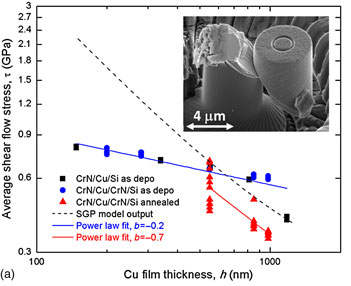
Axial compression was conducted on micro-pillars, in which polycrystalline Cu thin films were sandwiched between CrN and Si. Plastic flow of Cu was achieved, when the Cu films are inclined either at 90° or 45° with respect to the pillar axis. The texture of Cu films was altered by changing the template on which film growth occurred. The Cu microstructure was further altered by post-deposition annealing. The flow stress shows little dependence on the film texture in the as-deposited state. However, annealing influences the flow stress of confined Cu films significantly. The implications on strain gradient plasticity models are discussed.
Polycrystalline compounds of Dy0.55Sr0.45Mn1−xFexO3 (x = 0.0 and 0.20) were synthesized using ceramic method and characterized by X-ray powder diffraction technique using CuKα (1.5406 Å) radiation at room temperature. All the diffraction peaks were indexed to an orthorhombic cell with space group Pnma (#62). Whole powder diffraction profile refinement was performed using GSAS package.
Using Finite Element Method (FEM) simulations is possible to study the homogeneity of deformation in the Equal Channel Angular Pressing (ECAP) process. In this work an investigation about the influence of a modified die on strain distribution in an ecaped Al6060 alloy was carried out. Due to that, tensile stress occurs in the vicinity of upper surface of the specimen in the severe plastic deformation zone, which increases the cracking and fracture tendency of the specimen and impedes further ECAP processing, the conventional ECAP die was modified to eliminate the tensile stress and enhance the compressive stress in the severe plastic deformation zone and reducing the cracking and fracture tendency of the specimen. Finite element analysis demonstrated that the stress state changes from tensile to strongly compressive when using the modified die. The aim of this study is to evaluate the advantages/disadvantages of the modified ECAP die and processing conditions.
High-pressure torsion (HPT) is a processing technique in which samples are subjected to a high pressure and torsional straining. Anvil alignment and anvil roughness are two important factors related to the successful application of the HPT processing technique. Using a two-phase duplex stainless steel as a model material, experiments were conducted by placing the anvils in different amounts of initial misalignment. Experiments show that the flow patterns (the development of double-swirl patterns) in HPT are dependent upon the alignment of the anvils within the HPT facility. Through carefully designed experiments, it is shown that the presence of a double-swirl is a feature of HPT processing when the initial positions of the anvils have a small lateral misalignment. The effect of the double-swirl patterns on the hardness evolution was also evaluated quantitatively. By comparing the flow patterns developed on the disc upper surface using both rough and smooth anvils with a fixed anvil misalignment, it was demonstrated that there are some differences in the flow patterns which are dependent upon the anvil surface roughness.