To save content items to your account,
please confirm that you agree to abide by our usage policies.
If this is the first time you use this feature, you will be asked to authorise Cambridge Core to connect with your account.
Find out more about saving content to .
To save content items to your Kindle, first ensure no-reply@cambridge.org
is added to your Approved Personal Document E-mail List under your Personal Document Settings
on the Manage Your Content and Devices page of your Amazon account. Then enter the ‘name’ part
of your Kindle email address below.
Find out more about saving to your Kindle.
Note you can select to save to either the @free.kindle.com or @kindle.com variations.
‘@free.kindle.com’ emails are free but can only be saved to your device when it is connected to wi-fi.
‘@kindle.com’ emails can be delivered even when you are not connected to wi-fi, but note that service fees apply.
Thermodynamics is a remarkable subject, both in its pervasiveness throughout the pure and engineering sciences, and in the striking simplicity and elegance of its principles. Indeed, it is hard to underestimate the significance of thermodynamics to virtually any physical problem of interest, even if its role appears only indirectly through derivative theories or models. As a testament to its importance, Einstein made the rather potent statement that thermodynamics is “the only physical theory of universal content concerning which I am convinced that within the framework of the applicability of its basic concepts, it will never be overthrown.”
At the same time, thermodynamics can be surprisingly difficult to grasp at a fundamental level, even for the experienced student. Unlike many other advanced scientific subjects, its main challenges are not mathematical in nature; a working knowledge of multivariate calculus is usually quite sufficient. Instead, the most difficult aspects of thermodynamics are its conceptual underpinnings. Students often struggle with the seemingly simple task of how to begin thinking about a problem, finding it difficult to answer questions such as the following. What constitutes the system? What is constant or constrained? What thermodynamic variables are equal across a boundary? What assumptions and models are reasonable? All of these questions precede the analytical analysis and are concerned with how to transform the physical problem into a mathematical one. When this is done, the solutions often present themselves in a rather straightforward manner, at least for an introductory treatment.
To conceptualize the molecular origins of thermodynamic equilibrium, one must first understand the elemental ways by which molecules interact. How does the world really work? What are the most fundamental principles that form the basis of reality as we know it?
Currently our understanding of reality rests upon two principal concepts in physics: quantum theory and relativity. Both of these have been subjected to stringent experimental tests over the past century, and their combination has in part led to a deep understanding of elementary particles. There still remain some incompatibilities between the two, namely in understanding the nature of gravity, and there have been intense efforts to find new fundamental physical explanations. However, for the purposes of our discussion, we will focus solely on quantum theory since for nearly all of the models and systems that we will discuss one can safely avoid considerations of relativistic effects.
Quantum mechanics describes the complete time evolution of a system in a quantum sense, in a manner analogous to what Newtonian mechanics does for classical systems. It is most easily described in terms of a system of fundamental particles, such as electrons and protons.
Throughout this text we have presented a molecular foundation for the principles of thermodynamics that has considered many highly simplified molecular models of a variety of systems, including idealized gases, solutions, polymers, and crystals. It might not be immediately obvious how we extend these ideas to more realistic models that, for example, might entail structured molecules with complex potential energy functions including bonded, electrostatic, and van der Waals energies all at once. Even the seemingly simple task of developing the thermodynamics of a monatomic fluid at high densities, such as liquid argon, can be challenging owing to the difficulty of treating the detailed pairwise interactions in the configurational partition function.
Two routes enable one to move beyond the general statistical-mechanical considerations of Chapters 16–19 to solve molecular models of nontrivial complexity. The first is the large collection of mathematical approximations and conceptual approaches that comprises the framework of statistical-mechanical theory. These techniques often give closed-form but approximate analytical expressions for the properties of a system that are valid in certain limits (e.g., the high-density one), or, alternatively, sets of equations that can be solved using standard numerical tools. The particular approaches are usually system-specific because they hinge on simplifications motivated by the physics of the interactions at hand. We will not discuss this body of work in any detail, but refer the reader to the excellent introductory texts by Hill and McQuarrie.
It is a familiar fact that pure substances tend to exist in one of three distinct states: solid, liquid, and gas. Take water, for example. As ice is heated at atmospheric pressure, it suddenly melts into liquid at a specific temperature. As the liquid continues to be heated, it eventually reaches a temperature at which it spontaneously vaporizes into a gas. These transitions are discontinuous; they occur at specific state conditions or particular combinations of T and P. At exactly those conditions, the system can exist in more than one form such that two (or more) phases are in equilibrium with each other.
Although we are typically familiar with phase behavior at atmospheric pressure, most substances experience a diverse set of phases over a broad range of pressures. Pure substances often have more than one crystalline phase, depending on the pressure. Figure 10.1 shows a schematic representation of a P–T phase diagram of water that illustrates the kind of complex behavior that can exist. In the case of mixtures, there are even more possibilities for phase equilibrium: for example, one can have equilibrium between two liquids of different compositions, or among multiple solid and liquid phases.
Most synchrotron radiation X-ray diffraction (XRD) beamlines have been primarily designed for studying conventional materials, whereas a modern approach to nanomaterials requires a complete control of the diffracted signal, and therefore of the optics and general setup of the beamline. This requirement is especially relevant when Line Profile Analysis is pushed to the limits of large domain sizes, small deformations, or low defects concentration, which is a driving force to use synchrotron radiation XRD. We combine the SHADOW ray-tracing optical simulation with the calculation of powder diffraction profile from standard materials, into a high-level workflow environment based on the ORANGE software. Algorithms are developed to reproduce optical elements in a realistic form, so to evaluate the effects of aberrations, with the final purpose of reconstructing the Instrumental Profile Function of the beamline, with the possibility of investigating the role of each separate element. The results of this work can be of interest to most beamlines as a powerful tool for the design of setups of existing as well as new beamlines.
In this chapter we extend the fundamental properties of solutions introduced in Chapter 12 to a variety of cases in which a more advanced analysis is required. The uninterested reader may wish to skip these topics. Here we first examine in detail the phenomenology and mathematical description of liquid–vapor equilibrium in multicomponent systems, including nonideal ones. Subsequently, we consider two important classes of systems – polymers and strong electrolytes – for which the ideal solution never provides a reasonable model. We provide the basic models and conceptual underpinnings in these analyses; however, excellent elaborations on these topics can be found in the references noted at the end of the chapter.
Phenomenology of multicomponent vapor–liquid equilibrium
Because multicomponent vapor–liquid equilibrium is so important to the chemical process industries, we elaborate on the ideas initially developed in Chapter 12. Before we consider the mathematics of this problem, let us begin by describing some essential phenomenology. The behavior upon heating a pure liquid at constant pressure P is familiar: its temperature increases until the boiling temperature is reached, at which Pvap(Tb) = P. The liquid vaporizes entirely at Tb and then the temperature subsequently increases again as the vapor is heated.
Conjugated polymers are being considered for use at the interface between hard inorganic metallic and semiconducting electrodes and soft biological tissues. These organic materials have properties that are intermediate to these two extremes, and their chemistry, structure, and performance can be precisely manipulated over a large range. Examples of current interest included copolymers of poly(3,4-ethylene dioxythiophene) and poly(3,4-propylene dioxythiophene). This paper will review past efforts, recent activities, and future possibilities in this rapidly expanding area of materials research and technology.
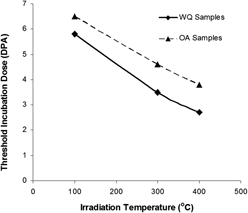
We report here the microstructural changes occurring in the zirconium alloy Excel (Zr–3.5 wt% Sn–0.8Nb–0.8Mo–0.2Fe) during heavy ion irradiation. In situ irradiation experiments were conducted at reactor operating temperatures on two Zr Excel alloy microstructures with different states of alloying elements, with the states achieved by different solution heat treatments. In the first case, the alloying elements were mostly concentrated in the beta (β) phase, whereas, in the second case, large Zr3(Mo,Nb,Fe)4 secondary phase precipitates (SPPs) were grown in the alpha (α) phase by long term aging. The heavy ion induced damage and resultant compositional changes were examined using transmission electron microscopy (TEM) in combination with scanning transmission electron microscope (STEM)-energy dispersive x-ray spectroscopy (EDS) mapping. Significant differences were seen in microstructural evolution between the two different microstructures that were irradiated under similar conditions. Nucleation and growth of <c>-component loops and their dependence on the alloying elements are a major focus of the current investigation. It was observed that the <c>-component loops nucleate readily at 100, 300, and 400 °C after a threshold incubation dose (TID), which varies with irradiation temperature and the state of alloying elements. It was found that the TID for the formation of <c>-component loops increases with decrease in irradiation temperature. Alloying elements that are present in the form of SPPs increase the TID compared to when they are in the β phase solid solution. Dose and temperature dependence of loop size and density are presented. Radiation induced redistribution and clustering of alloying elements (Sn, Mo, and Fe) have been observed and related to the formation of <c>-component loops. It has been shown that at the higher temperature tests, irradiation induced dissolution of precipitates occurs whereas irradiation induced amorphization occurs at 100 °C. Furthermore, dose and temperature seem to be the main factors governing the dissolution of SPPs and redistribution of alloying elements, which in turn controls the nucleation and growth of <c>-component loops. The correlation between the microstructural evolution and microchemistry has been found by EDS and is discussed in detail.
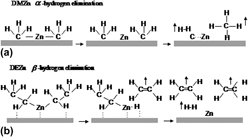
In this study, the authors have comparatively studied the influence of H2 addition on the structures and properties of ZnO films grown by metal organic (MO) chemical vapor deposition with dimethyl zinc and diethyl zinc as zinc precursors and N2O and O2 as oxygen sources, respectively. Various characterization methods, like x-ray diffraction, Raman scattering, Hall effect, photoluminescence, and atomic force microscopy, have been utilized, showing that H2 has different effects on different MO precursors and oxidants. The H2 addition has significantly improved the crystal structural quality of ZnO thin films for the case of dimethyl zinc source, but an opposite effect has been found for the case of diethyl zinc. Moreover, the H2 addition can significantly improve the optical properties of the ZnO films, regardless of the zinc MO sources used, with the surface morphology improved too. The suppression of carbon-related contaminations depends on the use of different precursors and whether H2 is added. By analyzing the experimental results, we have given the effects of H2 on the decomposition of the discussed MO precursors and oxidants, the proposed mechanism could be used in understanding the experimental data.
The Mn-steel matrix composite locally reinforced with in situ TiC–TiB2 ceramic particulate was successfully fabricated using a thermal explosion-casting route in a Cu–Ti–B4C system with various B4C particle sizes. With the increase of B4C particle size, the ignition temperature increased, the combustion temperature decreased, and the size of the TiC and TiB2 ceramic particulates became smaller. The hardness, friction coefficient, and wear resistance of the composite were higher than those of the Mn-steel matrix. With the increase of B4C particle size, the size of the TiC and TiB2 ceramic particulates fabricated in the local reinforcing region decreased, the interface bonding between reinforcing region and matrix became poor, and the number of pores in the local reinforcing region increased. Moreover, the composite with ∼3.5 μm B4C showed the best antiwear property. At a low load of 20 N, the dominant wear mechanisms of the Mn-steel matrix composite were microcutting and abrasive wear. While, at a high load of 80 N, the dominant wear mechanisms were microcutting and adhesion wear associated with the formation of delamination layer.