To save content items to your account,
please confirm that you agree to abide by our usage policies.
If this is the first time you use this feature, you will be asked to authorise Cambridge Core to connect with your account.
Find out more about saving content to .
To save content items to your Kindle, first ensure no-reply@cambridge.org
is added to your Approved Personal Document E-mail List under your Personal Document Settings
on the Manage Your Content and Devices page of your Amazon account. Then enter the ‘name’ part
of your Kindle email address below.
Find out more about saving to your Kindle.
Note you can select to save to either the @free.kindle.com or @kindle.com variations.
‘@free.kindle.com’ emails are free but can only be saved to your device when it is connected to wi-fi.
‘@kindle.com’ emails can be delivered even when you are not connected to wi-fi, but note that service fees apply.
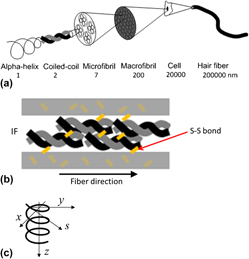
The mechanical behavior of human hair is determined by the interaction of trichocyte alpha keratin protein, matrix, and disulfide bonds crosslinking. Much effort has been spent to understand the link between the microscopic structure and the macroscopic fiber properties. Here we apply a mesoscopic coarse-grained model of the keratin macrofilament fibril combined with an analytical solution based on the concept of entropic hyperelasticity of the protein helix to investigate the link between the microscopic structure and the macroscopic properties of keratin fibers. The mesoscopic model provides good agreement with a wide range of experimental results. Based on the mesoscopic model, the predicted stress–strain curve of hair fibers agrees well with our own experimental measurements. The disulfide crosslink between the microfibril–matrix and matrix–matrix contributes to the initial modulus and provides stiffening at larger deformation of the trichocyte keratin fibers. The results show that the disulfide bonds reinforce the macrofilament and enhance the robustness of the macrofilament by facilitating the microfilaments to deform cooperatively. The availability of a mesoscopic model of this protein opens the possibility to further explore the relationship between microscopic chemical structure and macroscopic performance for a bottom-up description of soft materials.
The Gran Pirámide, a Mexican cultural heritage site, is located at the archaeological site of Cholula, Puebla, Mexico. At the base of its platform this pyramid is the largest in the world. It was built in layers from 800 to 1100 AD by the Cholultecan pre-Hispanic culture. The archaeological site is famous by its great mural paintings that have been well-studied. The pyramid was built with earthen construction, a system of multiple bulding episodes with layers of adobe. The building material, adobe, has not been well studied. Due to its fragile condition, a more extensive study was conducted to understand the behavior of the building and the mural paintings substrate, in order to propose conservation strategies.
Geological context of the area was the starting point to propose the relevant materials used in its construction. That was a fundamental key for the interpretation of the experimental techniques used that include X-ray Diffraction (XRD), Particle-Induced X-ray Emission (PIXE), 29Si and 27Al Nuclear-Magnetic Resonance with Magic-Angle Spin (NMR-MAS), Thermal Analysis, Optical and Scanning Electron Microscopy (SEM) and colorimetric measurements.
The results obtained from the original adobes have been compared with fresh soils from horizons related with pre-Hispanic activity. The results indicate presence of amorphous materials and neo-mineral formation besides feldspars and opal. The amorphous phases have been identified by NMR-MAS and SEM.
Differences were found in the composition from the adobe used for the joints, mainly in the clay fraction, that can be distinguished by color and that guided to group the information acquired.
These results provide new information on the composition and microstructure of adobes from the Gran Pirámide of Cholula. Further studies will involve soil physics methods and erosion tests to complete the task of having a comprehensive knowledge of the earth architecture of the pyramid.
Colonial mural painting developed in Mexico in XVI century after the conquest of the pre-Hispanic cultures following the evangelization process little information exists about the chronology of the paintings and workshops, the painters, the pictorial techniques or the materiality of this art work.
In this work, we present the non-invasive methodology of study of the pigments and other components of nine mural paintings in three colonial Augustinian ex-convents located in Epazoyucan, Actopan and Ixmiquilpan, in the state of Hidalgo, central Mexico. These places were selected not only because of the inherent value and iconographic characteristics of the paintings, which date to the XVI and XVII century, but also because they are in the same region and are well preserved and in good condition. Then it is possible to compare their materiality and get new information to answer to some of questions related to these paintings.
X-ray Fluorescence (XRF) and Raman spectroscopy were conducted using portable equipment on scaffolds after a global examination under ultraviolet light. We were able to distinguish between different pigments used for different colors such as vermillion, orpiment, and a copper pigment, for the bright red, gold yellow, and green, respectively. These pigments are characteristic of the known Mexican Colonial color palette. Apart from this, we also found the presence of indigo in the blues, minium, and cochineal. A first comparison among the mural paintings of the three sites indicates different palettes and painting periods.
The Museum of the Great Temple of Tenochtitlan in Mexico City holds a collection of several thousands of polished stone artifacts that were excavated and identified as temple offerings. These can stratigraphically be related to the sequential construction stages (II-VII) of the ceremonial area of the Aztec capital from the foundation of the city in 1325 to 1521, when the Spaniards conquered the city. A non-destructive investigation of the elemental and chemical composition of these archaeological artifacts helps us to understand the provenance of these pieces, their use and the specific mineralogical choice for these artifacts as well as more information regarding trade routes relevant to the development of the Aztec empire. A mineralogical analysis of, in total, 450 stone artifacts was carried out using infrared spectroscopy (FTIR) and X-ray Fluorescence (XRF). From this, eighty-five pieces were selected according to their excavation location, either in the Great Temple itself or in the surrounding buildings, as well as to represent the different construction stages of the area (this is part of a World Heritage Site). The resulting mineralogical and chemical information was related to possible mineral resources that were controlled and used as the empire expanded. Artifacts made from high-status semi-precious minerals, like jadeite and turquoise, are found to be concentrated in the central buildings and in the Great Temple itself, but also in the later construction periods of the area.
This comprehensive, self-contained guide to X-ray spectroscopy will equip you with everything you need to begin extracting the maximum amount of information available from X-ray spectra. Key topics such as the interaction between X-rays and matter, the basic theory of spectroscopy, and selection and sum rules, are introduced from the ground up, providing a solid theoretical grounding. The book also introduces core underlying concepts such as atomic structure, solid-state effects, the fundamentals of tensor algebra and group theory, many-body interactions, scattering theory, and response functions, placing spectroscopy within a broader conceptual framework, and encouraging a deep understanding of this essential theoretical background. Suitable for graduate students, researchers, materials scientists and optical engineers, this is the definitive guide to the theory behind this powerful and widely used technique.
We describe measurements aimed at tracking the subsurface energy deposition of ionic radiation by encapsulating an irradiated oxide target within multiple, spatially separated metal–oxide–semiconductor (MOS) capacitors. In particular, we look at incident kinetic energy and potential energy effects in the low keV regime for alkali ions (Na+) and multicharged ions (MCIs) of ArQ+ (Q = 1, 4, 8, and 11) incident on the as-grown layers of SiO2 on Si. With the irradiated oxide encapsulated under Al top contacts, we record an electronic signature of the incident ionic radiation through capacitance–voltage (C–V) measurements. Both kinetic and potential energy depositions give rise to shifted C–V signatures that can be directly related to internal electron–hole pair excitations. The MCI data reveal an apparent power law dependence on charge state, which is at odds with some prior thin foil studies obtained at higher incident energies.
In this study, Vickers indentation was used to investigate the two-way shape-memory effect (TWSME) in an austenitic Ti-50.9 at.% Ni alloy, exposed to different heat treatments. Three aging treatments were used to manipulate the size of Ti3Ni4 precipitates. All samples were Vickers indented, and the indent depth was investigated as function of thermal cycling. The TWSME was found only in the material aged at 400 °C, which contained coherent precipitates. Thermal cycling shows stable TWSME, however, heating well above the austenite finish temperature lead to permanent austenitic protrusions. The results indicate that stabilized martensite plays a critical role in creating TWSME surfaces.
The use of a catalyst is required to synthesize poly(D,L-lactide) (PLA) and tin (II) 2-ethylhexanoate could be highlighted among them. However, this kind of catalysts can produce bio-dangerous compounds limiting the PLA in medical applications, therefore there is a need to investigate novel bio-safe catalysts. Taking into account this problem, this communication reports the use of micro- and nano-ZnO particles as catalysts for the microwave-assisted polymerization of D,L-lactide. By microwave heating a high monomer conversion (higher than 95%) was achieved in a relatively short reaction time (3 hours). Morphology/size and concentration of ZnO particles presented a strong effect on the production of PLA, star-like microparticles leaded to conversion ca. 25%, well below to the values achieved with the nanoparticles. Furthermore, the formation of a ZnO-PLA hybrid was evidenced by spectroscopic and thermal characterization techniques. The methodology herein developed represents a new pathway for the green synthesis of PLA.
Thermoelectric (TE) generators have very important applications, such as emerging automotive waste heat recovery and cooling applications. However, reliable transport properties characterization techniques are needed in order to scale-up module production and thermoelectric generator design. DOE round-robin testing found that literature values for figure of merit (ZT) are sometimes not reproducible in part for the lack of standardization of transport properties measurements. In Sandia National Laboratories (SNL), we have been optimizing transport properties measurements techniques of TE materials and modules. We have been using commercial and custom-built instruments to analyze the performance of TE materials and modules. We developed a reliable procedure to measure thermal conductivity, seebeck coefficient and resistivity of TE materials to calculate the ZT as function of temperature. We use NIST standards to validate our procedures and measure multiple samples of each specific material to establish consistency. Using these developed thermoelectric capabilities, we studied transport properties of Bi2Te3 based alloys thermal aged up to 2 years. Parallel with analytical and microscopy studies, we correlated transport properties changes with chemical changes. Also, we have developed a resistance mapping setup to measure the contact resistance of Au contacts on TE materials and TE modules as a whole in a non-destructive way. The development of novel but reliable characterization techniques has been fundamental to better understand TE materials as function of aging time, temperature and environmental conditions.
We have investigated the effect of oxygen pressure during growth (PO2) on the electronic and magnetic properties of PrAlO3 films grown on TiO2-terminated SrTiO3 substrates. The films are smooth, with flat terraces. Resistivity measurements show an increase in the sheet resistance as PO2 is increased from 10–3 to 10–4 torr, with an usual peak as a function of temperature for the sample grown in higher oxygen pressure. We measured a moderate positive magnetoresistance (MR) at low magnetic fields that evolves into a larger negative MR at high fields, for both PO2 samples. Hall effect data exhibit a complex temperature dependence that suggests a compensated carrier density. We observe behavior consistent with two different types of carriers at each of the two different interfaces.
The biocompatibility of an implant material depends on the bulk physical properties in addition to the surface properties. In biomedical engineering and industry Ti and Ti-alloys are very popular biological implant material for their bulk physical properties and strength to weight ratio resembling those of nature bone. It is possible to modify the surface properties of titanium for enhanced surface biocompatibility. The main objective of the this study is to engineer a smart Ti-based prosthesis surface by self induced chemically modified titanium oxide nano-film by the chemical mechanical polishing process (CMP). This new process applied on bio-implants aims at significantly reducing the out-diffusion of Ti and other metallic impurities from prosthesis in contact with body fluids and tissue and simultaneously enhancing the surface mechanical, chemical and biological properties. CMP technique enables the growth of a thicker and denser self-protective native oxide on Ti and Ti alloy samples, while simultaneously inducing a controlled surface roughness. It is demonstrated that the Ti based dental implants with self-protective oxide induced surfaces help minimize chemical and bacterial reactivity in addition to Ti ion dissolution while promoting their biocompatibility through surface patterning. The studied self-protective oxide films can also be utilized for many additional applications including bio-sensors.
We present our findings on structural features and trends observed in single crystal structural studies for a series of oligothiophene and ethylenedioxythiophene (EDOT) molecules substituted with bromo and tricyanovinyl groups. The presence of a C=C bridge as well as the introduction of n-butyl solubilizing groups are also addressed. Focus of the work will be on how these structural modifications, in particular, how inter- and intra- molecular interactions impact planarity and packing of molecules in the observed crystal structures.
A metallurgical by product mostly constituted of Wustita (FeO) was transformed to Magnetite (Fe3O4) spheres using a flame treatment. Then magnetite spheres surface was modified by cold plasma treatment with ethylene, where a thin polyethylene film was deposited on the spheres surface. Finally, HDPE composites with modified spheres were obtained by melt mixing and its thermal conductivity was determined by MDSC. It was found that spheres surface modification helps to increase composites thermal conductivity.
Mechanical property degradation due to an ordering phase transformation is a concern for alloys based on the Ni-Cr binary system (e.g., 690, 625), particularly in nuclear power applications, such as stream generator tubing, reactor pressure vessel and head control rod drive mechanism penetrations, where component lifetimes can exceed 40 years. In the present research, the disorder-order phase transformation has been studied in Ni-Cr model alloys with varying stoichiometry by experimental methods. In this paper, the effect of composition on ordering is characterized via X-ray diffraction.
Two Mo-bearing glasses considered as candidate forms for high level waste (HLW) a uranium-graphite reactor spent nuclear fuel (SNF) reprocessing were characterized. Incorporation of Mo in sodium aluminophosphate (SAP) glass increases its tendency to devitrification with segregation of orthophosphate phases. Valence state and local environment of Mo in the materials containing ∼2 wt.% MoO3 were determined by X-ray absorption fine structure (XAFS) spectroscopy. In the quenched samples composed of major vitreous and minor AlPO4 nearly all Mo is located in the vitreous phase as [Mo6+О6] units whereas in the annealed samples Mo is partitioned among vitreous and one or two orthophosphate crystalline phases in favor of the vitreous phase. Mo predominantly exists in a hexavalent state in distorted octahedral environment. Four oxygen ions are positioned at a distance of ∼1.71-1.73 Å and two - at a distance of 2.02-2.04 Å. Minor Mo(V) is also present as indicated by a response in EPR spectra with g ≈ 1.911-1.915.
Zinc oxide thin films prepared by sol-gel and doped with different aluminum percentages were deposited by spray-pyrolysis deposition techniques on FTO and ITO substrates. The films were applied as the sensitive layer of pH-sensors EGFET devices. ZnO:Al films on FTO substrates shows a decrease in sensor quality with the dopant percentage increase. The opposite occurs when the substrate was ITO. The best quality film to be used as pH-sensor on FTO substrates was the ZnO:Al (3%) with 29 mV/pH sensitivity value and linear adjust of 0.99. For ITO substrates the best quality was achieved for ZnO:Al (10%), with sensitivity about 30 mV/pH and 0.99 linear adjust.