To save content items to your account,
please confirm that you agree to abide by our usage policies.
If this is the first time you use this feature, you will be asked to authorise Cambridge Core to connect with your account.
Find out more about saving content to .
To save content items to your Kindle, first ensure no-reply@cambridge.org
is added to your Approved Personal Document E-mail List under your Personal Document Settings
on the Manage Your Content and Devices page of your Amazon account. Then enter the ‘name’ part
of your Kindle email address below.
Find out more about saving to your Kindle.
Note you can select to save to either the @free.kindle.com or @kindle.com variations.
‘@free.kindle.com’ emails are free but can only be saved to your device when it is connected to wi-fi.
‘@kindle.com’ emails can be delivered even when you are not connected to wi-fi, but note that service fees apply.
To reinforce the reliability issue brought by excessive interfacial reaction with the dimensional scale-down of electronic device, an electroless Ni–P–ZrO2 (17.5 at.% of P) composite coating was developed as the under bump metallization (UBM) for lead-free solder interconnect. ZrO2 nanoparticles were proved to be homogeneously distributed and helped improve wetting ability of the layer. Both Sn–3.5Ag/Ni–P–ZrO2 and Sn–3.5Ag/Ni–P solder joints were prepared and aged at various conditions to study the interfacial reaction. Growth of intermetallic compounds (IMCs) without serious spalling in solder/Ni–P–ZrO2 joint was slowed down because of the barrier property of incorporation of ZrO2 nanoparticles, which blocked the diffusion of Ni and Cu atoms. Based on the IMC growth, the activation energy of solder/Ni–P–ZrO2 was estimated to be higher than that of plain solder joint. The top-view of IMCs demonstrated a much finer grain size compared with that of solder/Ni–P joint. A reactive diffusion-induced compound formation mechanism was proposed to address the microstructural evolution in detail. Moreover, solder/Ni–P–ZrO2 joint demonstrated higher shear strength than did solder/Ni–P joint for different aging durations. The fracture surface of solder/Ni–P joint after shear test showed ductile transition failure, with big dimples and plastic deformation.
This study demonstrates a highly sensitive humidity sensor based on treated multiwalled carbon nanotube (tr-MWCNT) and hydroxyethyl cellulose (HEC) composite films. Tr-MWCNTs are obtained by mixed acid treatment to enhance their hydrophilicity and improve their dispersion in distilled water. Compared to tr-MWCNT/silicone rubber (SR) composite film, the humidity sensitivity of tr-MWCNT/HEC film is much higher than tr-MWCNT/SR film with the same film thickness. The humidity sensing mechanisms of tr-MWCNT/HEC composites are explained by electron donation model and swelling mechanism. Speaking and blowing experiments were also carried out and the results show that tr-MWCNT/HEC composite film is sensitive to both speaking and blowing; furthermore, it can distinguish the small humidity level difference between speaking and blowing. Other sensing characteristics, including response and recovery time, stability, and temperature effect, are also investigated. The high humidity sensitivity of tr-MWCNT/HEC composite film indicates that it can be an excellent humidity sensitive material.
The formation and decomposition of silico-ferrite of calcium and aluminium (SFCA) and SFCA-I iron ore sinter bonding phases have been investigated using in situ synchrotron and laboratory X-ray diffraction (XRD) and neutron diffraction (ND). An external standard approach for determining absolute phase concentrations via Rietveld refinement-based quantitative phase analysis is discussed. The complementarity of in situ XRD and ND in characterising sinter phase formation and decomposition is also shown, with the volume diffraction afforded by the neutron technique reducing errors in the quantification of magnetite above ~1200 °C. Finally, by collecting 6 s laboratory XRD datasets and using a heating rate of 175 °C min−1, phase formation and decomposition have been monitored under heating rates more closely approximating those encountered in industrial iron ore sintering.
We report on the analysis of virtual powder-diffraction patterns from serial femtosecond crystallography (SFX) data collected at an X-ray free-electron laser. Different approaches to binning and normalizing these patterns are discussed with respect to the microstructural characteristics which each highlights. Analysis of SFX data from a powder of Pr0.5Ca0.5MnO3 in this way finds evidence of other trace phases in its microstructure which was not detectable in a standard powder-diffraction measurement. Furthermore, a comparison between two virtual powder pattern integration strategies is shown to yield different diffraction peak broadening, indicating sensitivity to different types of microstrain. This paper is a first step in developing new data analysis methods for microstructure characterization from serial crystallography data.
Rapid, on-line measurement of feedstock mineralogy is a highly attractive technology for the mineral processing industry. A Monte Carlo particle transport-based modelling technique has been developed to help design and predict the measurement performance of on-line energy-dispersive X-ray diffraction (EDXRD) analysers. The accuracy of the technique was evaluated by performing quantitative phase analysis on a suite of fifteen synthetic potash ore samples. The diffraction profile of each sample was measured with a laboratory EDXRD analyser and an equivalent profile was simulated in the Monte Carlo package. Linear regression analysis was used to determine the mineral abundances in each sample from both the measured and modelled profiles. Comparison of the results showed that the diffraction profiles and measurement accuracies obtained by simulation agree very well with the measured data.
In many ways, studies of materials and minerals by powder-diffraction techniques are complementary, with techniques honed in one field equally applicable to the other. Many of the example techniques described within this paper were developed for analysis of functional materials and subsequently applied to minerals. However, in a couple of cases, the study of new minerals was the initiation into techniques later used in materials-based studies. Hopefully they will show that the study of new minerals structures can provide opportunities to add new methodologies and approaches to future problems. In keeping with the Australian X-ray Analytical Association many of the examples have an Australian connection, the materials ranging from organics to battery materials.
Rietveld-based quantitative X-ray diffraction (QXRD) has been extensively used for mineralogical characterization in order to understand the reaction chemistry, and kinetics of minerals leaching and formation. This work presents examples where QXRD has been applied to understanding fundamental aspects of these two processes. Firstly, the co-processing of nickel laterites and sulphidic materials has the potential to offer several advantages that include the use of lower grade (including non-smeltable) concentrates, improvement in the rheological behaviour of the blends, and reduction in the use of sulphuric acid. The leaching kinetics and chemistry of mixed nickel laterite ore and sulphide concentrate were explored by the QXRD analysis of feed materials and, intermediates and final leach residues produced using controlled oxidation rates. Under high temperature (250 °C) and pressure oxidation (~40 to 45 atm.) conditions, sulphide minerals in the nickel concentrate underwent several oxidative hydrothermal transformations, and ferrous iron was oxidized and precipitated primarily as hematite. High recovery of nickel can be achieved with low acid consumption under these conditions. Secondly, iron precipitation/removal is an important down-stream process in hydrometallurgy. Moderate concentrations of ferrous iron can be oxidized using micro-organisms with oxidation rates several orders of magnitude faster compared with abiotic oxidation at ambient temperature and pressure. QXRD and chemical analysis have indicated that after oxidation, iron at pH ~2 mostly precipitates as jarosite with various amounts of K+, Na+, NH4+, and H3O+ incorporated into the structure. Bio-catalysed iron removal can be achieved with minimum copper and nickel losses at relatively low pH conditions.
The yttrium-based metal–organic framework, Y(btc) (btc = 1,3,5-benzenetricarboxylate), shows moderate uptake of methane (0.623 mmol g−1) and molecular oxygen (0.183 mmol g−1) at 1 bar and 308 K. Neutron powder-diffraction data for the guest-free, CD4-, and O2-loaded framework reveal multiple adsorption sites for each gas. Both molecular guests exhibit interactions with the host framework characterised by distances between the framework and guest atoms that range from 2.83 to 4.81 Å, with these distances identifying interaction most commonly between the guest molecule and the carboxylate functional groups of the benzenetricarboxylate bridging ligand of the host.
Nanoporous carbon membranes (NCMs) were fabricated by the blends of resorcinol–formaldehyde (RF) resin and Pluronic F-127 through the processes of assembly, membrane-casting, solidification, and pyrolysis. The effect of the catalyst type (i.e., NaOH and Na2CO3) on the structure and property of precursors and their derived NCMs was investigated. The as-obtained precursors and NCMs were characterized by thermogravimetry, differential scanning calorimetry, x-ray diffraction, Fourier transform infrared spectroscopy, transmission electron microscopy, elemental analysis, nitrogen adsorption, and gas permeation techniques. The results have shown that defect-free NCMs can be easily procured by the NaOH and Na2CO3 catalysts. In contrast, the precursor made from the Na2CO3 catalyst exhibits higher char yield than that from NaOH after pyrolysis. NaOH-based NCMs are beneficial for the separation of H2/N2 and CO2/N2 gas pairs. Na2CO3-based NCMs are more favorable for the separation of O2/N2 with an ideal selectivity of 6.29 and an O2 permeability of 3.27 Barrer.
This study presents the optical properties of layered ZnO/Al/ZnO composite thin films that are being explored for potential applications in solar cells and light emitting devices. The composite thin films are explored as alternatives to ZnO thin films. They are produced via radio frequency magnetron sputtering. The study clarifies the role of the aluminum mid-layer in a ZnO (25 nm)/Al/ZnO (25 nm) film structure. Multilayers with low resistivity ∼362 µΩ cm and average transmittances between ∼85 and 90% (in the visible region of the solar spectrum) are produced. The highest Haacke figure of merit of 4.72 × 10⁻³ Ω−1 was obtained in a multilayer with mid-layer Al thickness of 8 nm. The combined optical band gap energy of the multilayered films increased by ∼0.60 eV for mid-layer Al thicknesses between ∼1 and 10 nm. The observed shifts in the optical absorption edges to shorter wave lengths of the spectrum are shown to be in agreement with the Moss–Burstein effect.
A number of synchrotron X-ray fluorescence microprobes (XFMs) around the world offer synchrotron X-ray microdiffraction (μXRD) to enhance mineral phase identification in geological and other environmental samples. Synchrotron μXRD can significantly enhance micro X-ray fluorescence and micro X-ray absorption fine structure measurements by providing direct structural information on the identity of minerals, their crystallinity, and potential impurities in crystal structures. The information is useful to understand the sequestration of metals in mineral deposits, mineral processing residues, soils, or sediments. Synchrotron μXRD was employed to characterize a surficial calcrete uranium (U) ore sample and to illustrate its usefulness in conjunction with U LIII μXANES analysis. μXRD and U LIII μXANES revealed that the mineral carnotite [K2(UO2)2(V2O8)·nH2O, n = 0, 1, 2, or 3] was not the sole U bearing mineral phase present and that surface complexes and or an amorphous precipitate were present as well. Unit-cell analysis from the μXRD patterns revealed that the interlayer spacing of carnotite was not uniform and that significant unit-cell volume expansions occurred likely because of variable cations (K+, Rb+, and Sr2+) and variably hydrated interlayer cations being present in the interlayer. Oriented specimen, single crystal effects, and the fixed orientation of the sample relative to the incident beam and the charge-coupled device camera limit the number of visible reflections and complicate mineral phase identification. With careful analysis of multiple structural analysis tools available at XFMs, however, a strong link between X-ray amorphous and X-ray crystalline materials in geologic and environmental samples can be established.
X-ray powder diffraction data, unit-cell parameters, and space group for methylene bis(thiocyanate) (C3H2N2S2) are reported [a = 6.6888(4) Å, b = 8.0616(6) Å, c = 11.089(1) Å, β = 105.33(1), Z = 4, unit-cell volume V = 576.68(7) Å3, with M20 = 56.0 and F30 = 43.8 (0.0079, 87)]. All measured lines were indexed and are consistent with the monoclinic I2/c space group.
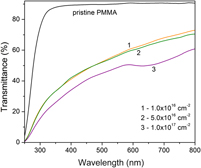
Polymethylmethacrylate (PMMA) and polyimide (PI) samples are implanted by 40 keV Cu+ ions with high fluences to synthesize copper nanoparticles in shallow polymer layers. The produced metal/polymer nanocomposites are studied using atomic force and scanning electron microscopies as well as optical transmission spectroscopy. It is found that nucleation and growth of copper nanoparticles are strongly fluence-dependent as well as they are affected by the polymer properties, in particular, by radiation stability yielding different nanostructures for the implanted PI and PMMA. Shallow synthesized nanoparticles are observed to partly tower above the sample surface due to a side effect of high-fluence irradiation leading to considerable sputtering of polymers. Implantation and particle formation significantly change optical properties of both polymers reducing transmittance in the UV–visible range due to structural and compositional change as well as causing an absorption band related to localized surface plasmon resonance (LSPR) of the nanoparticles. The role of polymer type and its degradation under the implantation on LSPR is studied to optimize conditions for the formation of nanoplasmonic materials.
The effects of the different shot peening parameters on the 6061 alloy specimens' surface have been investigated. It is found that the compressive residual stresses and the surface roughness of the surface layer for all shot-peened specimens are improved greatly. The maximum stress value and the maximum roughness are obtained by the shot flow rate of 5.5 lbs/min and air pressure of 20 psi. The microstructure observation results indicate that a nanostructured layer with an average grain size below 100 nm has been created on the top surface layer of each specimen. In the top surface nanostructured layer, the microhardness is enhanced. It is resulted from the grain refinement and the strain hardening. The results of electrochemical measurements, surface corrosion morphology observation, and EDS analysis indicate that the corrosion susceptibility of the 6061 alloy could be significantly enhanced by means of the shot-peening-induced surface nanocrystallization.
The present investigation addressed the weldability of Super Ni 718 alloy and AISI 316L using gas tungsten arc (GTA) welding process using three different filler wires, such as ER2594, ERNiCrMo-4 and ERNiCrCoMo-1. Interface microstructures showed the formation of secondary phases at the heat-affected zone (HAZ) of Super Ni 718 alloy and delta ferrite colonies at the HAZ of AISI 316L. It was witnessed from the weld microstructures that the deleterious phases were suppressed or controlled while using these filler wires for joining the bimetals. Tensile results corroborated that the failure occurred at the parent metal of AISI 316L in all the cases. The presence of microvoids and dimples characterized for the ductile mode of fracture in these weldments. Charpy V-notch test results showed that the weldments using ERNiCrMo-4 filler exhibited higher impact energy. A detailed study has been made to investigate the structure–property relationships of these weldments using optical and scanning electron microscopic techniques.
Conjugated polymer films are of considerable current interest for functionalizing the surfaces of a wide variety of devices including implantable biomedical electronics. Toward these ends, copolymer films of 3,4-ethylenedioxythiophene (EDOT) with a carboxylic acid functional EDOT (EDOTacid) were electrochemically deposited and characterized as a systematic function of the EDOTacid content (0, 25, 50, 75, and 100%). Chemical surface characterization of the films confirmed the presence of both EDOT and EDOTacid units. Toluidene blue assays showed that the surface concentration of the carboxylic acid groups increased to a maximum of 2.75 nmoles/mm2, and the contact angle measurements confirmed the increased hydrophilicity of the films with increasing EDOTacid content (decreasing from 52.6 to 32.5 degrees). Cyclic voltammetry showed that the films had comparable charge storage capacities regardless of their composition. The morphology of the films varied depending on the monomer feed ratio. The addition of EDOTacid induced a transition from a nodular, porous surface to a more dense, pleated surface structure. These methods provide a facile means for synthesizing electrically active carboxylic acid functional poly(3,4-ethylenedioxythiophene) copolymer films with tunable hydrophilicity and surface morphologies.
Carbon nanotube (CNT)-reinforced aluminum composite powders were synthesized by cryogenic milling. The effects of different milling parameters and CNT contents on the structural characteristics and mechanical properties of the resulting composite powders were studied. Detailed information on powder morphology and the dispersion and structural integrity of the CNTs is crucial for many powder consolidation methods, particularly cold spray, which is increasingly utilized to fabricate metal-based nanocomposites. While all of the produced composite powders exhibited particle sizes suitable for spray applications, it was found that with increasing CNT content, the average particle size decreased and the size distribution became narrower. The dispersion of CNTs improved with milling time and helped to maintain a small Al grain size during cryogenic milling. Although extensive milling allowed for substantial grain size reduction, the process caused notable CNT degradation, leading to a deterioration of the mechanical properties of the resulting composite.
Modified MMT clay-doped PMMA composites have been prepared by solvent casting method for different weight percentages. The prepared composite films were characterized by FTIR and SEM. Also, the DC conductivity was carried out for PMMA and PMMA composite films. Among all composites, it was found that 30 wt% shows highest conductivity of 1.59 × 10⁻³ S/cm. The negative thermal coefficient behavior of these polymer composite films confirms that the increase in conductivity is due to the elongation of polymer chain which helps in charge transport mechanism. Dielectric study also shows that 30 wt% has the lowest dielectric constant and dielectric loss of 2.5 and 3.3, respectively, resulting in an increase in conductivity of 5 × 10⁻³ S/cm. The isotropic nature of 30 wt% composite film shows a high quality factor of 0.005 because of overdamping of electron at 104 Hz. Cole–cole plots show that the semi arc originated from a single point and its area decreases with filler concentration up to 30 wt% due to drop in the electrical resistance. Tensile modulus increases because of high MMT aspect ratio and distribution ratio. The 30 wt% of the composite shows high tensile strength at 55 MPa which induces 8% of strain in the PMMA–MMT clay composite films. Therefore, these composite films can be used in many sensor and solar technologies as encapsulation materials.
Operando energy-dispersive x-ray diffraction (EDXRD) was carried out on a newly formed 8 Ah lithium iron phosphate (LiFePO4) battery with the goal of elucidating the origin of asynchronous phase transformation commonly seen with in situ x-ray diffraction studies. The high-energy photons at the NSLS X17B1 beamline allow for penetration into a fully assembled battery and therefore negate any need for a specially designed in situ cell which often uses modified current collectors to minimize x-ray attenuation. Spatially-and-temporally resolved phase-mapping was conducted with a semiquantitative reference intensity ratio (RIR) analysis to estimate the relative abundance of the delithiated phase. The data show an asynchronous response in the stoichiometry versus the electrochemical profile and suggest limited diffusion in the electrode toward the end of discharge. Our results confirm that the asynchronous electrode response is not just limited to specially designed cells but occurs in fully assembled cells alike. We attribute this behavior to be a consequence of performing a local measurement over a wide-area heterogeneous reaction.
Creep and electromigration (EM) have been two reliability concerns in microelectronic devices for a long time. The related failure mechanisms have been widely investigated and comprehended individually. However, there is a lack of attention with regard to the interaction(s) between current density and creep, the coupling effect of which is more analogous to the real service conditions of lead-free solder joint. In this study, a series of experiments were carried out on the simple shear lap joint to investigate the effects of current density magnitude on the creep behavior of solder joints. The results indicated that dislocation creep was the main failure mechanism for low current density sample. For high current density sample, the failure mechanism was mainly dominated by copper atom migrating process which led the joint experience a higher risk of brittle fracture failure.