To save content items to your account,
please confirm that you agree to abide by our usage policies.
If this is the first time you use this feature, you will be asked to authorise Cambridge Core to connect with your account.
Find out more about saving content to .
To save content items to your Kindle, first ensure no-reply@cambridge.org
is added to your Approved Personal Document E-mail List under your Personal Document Settings
on the Manage Your Content and Devices page of your Amazon account. Then enter the ‘name’ part
of your Kindle email address below.
Find out more about saving to your Kindle.
Note you can select to save to either the @free.kindle.com or @kindle.com variations.
‘@free.kindle.com’ emails are free but can only be saved to your device when it is connected to wi-fi.
‘@kindle.com’ emails can be delivered even when you are not connected to wi-fi, but note that service fees apply.
The study of water’s functional role on hydrophilic surfaces of biological and soft materials benefits from experimental measurements that operate at finer length and time scales than contact-angle-measurement-derived surface wettability. We show that local translational diffusivity permits the empirical determination of local hydrophilicity by means of Overhauser dynamic nuclear polarization (ODNP) amplified 1H NMR relaxometry. Large unilamellar vesicles (LUVs) in dilute bulk water solution serve as good model hydrophilic surfaces, and their surface water diffusion was shown to be partially or entirely decoupled from the bulk water viscosity, with the extent of decoupling dependent on the surface activity of the particular viscogen chosen. The effective hydrophilicity of a hydrated LUV surface in solution was further shown to be tunable by specific ions or osmolytes dissolved in solution, and the chemical makeup of a surface can give rise to a heterogeneous hydration dynamics landscape, as demonstrated on protein surfaces. ODNP-derived surface water diffusivity is suggested to be a unique tool for the site-specific mapping of the interaction landscape of a wide range of functional materials operating in aqueous solution, from wet adhesives to fuel cell membranes.
Interfacial water is believed to determine practical outcomes in systems of interest to biology, materials science, geology, and many other disciplines. In this article, recent progress in understanding interfacial water achieved using molecular simulations is reviewed. After the reliability of recent approaches is discussed, three possible research directions are described. These future developments promise to have a large impact on both fundamental science and applications of societal importance.
Cu2ZnSn(S,Se)4 (CZTSSe) photovoltaics (PV) have long been considered promising candidates for large-scale PV deployment due to the availability of constituent elements and steady improvements in device efficiency over time. The key limitation to high efficiency in this technology remains a deficit in the open-circuit voltage with respect to the band gap. The past decade has seen significant progress toward understanding how the various material properties such as bulk and surface composition, point defects (intrinsic and extrinsic), and grain boundaries all impact the optoelectronic properties of CZTSSe materials, and consequently device performance. This paper aims to summarize what is known about the CZTSSe bulk and surfaces, and how these material properties may be related to the Voc deficit.
Significant α-phase growth confinement in Grade 4 titanium (Ti) and substantial β-phase refinement in Grade 7 Ti were observed during high-temperature annealing. The mechanism for each observation was identified through detailed microstructural investigation assisted with phase diagram analyses. The former observation was due to the pinning effect of Fe-stabilized grain boundary (GB) β-Ti phases in Grade 4 Ti. The latter observation resulted from the redistribution of Fe and, palladium (Pd) in particular, in Fe-stabilized and Pd-containing GB β-Ti phases in Grade 7 Ti. Pd was found to exist mainly in two forms in cold-rolled Grade 7 Ti, i.e. Fe-stabilized GB β-Ti phases and an occasionally observed orthorhombic Ti88Pd9Fe3 phase. The latter is close to the Ti2Pd3 intermetallic phase in terms of the crystal structure.
Aiming to clarify the effects of initial states on hot deformation behavior of a powder metallurgy nickel-based superalloy FGH96, specimens in hot isostatic pressed (HIPed) and solution states were isothermally compressed in the temperature range of 1000–1150 °C and the strain rate range of 0.001–1.0 s−1. It revealed that the flow behavior of FGH96 was dependent on the initial states, in which the deformation resistance was higher in the solution state than that in the HIPed state at evaluated temperatures, and the differences became less when the temperature was higher than the γ′ dissolution temperature. The calculated hot activation energy using peak stresses are 590 and 1285 kJ mol−1 for HIPed and solution specimens. Comparison with HIPed specimen, the efficiency of power dissipation (η) in solution specimen is less, and the optimum workability regime moves to higher temperatures. Cracking and in-grain shear bands were observed in the specimens when compressed in flow instability areas.
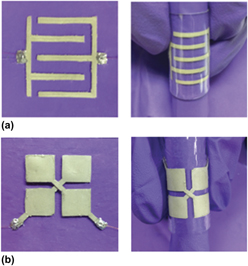
In recent years wearable devices have attracted significant attention. Flexibility and stretchability are required for comfortable wear of such devices. In this paper, we report flexible and stretchable touch sensors with two different patterns (interdigitated and diamond-shaped capacitors). The touch sensors were made of screen-printed silver nanowire electrodes embedded in polydimethylsiloxane. For each pattern, the simulation-based design was conducted to choose optimal dimensions for the highest touch sensitivity. The sensor performances were characterized as-fabricated and under deformation (e.g., bending and stretching). While the interdigitated touch sensors were easier to fabricate, the diamond-shaped ones showed higher touch sensitivity under as-fabricated, stretching or even bending conditions. For both types of sensors, the touch sensitivity remained nearly constant under stretching up to 15%, but varied under bending. They also showed robust performances under cyclic loading and against oxidation.
The demands for highly transparent thin films for many integrated optical systems increase rapidly. The aim of the present work is to address these important needs. We show a novel approach for the nanocolloidal processing of barium titanate with enhanced optical transparency. The results showed that the stability of the prepared solution and optical transparency of the resulted thin film improved significantly. The study of the structure and properties of the prepared solutions indicated that the enhanced and homogenous transparency is due to the size-effect of the particles embedded in the solution, which are nanostructured. It seems to us that the proposed method has the capability of being a general strategy for obtaining highly transparent solutions and thin films. Moreover, the enhanced transparency of the prepared thin films can improve the energy efficiency of the solar power systems significantly.
For understanding the atomic processes involved, in situ observation at near-atomic spatial resolution is needed in the studies of lithium ion battery materials. We show that the Li transport and the lithiation of carbon atoms may be triggered by the electron beam in an electron microscope, together with simultaneous real-time monitoring of electron energy-loss spectroscopy to reveal the chemical state of the species. The local electric field induced in an electrolyte particle by an electron beam acts on Li ions, resulting in Li transport and reaction with carbons. This process closely mimics the charging process of an electrochemical battery charge cycle, without an external power supply. We find that the lithium transport occurs in the form of Li+.
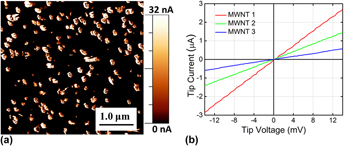
Vertically aligned, untangled planarized arrays of multiwall carbon nanotubes (MWNTs) with Ohmic back contacts were grown in nanopore templates on arbitrary substrates. The templates were prepared by sputter depositing Nd-doped Al films onto W-coated substrates, followed by anodization to form an aluminum oxide nanopore array. The W underlayer helps eliminate the aluminum oxide barrier that typically occurs at the nanopore bottoms by instead forming a thin WO3 layer. The WO3 can be selectively etched to enable electrodeposition of Co catalysts with control over the Co site density. This led to control of the site density of MWNTs grown by thermal chemical vapor deposition, with W also serving as a back electrical contact. Ohmic contact to MWNTs was confirmed, even following ultrasonic cutting of the entire array to a uniform height.
To evaluate the influence of strain rate on mechanical behavior of nanocrystalline (NC) materials, a phase mixture constitutive model composed of ordered grain interior phase and plastically softer grain boundary dislocation pile up zone phase was built. Because of dissimilar properties and mismatch between the two phases, dislocation density evolution controlling mechanism based on statistically stored dislocations and geometrically necessary dislocations was analyzed and extended to NC regime to consider their disparate effects. Based on the composite model, a new stress–strain constitutive relation for strain rate-dependent behaviors was firstly established based on dislocation density evolution and strain gradient theory. The calculated data were then compared with corresponding experimental curves and strong strain rate-dependent behaviors were exhibited, which indicated that the predictions kept in good agreement with experiments. Further discussions were presented for calculations of strain rate sensitivity and activation volume for NC Ni through the proposed model.
Magnesium aluminate (MgAl2O4) spinel nanoparticles with an average crystalline size of 35 nm were synthesized by polymer-gel and isolation-medium-assisted calcination. In the process, a large excess of MgO, 40 times the stoichiometric amount of spinel, is added to the precursor mixture to separate the spinel particles as they are nucleated to prevent their agglomeration and coarsening during calcination. Well-dispersed MgAl2O4 nanoparticles with a single-crystal structure were obtained after acid washing of calcined product. The microstructures of the as-prepared samples were characterized by differential thermal and thermogravimetric analysis, x-ray diffractometry, Fourier transform infrared spectroscopy, nitrogen adsorption–desorption isotherms, scanning electron microscopy, energy-dispersive x-ray spectroscopy, and transmission electron microscopy. The results indicate that MgO acting as the isolation medium is effective in preventing the agglomeration of MgAl2O4 nanoparticles, and it also prevents their contamination by introducing an isolation medium during the preparation process. The nanopowder was sintered up to 95% of the theoretical density but with parallel grain growth.
Electrochemical reactions at both positive and negative electrodes in a nickel metal hydride (Ni-MH) battery during charge have been investigated by in situ neutron powder diffraction. Commercially available β-Ni(OH)2 and LaNi5-based powders were used in this experiment as positive and negative electrodes, respectively. Exchange of hydrogen by deuterium for the β-Ni(OH)2 electrode was achieved by ex situ cycling of the cell prior to in situ measurements. Neutron diffraction data collected in situ show that the largest amount of deuterium contained at the positive electrode is de-intercalated from the electrode with no phase transformation involved up to ∼100 mA h/g and, in addition, the 110 peak width for the positive electrode increases on charge. The negative electrode of composition MmNi3.6Al0.4Mn0.3Co0.7, where Mm = Mischmetal, exhibits a phase transformation to an intermediate hydride γ phase first and then to the β phase on charge. Unit cell dimensions and phase fractions have been investigated by Rietveld refinement of the crystal structure.
Comprehensive intermetallic compound phase analysis at wire bond interfaces was performed for a side-by-side comparative study between 18 µm Pd-only coated Cu wire and 18 µm Pd-coated Cu wire followed by Au flash coating. Scanning electron microscopy and transmission electron microscopy results combined with nanobeam electron diffraction and structure factor calculation identified the formation of metastable θ′-CuAl2 and Cu9Al4 in both of the wire bonds before and after high temperature storage test. In particular, nanobeam electron diffraction and structure factor calculation unambiguously revealed that the two intermetallic compound phases grow in size after high storage temperature test in a manner that they maintain their epitaxial relationships that minimize lattice mismatch at the Cu/Al wire bond interface. Nanobeam electron diffraction and energy dispersive x-ray spectroscopy results found no significant Au flash coating effects in terms of intermetallic compound morphology, phase, and thermal evolution.
Some of the stable isotopes of silicon and carbon have zero nuclear spin, whereas many of the other elements that constitute semiconductors consist entirely of stable isotopes that have nuclear spins. Silicon and diamond crystals composed of nuclear-spin-free stable isotopes (28Si, 30Si, or 12C) are considered to be ideal host matrixes to place spin quantum bits (qubits) for quantum-computing and -sensing applications, because their coherent properties are not disrupted thanks to the absence of host nuclear spins. The present paper describes the state-of-the-art and future perspective of silicon and diamond isotope engineering for development of quantum information-processing devices.
Measurements of stress evolution during low-energy argon ion bombardment of Si have been made using a real-time wafer curvature technique. During irradiation, the stress reaches a steady-state compressive value that depends on the flux and energy. Once irradiation is terminated, the measured stress relaxes slightly in a short period of time to a final value. To understand the ion-induced stress evolution and relaxation mechanisms, we account for the measured behavior with a model for viscous relaxation that includes the ion-induced generation and annihilation of flow defects in an amorphous Si surface layer. The analysis indicates that bimolecular annihilation (i.e., defect recombination) is the dominant mechanism controlling the defect concentration both during irradiation and after the cessation of irradiation. From the analysis, we determine a value for the fluidity per flow defect.