To save content items to your account,
please confirm that you agree to abide by our usage policies.
If this is the first time you use this feature, you will be asked to authorise Cambridge Core to connect with your account.
Find out more about saving content to .
To save content items to your Kindle, first ensure no-reply@cambridge.org
is added to your Approved Personal Document E-mail List under your Personal Document Settings
on the Manage Your Content and Devices page of your Amazon account. Then enter the ‘name’ part
of your Kindle email address below.
Find out more about saving to your Kindle.
Note you can select to save to either the @free.kindle.com or @kindle.com variations.
‘@free.kindle.com’ emails are free but can only be saved to your device when it is connected to wi-fi.
‘@kindle.com’ emails can be delivered even when you are not connected to wi-fi, but note that service fees apply.
We report a new insulation composite of aramid honeycombs filled with superflexible resorcinol–formaldehyde aerogels. Aerogels produced via a sol–gel process were dried with supercritical CO2. The aerogels exhibit a high, rubber-like flexibility, due to almost zero shrinkage and networking of nanoparticles and suitably sized macropores. The high porosity of the aerogels in the range of about 95–98% leads to a low thermal conductivity about 0.037 W/mK and low bulk density of 0.05 g/cm3. The filling of light and stiff aramid honeycombs with these flexible aerogels results in a composite with decreased thermal conductivity and modified mechanical properties.
Indentation-induced phase transformation processes were studied by in situ Raman imaging of the deformed contact region of silicon thin films, using a Raman spectroscopy-enhanced instrumented indentation technique (IIT). In situ Raman imaging was used to study the generation and evolution of the phase transformation of silicon while performing an IIT experiment analyzed to determine the average contact pressure and indentation strain. This is, to our knowledge, the first sequence of Raman images documenting the evolution of the strain fields and changes in the phase distributions of a material while conducting an indentation experiment. The reported in situ experiments provide insights into the transformation processes in silicon during indentation, confirming, and providing the experimental evidence for, some of the previous assumptions made on this subject. The developed Raman spectroscopy-enhanced IIT has shown its potential in advancing the understanding of deformation mechanisms and will provide a very useful tool in validating and refining contact models and related simulation studies.
Practical implementation of oxide thermoelectrics on an industrial or commercial scale for waste heat energy conversion requires the development of chemically stable interfaces between metal interconnects and oxide thermoelements that exhibit low electrical contact resistances. A commercially available high-chrome iron alloy (i.e., Crofer® 22 APU) serving as the interconnect metal was spray coated with LaNi0.6Fe0.4O3 (LNFO) or (Mn,Co)3O4 spinel and then interfaced with a p-type thermoelectric material—calcium cobaltate (Ca3Co4O9)—using spark plasma sintering. The interfaces have been characterized in terms of their thermal and electronic transport properties and chemical stability. With long-term exposure of the interfaced samples to 800 °C in air, the cobalt–manganese spinel acted as a diffusion barrier between the Ca3Co4O9 and the Crofer® 22 APU alloy resulting in improved interfacial stability compared to that of samples containing LNFO as a barrier layer, and especially those without any barrier. The initial area specific interfacial resistance of the Ca3Co4O9/(Mn,Co)3O4/Crofer® 22 APU interface at 800 °C was found to be ∼1 mΩ·cm2.
Compounds in the BaxSr3−xTiNb4O15 series with x = 0.0–3.0 were synthesised. Synchrotron X-ray diffraction data were collected for each member synthesised. Rietveld refinements were performed for all compositions. A composition-dependent phase transition between orthorhombic and tetragonal symmetries was found. Cation ordering was observed between barium and strontium atoms in the two distinct A site cavities
From the view of tissue engineering, the deficiency in porosity has impeded further application of bacterial cellulose (BC) as a super biomaterial. In this study, we used a combination method consisting of acetic acid treatment and freeze-drying operation to improve the porous profile of BC, as well as a simple and fast method to measure the thickness, density, and porosity of BC. Results have shown a significant improvement in the porosity of the inner structure of BC treated with acetic acid and freeze-drying. Microscopic observation by scanning electron microscopy exhibited explicit evidences that more orderly porous layer-by-layer structures and more pores were formed along the cross section of modified BC as compared with the control. The enhancement of mechanical properties and crystallinity of modified BC was also demonstrated due to the improvement of material porosity in the particular extent from 50.3 to 76.43%. Cell culture of human fibroblast cells exhibited good cell viability on modified BC, suggesting that a better porous profile of BC on the surface and cross section helps facilitate cells to attach, as well as potentially promotes cells to grow in. These significant results may open the possibility of producing BC nanomaterials for tissue engineering with desirable properties.
In this article, a comprehensive investigation on the thermal properties of Yb3Al5O12 is conducted, including Debye temperature, thermal expansion coefficient (TEC), thermal diffusivity, heat capacity, and thermal conductivity. The calculated Debye temperature of Yb3Al5O12 from the measured elastic properties is 625 K. The linear and volumetric thermal expansions of Yb3Al5O12 from 298 to 1273 K are (7.83 ± 0.14) × 10−6 and (23.74 ± 0.42) × 10−6 K−1, respectively. The linear TEC of the polycrystalline bulk Yb3Al5O12 determined by dilatometer is (8.22 ± 0.3) × 10−6 K−1. The measured thermal conductivities of Yb3Al5O12 are 4.67 and 2.05 W (m K)−1, respectively, at 300 and 1400 K. The estimated minimum thermal conductivity, κmin, is 1.22 W (m K)−1. The high temperature thermal conductivity is close to the evaluated κmin, which is lower than most commonly used thermal barrier coating (TBC) material such as Y2O3-stabilized-ZrO2 (YSZ). The unique combination of these properties renders Yb3Al5O12 being a very promising candidate material for TBC.
Superelasticity of shape memory alloy (SMA) results from the reversible thermoelastic martensitic transformation. Although this property has been studied extensively at the macroscale, the study of this superelastic behavior at the micro/nanoscale is relatively new. In this work, we processed TiNi-based SMAs with different compositions and different phase transformation temperatures. Nanoindentations were performed with different peak loads and at various temperatures to systematically characterize the degree of localized stress-induced martensitic transformation at the nanoscale for each SMA. Micropillar compression tests were also performed to study the global superelastic behavior at the microscale. The physics of stress-induced martensitic transformation versus the phase transformation temperature, the testing temperature, and the peak load relations was explored and the difference between the localized and the global superelastic behaviors was discussed. Our results demonstrate the potential of integrating TiNi-based SMAs into functional micro- and nanodevices.
A new software application has been developed to provide a convenient method for the submission of diffraction data directly to the International Centre for Diffraction Data, for inclusion in the Powder Diffraction File (PDF)™. The application, titled Genie, acts as a portal for the merging of data from separate sources allowing the user to quickly and easily submit their data for the PDF. Using Java Web Start technology Genie can be run using all common computer platforms. Genie is flexible and can be used to read a variety of common file formats. Furthermore, Genie can also be used for submission of New Diffraction Data for publication in the Powder Diffraction Journal.
X-ray diffraction and scattering on a single multipurpose X-ray platform have been used to probe the structure, composition, and thermal behavior of TiO2 nanoparticles ranging in size from 1 to 10 nm. Ambient and non-ambient Bragg diffraction, small-angle X-ray scattering (SAXS), as well as total scattering and pair-distribution function (PDF) analysis are combined to obtain a comprehensive picture of the samples. At these ultrasmall particle-size dimensions, SAXS and PDF prove powerful in distinguishing the salient features of the materials, in particular the size distribution of the primary particles (SAXS) and the identification of the TiO2 polymorphs (PDF). Structural features determined by X-ray scattering techniques are corroborated by high-resolution transmission electron microscopy. The elemental make-up of the materials has been measured using X-ray fluorescence spectrometry and energy-dispersive X-ray analysis.
Pulsed tandem gas metal arc welding (PT-GMAW) is being developed to increase productivity and minimise weld-induced distortion in ship-building. The PT-GMAW process was used in pulse–pulse mode to butt-weld two different strength and thickness steels; the residual stress and hardness profiles of the welds are reported and correlated.
The structural evolution of the “zero-strain” Li4Ti5O12 anode within a functioning Li-ion battery during charge–discharge cycling was studied using in situ neutron powder-diffraction, allowing correlation of the anode structure to the measured charge–discharge profile. While the overall lattice response controls the “zero-strain” property, the oxygen atom is the only variable in the atomic structure and responds to the oxidation state of the titanium, resulting in distortion of the TiO6 octahedron and contributing to the anode's stability upon lithiation/delithiation. Interestingly, the trend of the octahedral distortion on charge–discharge does not reflect that of the lattice parameter, with the latter thought to be influenced by the interplay of lithium location and quantity. Here we report the details of the TiO6 octahedral distortion in terms of the O–Ti–O bond angle that ranges from 83.7(3)° to 85.4(5)°.
The conjugated polymer poly(2,5-dihexyl-1,4-phenylene-alt-2-amino-4,6-pyrimidine) was synthesized and used in the supramolecular functionalization of single-walled carbon nanotubes (SWNTs). It was found that this polymer can form strong supramolecular polymer–nanotube assembly and produce a stable composite in solution. The resulting polymerized nanotubes were analyzed by UV–Vis absorption and emission spectroscopy, thermogravimetry, transmission electron microscopy and scanning electron microscopy. It was found that the noncovalent functionalization did not damage the nanotube structure. The polymer content in the polymer–nanotube composite could be calculated to be 41% by thermogravimetry analysis. The composite exhibited certain solubility in dimethylacetamide (DMAc), where the solubility in the absence of excess free polymer solution is 78.7 mg L−1. The composite exhibited a conductivity of 0.005 S cm−1 and the anodic and cathodic peaks were observed at 0.47 and 0.37 V. Galvanostatical charge/discharge tests give good cycling behavior of maintaining a stable capacitance value of 66.7 F g−1 over 1000 cycles at a current load of 1 mA cm−2 without distinct drop.
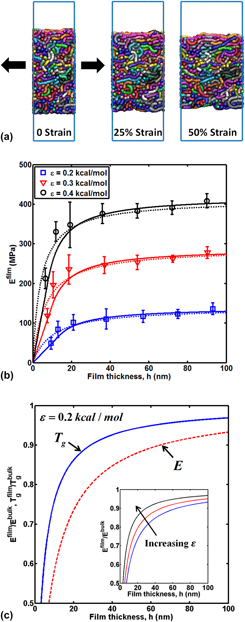
The mechanical properties of nanoscale free-standing polymer thin films exhibit size dependence due to surface effects. However, it remains a challenge to determine the length scales at which differences are exhibited between film and bulk polymer properties. Here we use molecular dynamics simulations to uncover the dependence of elastic modulus (E) of free-standing films on film thickness and bulk properties. Comparison of the glass transition temperature (Tg) and E indicates that Tg converges to the bulk value slightly faster as the film thickness increases. The free-surface effects that give rise to a depression in E and Tg are observed to be stronger for polymers with weaker intermolecular interactions. The most intriguing aspect of our study is the finding that despite the observed decrease in the modulus of the film up to a thickness of over 100 nm, the local stress distribution reveals that the preserved length scale of perturbation of the free surface is only several nanometers.
A distinguished mathematician and notable university teacher, Isaac Todhunter (1820–84) became known for the successful textbooks he produced as well as for a work ethic that was extraordinary, even by Victorian standards. A scholar who read all the major European languages, Todhunter was an open-minded man who admired George Boole and helped introduce the moral science examination at Cambridge. His many gifts enabled him to produce the histories of mathematical subjects which form his lasting memorial. First published between 1886 and 1893, the present work was the last of these. Edited and completed after Todhunter's death by Karl Pearson (1857–1936), another extraordinary man who pioneered modern statistics, these volumes trace the mathematical understanding of elasticity from the seventeenth to the late nineteenth century. Volume 1 (1886) begins with Galileo Galilei and extends to the researches of Saint-Venant up to 1850.
Describing all aspects of the physics of transition metal compounds, this book provides a comprehensive overview of this unique and diverse class of solids. Beginning with the basic concepts of the physics of strongly correlated electron systems, the structure of transition metal ions, and the behaviours of transition metal ions in crystals, it goes on to cover more advanced topics such as metal-insulator transitions, orbital ordering, and novel phenomena such as multiferroics, systems with oxygen holes, and high-Tc superconductivity. Each chapter concludes with a summary of key facts and concepts, presenting all the most important information in a consistent and concise manner. Set within a modern conceptual framework, and providing a complete treatment of the fundamental factors and mechanisms that determine the properties of transition metal compounds, this is an invaluable resource for graduate students, researchers and industrial practitioners in solid state physics and chemistry, materials science, and inorganic chemistry.
Designing materials for application as electrodes in sodium-ion batteries may require the use of unconventional materials to realize acceptable reversible sodium insertion/extraction capabilities. To design new materials simple electrochemical methods need to be coupled with other techniques such as in situ x-ray diffraction (XRD) to correlate the influence of electrochemical performance on a parameter that can be modified, e.g., the crystal structure of the material. Here we use in situ synchrotron XRD data on Gd2TiO5-containing cells to show the minor changes in reflection positions during discharge/charge that illustrates minimal volume expansion and contraction due to insertion/extraction reactions. These small changes correlate to the Gd2TiO5 anode material in both lithium- and sodium-ion batteries showing reversible capacities of ∼45 and ∼23 mA h/g after 20 cycles, respectively. Analysis of sodium location in the crystal structure shows a preference for sodium in the smaller channels along the c axis direction during the first discharge before moving to the larger channels at the charged state. Therefore, in this work, in situ studies highlight minimal structural changes with respect to volume expansion during electrochemical cycling and illustrate where sodium ions locate within the Gd2TiO5 structure.
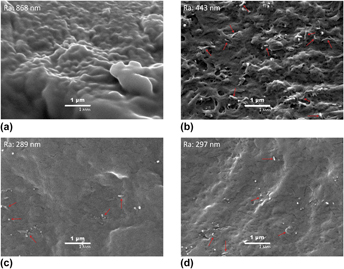
Pristine multiwalled carbon nanotubes (P-MWCNTs) were functionalized with carboxylic groups (MWCNT-COOH) through oxidation reactions and then reduced to produce hydroxyl groups (MWCNT-OH). Pristine and functionalized MWCNTs were used to produce poly(hydroxybutyrate-co-hydroxyvalerate) (PHBV) nanocomposites with 0.5 wt% of MWCNTs. MWCNT functionalization was verified by visual stability in water, infrared and Raman spectroscopy, and zeta potential measurements. Pristine and functionalized MWCNTs acted as the nucleating agent in a PHBV matrix, as verified by differential scanning calorimetry (DSC). However, the dispersion of filler into the matrix, thermal stability, and direct current (DC) conductivity were affected by MWCNT functionalization. Scanning electron microscopy (SEM) showed that filler dispersion into the PHBV matrix was improved with MWCNT functionalization. The surface roughness was reduced with the addition and functionalization of MWCNT. The thermal stability of PHBV/MWCNT-COOH, PHBV/P-MWCNT, and PHBV/MWCNT-OH nanocomposites were 20, 30, and 30 °C higher than neat PHBV, respectively, as verified by thermogravimetry analysis (TGA). Addition of pristine and functionalized MWCNTs provided electrical conductivity in nanocomposite, which was higher for PHBV/P-MWCNTs (1.2 × 10⁻⁵ S cm−1).
The effect of electric-current pulses on the evolution of microstructure and texture in cryogenically rolled copper was determined. The pulsed material was found to be completely recrystallized, and the recrystallization mechanism was deduced to be similar to that operating during conventional static annealing. The microstructural changes were explained simply in terms of Joule heating. A significant portion of the recrystallization process was concluded to have occurred after pulsing; i.e., during cooling to ambient temperature. The grain structure and microhardness were shown to vary noticeably in the heat-affected zone (HAZ); these observations mirrored variations of temper colors. Accordingly, the revealed microstructure heterogeneity was attributed to the inhomogeneous temperature distribution developed during pulsing. In the central part of the HAZ, the mean grain size increased with current density and this effect was associated with the temperature rise per se. This grain size was slightly smaller than that in statically recrystallized specimens.