To save content items to your account,
please confirm that you agree to abide by our usage policies.
If this is the first time you use this feature, you will be asked to authorise Cambridge Core to connect with your account.
Find out more about saving content to .
To save content items to your Kindle, first ensure no-reply@cambridge.org
is added to your Approved Personal Document E-mail List under your Personal Document Settings
on the Manage Your Content and Devices page of your Amazon account. Then enter the ‘name’ part
of your Kindle email address below.
Find out more about saving to your Kindle.
Note you can select to save to either the @free.kindle.com or @kindle.com variations.
‘@free.kindle.com’ emails are free but can only be saved to your device when it is connected to wi-fi.
‘@kindle.com’ emails can be delivered even when you are not connected to wi-fi, but note that service fees apply.
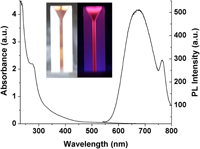
In this study, a simple, facile, green, and versatile strategy was developed for the synthesis of water-soluble and well-dispersed fluorescent gold nanoclusters (Au NCs) with wave length-tunable emissions using protein as capping agent and template. The resultant Au NCs exhibited excellent characteristics such as large Stokes shift, good stability, and high resistance to photobleaching. They showed strong emission at 680 nm, with a quantum yield of 4.5%. Heavy metal ion (Hg2+) could quench the fluorescence of Au NCs efficiently and thus the as-prepared Au NCs were successfully developed as “turn-off” fluorescent probes for the detection of Hg2+ sensitively and selectively. The lowest concentration to quantify mercuric ions could be as low as 1 nM and the fluorescence intensity of the Au NCs was proportional to the concentrations of Hg2+ over the range 8 × 10⁻⁸ M to 1 × 10⁻⁵ M (R = 0.9982). To validate the practicality of this probe, real water samples spiked with Hg2+ were determined with RSD values less than 3%. And the results demonstrated that the developed probes worked well in environmental samples. The action mechanism between the Au NCs and Hg2+ was explored as well.
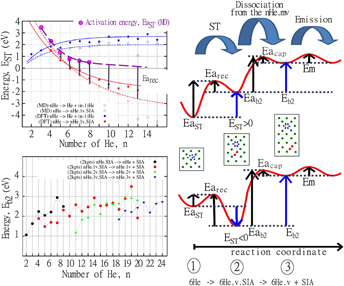
Density functional theory calculations and molecular dynamics with a recently developed potential for W–He were used to evaluate the thermal stability of helium-vacancy clusters (nHe.mv) as well as pure interstitial helium clusters in tungsten. The stability of such objects results from a competitive process between thermal emission of vacancies, self interstitial atoms (SIAs), and helium, depending on the helium-to-vacancy ratio in mixed clusters or helium number in pure interstitial helium clusters. We investigated in particular the ground state configurations as well as the activation barriers of self trapping and trap mutation, i.e., the emission of one SIA along with the creation of one vacancy from a vacancy-helium or pure helium object.
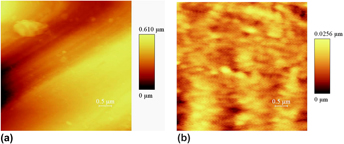
The aim of this research study is to produce high-quality TiO2 nanotube arrays using porous alumina templates. The templates are fabricated through anodizing bulk aluminum foils which can be utilized for the production of thick alumina templates. To produce the nanotube arrays, the alumina template pores are filled with the precursor sol by applying a DC electric field. Then, the deposited nanotubes are heat treated at 320 °C for 2 h and, subsequently, sintered for 2 h at 400 and 750 °C to obtain nanotubes with pure anatase and rutile phases, respectively, as confirmed by x-ray diffraction data. Scanning and transmission electron microscopy (SEM and TEM) investigations show that the nanotubes have been deposited in the channels of the nanoporous alumina template. Also, SEM investigations show the existence of a vast area of TiO2 nanotube arrays when we use semiconductor alumina templates.
The dissimilar lattice-evolution of the isostructural layered Li(Ni,Co,Al)O2 (NCR) and Li(Ni,Co,Mn)O2 (CGR) cathodes in commercial lithium-ion batteries during overcharging/discharging was examined using operando neutron powder-diffraction. The stacking axis (c parameter) of both cathodes expands on initial lithiation and contracts on further lithiation. Although both the initial increase and later decrease are smaller for the CGR cathode, the overall change between battery charged and discharged states of the c parameter is larger for the CGR (1.29%) than for the NCR cathode (0.33%). We find these differences are correlated to the transition metal to oxygen bond (as measured through the oxygen positional-parameter) which is specific to the different cathode chemistries. Finally, we note the formation of and suggest a model for a LiCx intermediate between graphite and LiC12 in the anode of both batteries.
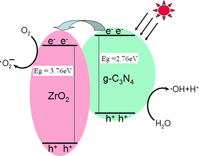
The ZrO2 and graphitic carbon nitride (g-C3N4) composite photocatalyst has been prepared by calcination process and hydrothermal treatment. The photocatalyst was characterized by x-ray diffraction, scanning electron microscopy, x-ray photoelectron spectroscopy, UV–vis diffuse reflection spectroscopy, Brunauer–Emmett–Teller and photoluminescence spectra. The photocatalytic activity of the photocatalysts was evaluated by degradation of methylene blue under visible light irradiation. The results showed that the activity of the composite photocatalyst ZrO2/g-C3N4 for photodegradation of MB is much higher than that of either pure g-C3N4 or ZrO2, which is ascribed to the effective electron–hole separation based on the photoluminescence spectra. The •O2− might be the main active species in MB photodegradation, and the •OH and photogenerated electrons are also partly involved in the process of photocatalytic degradation.
Novel hybrid diblock copolymers consisting of bidentate ligand-functionalized chains have been synthesized via click reaction and RAFT radical polymerization. The chemical structure and molecular weight of the synthesized poly(methacrylate-POSS)-block-poly(4-vinylbenzyl-2-pyridine-1H-1,2,3-triazole) (PMAPOSS-b-PVBPT) were characterized by NMR and GPC. The copolymers had been utilized to construct metal-containing polymer micelle by the metal–ligand coordination and electrostatic interaction in this study. The self-assembly behaviors of PMAPOSS-b-PVBPT in chloroform, a common solvent, under the effect of Zn(OTf)2 and HAuCl4 were investigated by TEM, DLS, and variable temperature NMR. Besides, micellization of this diblock copolymer was achieved in ethylene glycol, a selective solvent for PMAPOSS-b-PVBPT. The experimental results revealed that the incorporation of heterocyclic rings bearing nitrogen atoms in polymer side chains played an important role in the construction of metal-containing copolymer micelles. The prepared metal-containing PMAPOSS-b-PVBPT micelles had good dynamic and thermal stability due to the strong metal–ligand coordination interaction and electrostatic interaction.
In analyzing various phenomena in TM compounds in the previous chapter, we have already several times come across the situation when a material, depending on conditions, can be in an insulating or in a metallic state. Such metal–insulator transitions can be caused either by doping (a change in band filling) or by temperature, pressure, magnetic field, etc. The topic of metal–insulator transitions is one of the most interesting in the physics of systems with correlated electrons. Such metal–insulator transitions often lead to dramaticffects and a drastic change in all properties of the system; and the large sensitivity of materials close to such transitions to external perturbations can be used in many practical applications.
In principle, metal–insulator transitions are not restricted to systems with correlated electrons. They are often observed in more conventional solids, well described by the one-electron picture and standard band theory. However the most interesting such transitions, often significantly different from those in “band” systems, are indeed met in systems with strongly correlated electrons, in particular in transition metal compounds – see for example Mott (1990) or Gebhard (1997).
Different types of metal–insulator transitions
One can divide all metal–insulator transitions into three big groups; these are discussed in the sections below.
Metal–insulator transitions in the band picture
The first group of metal–insulator transitions are transitions which can be understood on the one-electron level in the framework of band theory – although, of course, interactions of some type are always necessary for such transitions.
Until now, when considering systems with strongly correlated electrons, we mostly discussed the properties of d-electrons themselves. However most often we are dealing not with systems with only TM elements (pure TM metals), but with different compounds containing, besides TM ions with their d-electrons, also other ions and electrons. These may be itinerant or band electrons, for example in many intermetallic compounds; some of these will be considered below, in Chapter 11. But more often we are dealing with compounds such as TM oxides, fluorides, etc., which are insulators. Still, even in this case we have in principle to include in our discussion not only the correlated d-electrons of transition metals, but also the valence s- and p-electrons of say O or F. This we have already done to some extent when we were considering the crystal field splitting of d levels in Chapter 3, in particular the p–d hybridization contribution to it, see Section 3.1 and Figs 3.5–3.8.
In some cases we can project out these other electrons and reduce the description to that containing only d-electrons, but with effective parameters determined by their interplay with say p-electrons of oxygens. In other cases, however, we have to include these electrons explicitly. This, in particular, is the case when the energy of oxygen 2p levels is close to that of d levels.
After having presented briefly in Chapter 1 the general approach to the description of correlated electrons in solids using a simplified model – the nondegenerate Hubbard model (1.6) – from this chapter on we turn toward a more detailed treatment of the physics of transition metal compounds, which will take into account the specific features of d-electrons. The well-known saying is that “the devil is in the details.” Thus if we want to make our description realistic, we have to include all the main features of the d states, the most important interactions of d-electrons, etc. We begin by summarizing briefly in this chapter the basic notions of atomic physics, with specific applications to d-electrons in isolated transition metal ions. For more details, see the many books on atomic physics; specifically for application to transition metals, see Ballhausen (1962), Abragam and Bleaney (1970), Griffith (1971), Cox (1992), and Bersuker (2010).
Elements of atomic physics
Here we recall some basic facts from atomic physics, which will be important later on. We give here only a very sketchy presentation; one can find the details in many specialized books on atomic physics, for example the works cited above and Slater (1960, 1968).
The state of an electron in an atom is characterized by several quantum numbers.
The topic of this book is the physics of transition metal compounds. In all their properties strong electron correlations play a crucial role. However TM compounds are not the only materials in which electron correlations are extremely important. Other such systems are substances containing rare earth elements with partially filled 4 f shells or actinide compounds with 5 f -electrons. These systems show a lot of very interesting special properties such as mixed valence and heavy fermion behavior. And though these phenomena were discovered and are mostly studied in 4 f and 5 f systems, similar effects, maybe less pronounced, are also observed in some TM compounds. The main concepts, and also the main problems in the physics of rare earth (and actinide) compounds are very similar to those in TM systems. Therefore we also include in this book, formally devoted to TM materials, this short chapter in which we summarize the main phenomena discovered in 4 f and 5 f systems, and compare them and their description with that of TM systems. Some of the sephenomena were even discovered first in materials with TM ions, but later proved to be essential in treating rare earth systems; while other notions were introduced for rare earth compounds and later transferred to the study of transition metal systems.
There exists a significant body of literature devoted specifically to some of the topics discussed briefly below. One can find detailed descriptions for example in Hewson (1993) or Coleman (2007).
Transition metal (TM) compounds present a unique class of solids. The physics of these materials is extremely rich. There are among them good metals and strong, large-gap insulators, and also systems with metal–insulator transitions. Their magnetic properties are also very diverse; actually, most strong magnets are transition metal (or rare earth) compounds. They display a lot of interesting phenomena, such as multiferroicity or colossal magnetoresistance. Last but not least, high-Tc superconductors also belong to this class.
Transition metal compounds are manifestly the main area of interest and the basis for a large field of physical phenomena: the physics of systems with strong electron correlations. Many novel ideas, such as Mott insulators, were first suggested and developed in application to transition metal compounds.
From a practical point of view, the magnetic properties of these materials have been considered and used for a long time, but more recently their electronic behavior came to the forefront. The ideas of spintronics, magnetoelectricity and multiferroicity, and high-Tc superconductivity form a very rich and fruitful field of research, promising (and already having) important applications.
There are many aspects of the physics of transition metal compounds. Some of these are of a fundamental nature – the very description of their electronic structure is different from the standard approach based on the conventional band theory and applicable to standard metals such as Na or Al, or insulators or semiconductors such as Ge or Si.
As discussed at the beginning of Chapter 7, there can exist different types of ordering phenomena connected with charge degrees of freedom. Examples are ordering of charges themselves (charge “monopoles”); ordering of electric dipoles, giving ferroelectricity (FE); or ordering of electric quadrupoles, which happens in orbital ordering. We have already discussed the first and third possibilities; we now turn to the second.
Ferroelectricity is a broad phenomenon, in no way restricted to TM compounds. There are ferroelectrics among organic compounds, in some molecular crystals, in systems with hydrogen bonds. But the best, and most important in practice, are ferroelectrics on the basis of TM compounds such as the famous BaTiO3, or the widely used Pb(ZrTi)O3 (“PZT”). And it is in these compounds that one also sometimes meets a very interesting interplay of ferroelectricity and magnetism – the field now known mostly as multiferroicity. By multiferroics (Schmid, 1994) we refer to materials which are simultaneously ferroelectric and magnetic – possibly ferro- or ferrimagnetic, although such cases are rather rare, most of the known multiferroics being antiferromagnetic. (Sometimes ferroelastic systems are alsoincluded in this class.) In this chapter we discuss these classes of compounds, paying attention mostly to the microscopic mechanisms of ferroelectricity and its eventual coupling to magnetism.
A general treatment of ferroelectricity, dealing mainly with the macroscopic aspects of ferroelectrics and their phenomenological description, with special attention paid to practical applications, may be found in many books, for example Megaw (1957), Lines and Glass (1977), Scott (2000), Gonzalo (2006), Blinc (2011).
When we put a transition metal ion in a crystal, the systematics of the corresponding electron states changes. For isolated atoms or ions we have spherical symmetry, and the corresponding states are characterized by the principal quantum number n, by orbital moment l and, with spin–orbit coupling included, by the total angular momentum J. When the atom or ion is in a crystal, the spherical symmetry is violated; the resulting symmetry is the local (point) symmetry determined by the structure of the crystal. Thus, if a transition metal ion is surrounded by a regular octahedron of anions such as O2− (Fig. 3.1) (this is a typical situation in many TM compounds, e.g. in oxides such as NiO or LaMnO3), the d levels which were fivefold degenerate in the isolated ion (l = 2; lz = 2, 1, 0, −1, −2) are split into a lower triplet, t2g, and an upper doublet, eg (Fig. 3.2). The corresponding splitting is caused by the interaction of d-electrons with the surrounding ions in the crystal, and is called crystal field (CF) splitting. The type of splitting and the character of the corresponding levels is determined by the corresponding symmetry. The detailed study of such splittings is a major field in itself, and is mostly treated using group-theoretical methods.