To save content items to your account,
please confirm that you agree to abide by our usage policies.
If this is the first time you use this feature, you will be asked to authorise Cambridge Core to connect with your account.
Find out more about saving content to .
To save content items to your Kindle, first ensure no-reply@cambridge.org
is added to your Approved Personal Document E-mail List under your Personal Document Settings
on the Manage Your Content and Devices page of your Amazon account. Then enter the ‘name’ part
of your Kindle email address below.
Find out more about saving to your Kindle.
Note you can select to save to either the @free.kindle.com or @kindle.com variations.
‘@free.kindle.com’ emails are free but can only be saved to your device when it is connected to wi-fi.
‘@kindle.com’ emails can be delivered even when you are not connected to wi-fi, but note that service fees apply.
This chapter analyzes the thermodynamic stability of “static concentration waves.” The idea is that an ordered structure can be described as a variation of chemical composition from site to site on a crystal lattice, and this variation can be written as a wave, with crests denoting B-atoms and troughs the A-atoms, for example. The wave does not propagate, so it is called a “static” concentration wave. Another important difference from conventional waves is that the atom sites are exactly on the tops of crests or at the bottoms of troughs, so we do not consider the intermediate phases of the concentration wave, at least not in our main examples. A convenient feature of this approach is that an ordered structure can be described by a single wavevector, or a small set of wavevectors. The disordered solid solution has no such periodicity, so the amplitude of the concentration wave, η, serves as a long-range order parameter.
This chapter begins with a review of how periodic structures in real space are described by wavevectors in k-space, and then explains the “star” of the wavevector of an ordered structure. A key step for phase transitions is writing the free energy in terms of the amplitudes of static concentration waves.
Chapter 3 derived the diffusion equation with the assumption of random atom jumps. Solutions to the diffusion equation were presented, but the reader was warned that these solutions require a constant diffusion constant D, and this is rarely true as an alloy evolves during a phase transformation. There are other risks in using the diffusion equation when atom motions occur by the vacancy mechanism, where a mobile vacancy rearranges atoms in its wake. This chapter explains the nonrandomness of atom jumps with a vacancy mechanism, and these nonrandom characteristics occur even when the vacancy itself moves by random walk. Furthermore, in an alloy with chemical interactions strong enough to cause a phase transformation, the vacancy frequently resides in energetically favorable locations, so any assumption of random walk may be seriously in error.
When materials with different diffusivities are brought into contact, their interface is displaced with time because the fluxes of atoms across the interface are not equal in both directions. Other phenomena such as stresses and voids may develop during interdiffusion. An applied field can bias the diffusion process towards a particular direction, and such a bias can also be created by chemical interactions between atoms. Chapter 9 ends with two other topics of diffusion – one is atom diffusion that occurs in parallel with atom jumps forced without thermal activation, and the second is a venerable statistical mechanics model of diffusion that has components used today in many computer simulations of diffusion.
Nanostructured materials are of widespread interest in science, engineering, and technology. For the purpose of thermodynamics, it is useful to define nanomaterials as materials with structural features of approximately 10 nm or smaller, i.e., tens of atoms across. Important physical properties of nanomaterials originate from one or two basic features:
• Nanomaterials have a high surface-to-volume ratio, and a large fraction of atoms located at, or near, surfaces.
• Nanomaterials confine electrons, phonons, or polarons to relatively small volumes, altering their energies. The confinement of structural defects such as dislocations or internal interfaces alters their energies and interactions, too.
A practical question is whether nanostructures are adequately stable at modest temperatures. A more basic question is how the thermodynamics of nanostructured materials differs from conventional bulk materials. In short, their internal energy is raised by the surfaces, interfaces, or composition gradients in nanostructures. Chapter 16 discusses the thermodynamics of interfaces, but Sections 6.6 and 11.2 covered important aspects of surface energy, including surface relaxation and reconstruction processes that are driven by chemical energy. Some basic issues for the confinement of electrons in nanostructures are presented here.
The free energy of nanostructured materials is altered by the entropy from the configurations of nanostructural degrees of freedom and their excitations. These entropy contributions tend to stabilize a nanomaterial at finite temperatures.
Section 1.1 put phase transitions in materials into a broader context of phase transitions in general. Most of this book has been on how atoms arrange themselves at different T and P, and how these arrangements change abruptly through a phase transition. Atoms in solids tend to be a bit sluggish in their movements, however, and their arrangements can be slow to attain states of thermodynamic equilibrium. Diffusion and nucleation, which retard, redirect, or even arrest the paths to equilibrium, are kinetic phenomena of interest and importance. Those nonthermodynamic phenomena are essential to the full life cycle of a phase transformation, but they obscure the singularities in the free energy function or its derivatives that underlie the thermodynamics of a phase transition.
The more general field of phase transitions often places rigorous emphasis on thermodynamic equilibrium, even at temperatures that are very low, or at temperatures very near a critical temperature where atomic structures may not attain equilibrium in reasonable times. Liquid–gas transitions and magnetic transitions are often better candidates for studies of phase transitions for their own sake. Nevertheless, concepts from the broader field of phase transitions do help our understanding of phase transformations in solid materials. Much of the interest in the basic physics of phase transitions is in how a system behaves very close to the critical temperature.
Magnetism in materials originates with electron spins and their alignments. Groups of spins develop patterns and structures at low temperatures through interactions with each other. With temperature, pressure, and magnetic field, these spatial patterns of electron spins are altered, and several trends can be understood by thermodynamic considerations.
This chapter describes how magnetic structures change with temperature. The emphasis is on magnetic moments localized to individual atoms, as may arise from unpaired 3d electrons at an iron atom, for example. The strong intraatomic exchange interaction gives an atom a robust magnetic moment, but the magnetic moments at adjacent iron atoms interact through interatomic exchange interactions. Interatomic exchange interactions are often weaker, having energies comparable to thermal energies. Interatomic exchange is analogous to chemical bonding between pairs of atoms in a binary alloy that develops chemical order. The critical temperature of chemical ordering Tc corresponds to the Curie temperature for a magnetic transition TC, and short-range chemical order above the Tc finds an analog in the Curie–Weiss law for paramagnetic susceptibility above TC. For chemical ordering the atom species are discrete types, whereas magnetic moments can vary in strength and direction as vector quantities. This extra freedom allows for diverse magnetic structures, including antiferromagnetism, ferrimagnetism, frustrated structures, and spin glasses.
As discussed in Sect. 1.5.2, phase transformations can occur continuously or discontinuously. The discontinuous case begins with the appearance of a small but distinct volume of material having a structure and composition that differ from those of the parent phase. A discontinuous transition can be forced by symmetry, as formalized for some cases in Sect. 14.4. There is no continuous way to rearrange the atoms of a liquid into a crystal, for example. The new crystal must appear in miniature in the liquid, a process called “nucleation.” If the nucleation event is successful, this crystal will grow. The process of nucleation is an early step for most phase transformations in materials. It has many variations, but two key concepts can be appreciated immediately.
Because the new phase and the parent phase have different structures, there must be an interface between them. The atom bonding across this interface is not optimal, so the interfacial energy must be positive. This surface energy is most significant when the new phase is small, because a larger fraction of its atoms are at the interface. Surface energy plays a key role in nucleation.
For nucleation of a new phase within a solid, a second issue arises when the new phase differs in shape or specific volume from the parent phase. The mismatch creates an elastic field that costs energy. This is not a concern for nucleation in a liquid or gas, since the surrounding atoms can flow out of the way.
The fracture property estimation of ductile materials with small volumes at room temperature was performed experimentally and analytically in this study. A modified energy method of the small punch test (SPT) was applied to estimate fracture toughness based on the membrane stretch analysis. The effective strain was assumed to be the average value of center strain and contact boundary strain. To overcome the problem involved in strain calculation by microscopic observation, one relatively simple correlation which related effective fracture strain to displacement was proposed. The results obtained by the modified energy model and conventional experiment were in good agreement. Furthermore, a three-dimensional finite element model was established successfully. The influence of ball diameter and center hole diameter in the lower die on the SPT was analyzed by detailed discussion. Finally, the applicability and accuracy of the modified energy model based on the SPT were proved. An economic, effective energy method can be obtained from the present study to assess the properties of in-service components and micrometer scale materials.
Figures 1.5c,d and 1.6a,b illustrate the difference between chemical unmixing that occurs by nucleation and growth (the topic of the previous Chapter 11) and spinodal decomposition (the topic of Chapter 12). Nucleation creates a distinct surface between the new phase and the parent phase, and the two phases differ significantly in their chemical composition or structure. In addition to the surface energy, an elastic energy is often important, too.
Spinodal decomposition does not involve a surface in the usual sense because it begins with infinitesimally small changes in composition. Nevertheless, there is an energy cost for gradients in composition, specifically the square of the gradient, since a region with a large composition gradient begins to look like an interface. The “square gradient energy” is an important new concept presented in this chapter, but it is also essential to phase field theory and to the Ginzburg–Landau theory of superconductivity.
At the end of Sect. 2.7 on unmixing phase diagrams, it was pointed out that there are conceptual problems with a free energy that is concave downwards because the alloy is unstable, but the free energy pertains to equilibrium states. An unstable free energy function may prove useful for short times, however. Taking a kinetic approach, we use the thermodynamic tendencies near equilibrium to obtain a chemical potential to drive a diffusion flux that causes unmixing.
Historically there has been comparatively little work on how phase transitions in materials depend on pressure, as opposed to temperature. For experimental work on materials, it is difficult to achieve pressures of thermodynamic importance, whereas high temperatures are obtained easily. The situation is reversed for computational work. The thermodynamic variable complementary to pressure is volume, whereas temperature is complemented by entropy. It is comparatively easier to calculate the free energy of materials with different volumes, as opposed to calculating all different sources of entropy.
Recently there have been rapid advances in high-pressure experimental techniques, often driven by interest in the geophysics of the Earth. New materials are formed under extreme conditions of pressure and temperature, and some such as diamond can be recovered at ambient pressures. The use of pressure to tune the electronic structure of materials can be a useful research tool for furthering our understanding of materials properties. Sometimes the changes in interatomic distances caused by pressure can be induced by chemical modifications of materials, so experiments at high pressures can point directions for materials discovery.
Chapter 8 begins with basic considerations of the thermodynamics of materials under pressure, and how phase diagrams are altered by temperature and pressure together. Volume changes can also be induced by temperature, and the concept of “thermal pressure” from nonharmonic phonons is explained.
We investigate the effect of dopant species and structure on the thermal conductivity of Sb-doped SnO2 (ATO) and Ta-doped SnO2 (TTO) films and compare the results with those of In2O3-, ZnO-, and TiO2-based transparent conductive films. The thermal conductivities (λ) of polycrystalline ATO and TTO films are 4.4–4.9 and 4.7 W m−1 K−1, respectively. The thermal conductivities via phonons (λph) are almost identical for both dopant species (Sb and Ta): 4.3 and 4.5 W m−1 K−1 for Sb and Ta, respectively, on average. These results for λph are larger than that for Sn-doped In2O3 films (3.8 W m−1 K−1) and considerably larger than that for amorphous ATO films (1.0 W m−1 K−1). These facts lead us to conclude that the base-material species (SnO2 or In2O3) and structure (polycrystalline or amorphous) affect the thermophysical properties of ATO and TTO much more than the dopant species.
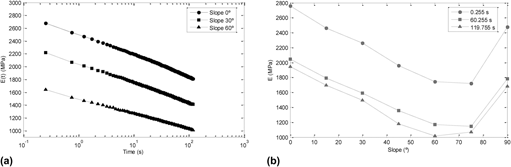
Mechanical properties of parts constructed with additive manufacturing (AM) technologies are highly influenced by raw material and process characteristics. It is widely assumed that a certain degree of anisotropy should be expected in AM parts due to their layer-upon-layer nature. Present work focuses on the PolyJet process, where each layer is built by selective jetting of photopolymers upon flat surfaces and subsequent UV radiation curing. An extensive experimental program was carried out to find out if the so-constructed parts present viscoelastic behavior and if their mechanical characteristics also depend on part orientation. Both hypotheses have been proven true, so a viscoelastic orthotropic-like behavior shall be expected in PolyJet manufactured part. Nevertheless, a significant improvement on material properties has been found for nearly vertical building orientations. This unexpected behavior is related to a shielding effect upon UV curing caused by support material.
This book explains the thermodynamics and kinetics of most of the important phase transitions in materials science. It is a textbook, so the emphasis is on explanations of phenomena rather than a scholarly assessment of their origins. The goal is explanations that are concise, clear, and reasonably complete. The level and detail are appropriate for upper division undergraduate students and graduate students in materials science and materials physics. The book should also be useful for researchers who are not specialists in these fields. The book is organized for approximately linear coverage in a graduate-level course. The four parts of the book serve different purposes, however, and should be approached differently.
Part I presents topics that all graduate students in materials science must know. After a general overview of phase transitions, the statistical mechanics of atom arrangements on a lattice is developed. The approach uses a minimum amount of information about interatomic interactions, avoiding detailed issues at the level of electrons. Statistical mechanics on an Ising lattice is used to understand alloy phase stability for basic behaviors of chemical unmixing and ordering transitions. This approach illustrates key concepts of equilibrium T–c phase diagrams, and is extended to explain some kinetic processes. Essentials of diffusion, nucleation, and their effects on kinetics are covered in Part I.