To save content items to your account,
please confirm that you agree to abide by our usage policies.
If this is the first time you use this feature, you will be asked to authorise Cambridge Core to connect with your account.
Find out more about saving content to .
To save content items to your Kindle, first ensure no-reply@cambridge.org
is added to your Approved Personal Document E-mail List under your Personal Document Settings
on the Manage Your Content and Devices page of your Amazon account. Then enter the ‘name’ part
of your Kindle email address below.
Find out more about saving to your Kindle.
Note you can select to save to either the @free.kindle.com or @kindle.com variations.
‘@free.kindle.com’ emails are free but can only be saved to your device when it is connected to wi-fi.
‘@kindle.com’ emails can be delivered even when you are not connected to wi-fi, but note that service fees apply.
Each tooth, even though it looks simple, is an organ with complex structure and consists of multiple types of tissues (Ten Cate, 1998). Dentin is the main component, which is a hard and avascular tissue with a small hollow tubular inside. Enamel is the hardest tissue of the whole living body, protecting the dentin underneath by covering the crown dentin. Cementum, including cellular and acellular cementum, is present on the surface of root dentin. Other than those three types of hard tissue, a tooth also contains dental pulp, the highly vascularized soft tissue that acts as nutrition source and biosensor, as well as periodontal ligament (PDL), the tissue with well-organized collagen bundles that anchors the tooth to the surrounding alveolar bone. Among those tissues, only enamel is from the epithelium. The rest of the dental tissues are all from the neural crest-cell-derived mesenchyme (Nanci, 2007). The sequential and reciprocal interactions between the oral epithelium and the cranial neural crest-derived mesenchyme are essential to control tooth formation, including their size, number, and shape (Thesleff and Nieminen, 1996).
Severe limb trauma often results in substantial injuries to multiple tissue types, including bone, skeletal muscle, nerve, and vasculature. These injuries generally present increased clinical challenges and frequently cannot be managed with conventional reconstruction techniques. Furthermore, due to the complex nature of these injuries, there is no real consensus on intervention strategies [1–3]. Given the inherent severe and pervasive tissue damage, multistage treatment is routinely required, and patients are typically encumbered with diminished long-term function even if limb salvage and reconstruction are successful [4, 5].
Extremity trauma remains the predominant type of combat casualty for US armed forces members engaged in ongoing military conflicts, a continuation of historical trends. Explosive munitions are the primary cause of these injuries [6, 7], resulting in penetrating blast wounds with large zones of injury that encompass multiple tissue types, and, notably, a high incidence of bone and soft-tissue trauma [6] (Figure 29.1). High-energy trauma incidents, such as motor vehicle collisions, produce an additional civilian patient population. Although passenger survival in these incidents has increased with improved engineering of safety features, severe extremity trauma remains common [8, 9].
The study demonstrates the 100% repeated recyclability of hybrid membranes without any pretreatment. Composite membranes designed with titanium dioxide (TiO2) nanoparticles (NPs) and polysulfone (PSf) membranes were used for reduction of chromium (Cr) (VI) to Cr (III) under sunlight. Different concentrations of TiO2 NPs varying from 1.5% to 2.5% with the difference of 0.5% were incorporated into the membrane matrix. Increase in weight percentage of TiO2 particles enhances the reduction to 100% within 2.5 h with an increase in recyclable capacity as well. The effect of recycling on the surface of the membrane was studied using x-ray diffraction (XRD), scanning electron microscope (SEM), and atomic force microscopy (AFM). The observations in general indicate an increase in roughness without affecting the catalytic efficiency up to six recycles. The study on surface membrane morphology and catalytic efficiency with reusability opens a scope for a feasible economical chromium reduction via a membrane process. Macro and micro structure of the membrane before reduction and after recycling were studied and compared with scientific evidence. Based on the results, the kinetic model was proposed for the reduction reactions.
Motivation for cardiac tissue regeneration in vitro
Myocardial infarction (MI) leads to the death of cardiomyocytes, and the infarct area becomes replaced by a fibroblastic scar tissue that has no contractile function. This reduces the pumping ability of the heart and the cardiac output. In addition, the scar tissue thins due to the lack of vasculature to provide oxygen and nutrients to the infarct site, thus leading to high wall stress and cardiac dilatation, which may ultimately lead to heart failure.
The adult heart has a limited regenerative capacity. The shortage of donor organs further suggests a need to develop new treatment strategies for cardiovascular diseases. Cardiac tissue regeneration can be achieved through several strategies, including (1) gene therapy, (2) cell transplantation, and (3) implantation or injection of biomaterials or engineered cardiac tissues. The goal of these cardiac tissue regeneration strategies is to repair the damaged myocardium through supporting vascularization and cell survival, in turn reducing wall thinning and preventing dilatation and heart failure. Gene therapy is not a specific topic of this chapter, in which the focus will be on bioreactors for cell expansion and engineering of cardiac tissues for cardiac tissue regeneration. Instead, we refer the reader to excellent reviews [1–3].
The skin is the largest organ in the body and constitutes the interface between the body’s internal organs and its external surroundings. It serves multiple functions, lending thermoregulation, structure, and insulation to the body, and preventing water loss, while also acting as a barrier against external pathogens (Elias and Friend, 1975). The skin also allows an individual to respond to the environment through the nerve endings that sense different stimuli such as touch, pressure, temperature, and pain. These functions are essential for an individual’s survival and are maintained owing to the skin’s ability for regeneration. Much evidence has shown that the presence of stem cells in the epidermis and hair follicles underlies skin regeneration. In this chapter, we will review how skin is maintained under homeostatic conditions and following injury, particularly focussing on the role of stem cells in the hair follicle.
Skin homeostasis
The skin epidermis (i.e. inter-follicular epidermis) is composed of keratinocytes that form stratified squamous epithelium. Throughout an individual’s lifetime, epidermal cells of the skin differentiate and migrate to the superficial layer of the epidermis where they are shed, while being continuously renewed by proliferating cells of the basal layer adjacent to the basement membrane (Figure 33.1) (Mackenzie, 1970; Potten 1974; Watt 2001). Cells in the basal layer of the epidermis are a heterogeneous population in terms of their gene expression (Tani et al., 2000), proliferation rate (Potten and Morris, 1988), and differentiation status (Kaur and Li, 2000). Keratin 14-expressing basal epidermal cells contain long-lived stem cells that contribute to wound healing as well as maintenance of the basal layer of the epidermis (Mascre et al., 2012). However, the specific location of the stem cell niche or markers of stem cells for the inter-follicular epidermis has not yet been identified (Clayton et al., 2007). The properties of epidermal stem cells, and whether stem cells play distinct roles from their progeny in the renewal of skin epidermis, remain unknown.
In the USA, 40% of all deaths are caused by cardiovascular disease. More than half of these incidents are a direct result of coronary artery disease [1]. In an effort to decrease the mortality from coronary heart disease, more than 500,000 coronary artery bypass procedures are performed annually [1]. The coronary artery lumen’s inner diameter (ID) is about 4 mm at most, requiring a similarly small-diameter conduit to bypass the blocked artery. The most successful vascular conduit is the patient’s own blood vessel, most commonly the greater saphenous vein in the leg or the internal mammary artery. However, autologous vessels are often unavailable to patients in need of a vascular graft replacement, due to prior harvesting or disease-associated vascular damage.
In search of an alternative vascular replacement, at the beginning of the twentieth century allografts were developed as the first valid vascular replacement. However allografts’ limited long-term success due to aneurysm, calcification, and thrombosis, in addition to low availability and concerns relating to infectious diseases, have hindered their clinical acceptance [2, 3]. The allografts’ shortcomings in small-diameter vascular applications led to the development of synthetic substitutes in the 1950s. Despite the polymers’ thrombogenic surface and lack of compliance, they demonstrated acceptable long-term performance in large-diameter vessels (ID > 6 mm). However, polymeric grafts are inadequate when used in medium- or small-diameter applications.
In nature, biological structures often exhibit complex geometries that serve a wide range of specific mechanical functions. One such example are the ammonites, a large group of extinct mollusks, which produced elaborate, fractal-like hierarchical suture interface patterns. This report experimentally explores the influence of hierarchical suture interface designs on mechanical behavior by taking advantage of additive manufacturing and its ability to fabricate complex geometries. In addition, structure/property relationships of additively manufactured multi-material prototypes are investigated. It is shown that increasing the order of hierarchy amplifies stiffness by more than an order of magnitude. Tensile strength can also be tailored by changing the order of hierarchy, which alters the normal to shear stress ratio of the interfacial layer. The addition of failure mechanisms with increased order of hierarchy also significantly increases the toughness. Therefore, hierarchical suture interfaces can be used to diversify the mechanical behavior of additively manufactured materials.
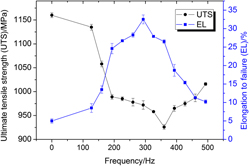
Electropulsing treatment (EPT) provided a promising technology to improve the microstructure and plasticity of the cold-rolled Ti–6Al–4V noticeably while only affecting the strength mildly. Thus, titanium alloy of high plasticity and good comprehensive property can be obtained by this high efficient processing method. The research found that the tensile ductility could be improved largely with the increasing frequency. In the low frequency, the maximum ductility (32.5%) could be obtained at 293 Hz-EPT. Under high-frequency EPT, plasticity has a slight decrease but the tensile strength increases in the contrary. With the help of multi-characterization, abstracting phenomena are explained and therefore the conclusion has been drawn that the whole process of increasing frequency EPT can be divided roughly into two periods: (a) recrystallization period in the low frequency, at this period athermal effect of the EPT played a leading role and (b) phase change period in the high frequency, at this period the other important factor of the EPT thermal effect was predominant. As a comparison, furnace heat treatment is conducted to prove the preferential phase transition instead of complete recrystallization under the single heating effect. The mechanism of the results can be discussed by the competitive mechanism of recrystallization process and phase change in the EPT processing.
Organ failure and tissue loss are challenging health issues due to the widespread occurrence of injuries, the lack of donated organs for transplantation, and the limitations of conventional artificial implants. The field of tissue engineering and regenerative medicine emerged to solve these issues by providing biological alternatives that restore, maintain, or improve tissue function for harvested tissues and organs [1–5]. In a typical tissue engineering approach, cells are grown in a three-dimensional (3D) biodegradable scaffold, which, ideally, should perform the structural and biochemical functions of the natural extracellular matrix (ECM), providing cells with topological and chemical cues as well as mechanical support until the cell-produced ECM takes over. Therefore, there is a set of key characteristics that the scaffold should have. First, adequate space or porosity with high interconnectivity is needed throughout the 3D scaffold in order to allow cell adhesion, migration, proliferation, and differentiation into the desired cell phenotypes for new tissue formation [6, 7]. A porous structure not only defines the initial void space available for cell seeding/ingrowth and new tissue formation, but also determines the mass transport pathways. Second, appropriate surface architecture is critical since this is where the cell–matrix interactions occur. In connective tissues, such as bone, skin, ligament, and tendon, the ECM consists primarily of proteoglycans and fibrous proteins, such as collagen. The fibrous architecture of collagen contributes to the mechanical stabilities of the ECM, and plays a vital role in cell attachment, proliferation, and differentiation [8]. Type I collagen is the most abundant type of collagen and forms nanofiber bundles with fiber diameter ranging from 50 to 500 nm. A nanofibrous (NF) surface is desired to mimic the natural ECM and is found to be advantageous in improving cell attachment, migration, proliferation, and differentiation [9]. Therefore, polymeric scaffolds with porous structure at the micrometer scale and fibrous architecture at the nanometer dimension should be promising candidates for tissue regeneration. Although it is not the focus of this chapter, chemical and biological functionalization of scaffolds can enhance cell–biomaterial interactions [10].
Where does a tissue engineer look for inspiration? What is the gold standard to which we hold our designs? Since antiquity, humankind has looked at the world around it for clues as to how we can improve our quality of life, and the gaze of the tissue engineer finds its way there as well. The metamorphosis of this inspiration into technology for the improvement of humankind is the mission of the engineer.
Complex structures are often found performing incredible feats in nature [1]. For example, brachiopod and mollusk shells are subjects of current study, due to their amazingly strong, layered structure [2, 3]. This natural composite structure is being used as inspiration for tissue-engineered structures for cortical bone. This is an example of nature-as-inspiration by utilizing composite material systems for bone tissue engineering scaffold design, an area of great success already, with potential for further advancement. The human body provides a model where collagen fibers are mineralized in a precise manner, resulting in a network of ceramic nanoscale crystals interspersed with an organic mesh. This leads to a hierarchical structure comprising these components and creating bone tissue, which through its complexity derives requisite qualities such as strength, toughness, fatigue life, and nutrient transfer [4]. This example is a common one, but not the only one. In fact, any scaffold design that incorporates one or more aspects of the naturally occurring extracellular matrix (ECM) is biomimetic by definition. In fact, in a broader sense so is any engineering design that borrows from nature. “What has fins like a whale, skin like a lizard and eyes like a moth? The future of engineering.” Tom Mueller’s question posed in National Geographic no doubt ignites a sense of wonderment resulting in brainstorming sessions about countless unsolved engineering problems, but we must focus. Within the scope of this chapter, we will focus on biomedical engineering, and more specifically polymer/ceramic composite scaffold design for use in tissue regeneration.
Tissue engineering aims to develop biological substitutes that repair or replace damaged tissues or whole organs by combining technologies from engineering and medical sciences [1]. Although tissue engineering has enabled successful generation of various artificial tissue substitutes, such as skin [2], bladder [3], cartilage [4], bone [5], heart valves [6], and blood vessels [7], a number of challenges remain to be solved. It has been challenging to engineer large and vascularized organs such as the heart or liver. These tissues depend on adequate vascularization for the supply of nutrients and oxygen. In tissue engineering, this translates into not only creating the specific tissue but also making the highly organized vasculature. On the other hand, avascular tissues such as heart valves or cartilage depend on adequate diffusion for their supply of nutrients and oxygen. In terms of engineering, an avascular biomimetic construct cannot be too thick [8, 9], since this would lead to a limited supply of nutrients and oxygen [1]. Microfabrication strategies aim to overcome these limitations by controlling the size, geometry and features of three-dimensional (3D) in-vitro tissue-engineered constructs. Recent advances in biomaterials combined with developments in microengineering methods have enabled the development of vascular networks, prevascularized tissue constructs, and creation of well-ordered tissue constructs from microgel units with different cell types. [10].
Native tissues consist of cells that reside in a framework called the extracellular matrix (ECM). The ECM is composed of proteins (e.g. collagen), fibers (e.g. elastin), polysaccharides (e.g. hyaluronic acid), glycosaminoglycans (e.g. heparan sulfate), and growth factors (e.g. fibroblast growth factor). The ECM functions as a support system for cells to exert their biological function and can be viewed as the scaffolding environment for the tissues. Traditional tissue engineering uses synthetic scaffolds or biomaterials as molds to create tissue constructs. These scaffolds are typically porous, biocompatible, and degradable, and allow sufficient diffusion to occur [11]. Furthermore, such scaffolds enable cell adhesion, proliferation, and differentation, and tissue organization that are similar to those in their native counterparts [12]. Over time, the synthetic scaffold will degrade in vivo, while the cells deposit new natural scaffolding (ECM), thus leading to the formation of new tissue.
Since the first successful organ transplantation with a kidney in 1954 [1], scientists have maintained the dream of being able to fabricate organs on request. Organogenesis – or the creation of organs from artificial manipulation of cells, materials, growth factors (GFs), and other organ elements – has been waiting for the appropriate technology to emerge. This futuristic technique should be capable of rebuilding the compositional and structural complexities of human tissues and organs. The recent development of bioprinting technologies (defined by their high resolution and high-speed construction) has revived interest in applying those emerging methods for organogenesis. The term “organ printing” has become standard since the 2000s [2–4]. It refers to the line of investigations related to the development of the technologies for the construction of three-dimensional (3D) structures based on the deposition of different cell lines and biochemical promoters.
Although individual tissue systems have been successfully engineered for various applications using the basic tissue engineering approach, the means for the building of complex tissues that consist of multiple cell and tissue components have not been established. This is due to various challenges encountered in the tissue building process. One of the challenges has been the inability to recreate the well-defined cellular configurations and functions of a native tissue. Living tissues contain multiple cell types and various extracellular materials arranged in specific patterns that are difficult to replicate in vitro. Thus, one important goal of tissue engineering and regenerative medicine is to develop a tissue fabrication method that allows specific control over the placement of various cells and matrices in three dimensions in order to mimic the complexity of native tissue architecture. Emerging “organ printing” or “bioprinting” methodologies are being investigated in order to create tissue-engineered constructs that initially have more defined spatial organization. The underlying hypothesis is that with these biomimetic patterns one can achieve improved therapeutic outcomes [5].
Hydrogels are an excellent scaffold structure for numerous applications in tissue engineering and regenerative medicine. In particular, they can be used as cell and drug carriers to deliver such therapeutic components directly and locally [1]. Hydrogels can be injected and crosslinked in situ, reducing the need for risky invasive surgeries [2]. In addition, hydrogels can mimic the natural extracellular matrix (ECM) environment, and allow one to control cellular and tissue functions as well as the transport of nutrients and bioactive molecules [3, 4].
Fumarate-based hydrogels are synthetic polymers, allowing flexible control of physical, mechanical, and degradative properties for a desired application [4]. Fumaric acid, the fundamental component of these hydrogel scaffolds, is an unsaturated organic acid that is commonly found in the human body and can be metabolized through the Krebs cycle [5–7]. Polymer chains that contain fumarate units crosslink easily via the unsaturated double bonds and degrade through hydrolysis of the ester bonds in the fumarate group [6–9]. Furthermore, the biodegradable nature of these hydrogels allows neotissue ingrowth and eliminates the need for further surgery to remove the implanted scaffold [5, 10].
The ideal biological scaffold would provide structural support appropriate for the tissue of interest, and an adhesion surface that maintains phenotypic cues suited to the tissue and has the ability to change as the functional requirements of the target tissue change. The extracellular matrix (ECM) is the aggregate product of cells that reside in a given tissue, organ, or microenvironment and has all of these characteristics. In addition to serving as structural support for the tissue, the ECM has numerous functional roles that it fulfills through site-specific ligands that serve as cell-attachment anchors, differentiation cues, and mediators of intracellular signaling pathways. Furthermore, the ECM is in a constant state of “dynamic reciprocity” with the resident cells of the given tissues or organ, which is manifested by the temporal change in composition and structure in response to the requirements and activity of the resident cells that reside within the ECM. Stated differently, the composition and structure of the matrix are optimized for each tissue and change in response to mechanical forces, biochemical milieu, oxygen requirements/concentration, pH, and gene expression, among other factors. The ECM also plays a central role in mammalian development, normal physiology, and the response to injury. For these reasons, if harvested and processed appropriately, the ECM has been shown to promote constructive, site-specific remodeling when used as a biological scaffold for regenerative medicine applications.
Beginning with a discussion of the components that comprise the extracellular matrix, the present chapter will review the use of extracellular matrix as a biological scaffold material in tissue engineering and regenerative medicine applications with a specific focus on the mechanisms by which such scaffolds promote functional restoration of tissue following injury.
Owing to the inability of cartilage to heal even minor defects, as well as the prevalence of osteoarthritis, the biological repair of this tissue has been the primary focus of decades of basic science and pre-clinical research. This research focussed on cartilage repair has witnessed marked advances via developments in biomaterials science as well as in tissue engineering methodologies. In this chapter, we review select topics in cartilage tissue engineering, describe current clinical cartilage repair procedures, and discuss ongoing considerations relating to the realization of these advances through pre-clinical animal models.
Cartilage
Cartilage is a collagenous, proteoglycan-rich, and water-saturated flexible soft connective tissue. A single cell type, the chondrocyte, is responsible for cartilage tissue maintenance and homeostasis. The tissue is aneural and avascular in the adult and relies on diffusion for nutrient and waste exchange (Brodin, 1955; Strangeways, 1920). The structure and function of cartilage categorizes these soft connective tissues into three broad groupings: elastic cartilage, fibrocartilage, and hyaline cartilage (Gray and Goss, 1973).
Hematopoietic stem cells (HSCs) are a type of adult stem cell that give rise to all cells in the blood lineage. In adult mammals, they reside in the spongy bone marrow of the long bones. HSCs are not only the most widely studied stem cells, but also the most common cells used in transplantation in the clinic. Since blood is the most commonly transplanted tissue in clinical settings, this makes HSCs an important candidate in establishing better treatments for hematological malignancies.
They have been widely studied for the last 40 years, and the literature on HSCs covers a diverse range of topics. Since it is impossible to cover all aspects of HSC biology in one chapter, here we will focus briefly on the origins of HSCs and their microenvironments, or niches, the isolation methods of HSCs, the standard assays for detection of HSC activity, in-vitro expansion of HSCs, their clinical relevance, and the potential role of the HSC niches in cancer metastases.