To save content items to your account,
please confirm that you agree to abide by our usage policies.
If this is the first time you use this feature, you will be asked to authorise Cambridge Core to connect with your account.
Find out more about saving content to .
To save content items to your Kindle, first ensure no-reply@cambridge.org
is added to your Approved Personal Document E-mail List under your Personal Document Settings
on the Manage Your Content and Devices page of your Amazon account. Then enter the ‘name’ part
of your Kindle email address below.
Find out more about saving to your Kindle.
Note you can select to save to either the @free.kindle.com or @kindle.com variations.
‘@free.kindle.com’ emails are free but can only be saved to your device when it is connected to wi-fi.
‘@kindle.com’ emails can be delivered even when you are not connected to wi-fi, but note that service fees apply.
The atoms of a crystal execute small, oscillatory motions about their equilibrium positions called lattice vibrations. These vibrations are stimulated by thermal energy or by external agents such as electromagnetic and mechanical forces. As with molecular vibrations, the atomic motions of the lattice can be expressed as linear combinations of the normal modes of motion. Classically, the energy contained in a given normal mode is unrestricted. In quantum theory the energy in a normal mode is quantized in discrete units of ħω. A quantum (ħω)ofenergyin a normal mode of vibration is called a phonon. More loosely, the lattice vibration wave in a crystal is also called a phonon.
Because of the translation symmetry of an (infinite) crystal the normal modes are characterized by a wavevector, k. In the case of lattice vibrations we associate a vector with the physical displacement of each atom from its equilibrium position. The Cartesian components of displacements transform in the same way as the p-orbitals and therefore the application of space-group theory to lattice vibrations is analogous to finding the tight-binding energy bands of a crystal with only p-orbitals on each atom. The method of analysis of lattice vibrations is the same as that employed in Chapter 10 for tight-binding energy bands. Instead of energy bands we obtain “phonon branches”.
In this chapter we illustrate how group theory can be used to find the normal mode frequencies of isotopically substituted molecules. We consider triatomic molecules of the AB2 type with isotopic substitutions for either the A atom or the B atom, or both. In particular, we analyze and derive numerical results for H2O when deuterium or tritium is substituted for hydrogen and when 18O is substituted for 16O. We begin by analyzing the vibrational modes of the AB2 molecule, and then go on to discuss the vibrational modes of isotopically substituted AB2 molecules.
Step 1: Identify the point group and its symmetry operations
A schematic representation of an AB2 molecule is shown in Fig. 2.1(a). In two dimensions the only symmetry operations are the identity, E, and 180-degree rotation about an axis through the A site, bisecting the B–B line. Reflection in the line of the C2 axis gives the same result as C2 in two dimensions. The group is C2. In three dimensions, the elements include C2, a reflection in the plane perpendicular to the plane of the paper and containing the C2 axis, σv, and reflection in the plane of the paper,σ′v. In three dimensions the group is C2v. Since the AB2 molecule has no out-of-plane vibrational modes (Exercise 1.15), we shall use the smaller C2 group for analysis.
Unlike orbital angular momentum, the total spin of a system can be integral or half-integral. Fermions such as electrons, positrons, neutrinos, and quarks possess intrinsic angular momentum or spin with a measurable value of ±1/2 (in units of ħ). Composite particles such as protons and neutrons also have measurable spin of ±1/2 and atomic nuclei can have half-integral spin values (1/2, 3/2, 5/2, …). The “spinor” function for half-integral spin is unusual in that rotation by 2π transforms it into the negative of itself. A rotation by 4π is required in order to transform the spin function into itself. While this may at first glance seem unreasonable, there are simple examples that display this property.
Take a strip of paper and form a Möbius strip by twisting one end 180° and joining it to the other end. Start at any point on the strip and trace a line through 360°. You do not end up at the starting point, but rather on the other side of the paper strip, as shown in Fig. 5.1. Continue tracing along the surface for another 360° and you will return to the original starting point.
Early spectroscopic experiments on hydrogen and hydrogen-like atoms revealed that there were twice as many states as predicted by the solutions of Schrödinger's equation. The idea that an electron could have intrinsic angular momentum (spin) with two possible states was proposed by Kronig, Uhlenbeck, and Goudsmit [5.1] in 1925.
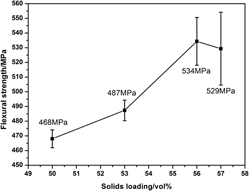
A new kind of nontoxic, water-soluble copolymer consisting of isobutylene and maleic anhydride was used to gelcast alumina ceramics at room temperature in air. The polymer acts as both a dispersant and a gelling agent. The influence of the polymer on zeta potential, rheological and gelling behavior of the alumina slurry was studied. Copolymers with a lower molecular weight had greater dispersing ability. Copolymers with a larger molecular weight had greater gelling ability. Alumina slurries with solids loading up to 58 vol% were prepared by adding copolymer (0.3 wt%, relative to the powder) with both short and long molecular chains. Increasing solids loading from 50 to 58 vol% decreased the linear shrinkage from 4.63% to 1.50% after drying, and from 14.51% to 13.18% after sintering, respectively. A solids loading of 56 vol% was associated with the highest flexural strength, as high as 534 MPa.
Thiocolchicoside (THC) is an important active pharmaceutical ingredient (API) used as a muscle relaxant because of its anti-inflammatory and analgesic effects. The only entry for a THC-related compound present in the Cambridge Structural Database (CSD) corresponds to a THC ethanol solvate hydrate (refcode: THCLCS). The diffraction pattern recorded for the THC raw material (C27H33NO10S·xH2O) is different from the pattern calculated using the THCLCS crystallographic data contained in the CSD. The indexing of the THC raw material pattern, produced an orthorhombic unit cell with a = 28.018(7) Å, b = 12.519(2) Å, c = 8.519(1) Å, and V = 2988.01 Å3. All the diffraction maxima of the powder pattern of a phase recrystallized in water (C27H33NO10S·2H2O) can be indexed in an orthorhombic cell with a = 25.264(4) Å, b = 13.537(3) Å, c = 8.553(1) Å, and V = 2925.12 Å3. Thermogravimetric analysis shows that this compound is a dihydrate phase. Upon heating, a new anhydrous phase (C27H33NO10S) with a monoclinic cell and unit cell parameters: a = 17.090(5) Å, b = 19.485(5) Å, c = 8.526(3) Å, β = 100.30(2)°, and V = 2793.34 Å3 is obtained.
Two additional forms of K2FeF5 are disclosed and characterized by powder diffraction. One (form-IV) adopts a new A2MF5 structural type, space group C2/m, a = 13.0919(2) Å, b = 5.7311(1) Å, c = 7.3114(1) Å, β = 118.241(1), and Z = 4, it is obtained from the thermal evolution of form-III, isostructural with Rb2FeF5, space group Pnma, a = 7.3964(2) Å, b = 5.6779(1) Å, c = 11.5445(3) Å, and Z = 4. Both forms are compared to two previously reported polymorphs. The III → IV transition is topotactic, conserving the same zigzag cis-connected octahedral (FeF5)n2n− chains after an ~90° rotation and 1/2b translation of half of them.
Mechanical strain triggers changes in inherent molecular structure, especially in polymeric and biological materials. Unlike conventional techniques, we demonstrate a novel dynamic mechanical characterization method to study the effect of this structural evolution with strain on elastic properties. During tensile characterization of small diameter fibers, we quantitatively measured the viscoelastic properties as a continuous function of strain. While this approach is useful to characterize the elastic properties of metal microwires independent of applied strain, it is extremely important for fundamental understanding of molecular changes and their effect on the viscoelastic properties in materials such as polymer fiber and spider silk.
Achieving control of crystalline quality is a key barrier to developing thermoelectric (TE) nanowires. We show that the structural properties of free-standing Bi2(Te.97Se.03)3 nanowire arrays on substrates can be improved by postdeposition annealing. Nanowires were electrochemically deposited into anodized aluminum oxide nanopore templates formed directly on metallized Si(100). The templates were chemically removed prior to annealing in a 3% H2/Ar environment to prevent microcrack formation that results from thermal stresses. Grain sizes grew exponentially with annealing temperature until reaching the full 75-nm diameter of the nanowires at 300 °C; growth was linear above this temperature since grains could grow further only in the axial directions. Crystalline quality, along with the development of the preferred (110) orientation for optimal TE properties, improved with increasing annealing temperature between 200 and 400 °C. However, continued loss of Te composition with annealing led to a mixed phase of Bi2Te3 and Bi4Te3 at 500 °C.
Gold–silver (Au–Ag) bimetal dispersed SiO2 composite films were fabricated via a chemical solution approach combining sol–gel with a spin-coating process, and they were investigated by transmission electron microscopy (TEM), x-ray photoelectron spectroscopy (XPS), and ultraviolet-visible absorption spectra. TEM image indicated that Ag and/or Au nanoparticles (NPs) had a spherical structure with large size distributions. The XPS results demonstrated that the presence of both Ag and Au NPs in the composite film is in each metal state. The optical absorption spectra of the composite film further confirmed the formation of nanosized Au and Ag particles, given by the two surface plasmon resonance (SPR) peaks. Unlike other Au–Ag composite films, these two SPR peaks had almost the same intensity, which is rarely obtained by a chemical approach. Compared to optical absorption spectra calculated by the modified Mie theory, the location and intensity of SPR peaks had a little difference, which could be attributed to large size distributions of Ag and Au bimetal NPs in the composite film along with the experimental process. In addition, the intensity of both SPR peaks was content-related.
Ordered 30-nm Co1−xSnx (0 ≤ x ≤ 0.78) nanowire arrays have been prepared by co-electrodeposition of Co and Sn into pores of homemade anodized aluminum oxide (AAO). The magnetic properties of the Co1−xSnx nanowires are presented as a function of Sn content (x), annealing, electrolyte pH, electrodeposition frequency, and wave form. The result of energy-dispersive x-ray spectroscopy (EDX) showed anomalous co-deposition for Co and Sn. The nanowires have uniaxial magnetic anisotropy with easy magnetization direction along the nanowire axis due to the large shape anisotropy. As-deposited and annealed alloy nanowires, determined by x-ray diffraction (XRD), have amorphous phase. The nanowires electrodeposited at different pH and the electrodeposition frequencies have significantly different magnetic properties. Magnetization measurement showed that variation in magnetic properties of the nanowire arrays rooted in surface formation of Co(OH)2 and Sn(OH)2 in upper pH. The XRD patterns of Co and Co0.97Sn0.03 of nanowires obtained at pH = 2 and 4 obviously illustrated that pH affects the crystal structure of Co nanowires but has no effect on alloy nanowires. Moreover, the precipitation process was affected by raising the electrodepositing frequency via changing the rate of reduction of solute ions. The electrodeposition wave form has no significant effect on nanowire magnetic properties. The considerable enhanced coercivity has been measured in annealed nanowires. Experimental data demonstrate that the optimized composition for annealed Co1−xSnx nanowire is around Co0.93Sn0.07 in which the coercivity (Hc) has a maximum value of 2030 Oe.
Aluminum matrix fly ash (AMFA) cenosphere composites were fabricated using the stir casting technique. The used type of fly ash cenosphere, which accounted for over 60% in all fly ash particles, was in narrow and small size (2–30 μm). During synthesis, effects of several key technological parameters on microstructure and properties were investigated using orthogonal experimental design. The optimal technological parameter was achieved as: melt temperature of 700 °C + stirring rate of 1200 r/min + stirring time of 6 min + fly ash cenosphere content of 13 wt%. With this optimal technological parameter, as-cast and forged composites were manufactured. Their tensile strengths were measured and improved maximally by 50% when the cenosphere content is 13 wt%. Such size and content of fly ash cenosphere and technological parameter could largely improve the properties of composites, which should be introduced into the production process of AMFA composites.
Atomically thin films, such as graphene, graphene oxide, hexagonal-boron nitride (h-BN), and molybdenum disulfide (MoS2), have attracted intensive studies to explore their properties and potential applications as next generation materials due to their outstanding mechanical, electrical, thermal, and optical properties. The study of the mechanical behavior of this class of materials is in particular interesting as it not only physically determines the potential application fields where these materials can be utilized but also has revealed unique mechanical size effects and phenomena. Researchers have been studying the mechanical properties such as elastic modulus, strength, friction, and fracture behavior of atomically thin films for over a decade now. Here, we review recent results of the mechanical characterization and understanding of this class of materials.
We performed first-principles calculations to obtain the phonon deformation potential (PDP) constants of wurtzite ZnO. The results are in good agreement with available experimental data except for a few PDP constants. We also found that the phonon frequencies of the A1 and B2 modes have relatively stronger nonlinear characteristics than the other modes.
A very simple model for the kinetics of oxidation of carbon Nanotubes (NTs) is proposed which is able to reproduce the main features of their measured kinetic thermal oxidation profiles. Based on this model the resistance to oxidation of NTs is found to decrease with increasing defect density and amorphous phases, i.e. sp3 bonding component. This finding supports the validity of assumptions previously made to explain the correlation between results of Raman Spectroscopy (RS) and Kinetic Thermal Analysis (KTA) on NTs via a three-stage model, inspired to that proposed by Ferrari and Robertson for other nanocarbons.
Advanced biomaterials that mimic the structure and function of native tissues and permit stem cells to adhere and differentiate is of paramount importance in the development of stem cell therapies for bone defects. Successful bone repair approaches may include an osteoconductive scaffold that permits excellent cell adhesion and proliferation, and cells with an osteogenic potential. The objective of this study was to evaluate the cell proliferation, viability and osteocyte differentiation of equine-derived bone marrow mesenchymal stem cells (EqMSCs) when seeded onto biocompatible and biodegradable calcium-deficient hydroxyapatite (CdHA) tubular-shaped bacterial cellulose scaffolds (BC-TS) of various sizes. The biocompatible gel-like BC-TS was synthesized using the bacterium Gluconacetobacter sucrofermentans under static culture in oxygen-permeable silicone tubes. The BC-TS scaffolds were modified using a periodate oxidation to yield biodegradable scaffolds. Additionally, CdHA was deposited in the scaffolds to mimic native bone tissues. The morphological properties of the resulting BC-TS and its composites were characterized using scanning electron microscopy. The ability of the BC-TS and its composites to support and maintain EqMSCs growth, proliferation and osteogenic differentiation in vitro was also assessed. BC-TS and its composites exhibited aligned nanofibril structures. MTS assay demonstrated increasing proliferation and viability with time (days 1, 2 and 3). Cell-scaffold constructs were cultured for 8 days under osteogenic conditions and the resulting osteocytes were positive for alizarin red. In summary, biocompatible and biodegradable CdHA BC-TS composites support the proliferation, viability and osteogenic differentiation of EqMSCs cultured onto its surface in vitro, allowing for future potential use for tissue engineering therapies.
Apatites are often seen as good potential candidates for the immobilization of halide-rich wastes and, in particular, chlorapatite (Ca5(PO4)3Cl) has received much attention in recent years. However, synthesis of chlorapatite waste-forms can produce a complicated multi-phase system, with a number of secondary phases forming, including β-TCP (Ca3(PO4)2), spodiosite (Ca2(PO4)Cl) and pyrophosphate (Ca2P2O7), many of which require elevated temperatures and extended calcinations times to reduce. Calcium vanadinite (Ca5(VO4)3Cl) demonstrates a much simpler phase system, with calcination at 750 °C yielding Ca5(VO4)3Cl together a small quantity of a Ca2V2O7 secondary phase, the formation of which can be retarded by the addition of excess CaCl2. Characterization of compositions doped with SmCl3 as an inactive analogue for AnCl3 show the Cl to be immobilized in the vanadinite whilst the Sm forms a wakefieldite (SmVO4) phase.