Refine search
Actions for selected content:
106129 results in Materials Science
X-ray powder diffraction data for compound Er3Co4Al12
-
- Journal:
- Powder Diffraction / Volume 28 / Issue 4 / December 2013
- Published online by Cambridge University Press:
- 29 May 2013, pp. 293-295
-
- Article
- Export citation
Effect of Dy-doping on the microstructure and magnetic properties of Y1−xDyxMnO3
-
- Journal:
- Powder Diffraction / Volume 28 / Issue S1 / September 2013
- Published online by Cambridge University Press:
- 29 May 2013, pp. S45-S49
-
- Article
- Export citation
X-ray powder diffraction data for copper(II), bis[(2E)-3-methoxy-2-[(2,6-dimethylphenyl)imino]-4-[(2,6-dimethylphenyl)imino-κN]-3-pentanolato-κO] complex
-
- Journal:
- Powder Diffraction / Volume 28 / Issue 4 / December 2013
- Published online by Cambridge University Press:
- 29 May 2013, pp. 296-298
-
- Article
- Export citation

Polyanion modulated evolution of perovskite BiFeO3 microspheres to microcubes by a microwave assisted hydrothermal method
-
- Journal:
- Journal of Materials Research / Volume 28 / Issue 11 / 14 June 2013
- Published online by Cambridge University Press:
- 24 May 2013, pp. 1498-1504
- Print publication:
- 14 June 2013
-
- Article
- Export citation

Optical and upconversion properties of Er3+-doped oxyfluoride transparent glass-ceramics containing SrF2 nanocrystals
-
- Journal:
- Journal of Materials Research / Volume 28 / Issue 11 / 14 June 2013
- Published online by Cambridge University Press:
- 24 May 2013, pp. 1481-1489
- Print publication:
- 14 June 2013
-
- Article
- Export citation
Luminescent properties of Eu3+-doped SmBa3B9O18
-
- Journal:
- Powder Diffraction / Volume 28 / Issue S1 / September 2013
- Published online by Cambridge University Press:
- 24 May 2013, pp. S41-S44
-
- Article
- Export citation

SiOC ceramics with ordered porosity by 3D-printing of a preceramic polymer
-
- Journal:
- Journal of Materials Research / Volume 28 / Issue 17 / 14 September 2013
- Published online by Cambridge University Press:
- 23 May 2013, pp. 2243-2252
- Print publication:
- 14 September 2013
-
- Article
- Export citation

A facile in situ morphological characterization of smart genipin-crosslinked chitosan–poly(vinyl pyrrolidone) hydrogels
-
- Journal:
- Journal of Materials Research / Volume 28 / Issue 17 / 14 September 2013
- Published online by Cambridge University Press:
- 23 May 2013, pp. 2401-2408
- Print publication:
- 14 September 2013
-
- Article
- Export citation
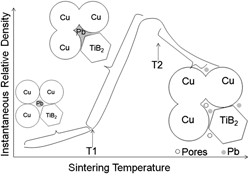
Densification kinetics, phase assemblage and hardness of spark plasma sintered Cu–10 wt% TiB2 and Cu–10 wt% TiB2–10 wt% Pb composites
-
- Journal:
- Journal of Materials Research / Volume 28 / Issue 11 / 14 June 2013
- Published online by Cambridge University Press:
- 22 May 2013, pp. 1517-1528
- Print publication:
- 14 June 2013
-
- Article
- Export citation

Improvement in the open-circuit voltage of an organic photovoltaic device through selection of a suitable and low-lying highest occupied molecular orbital for the electron donor layer
-
- Journal:
- Journal of Materials Research / Volume 28 / Issue 11 / 14 June 2013
- Published online by Cambridge University Press:
- 22 May 2013, pp. 1442-1448
- Print publication:
- 14 June 2013
-
- Article
- Export citation

Room-temperature gelcasting of alumina with a water-soluble copolymer
-
- Journal:
- Journal of Materials Research / Volume 28 / Issue 11 / 14 June 2013
- Published online by Cambridge University Press:
- 22 May 2013, pp. 1512-1516
- Print publication:
- 14 June 2013
-
- Article
- Export citation

Facile synthesis of poly(methylsilsesquioxane) and MgO nanoparticle composite dielectrics
-
- Journal:
- Journal of Materials Research / Volume 28 / Issue 11 / 14 June 2013
- Published online by Cambridge University Press:
- 22 May 2013, pp. 1490-1497
- Print publication:
- 14 June 2013
-
- Article
- Export citation
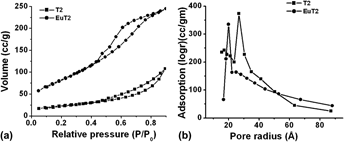
Effective optoelectronic and photocatalytic response of Eu3+-doped TiO2 nanoscale systems synthesized via a rapid condensation technique
-
- Journal:
- Journal of Materials Research / Volume 28 / Issue 11 / 14 June 2013
- Published online by Cambridge University Press:
- 22 May 2013, pp. 1471-1480
- Print publication:
- 14 June 2013
-
- Article
- Export citation

Synthesis of porous Li2MnO3-LiNi1/3Co1/3Mn1/3O2 nanoplates via colloidal crystal template
-
- Journal:
- Journal of Materials Research / Volume 28 / Issue 11 / 14 June 2013
- Published online by Cambridge University Press:
- 22 May 2013, pp. 1505-1511
- Print publication:
- 14 June 2013
-
- Article
- Export citation

Ice-templating, freeze casting: Beyond materials processing
-
- Journal:
- Journal of Materials Research / Volume 28 / Issue 17 / 14 September 2013
- Published online by Cambridge University Press:
- 21 May 2013, pp. 2202-2219
- Print publication:
- 14 September 2013
-
- Article
- Export citation
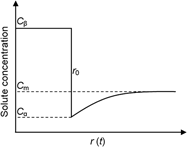
Precipitation kinetics of M23C6 in T/P92 heat-resistant steel by applying soft-impingement correction
-
- Journal:
- Journal of Materials Research / Volume 28 / Issue 11 / 14 June 2013
- Published online by Cambridge University Press:
- 17 May 2013, pp. 1529-1537
- Print publication:
- 14 June 2013
-
- Article
- Export citation

The microstructural and optical properties of Ge/Si heterostructures grown by low-temperature molecular beam epitaxy
-
- Journal:
- Journal of Materials Research / Volume 28 / Issue 11 / 14 June 2013
- Published online by Cambridge University Press:
- 17 May 2013, pp. 1432-1441
- Print publication:
- 14 June 2013
-
- Article
- Export citation

Atomic layer deposition of epitaxial HfO2 thin films on r-cut sapphire
-
- Journal:
- Journal of Materials Research / Volume 28 / Issue 13 / 14 July 2013
- Published online by Cambridge University Press:
- 17 May 2013, pp. 1680-1686
- Print publication:
- 14 July 2013
-
- Article
- Export citation
-
Textured epitaxial HfO2 thin films of monoclinic structure were grown on r-cut Al2O3 by atomic layer deposition from HfCl4 and H2O at temperatures 450–750 °C. The film-to-substrate out-of-plane orientation was determined to have a single (001)HfO2//(1 $\bar 1$02)α-Al2O3 relationship. The in-plane orientation showed the existence of two possible relationships: [100]HfO2//[110]α-Al2O3 and [ $\bar 1$00]HfO2//[110]α-Al2O3. In films deposited at 400 °C traces of (010) growth plane were observed in addition to the preferential (001) growth. The lattice of HfO2 was compressed in the surface plane and expanded in the surface normal direction. The strain was highest in the films grown at 450–550 °C. With the increase of deposition temperature to 750 °C, the strain decreased. The strain relaxation in films deposited at 750 °C was in correlation with marked surface roughening in the initial stage of deposition at this temperature. The roughness of the epitaxial films was lower than that of polycrystalline films with comparable thickness deposited on Si(100) and SiO2 substrates.


Seebeck coefficient of graded porous composites
-
- Journal:
- Journal of Materials Research / Volume 28 / Issue 17 / 14 September 2013
- Published online by Cambridge University Press:
- 17 May 2013, pp. 2316-2324
- Print publication:
- 14 September 2013
-
- Article
- Export citation
1 - Introduction
-
- Book:
- Physical Gels from Biological and Synthetic Polymers
- Published online:
- 05 May 2013
- Print publication:
- 16 May 2013, pp 1-17
-
- Chapter
- Export citation
