To save content items to your account,
please confirm that you agree to abide by our usage policies.
If this is the first time you use this feature, you will be asked to authorise Cambridge Core to connect with your account.
Find out more about saving content to .
To save content items to your Kindle, first ensure no-reply@cambridge.org
is added to your Approved Personal Document E-mail List under your Personal Document Settings
on the Manage Your Content and Devices page of your Amazon account. Then enter the ‘name’ part
of your Kindle email address below.
Find out more about saving to your Kindle.
Note you can select to save to either the @free.kindle.com or @kindle.com variations.
‘@free.kindle.com’ emails are free but can only be saved to your device when it is connected to wi-fi.
‘@kindle.com’ emails can be delivered even when you are not connected to wi-fi, but note that service fees apply.
The present chapter gives an overview of experimental platforms showing how they may be used to populate models for materials behaviour. The condensed phase defines the pressure and temperature range of interest, which may be approximately fixed at less than 1 TPa and below 10000 K. Indeed pressure has one of the largest ranges of all physical parameters in the universe (the pressure in a neutron star is c. 1033 Pa), so that most of the materials in nature are under conditions very different from those on Earth. The goal of shock experiments is to track response and mechanisms across the realms of stress and volume that are experienced by condensed-phase matter across the universe. At the highest pressures and temperatures, materials move from the solid to the liquid and then to plasma states as new correlations and bonding are formed. These high-density states have been termed warm dense matter (WDM) and lie beyond the finis extremis – outside the regime of extreme behaviour considered here. A summary of the phase space occupied by matter in these regions is shown in Figure 3.1.
The goal of experimental work is to provide adequate knowledge of the response of matter over the operating regimes of the relevant plasticity mechanisms. By this means, analytical descriptions can be constructed to try and capture the fundamental relationships between the independent variables – stress and stress state, strain and strain rate, and temperature – that determine the constitutive, damage and failure behaviour of materials. A shock impulse provides a pump to drive materials deformation and control of that impulse also allows a window into the operative mechanisms that lead to plasticity and damage evolution. This includes determining dynamic strength as a function of pressure as well as determining equation of state over the range of interest for particular applications.
This article reviews the use of x-ray computed tomography (XRCT) to investigate the structure and properties of cellular solids. In the first section, the possibilities offered by XRCT are presented. Examples of tomographic images are shown for the three classes of material (polymers, metals, and ceramics). Different characterizations of cellular solids performed thanks to XRCT images are shown: calculation of morphological parameters, in situ and ex situ mechanical tests, and use of the tomographic images to perform finite element (FE) modeling. The second part of the paper presents the existing methods to create the meshes from tomographic images and highlights some interesting results from the FE simulations.
In this paper, a process to introduce nanoscale cells in homogeneous polyetherimide (PEI) is presented. The nanofoams produced have a bulk porosity (void fraction) in the range of 25–64%, with the average cell sizes in the range of 40–100 nm. Uniform nucleation of cells throughout the volume of the PEI specimen was observed. Supercritical CO2 at 20 MPa was used as the blowing agent and the specimens were foamed in a hot press to ensure flatness for further processing and characterization. Sorption studies showed that at 20 MPa, PEI can absorb about 10% CO2 by weight and that a 1-mm thick specimen can reach an equilibrium concentration in approximately 100 h at 45 °C. The effects of desorption time, foaming temperature, clamping pressure, and foaming time were investigated. Several nanoscale morphologies were observed through changes in the foaming temperature, which ranged from 165 to 210 °C. In one experiment, it was found that when the clamping force is increased from 1 to 10 tons, the average cell size increased from 40 to 4000 nm or by a factor of 100. This points to the clamping force as an important process variable to control the nanostructure introduced in PEI. Optimal processing conditions for the production of defect-free nanofoams are presented.
Confined synthesis of three-dimensionally ordered mesoporous-imprinted (3DOm-i) zeolites within three-dimensionally ordered mesoporous (3DOm) carbons prepared from silica colloidal crystals was achieved through multiple hydrothermal (MHT) synthesis and steam-assisted crystallization (SAC). The transition of ordered mesoporous structures, starting from silica colloidal crystal to resulting 3DOm-i zeolites including the intermediate 3DOm carbon templates, and the correlations among the confined synthesis methods, crystal growth nature of different zeolites, and the sintering of the templates were studied. An imperfect replication was found in 3DOm-i zeolite when it compared to silica colloidal crystals regardless the synthesis methods (MHT or SAC), which might be originated from combination effects of sintering of the silica colloidal crystals and partial filling of cavities of the 3DOm carbon template during the confined synthesis, and the degree of the structure replication was notably influenced by microstructures of zeolite as well. A thorough investigation of the growth development of 3DOm-i BEA zeolites with various Si/Al ratios ranging from 14 to 27 through the MHT method confirmed that the crystallization takes place in the carbon template by a cage-to-cage propagation growth process.
Gold surfaces exhibit most interesting frictional properties on the nanometer scale. They can be studied in detail by means of friction force microscopy. Atomic-scale variations of the lateral force allow investigation of microscopic mechanisms of sliding. Friction force microscopy even reveals surface reconstruction of the gold surface as a modulation of the lateral force signal. Experiments indicate that the mobility of surface atoms at room temperature and plastic deformation mechanisms give rise to neck formation between gold and microscopic asperities in sliding contact. The frictional properties of gold surfaces change dramatically at temperatures below 150 K, where the surface diffusion is greatly reduced. Insight into the lubrication properties of self-assembled monolayers is provided by molecular-scale modulations of frictional forces. Molecular-scale maps of the friction force also allow identification of the relevant surface structure in experiments on electrochemically modified gold surfaces. Variation of the electrochemical potential is a means to reversibly switch between low and high friction states on gold surfaces.
This unified guide brings together the underlying principles, and predictable material responses, that connect metals, polymers, brittle solids and energetic materials as they respond to extreme external stresses. Previously disparate scientific principles, concepts and terminology are combined within a single theoretical framework, across different materials and scales, to provide all the tools necessary to understand, and calculate, the responses of materials and structures to extreme static and dynamic loading. Real-world examples illustrate how material behaviours produce a component response, enabling recognition – and avoidance – of the deformation mechanisms that contribute to mechanical failure. A final synoptic chapter presents a case study of extreme conditions brought about by the infamous Chicxulub impact event. Bringing together simple concepts from diverse fields into a single, accessible, rigorous text, this is an indispensable reference for all researchers and practitioners in materials science, mechanical engineering, physics, physical chemistry and geophysics.
Presenting a unique perspective on state-of-the-art physical gels, this interdisciplinary guide provides a complete, critical analysis of the field and highlights recent developments. It shows the interconnections between the key aspects of gels, from molecules and structure through to rheological and functional properties, with each chapter focusing on a different class of gel. There is also a final chapter covering innovative systems and applications, providing the information needed to understand current and future practical applications of gels in the pharmaceutical, agricultural, cosmetic, chemical and food industries. Many research teams are involved in the field of gels, including theoreticians, experimentalists and chemical engineers, but this interdisciplinary book collates and rationalises the many different points of view to provide a clear understanding of these complex systems for researchers and graduate students.
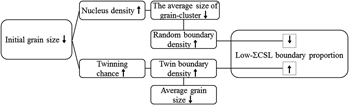
Grain boundary engineering (GBE) has been carried out in nickel-based Alloy 690 with different initial grain sizes. The microstructure evolution during GBE-processing is characterized using electron backscatter diffraction to study the initial grain size effects on the grain boundary network (GBN). The microstructures of the partially recrystallized samples revealed that the GBE-processing is a strain-recrystallization process, during which each grain-cluster is formed by “multiple twinning” starting from a single recrystallization nucleus. Taking into consideration the coincidence site lattices (CSLs) and ∑, which is defined as the reciprocal density of coincidence sites, a high proportion of low-∑ CSL grain boundaries (GBs) and large grain-clusters are found to be the features of GBE-processed GBN. The initial grain size has a combined effect on the low-∑ CSL GBs proportion. A large initial grain size reduces the number of recrystallization nuclei that form, increasing the cluster size, but decreasing twin boundary density. On the other hand, smaller initial grain sizes increase the density of twin boundary after recrystallization, while decreasing grain-cluster size. Neither the grain-cluster size nor the twin boundary density is the sole factor influencing the proportion of low-∑ CSL GBs. The ratio of the grain cluster size over the grain size governs the proportion of low-∑ CSL GBs.
Materiomics is growing. In this book, we have discussed and reviewed how one side of the materiomics coin, the screening of libraries of biomaterials, is developing, but the future of screening will go hand in hand with the other side of the coin – modelling. Materiomics is growing and is, one could say, still in its infancy. Currently, most materiomics research is performed by academic research groups, although a small but increasing number of companies are active in this area. It will be helpful to understand how fast this field will grow, and how it might develop.
To sketch a potential scenario perhaps it is worth looking at recent developments in the field of molecular biology. In the mid-1990s, there were specialized machines in the lab to produce oligonucleotides, so-called primers, used in the polymerase chain reaction, a specialist job which gave the lab a scientific head start. These days, however, a primer can be ordered online and be at your bench in days, for the cost of a few dozen Euros. By the late 1990s, we saw cDNAs arrayed on nitrocellulose, which allowed simultaneous quantification of expression for dozens to hundreds of genes. No more tedious northern blotting one gene at a time! Driven by these early successes, many institutes started investing in arraying equipment and software development, as DNA microarray analysis became increasingly popular. But the real breakthrough in the use of this technology came when companies such as Affymetrix invested not only in standardization and professionalization of the technology, but importantly also in the work flow of a DNA microarray experiment. These companies provided a full package with not only arrays but also the incubators, washing, data analysis, detailed work protocols, image analysis software and a customer service platform. In both cases, the new technological possibilities of oligonucleotide synthesis and DNA microarray production paved the way for breakthroughs in science. We think that this will also be possible for materiomics.
This chapter deals with an overview of basic microfabrication techniques. The goal is to explain to the reader how such techniques can be utilized in the field of materiomics. The basic processes used in microfabrication including photolithography, etching, electron beam lithography and micromoulding are explained. Some classic examples of these techniques as applied to materiomics are also shown. Furthermore, possible uses of such techniques, and the development and application of hybrid techniques to be able to answer fundamental questions about biological behaviour of materials, are also suggested.
Basic principles of microfabrication
Introduction
Techniques used to fabricate structures or devices smaller than 100 µm are commonly referred to as microfabrication techniques. Initially meant for the electronics industry, they have found a wide range of applications in diverse fields such as chemical engineering and the life sciences. Since the early 1990s, the application of microfabrication technologies in the area of chemical and biological analysis has been termed ‘micro total analysis systems’ (µTAS) (1). Microfabricated devices meant for µTAS initially offered the advantage of sample analysis on the microscale, but over the years, the evolution of these technologies has led to the facilitation of sample preparation, fluid handling, separation systems, cell handling and cell culturing in an integrated manner (1). The application of microtechnologies for the fabrication of devices or systems to study material properties benefits from cost efficiency, high performance, precision-based design flexibility, miniaturization and automated analysis. Miniaturization involves the convergence of multiple disciplines, such as fluid dynamics, material sciences, engineering and the life sciences, that need to join expertise in order to design functional systems. Moreover, these devices can be used to evaluate biological behaviour in vitro and can help us to test thousands of different biomaterials and surface properties without the complexity related to in vivo assays.
Given the demographic challenges of an ageing population combined with rising patient expectation and the growing emphasis placed on cost containment by healthcare providers, economic regenerative medicine approaches for regeneration of damaged and diseased organs and tissues are a major clinical and socio-economic need. The scope of this chapter is to use skeletal regeneration as the exemplar to discuss classical and high-throughput screening approaches to biomaterials development for regenerative medicine, including choice and design of materials based on clinical need, biological assessment and regulatory issues.
Basic principles: development of materials for regenerative medicine
The increase in an ageing population in developed countries is accompanied by a growing need for replacement and repair of damaged organs and tissues. Transplantation of the patient’s own tissue is still considered the gold standard in many applications, but limited availability, and complications associated with harvesting of the so-called autograft, are becoming an important drawback. Tissues and organs from human or animal donors present issues of disease transmission and functional failure. Alternative strategies, based on biological growth factors, cell therapy and tissue-engineered constructs, are being explored as alternatives to the patient’s own tissue, but their use is hampered by biological instability and high costs. These issues demonstrate the need for strategies based on biomaterials, which are often synthetic, and thus less prone to instability problems. In addition, the fact that (synthetic) biomaterials can often be produced in large quantities and thus be available off-the-shelf is an important advantage when coping with an increasing need for regenerative approaches.
To screen biomaterials in a materiomics approach, libraries of materials are produced. Different materials are used, varying from metals and cements, to covalent polymers that can be either premixed or polymerized in situ, to supramolecular systems that can be applied in a modular approach. This chapter describes the generation of such libraries using different kinds of materials and chemistries. Additionally, the advantages and limitations of the application of these different systems/biomaterials in a materiomics approach are discussed.
Introduction
Different synthetic biomaterials are used for many biomedical applications, varying from metals and ceramic cements, to polymers and supramolecular systems. To screen these biomaterials in a materiomics approach, as said above, libraries of materials are produced. Variations in biomaterials are screened as continuous gradients or in a discrete fashion. The properties that are varied and methods used to create variation within these libraries depend on the type of biomaterial. For the hard metal and ceramic-based biomaterials, the surface interaction with tissue is the property of most interest, and therefore properties such as surface roughness and topography are varied. Covalent polymers are diversified using combinatorial chemistry. The dynamic and self-assembling nature of supramolecular systems allows for the development of material libraries using a modular approach by mixing and matching of different compounds modified with supramolecular moieties.
It’s that sense of unease when you step out of the airport terminal building and onto the streets of Kathmandu. Or the moment when you open the door to your new office to see unfamiliar faces waiting for you. Step out of your comfort zone and discover how exciting, thrilling and liberating it can be: a new world is waiting for you. This book is about stepping out of the comfort zone of your own scientific discipline and about exposing yourself to something new. Embrace all the scientific disciplines that build modern-day biomaterials research, in the cultural hotpot of materiomics. Don’t let the jargon and three-letter abbreviations of cell biology hold you back, nor the abracadabra of statistical models, nor the Latin terms for body parts and diseases. Learn a new language and a whole new culture is waiting for you.
The compilation of this book was initiated after an exciting conference termed ‘High throughput screening of biomaterials: shaping a new research area’, held beside the Amsterdam canals in April 2011. The meeting was attended by 50 selected scientists from all over the globe and across all the disciplines of biomaterials research, and the format of the conference took away that sense of unease. Chemists talked to clinicians, biologists listened to information scientists, engineers brainstormed with policy makers. We decided to bring this open and inviting atmosphere to the public through this book. Therefore, each chapter contains a tutorial on the topic for non-experts, gives an overview of the current status of that field and discusses how this technology will further shape the future of materiomics. The result of this exciting journey is presented here and was made possible only with the help of all the authors and those who contributed to the organization of the conference (Anouk Mentink), the editing of the book (Ruben Burer) or the chapters (Kristen Johnson). We hope that this book will be a scientific passport which lets you travel across the border of your discipline and helps you to learn to appreciate that of others. You won’t be disappointed. Enjoy your journey!
High-content imaging (HCI) plays a pivotal role in high-throughput screening (HTS) of biological responses to biomaterials. This chapter will give a brief introduction to its basic principles by explaining the most commonly used imaging techniques, describing the general structure of an image analysis pipeline and providing a summary of available HCI software. Special emphasis will be devoted to the initial steps of image analysis such as image correction, segmentation and feature extraction. Additionally we include a brief overview of relevant literature and description of promising new tools for HCI. Finally, two classic experiments will be described, which use state-of-the-art HCI in biomaterial science by experts in the field.
Origins of high-content imaging
The first person to observe micro-organisms with a microscopic device was the Dutchman Antoni van Leeuwenhoek (1), who was able to make and polish tiny lenses of high curvature which were the forerunners of the modern microscope. Robert Hooke, the English father of microscopy, later improved on the design and confirmed van Leeuwenhoek’s findings. Since then, light microscopy has evolved into its modern incarnation. The first use of fluorescence microscopy in biology was in 1881 when the bacteriologist Paul Ehrlich used fluorescin to observe the aqueous humour in the eye. The first immuno-staining was performed in 1950 by Melvin Kaplan (2). Green fluorescent protein (GFP) was the first fluorescent protein used in biology. It was isolated from jellyfish in 1961 by Shimomura and co-workers, and it was cloned by Prisher in 1992. The ability either to use antibody conjugated fluorophores or to clone GFP into chimaeric proteins led to the implementation of the fluorescence microscope in modern biology. High-content imaging (HCI) is the automation of fluorescence microscopy whereby the manual interpretation of images is replaced by computer algorithms.
Materiomics approaches may be applied broadly in the design and characterization of a wide range of materials, going beyond the biomedical focus. This chapter presents essential concepts relevant to the implementation of materiomics to physical and chemical properties not usually associated with biomedical materials. Recent progress in this area is reviewed briefly with several examples given in high-throughput measurement of organic and inorganic materials properties. The applications that are covered range from speciality coatings to membranes for fuel cells and metal–organic framework materials for carbon capture. Properties treated here include mechanical, spectroscopic and transport characteristics.
Tutorial on basic principles
Materials complexity
While previous chapters have focused on the application of materiomics concepts to biomedical materials, this chapter will emphasize how and why materiomics is being employed in materials research and development beyond the biomaterials field. The central challenge inherent to materials research and development is that most products consist of multiple components whose final properties are usually a sensitive function of composition and processing conditions. The complex interactions make it difficult, if not impossible, to design products a priori without significant experimentation. Academicians are often interested in characterizing fundamental phenomena, such as phase transitions or magnetization, and discovering how these phenomena can be used to develop novel materials functionalities.
Computational and statistical tools play an important role in materiomics, to provide insights in the underlying processes that allow certain materials to outperform other materials. In this chapter, we discuss numerous methods that allow the analysis of materiomics data. Specifically, we describe the use of statistical tests, ranking and data mining approaches, model learning and testing, as well as experimental design and the exchange of experimental results. Also, we review some of the important publications in this field from the past 15 years, organizing them according to the type of material descriptors that were used.
Basic principles of data analysis
Computational methods play an ever more important role in the study of material function. Partly, this is due to the increased scale of the experiments being performed, with an accompanying need for automated analyses. But the move from low-throughput towards high-throughput experiments entails more than just testing more materials simultaneously. The extra information these experiments produce is slowly catalysing a transition to a more rational approach to material discovery, in which not just material screening plays a role but also material modelling. Materials and their environments are approached as systems that can be modelled and thus explored in silico. This ‘systems approach to material research’ has been termed materiomics. This transition is certainly needed given the size of the materiome that one wants to explore: many material parameters can be varied and combined into a practically infinite palette of combinations. This far surpasses even the reach of high-throughput screenings. The question that will be addressed in this chapter is: how can we efficiently make use of our capability to perform high-throughput experiments, to explore and characterize such a large search space?