To save content items to your account,
please confirm that you agree to abide by our usage policies.
If this is the first time you use this feature, you will be asked to authorise Cambridge Core to connect with your account.
Find out more about saving content to .
To save content items to your Kindle, first ensure no-reply@cambridge.org
is added to your Approved Personal Document E-mail List under your Personal Document Settings
on the Manage Your Content and Devices page of your Amazon account. Then enter the ‘name’ part
of your Kindle email address below.
Find out more about saving to your Kindle.
Note you can select to save to either the @free.kindle.com or @kindle.com variations.
‘@free.kindle.com’ emails are free but can only be saved to your device when it is connected to wi-fi.
‘@kindle.com’ emails can be delivered even when you are not connected to wi-fi, but note that service fees apply.
X-ray and neutron fiber diffraction has been used to study cellulose as it is converted from its naturally occurring crystal phase, cellulose I, to an activated crystal phase, cellulose IIII, by ammonia treatment. The detailed crystal structures determined for cellulose Iβ, an intermediate ammonia-cellulose I complex, and cellulose IIII, reveal a structural transition pathway: hydrogen bonded sheets of chains in cellulose Iβ slip with respect to each other to accommodate the penetrating ammonia guest molecules in the intermediate complex. On evaporation of ammonia from the intermediate complex, there is a relative small change in chain packing as an inter-sheet ammonia bridge is replaced by an inter-sheet hydrogen bond in cellulose IIII. When cellulose IIII is heated it converts back to cellulose Iβ. Both ammonia-cellulose I and cellulose IIII have extended chains of cooperative hydrogen bonds in relatively open crystal structures that may add to their susceptibility to rapid change.
Crystal structure and structural disorder of Ba3MgSi2O8 were reinvestigated by laboratory X-ray powder diffraction. The title compound was found to be trigonal with space group P3m1, Z=1, and unit-cell dimensions a=0.561 453(4) nm, c=0.727 629(4) nm, and V=0.198 641(2) nm3. The initial structural model used for structure refinement was taken from that of glaserite (K3NaS2O8) and modified by a split-atom model. In the split-atom model, one of the two types of Ba sites and that of SiO4 tetrahedra were, respectively, positionally and orientationally disordered. The new crystal structure and structural disorder were refined by the Rietveld method. The maximum-entropy-method-based pattern fitting (MPF) method was used to confirm the validity of the split-atom model, in which conventional structure bias caused by assuming intensity partitioning was minimized. The final reliability indices calculated from MPF were Rwp=6.52%, S=1.36, Rp=4.84%, RB=0.97%, and RF=0.52%. Details of the disorder structure of Ba3MgSi2O8 are shown in the three-dimensional and two-dimensional electron-density distribution maps determined by MPF.
Quantitative comparisons between patterns from PDF-4 and experimental data using the Integral Index method are presented. The software integrated into the PDF-4 (DDView+) provides the ability to calculate fully digitized diffraction patterns for all 272,232 entries (PDF-4+ 2007). To provide a means of quantitative comparison between entries in the Power Diffraction File (PDF) and experimental data obtained in the laboratory, data filtering using Boolean logic has been used to reduce the size of the comparison set. Within this comparison set, we have used the Integral Index method to provide quantitative comparisons between digitized patterns obtained from the PDF-4 and experimental data. The quantitative aspects facilitate total pattern matching, that is, selecting the pattern in the PDF-4 that most closely matches input experimental data. Several examples will be used to illustrate the pattern matching process and the utility of this approach will be examined.
A monoclinic phase isostructural to Al4W was revealed in Al–Ni–Re close to the Al–Re terminal. It is assumed to be a ternary extension of the high-temperature Al4Re phase usually transforming in binary alloys even by sharp quenching from the existence temperatures. The powder X-ray diffraction pattern of this phase of the Al77Ni2.5Re20.5 composition was indexed for the Cm space group with a=5.1538(12) Å, b=17.410(5) Å, c=5.1546(15) Å, and β=100.548(16)°.
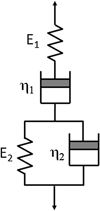
This study focuses on nanoindentation creep in polycarbonate (PC) and syndiotactic polystyrene (sPS) throughout the transient and steady-state regions. The viscoelastic Burgers model is used to explain transient creep data, while the power-law creep model is used to interpret steady-state creep data. The Newtonian shear viscosity of the Maxwell element and Young’s modulus of the Kelvin element are greater for the creep period than for the preload period, and an opposite trend is noted in the Newtonian shear viscosity of the Kelvin element and Young’s modulus of the Maxwell element. The fact that the Young’s moduli of Maxwell and Kelvin elements in the creep period are different from those in the preload period implies that a stress-induced mesomorphic structure forms or that crystallization occurs in nanoindentation creep. While the strain rate increases with decreasing preload period, the stress exponent factor is almost the same for all preload periods.
A series of synthetic calcium silicates has been produced comprising nano-sized plates. The starting calcium silicate referred to as nano-structured calcium silicate, NCS, appears itself X-ray amorphous but contains impurities of calcite. These impurities decompose during the dry thermal conversion of the material into wollastonite. NCS can be enriched with calcium or silicon, respectively. The silicon enriched NCS can be hydrothermally transformed into a sheet material related to Ca7Si16O38(OH)2. The X-ray pattern of this material was sufficient to allow the calculation of its unit cell with a comparatively high figure of merit. The calcium enriched NCS can form two very distinctly different ceramic materials upon hydrothermal treatment, one a band material (formed below 200 °C) and the other a rose petal shaped material (formed above 210 °C). The X-ray diffraction patterns could not be resolved. The fit between the observed and calculated patterns was less than 50% as expressed in comparatively low figures of merit (unusually <20), which is attributed to calcium carbonate impurities in the samples disrupting the long range order. The patterns of these calcium enriched samples could be best compared to those of tobermorite or truscotite.
Investigation into the early hydration of Portland cement was performed by in situ X-ray diffraction (XRD). Technical white cement was used for the XRD analysis on a D5000 diffractometer (Siemens). All diffraction patterns of the in situ measurement which were recorded up to 22 h of hydration at defined temperatures were analyzed by Rietveld refinement. The resulting phase composition was transformed with respect to free water and C-S-H leading to the total composition of the cement paste. The hydration reactions can be observed by dissolution of clinker phases as well as by the formation of the hydrate phases ettringite and portlandite. With increasing temperatures the reactions proceed faster. The formation of ettringite is directly influenced by the rate of dissolution of anhydrite and tricalcium aluminate (C3A). The beginning of the main period of hydration is marked by the start of portlandite formation. The experiments point out that a quantitative phase analysis of the cement hydration is feasible with standard laboratory diffractometers.
The crystal structure of Ag2GeO3 was determined from laboratory X-ray powder diffraction data (Cu Kα1) using the Rietveld method. The title compound is orthorhombic with space group P212121, Z=4, unit-cell dimensions a=0.463 09(1) nm, b=0.713 93(2) nm, and c=1.040 79(3) nm, and V=0.344 10(2) nm3 . The final reliability indices were Rwp=5.58%, S=1.26, Rp=4.20%, RB=0.67% , and RF=0.35% . The GeO4 tetrahedra form infinite chains of [Ge2O6] along the a axis, with two tetrahedra per identity period of 0.463 nm. Individual chains are connected by Ag atoms, one-half of which are almost linearly coordinated by two O atoms and the rest are coordinated by three O atoms. The relatively short Ag-Ag distances of 0.299 to 0.339 nm indicate Ag(I)-Ag(I) interaction. This compound is isostructural with Ag2SiO3.
Calcium carbonate crystals were prepared via a simple precipitation reaction of sodium carbonate with calcium chloride from mixed solutions of various amphiphilic organic solvents and water in the presence of cetyltrimethylammonium bromide at 25 and 60 °C. Our analysis shows that amphiphilic organic solvents and temperature have large influences on the structure and morphology of CaCO3. X-ray diffraction patterns show that single-phase hexahedral calcite was formed at 25 °C, and orthorhombic aragonite was obtained at 60 °C. Mixtures of major amounts of long aragonite crystals and minor amounts of calcite particles were also obtained at 60 °C in the methanol and the acetone solutions. Scanning electron microscopy images show that CaCO3 particles and aggregates with various morphologies, such as large solid and hollow hexahedral crystals and small round granules of calcite as well as glass-like and wheat-like aggregates of aragonite, were obtained depending on the experimental conditions. Based on the experimental results, a conclusion on the effects of temperature and amphiphilic organic solvents on the crystal structure and morphology are made.
Compound HoCo0.67Ga1.33 was synthesized and studied by means of X-ray powder diffraction technique. HoCo0.67Ga1.33 was found to have the orthorhombic CeCu2 structure (space group Imma) with a=4.3479(2) Å, b=7.0351(3) Å, c=7.4876(3) Å, Z=4, and Dcalc=8.62 g/cm3. The crystal structure of HoCo0.67Ga1.33 was also refined by the Rietveld method. Ho atoms were found to occupy the 4e positions and mixed Co/Ga atoms to share the 8h positions of the space group Imma (No. 74).
A new Tutton’s salt Tl2[Mn(OH2)6](SO4)2 was grown from aqueous solutions and characterized by chemical analysis and X-ray powder diffraction. It was found to be monoclinic, space group P21/a, a=0.93276(6), b=1.25735(8), c=0.62407(4) nm, and β=106.310(3)°. It is unstable in warm air and dissolves incongruently. A comparison of unit cell volumes for all 37 Tutton sulfate phases found in ICDD’s PDF-2 database (86 entries) reveals a reasonable correlation with Shannon and Prewitt’s ionic radii [Acta Crystallogr. 25, 925–926 (1969)] and several deviations, most of them seeming to be erroneous entries.
A new phase Zn3Cu4Sb2O12 was analyzed by X-ray powder diffraction. Its monoclinic unit cell parameters are a=21.0378(19) Å, b=8.7825(7) Å, c=5.5860(4) Å, and β=112.578(7)°, and the space group is either Cc (9) or C2/c (15). From comparison with density measurements, Z=4.
The structure of bethanechol chloride C7H17ClN2O2 is solved from conventional X-ray powder diffraction data in direct space [monoclinic unit cell with a=8.8749(3) Å, b=16.4118(7) Å, c=7.1373(3) Å, β=93.803(1)°, V=1037.29(7) Å3, Z=4, and space group P21/n]. The existence of a second orthorhombic closely related form is discussed.
1-N-(4-pyridylmethyl)amino naphtalene was synthesized by means of a reaction of alpha-naphthylamine, 4-pyridylcarboxyaldehyde, in anhydrous ethanol to obtainN-(4-pyridylen)-alpha-naphthylamine and that was reduced with NaBH4 to produce the wanted compound. The X-ray powder diffraction pattern for the new compound 1-N-(4-pyrydylmethyl)amino naphtalene was obtained. This compound crystallizes in a monoclinic system with refined unit cell parameters a=10.375(5) Å, b=17.665(6) Å, c=5.566(2) Å, β=100.11(3), and V=1004.3(5) Å3, with space group P2/m (No. 10).
The structure transitions and phase relationships of DyFe3−xAlx compounds have been investigated by X-ray powder diffraction. Our XRD results show that each of the compounds with x≤0.45 crystallizes in the rhombohedral PuNi3-type structure with space group R3¯m and Z=9; for the 0.8≤x<1.0 compounds, each has a hexagonal structure of the CeNi3 type with space group P63/mmc and Z=6; and each of the samples with 0.45<x<0.8 is a two-phase mixture of the PuNi3- and CeNi3-type structures. The calculated XRD intensities of the DyFe3−xAlx compounds with x=0.2, 0.33, 0.4, and 0.45 indicate that Dy occupies the 3a and 6c sites, Fe and Al distribute randomly on the 18h site, and the 3b and 6c sites are exclusively occupied by Fe, which agrees well with those of our experimental XRD patterns. The XRD intensities of the DyFe3−xAlx compounds with x=0.8 and 1.0 have also been calculated and found to agree with the experimental results with Dy on the 2c and 4f sites, Fe and Al at the 12k site, and Fe at the 2a, 2b, and 2d sites. In the two-phase region with x=0.45–0.8, the values of unit-cell parameters and phase compositions are linearly dependent on the value of x, indicating that the two phases are constituted by the same composition x with different stacking arrangements. This abnormal two-phase equilibrium is further confirmed by the structural analysis of the DyFe2.33Al0.67 (or x=0.67) sample. The samples with x=1.1 and 1.2 were also analyzed, and each found to be a mixture of more than two phases.