To save content items to your account,
please confirm that you agree to abide by our usage policies.
If this is the first time you use this feature, you will be asked to authorise Cambridge Core to connect with your account.
Find out more about saving content to .
To save content items to your Kindle, first ensure no-reply@cambridge.org
is added to your Approved Personal Document E-mail List under your Personal Document Settings
on the Manage Your Content and Devices page of your Amazon account. Then enter the ‘name’ part
of your Kindle email address below.
Find out more about saving to your Kindle.
Note you can select to save to either the @free.kindle.com or @kindle.com variations.
‘@free.kindle.com’ emails are free but can only be saved to your device when it is connected to wi-fi.
‘@kindle.com’ emails can be delivered even when you are not connected to wi-fi, but note that service fees apply.
Evidence for the recently described 2M2 polytype of brochantite from X-ray powder diffraction investigation of secondary alteration products of ore material from the Pierre Plate Mine, Vizille, Isère, France is presented. This report is the first to describe the 2M2 polytype from locations outside of Italy and through the use of powder XRD methods. In the procedure used herein, developed in a study by Merlino et al. [Eur. J. Mineral 15, 267–275 (2003)], we have used family reflections, common to both main types of brochantite, as the source of approximate cell parameters from which we obtain positions of characteristic reflections to demonstrate the unique choice of polytype, before final refinement stage. This method demonstrates that the determination of polytype is possible from powder data, for samples typical of both geological and urban environments. Least-squares refined cell parameters for the 2M2 polytype from Pierre Plate are a=12.7409(8) Å, b=9.8371(6) Å, c=6.0109(3) Å, and a=90.135(9)°, constrained in space group P21/n11.
Accurate minor and trace element analysis via micro-XRF can be more difficult to accomplish in single crystal and polycrystalline materials due to diffraction phenomena which obscure elemental peaks and distort the spectral background. A primary-beam filter is commonly used to eliminate diffractive artifacts as well as tube characteristic lines, but this dramatically reduces the sensitivity to lighter elements. One way around this is to collect a spectrum with unfiltered excitation to obtain the low-energy region, i.e., Na, Mg, Al, and Si, and then collect other portions of the spectrum under more optimized conditions. The fundamental parameter method is capable of using multiple spectra to quantify the complete element suite of the sample. By unifying the quantification for several spectra taken under different excitation conditions, the overall results can be improved. We have applied this method to selected cases for geological and metallurgical samples. The combined method gives better results for all elements than the single spectrum quantification as judged by agreement with the values from the supplier.
Micro-X-ray fluorescence (μ-XRF) is a rapidly evolving analytical technique which allows visualising the trace level metal distributions within a specimen in an essentially nondestructive manner. At second generation synchrotron radiation sources, detection limits at the sub-parts per million level can be obtained with micrometer resolution, while at third generation sources the spatial resolution can be better than 100 nm. Consequently, the analysis of metals within biological systems using micro- and nano-X-ray fluorescence imaging is a quickly developing field of research. Since X-ray fluorescence is a scanning technique, the elemental distribution within the sample should not change during analysis. Biological samples pose challenges in this context due to their high water content. A dehydration procedure is commonly used for sample preparation enabling an analysis of the sample under ambient temperature conditions. Unfortunately, a potential change in elemental redistribution during the sample preparation is difficult to verify experimentally and therefore cannot be excluded completely. Creating a cryogenic sample environment allowing an analysis of the sample under cryogenic condition is an attractive alternative but not available on a routine basis. In this article, we make a comparison between the elemental distributions obtained by micro-SR-XRF within a chemically fixed and a cryogenically frozen Daphnia magna, a model organism to study the environmental impact of metals. In what follows, we explore the potential of a dual detector setup for investigating a full ecotoxicological experiment. Next to conventional 2D analysis, dual detector X-ray fluorescence cryotomography is illustrated and the potential of its coupling with laboratory absorption micro-CT for investigating the tissue-specific elemental distributions within this model organism is highlighted.
Crystal structure of Li2BaSiO4 was reinvestigated by laboratory X-ray powder diffraction. The title compound was hexagonal with space group P63cm, Z=6, unit-cell dimensions a=0.810 408(2) nm, c=1.060 829(4) nm, and V=0.603 370(3) nm3. The initial structural model was successfully derived by the direct methods and further refined by the Rietveld method, with the anisotropic atomic displacement parameters being assigned for all atoms. The reliability indices calculated from the Rietveld refinement were Rwp=6.72%, S=1.17, Rp=5.06%, RB=1.86%, and RF=0.98%. The maximum-entropy method-based pattern fitting (MPF) method was used to confirm the validity of the structural model, in which conventional structure bias caused by assuming intensity partitioning was minimized. The final reliability indices calculated from MPF were Rwp=6.74%, S=1.17, Rp=5.10%, RB=1.49%, and RF=0.69%. Atomic arrangements of the final structural model were in excellent agreement with the three-dimensional electron-density distributions determined by MPF.
We have demonstrated that structures down to 150 nm can be visualized in X-ray projection images using nanofocus X-ray sources. Due to their unlimited depth of focus, they do not possess a limit on the specimen size. This is essential for three-dimensional tomographic imaging of samples with a diameter larger than a few microns. Further simulation studies have shown that optimization of the detector response curve and switching from a reflective X-ray target to a transmission target should allow us to reach sub-100-nm resolutions.
Rhombohedral-cubic transformation in Bi2Te3 doped-Pb1−xGexTe alloys is presented. Samples of Bi2Te3 doped Pb1−xGexTe were prepared by powder metallurgy approach. These powder samples were examined by high-temperature X-ray diffraction (XRD) and scanning electron microscopy/energy dispersive spectroscopy. A bulk (pressed powder) cylindrical specimen was used for dilatometery characterizations. According to the XRD examinations it seems that upon increasing the temperatures a continuous transformation occurs from the rhombohedral to the cubic phase, accompanied by the formation of a small amount of the phase Ge0.74Pb3.26Te4.
Al–2.5% Mg alloy exhibits the Portevin–Le Chatelier (PLC) effect at room temperature for a wide range of strain rates. Tensile test has been carried out on a flat Al–2.5% Mg alloy sample at a strain rate of 3.7×10⁻⁶ s−1. The strain rate was chosen so that the type C PLC band appears in the sample. X-ray diffraction profile has been recorded from the gauge length portion of the deformed sample to investigate the microstructure of the PLC band. Analysis revealed that the dislocation density is much higher within the band compared to the undeformed sample even at small strain. The PLC band in this alloy possesses an equal fraction of screw and edge dislocations.
K3Al3F12⋅nH2O (n=2,1) are the successive products of the thermal decomposition of K(H3O)2AlF6. Both structures are orthorhombic, built up from disconnected hexagonal-tungsten-bronze (HTB)-related layers, with K+ cations and H2O molecules inserted between. For n=2, there are two disconnected layers along a presenting different octahedra tilting [a=13.5135(2) Å, b=7.0433(1) Å, c=12.2252(2) Å, V=1163.60(3) Å3, Z=4, space group Pnma], whereas for n=1, the stacking is reduced to only one HTB layer along c [a=7.0523(5) Å, b=12.1005(9) Å, c=6.7057(5) Å, V=572.24(7) Å3 (at 170 °C), Z=2, space group Pmmn] after the departure of one water molecule. The thermodiffractometry ends in the α-KAlF4 form.
CdTe thin films were grown on indium tin oxide glass substrates by a closed-space sublimation method using a resistor heater. Crystalline structure, morphology, and band gaps of the films were characterized by X-ray diffraction (XRD), scanning electron microscopy (SEM), and optical absorption, respectively. The XRD analysis showed that the textures of the films were found to depend on the rate of increase in the heating current. The CdTe thin film had an (111) texture when the heating current rate was 2.0 A/min. The SEM analysis revealed that the film is composed of polyhedral grains of microns size. However, the (111) texture of the CdTe thin film observed by XRD decreased with the appearance of (220), (311), (400), (331), (422), and (511) peaks of the fcc CdTe phase when the heating current rate increased to 4.5 A/min. The (111) texture disappeared when the heating current was increased immediately from 0 A to the target current of 70 A. SEM results revealed that the grains in the film are round and the grain size is smaller than 1 μm. Optical absorption analysis showed that there is no distinctive difference in the band gaps of the films.
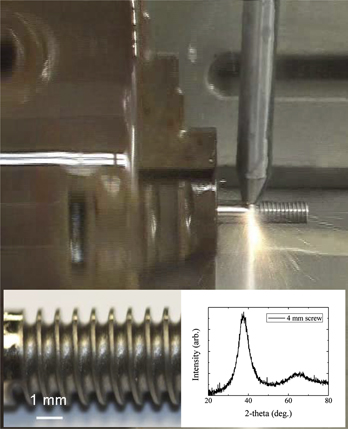
Bulk metallic glasses (BMGs) are a promising class of engineering materials, but they can be difficult to machine due to high hardness and a metastable structure. Crystallization due to machining can have negative effects, such as a decreased load-bearing capacity of fabricated parts, and thus should be avoided. Here, a Zr-based BMG was machined using abrasive waterjet (AWJ), electrical discharge, ns-pulsed laser engraving, and conventional dry-milling techniques. Characterization of the processed material indicated that AWJ preserves the amorphous phase and provides the combination of speed and flexibility required to rapidly fabricate small three-dimensional parts, while the other techniques did not achieve these goals. As proof-of-principle, a screw, similar to an orthopedic implant, was rapidly machined from the BMG using AWJ.
The modified Williamson–Hall and Warren–Averbach methods were used successfully for analyzing experimentally observed anisotropic X-ray diffraction line broadening and for determining reliable values of crystallite size and dislocation density in cerium oxide. The modified Williamson–Hall plot gives 22.3(2) nm for volume-weighted crystallite size, while the modified Warren–Averbach produces 18.0(2) nm for area-weighted grain size. The dislocation density and effective outer cut-off radius of dislocations obtained from the modified Warren–Averbach method are 1.8(3)×1015 m−2 and 15.5(1) nm, respectively.
Sauropod dinosaurs were typically one magnitude larger than any other living or extinct terrestrial animal. This sheer size of the sauropod leads to scale effects in their biology and physiology that still are inadequately understood. The only remnants of the sauropods are their fossilized bones. These fossilized bones have sustained burial for some hundred million years and thus may have experienced significant diagenetic changes. These diagenetic changes often do not affect bone preservation on the histological level, but may lead to significant alterations of the bone microstructure. Here the influence of diagenesis on the microstructure of fossilized sauropod bones using femur cross section of Brachiosaurus brancai that was excavated in the Tendaguru beds in Tanzania is investigated. The element distribution in this dinosaur bone is studied by a combination of micro-X-ray-fluorescence (μ-XRF) using synchrotron radiation and energy dispersive X-ray analyses (EDX) in the scanning electron microscope. These techniques reveal quantitative values of the element concentration at a macroscopic level combined with qualitative information at high spatial resolution of the distribution of Ca, Co, Cr, V, Pb, U, Sr, Y, and As in the fossil bones. This allows a differentiation between the remnants of the original bone apatite and pore filling minerals and also a visualization of damage, e.g., cracks introduced by diagenetic processes.
The biaxial stress and thermal expansion of multilayer doped-aluminosilicate environmental barrier coatings were measured in situ during cooling using microfocused high-energy X-rays in transmission. Coating stresses during cooling from 1000 °C were measured for as-sprayed and thermally cycled samples. In the as-sprayed state, tensile stresses as high as 75 MPa were measured in the doped-aluminosilicate topcoat at 375 °C, after which a drop in the stress occurred accompanied by through-thickness cracking of the two outermost layers. After thermally cycling the samples, the stress in the topcoat was reduced to approximately 50 MPa, and there was no drop in stress upon cooling. This stress reduction was attributed to a crystallographic phase transformation of the topcoat and the accompanying change in thermal expansion coefficient. The addition of a doped aluminosilicate to the mullite layer did not lower the stress in the topcoat, but may offer increased durability due to an increased compressive stress.
A new ternary compound Dy5Co6Sn18 was synthesized and studied. The crystal structure of Dy5Co6Sn18 was determined using the Rietveld refinement method. The compound was found to crystallize in tetragonal space group I41/acd, Tb5Rh6Sn18-type structure, with a=13.5598(3) Å, c=7.1470(5) Å, Z=8, and Dcalc=8.789 g/cm3. Measurements of magnetic susceptibility and electrical resistivity on polycrystalline samples were also performed. The Curie–Weiss law was followed, with θp=−15.7 K and μeff=10.61μB. Dy5Co6Sn18 is a spin-glass with a freezing temperature of 6.5 K.
X-ray powder diffraction data for three new bismuth yttrium ytterbium oxide compounds synthesized by solid-state reaction method are reported. The unit-cell dimensions were determined from X-ray diffraction method using Cu Kα radiation and evaluated by indexing programs. The cubic δ-Bi2O3 phase was identified to be the sole crystalline phase in Bi0.82Y0.09Yb0.09O1.5, Bi0.82Y0.12Yb0.06O1.5, and Bi0.82Y0.06Yb0.12O1.5 with lattice constants of a=5.5110(3), 5.5154(2), and 5.5113(2) Å, respectively.