Refine search
Actions for selected content:
26076 results in Abstract analysis
Cauchy problem for the Ginzburg-Landau equation for the superconductivity model
-
- Journal:
- Proceedings of the Royal Society of Edinburgh. Section A: Mathematics / Volume 127 / Issue 6 / 1997
- Published online by Cambridge University Press:
- 14 November 2011, pp. 1181-1192
- Print publication:
- 1997
-
- Article
- Export citation
Travelling fronts in nonlocal models for phase separation in an external field*
-
- Journal:
- Proceedings of the Royal Society of Edinburgh. Section A: Mathematics / Volume 127 / Issue 4 / 1997
- Published online by Cambridge University Press:
- 14 November 2011, pp. 823-835
- Print publication:
- 1997
-
- Article
- Export citation
Bifurcation from homoclinic to periodic solutions in singularly perturbed differential inclusions
-
- Journal:
- Proceedings of the Royal Society of Edinburgh. Section A: Mathematics / Volume 127 / Issue 4 / 1997
- Published online by Cambridge University Press:
- 14 November 2011, pp. 727-753
- Print publication:
- 1997
-
- Article
- Export citation
Homogenisation of Dirichlet problems for monotone operators in varying domains
-
- Journal:
- Proceedings of the Royal Society of Edinburgh. Section A: Mathematics / Volume 127 / Issue 3 / 1997
- Published online by Cambridge University Press:
- 14 November 2011, pp. 457-478
- Print publication:
- 1997
-
- Article
- Export citation
Periodic oscillations of forced pendulums with very small length*
-
- Journal:
- Proceedings of the Royal Society of Edinburgh. Section A: Mathematics / Volume 127 / Issue 1 / 1997
- Published online by Cambridge University Press:
- 14 November 2011, pp. 67-76
- Print publication:
- 1997
-
- Article
- Export citation
Periodic homogenisation of Hamilton–Jacobi equations: 2. Eikonal equations
-
- Journal:
- Proceedings of the Royal Society of Edinburgh. Section A: Mathematics / Volume 127 / Issue 4 / 1997
- Published online by Cambridge University Press:
- 14 November 2011, pp. 665-689
- Print publication:
- 1997
-
- Article
- Export citation
-
Homogenisation of the first-order Hamilton-Jacobi equations
 when H is periodic in the second variable, leads to an effective Hamiltonian H satisfying: uε converges, as ε → 0, to the solution u of ut + H(Du) = 0. In our first paper, we assumed that H is convex and we derived a variational formula giving H. In this second paper, we consider eikonal equations, i.e. H(p, x) = ½|p|2 – V(x). Using our variational formula, we compute explicitly the effective Hamiltonian in several cases, and we study precisely the lack of strict convexity for H (‘flat part’ around the origin).
 when H is periodic in the second variable, leads to an effective Hamiltonian
 The second Hamiltonian structure for the periodic Toda lattice
-
- Journal:
- Proceedings of the Royal Society of Edinburgh. Section A: Mathematics / Volume 127 / Issue 3 / 1997
- Published online by Cambridge University Press:
- 14 November 2011, pp. 547-566
- Print publication:
- 1997
-
- Article
- Export citation
Invariant radicals
-
- Journal:
- Proceedings of the Royal Society of Edinburgh. Section A: Mathematics / Volume 127 / Issue 4 / 1997
- Published online by Cambridge University Press:
- 14 November 2011, pp. 773-780
- Print publication:
- 1997
-
- Article
- Export citation
First-order corrections to the homogenised eigenvalues of a periodic composite medium. A convergence proof
-
- Journal:
- Proceedings of the Royal Society of Edinburgh. Section A: Mathematics / Volume 127 / Issue 6 / 1997
- Published online by Cambridge University Press:
- 14 November 2011, pp. 1263-1299
- Print publication:
- 1997
-
- Article
- Export citation
Lower semicontinuity in Sobolev spaces below the growth exponent of the integrand
-
- Journal:
- Proceedings of the Royal Society of Edinburgh. Section A: Mathematics / Volume 127 / Issue 4 / 1997
- Published online by Cambridge University Press:
- 14 November 2011, pp. 797-817
- Print publication:
- 1997
-
- Article
- Export citation
-
Let there be given a non-negative, quasiconvex function F satisfying the growth condition

for some p ∈]1, ∞[. For an open and bounded set Ω⊂ℝm, we show that if

then the variational integral
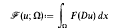
is lower semicontinuous on sequences of W1, p functions converging weakly in W1, q. In the proof, we make use of an extension operator to fix the boundary values. This idea is due to Meyers [26] and Maly [22], and the main contribution here is contained in Lemma 4.1, where a more efficient extension operator than the one in [22] (and in [14]) is used. The properties of this extension operator are in a certain sense best possible.
Optimal existence and uniqueness in a nonlinear diffusion–absorption equation with critical exponents
-
- Journal:
- Proceedings of the Royal Society of Edinburgh. Section A: Mathematics / Volume 127 / Issue 2 / 1997
- Published online by Cambridge University Press:
- 14 November 2011, pp. 217-242
- Print publication:
- 1997
-
- Article
- Export citation
-
We study the existence and uniqueness of non-negative solutions of the nonlinear parabolic equation

posed in Q = RN × (0, ∞) with general initial data u(x, 0) = u0(x) ≧ 0. We find optimal exponential growth conditions for existence of solutions. Similar conditions apply for uniqueness, but the growth rate is different. Such conditions strongly depart from the linear case m = 1, ut = Δu – u, and also from the purely diffusive case ut = Δum.
On the period maps of projective hypersurfaces
-
- Journal:
- Proceedings of the Royal Society of Edinburgh. Section A: Mathematics / Volume 127 / Issue 4 / 1997
- Published online by Cambridge University Press:
- 14 November 2011, pp. 859-869
- Print publication:
- 1997
-
- Article
- Export citation
Existence and uniqueness of discontinuous solutions for a hyperbolic system
-
- Journal:
- Proceedings of the Royal Society of Edinburgh. Section A: Mathematics / Volume 127 / Issue 6 / 1997
- Published online by Cambridge University Press:
- 14 November 2011, pp. 1193-1205
- Print publication:
- 1997
-
- Article
- Export citation
On rational de Rham cohomology associated with the generalised confluent hypergeometric functions I, ℙ1 case
-
- Journal:
- Proceedings of the Royal Society of Edinburgh. Section A: Mathematics / Volume 127 / Issue 1 / 1997
- Published online by Cambridge University Press:
- 14 November 2011, pp. 145-155
- Print publication:
- 1997
-
- Article
- Export citation
Renormalised solutions of nonlinear parabolic problems with L1 data: existence and uniqueness
-
- Journal:
- Proceedings of the Royal Society of Edinburgh. Section A: Mathematics / Volume 127 / Issue 6 / 1997
- Published online by Cambridge University Press:
- 14 November 2011, pp. 1137-1152
- Print publication:
- 1997
-
- Article
- Export citation
-
In this paper we prove the existence and uniqueness of a renormalised solution of the nonlinear problem
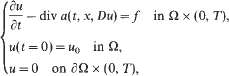
where the data f and u0 belong to L1(Ω × (0, T)) and L1 (Ω), and where the function a:(0, T) × Ω × ℝN → ℝN is monotone (but not necessarily strictly monotone) and defines a bounded coercive continuous operator from the space
 into its dual space. The renormalised solution is an element of C0 ([ 0, T] L1 (Ω)) such that its truncates TK(u) belong to
  with
with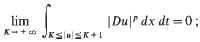
this solution satisfies the equation formally obtained by using in the equation the test function S(u)φ, where φ belongs to
 and where S belongs to C∞(ℝ) with
 into its dual space. The renormalised solution is an element of C
 with
with
 and where S belongs to C
Young measures in a nonlocal phase transition problem
-
- Journal:
- Proceedings of the Royal Society of Edinburgh. Section A: Mathematics / Volume 127 / Issue 3 / 1997
- Published online by Cambridge University Press:
- 14 November 2011, pp. 615-637
- Print publication:
- 1997
-
- Article
- Export citation
Positive definite temperature functions and a correspondence to positive temperature functions
-
- Journal:
- Proceedings of the Royal Society of Edinburgh. Section A: Mathematics / Volume 127 / Issue 5 / 1997
- Published online by Cambridge University Press:
- 14 November 2011, pp. 947-961
- Print publication:
- 1997
-
- Article
- Export citation
-
Positive definite temperature functions u(x, t) in ℝn+1 = {(x, t)| x ∈ ℝn,t > 0} are characterised by
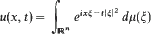
where μ is a positive measure satisfying that for every ℰ > 0,

is finite. A transform
 is introduced to give an isomorphism between the class ofall positive definite temperature functions and the class of all possible temperature functions in
  Then correspondence given by generalises the Bochner–Schwartz Theorem for the Schwartz distributions and extends Widder's correspondence characterising some subclass of the positive temperature functions by the Fourier-Stieltjes transform.

 is introduced to give an isomorphism between the class ofall positive definite temperature functions and the class of all possible temperature functions in
  Then correspondence given by
 Index to Volume 127
-
- Journal:
- Proceedings of the Royal Society of Edinburgh. Section A: Mathematics / Volume 127 / Issue 6 / 1997
- Published online by Cambridge University Press:
- 14 November 2011, pp. 1327-1330
- Print publication:
- 1997
-
- Article
- Export citation
PRM volume 127 issue 3 Cover and Front matter
-
- Journal:
- Proceedings of the Royal Society of Edinburgh. Section A: Mathematics / Volume 127 / Issue 3 / 1997
- Published online by Cambridge University Press:
- 14 November 2011, pp. f1-f2
- Print publication:
- 1997
-
- Article
-
- You have access
- Export citation
Eigenvalue problems for the wave equation with strong damping
-
- Journal:
- Proceedings of the Royal Society of Edinburgh. Section A: Mathematics / Volume 127 / Issue 4 / 1997
- Published online by Cambridge University Press:
- 14 November 2011, pp. 755-771
- Print publication:
- 1997
-
- Article
- Export citation
