Refine search
Actions for selected content:
26077 results in Abstract analysis
Eigenvalue problems for the wave equation with strong damping
-
- Journal:
- Proceedings of the Royal Society of Edinburgh. Section A: Mathematics / Volume 127 / Issue 4 / 1997
- Published online by Cambridge University Press:
- 14 November 2011, pp. 755-771
- Print publication:
- 1997
-
- Article
- Export citation
On the inhomogeneous system of isentropic gas dynamics by the viscosity method
-
- Journal:
- Proceedings of the Royal Society of Edinburgh. Section A: Mathematics / Volume 127 / Issue 2 / 1997
- Published online by Cambridge University Press:
- 14 November 2011, pp. 261-280
- Print publication:
- 1997
-
- Article
- Export citation
Justification of mean-field coupled modulation equations
-
- Journal:
- Proceedings of the Royal Society of Edinburgh. Section A: Mathematics / Volume 127 / Issue 3 / 1997
- Published online by Cambridge University Press:
- 14 November 2011, pp. 639-650
- Print publication:
- 1997
-
- Article
- Export citation
On the zeros of the second derivative
-
- Journal:
- Proceedings of the Royal Society of Edinburgh. Section A: Mathematics / Volume 127 / Issue 2 / 1997
- Published online by Cambridge University Press:
- 14 November 2011, pp. 359-368
- Print publication:
- 1997
-
- Article
- Export citation
A variational problem on subsets of ℝn
-
- Journal:
- Proceedings of the Royal Society of Edinburgh. Section A: Mathematics / Volume 127 / Issue 5 / 1997
- Published online by Cambridge University Press:
- 14 November 2011, pp. 1089-1101
- Print publication:
- 1997
-
- Article
- Export citation
PRM volume 127 issue 5 Cover and Front matter
-
- Journal:
- Proceedings of the Royal Society of Edinburgh. Section A: Mathematics / Volume 127 / Issue 5 / 1997
- Published online by Cambridge University Press:
- 14 November 2011, pp. f1-f2
- Print publication:
- 1997
-
- Article
-
- You have access
- Export citation
Oscillation theory for indefinite Sturm-Liouville problems with eigenparameter-dependent boundary conditions
-
- Journal:
- Proceedings of the Royal Society of Edinburgh. Section A: Mathematics / Volume 127 / Issue 6 / 1997
- Published online by Cambridge University Press:
- 14 November 2011, pp. 1123-1136
- Print publication:
- 1997
-
- Article
- Export citation
A variational approach to multiplicity in elliptic problems near resonance*
-
- Journal:
- Proceedings of the Royal Society of Edinburgh. Section A: Mathematics / Volume 127 / Issue 2 / 1997
- Published online by Cambridge University Press:
- 14 November 2011, pp. 385-394
- Print publication:
- 1997
-
- Article
- Export citation
On rank-one convex and polyconvex conformal energy functions with slow growth
-
- Journal:
- Proceedings of the Royal Society of Edinburgh. Section A: Mathematics / Volume 127 / Issue 3 / 1997
- Published online by Cambridge University Press:
- 14 November 2011, pp. 651-663
- Print publication:
- 1997
-
- Article
- Export citation
Homogenisation and θ — 2 convergence
-
- Journal:
- Proceedings of the Royal Society of Edinburgh. Section A: Mathematics / Volume 127 / Issue 3 / 1997
- Published online by Cambridge University Press:
- 14 November 2011, pp. 441-455
- Print publication:
- 1997
-
- Article
- Export citation
Regularity of the solutions for elliptic problems on nonsmooth domains in ℝ3. Part II: Regularity in neighbourhoods of edges
-
- Journal:
- Proceedings of the Royal Society of Edinburgh. Section A: Mathematics / Volume 127 / Issue 3 / 1997
- Published online by Cambridge University Press:
- 14 November 2011, pp. 517-545
- Print publication:
- 1997
-
- Article
- Export citation
Convergence of the viscosity solutions for weakly strictly hyperbolic conservation laws*
-
- Journal:
- Proceedings of the Royal Society of Edinburgh. Section A: Mathematics / Volume 127 / Issue 5 / 1997
- Published online by Cambridge University Press:
- 14 November 2011, pp. 1103-1110
- Print publication:
- 1997
-
- Article
- Export citation
Regularity results for equilibria in a variational model for fracture
-
- Journal:
- Proceedings of the Royal Society of Edinburgh. Section A: Mathematics / Volume 127 / Issue 5 / 1997
- Published online by Cambridge University Press:
- 14 November 2011, pp. 889-902
- Print publication:
- 1997
-
- Article
- Export citation
-
In recent years models describing interactions between fracture and damage have been proposed in which the relaxed energy of the material is given by a functional involving bulk and interfacial terms, of the form

where Ω is an open, bounded subset of ℝN, q ≧1, g ∈ L∞ (Ω ℝN), λ, β > 0, the bulk energy density F is quasiconvex, K⊂ℝN is closed, and the admissible deformation u:Ω→ ℝN is C1 in Ω\K One of the main issues has to do with regularity properties of the ‘crack site’ K for a minimising pair (K, u). In the scalar case, i.e. when uΩ→ ℝ, similar models were adopted to image segmentation problems, and the regularity of the ‘edge’ set K has been successfully resolved for a quite broad class of convex functions F with growth p > 1 at infinity. In turn, this regularity entails the existence of classical solutions. The methods thus used cannot be carried out to the vectorial case, except for a very restrictive class of integrands. In this paper we deal with a vector-valued case on the plane, obtaining regularity for minimisers of
 corresponding to polyconvex bulk energy densities of the form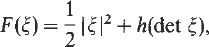
where the convex function h grows linearly at infinity.
 corresponding to polyconvex bulk energy densities of the form
Some new properties of Sobolev mappings: intersection theoretical approach
-
- Journal:
- Proceedings of the Royal Society of Edinburgh. Section A: Mathematics / Volume 127 / Issue 2 / 1997
- Published online by Cambridge University Press:
- 14 November 2011, pp. 337-358
- Print publication:
- 1997
-
- Article
- Export citation
A perturbation result of semilinear elliptic equations in exterior strip domains
-
- Journal:
- Proceedings of the Royal Society of Edinburgh. Section A: Mathematics / Volume 127 / Issue 5 / 1997
- Published online by Cambridge University Press:
- 14 November 2011, pp. 983-1004
- Print publication:
- 1997
-
- Article
- Export citation
-
In this paper we show that if the decay of nonzero ƒ is fast enough, then the perturbation Dirichlet problem −Δu + u = up + ƒ(z) in Ω has at least two positive solutions, where

a bounded C1,1 domain S = × ω Rn, D is a bounded C1,1 domain in Rm+n such that D ⊂⊂ S and Ω = S\D. In case ƒ ≡ 0, we assert that there is a positive higher-energy solution providing that D is small.
Travelling wave solutions for a balance law
-
- Journal:
- Proceedings of the Royal Society of Edinburgh. Section A: Mathematics / Volume 127 / Issue 3 / 1997
- Published online by Cambridge University Press:
- 14 November 2011, pp. 567-593
- Print publication:
- 1997
-
- Article
- Export citation
The spectrum and eigenspaces of a meromorphic operator-valued function
-
- Journal:
- Proceedings of the Royal Society of Edinburgh. Section A: Mathematics / Volume 127 / Issue 5 / 1997
- Published online by Cambridge University Press:
- 14 November 2011, pp. 1027-1051
- Print publication:
- 1997
-
- Article
- Export citation
Positive solution curves of semipositone problems with concave nonlinearities*
-
- Journal:
- Proceedings of the Royal Society of Edinburgh. Section A: Mathematics / Volume 127 / Issue 5 / 1997
- Published online by Cambridge University Press:
- 14 November 2011, pp. 921-934
- Print publication:
- 1997
-
- Article
- Export citation
-
We consider the positive solutions to the semilinear equation:
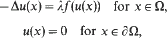
where Ω denotes a smooth bounded region in ℝN(N > 1) and ℷ 0. Here f :[0, ∞)→ℝ is assumed to be monotonically increasing, concave and such that f(0)<0 (semipositone). Assuming that f′(∞)≡limt→∞f(t)> 0, we establish the stability and uniqueness of large positive solutions in terms of (f(t)/t)′ When Ω is a ball, we determine the exact number of positive solutions for each λ > 0. We also obtain the geometry of the branches of positive solutions completely and establish how they evolve. This work extends and complements that of [3, 7] where f′(∞)≦0.
Spectral properties of the Orr-Sommerfeld problem
-
- Journal:
- Proceedings of the Royal Society of Edinburgh. Section A: Mathematics / Volume 127 / Issue 6 / 1997
- Published online by Cambridge University Press:
- 14 November 2011, pp. 1245-1261
- Print publication:
- 1997
-
- Article
- Export citation
PRM volume 127 issue 1 Cover and Front matter
-
- Journal:
- Proceedings of the Royal Society of Edinburgh. Section A: Mathematics / Volume 127 / Issue 1 / 1997
- Published online by Cambridge University Press:
- 14 November 2011, pp. f1-f2
- Print publication:
- 1997
-
- Article
-
- You have access
- Export citation
