Refine search
Actions for selected content:
26077 results in Abstract analysis
Acknowledgments
-
- Book:
- Geometric Control Theory
- Published online:
- 07 October 2009
- Print publication:
- 28 December 1996, pp xvii-xviii
-
- Chapter
- Export citation
1 - Basic formalism and typical problems
-
- Book:
- Geometric Control Theory
- Published online:
- 07 October 2009
- Print publication:
- 28 December 1996, pp 3-31
-
- Chapter
- Export citation
2 - Orbits of families of vector fields
-
- Book:
- Geometric Control Theory
- Published online:
- 07 October 2009
- Print publication:
- 28 December 1996, pp 32-63
-
- Chapter
- Export citation
4 - Control affine systems
-
- Book:
- Geometric Control Theory
- Published online:
- 07 October 2009
- Print publication:
- 28 December 1996, pp 95-124
-
- Chapter
- Export citation
Contents
-
- Book:
- Geometric Control Theory
- Published online:
- 07 October 2009
- Print publication:
- 28 December 1996, pp vii-xii
-
- Chapter
- Export citation
13 - Symmetry, integrability, and the Hamilton-Jacobi theory
-
- Book:
- Geometric Control Theory
- Published online:
- 07 October 2009
- Print publication:
- 28 December 1996, pp 407-443
-
- Chapter
- Export citation
Introduction
-
- Book:
- Geometric Control Theory
- Published online:
- 07 October 2009
- Print publication:
- 28 December 1996, pp xiii-xvi
-
- Chapter
- Export citation
6 - Systems on Lie groups and homogeneous spaces
-
- Book:
- Geometric Control Theory
- Published online:
- 07 October 2009
- Print publication:
- 28 December 1996, pp 150-194
-
- Chapter
- Export citation
On the divisor function d(n)
- Part of
-
- Journal:
- Mathematika / Volume 43 / Issue 2 / December 1996
- Published online by Cambridge University Press:
- 26 February 2010, pp. 320-322
- Print publication:
- December 1996
-
- Article
- Export citation
Sharp extensions of Bernstein's inequality to rational spaces
- Part of
-
- Journal:
- Mathematika / Volume 43 / Issue 2 / December 1996
- Published online by Cambridge University Press:
- 26 February 2010, pp. 413-423
- Print publication:
- December 1996
-
- Article
- Export citation
-
Sharp extensions of some classical polynomial inequalities of Bernstein are established for rational function spaces on the unit circle, on K = r (mod 2 π), on [-1, 1 ] and on ℝ. The key result is the establishment of the inequality

for every rational function f=pn/qn, where pn is a polynomial of degree at most n with complex coefficients and
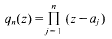
with | aj | ≠ 1 for each j and for every zo∈ δ D, where δ D,= {z∈ ℂ: |z| = l}. The above inequality is sharp at every z0∈δD.
Almost Fréchet differentiability of finitely many Lipschitz functions
- Part of
-
- Journal:
- Mathematika / Volume 43 / Issue 2 / December 1996
- Published online by Cambridge University Press:
- 26 February 2010, pp. 393-412
- Print publication:
- December 1996
-
- Article
- Export citation
A note on summands of compact convex sets
- Part of
-
- Journal:
- Mathematika / Volume 43 / Issue 2 / December 1996
- Published online by Cambridge University Press:
- 26 February 2010, pp. 286-294
- Print publication:
- December 1996
-
- Article
- Export citation
On the sum of four cubes
- Part of
-
- Journal:
- Mathematika / Volume 43 / Issue 2 / December 1996
- Published online by Cambridge University Press:
- 26 February 2010, pp. 323-348
- Print publication:
- December 1996
-
- Article
- Export citation
MTK volume 43 issue 2 Cover and Front matter
-
- Journal:
- Mathematika / Volume 43 / Issue 2 / December 1996
- Published online by Cambridge University Press:
- 26 February 2010, pp. f1-f2
- Print publication:
- December 1996
-
- Article
-
- You have access
- Export citation
On the non-existence of periodic neutral-wave solutions to a complex-valued periodic differential equation
- Part of
-
- Journal:
- Mathematika / Volume 43 / Issue 2 / December 1996
- Published online by Cambridge University Press:
- 26 February 2010, pp. 371-381
- Print publication:
- December 1996
-
- Article
- Export citation
-
The equation
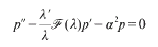
where ℱ is a certain complex-valued function of the given real periodic function λ, is studied analytically and numerically. The equation is motivated physically by a boundary-layer stability problem in which λ represents the skin-friction of the undisturbed basic flow profile. It is proved that no periodic neutral solutions exist for any attached basic flow and the implications of this result for certain vortex-wave interactions are discussed.
Orders in normal bands of groups
- Part of
-
- Journal:
- Mathematika / Volume 43 / Issue 2 / December 1996
- Published online by Cambridge University Press:
- 26 February 2010, pp. 295-319
- Print publication:
- December 1996
-
- Article
- Export citation
Isoperimetric problems for polytopes with a given number of vertices
- Part of
-
- Journal:
- Mathematika / Volume 43 / Issue 2 / December 1996
- Published online by Cambridge University Press:
- 26 February 2010, pp. 237-254
- Print publication:
- December 1996
-
- Article
- Export citation
On a class of generalized simplices
- Part of
-
- Journal:
- Mathematika / Volume 43 / Issue 2 / December 1996
- Published online by Cambridge University Press:
- 26 February 2010, pp. 274-285
- Print publication:
- December 1996
-
- Article
- Export citation
Some results about Minkowski addition and difference
- Part of
-
- Journal:
- Mathematika / Volume 43 / Issue 2 / December 1996
- Published online by Cambridge University Press:
- 26 February 2010, pp. 265-273
- Print publication:
- December 1996
-
- Article
- Export citation
-
The sum or Minkowski addition of two subsets, A, B ⊂ En is defined by:

On C2-smooth norms on c0
- Part of
-
- Journal:
- Mathematika / Volume 43 / Issue 2 / December 1996
- Published online by Cambridge University Press:
- 26 February 2010, pp. 362-370
- Print publication:
- December 1996
-
- Article
- Export citation
