Refine search
Actions for selected content:
26077 results in Abstract analysis
Lattice packing of spheres and the Wulff-Shape
- Part of
-
- Journal:
- Mathematika / Volume 43 / Issue 2 / December 1996
- Published online by Cambridge University Press:
- 26 February 2010, pp. 229-236
- Print publication:
- December 1996
-
- Article
- Export citation
Index to Volume 43
-
- Journal:
- Mathematika / Volume 43 / Issue 2 / December 1996
- Published online by Cambridge University Press:
- 26 February 2010, pp. 428-429
- Print publication:
- December 1996
-
- Article
- Export citation
Existence and uniqueness for a class of mixed type differential equations
- Part of
-
- Journal:
- Mathematika / Volume 43 / Issue 2 / December 1996
- Published online by Cambridge University Press:
- 26 February 2010, pp. 382-392
- Print publication:
- December 1996
-
- Article
- Export citation
H.J. Baues. Homotopy Type and Homology. Clarendon Press. 1996, ISBN 0 19 851482 4, 483pp., £80. - J. B. Brackenridge. The Key to Newton's Dynamics: the Kepler Problem and the Principia. University of California Press. 1995, ISBN 0 520 20217 1, 299pp., paperback £15.95. - H. Clemens and J. Kollár. Editors. Current Topics in Complex Algebraic Geometry. Cambridge University Press. 1995, ISBN 0 52156244 9, 158pp., hardback £24. - J. Cofman. Numbers and Shapes Revisited: More Problems for Young Mathematicians. Clarendon Press. 1995, ISBN 0 19 853460 4, 308pp., £19·50. - F. de Gandt. Force and Geometry in Newton's Principia. Princeton University Press. 1995, ISBN 0 691 03367 6, 297pp., £35. - C. R. Doering and J. D. Gibbon. Applied analysis of the Navier-Stokes equations. Cambridge University Press. 1995, ISBN 0 521 44557 4, 217pp., hardback £40. - N. D. Gilbert and T. Porter. Knots and Surfaces. Oxford University Press. 1995, ISBN 0 19 851490 5, 268pp., paperback £19·50. - J. L. Greenberg. The Problem of the Earth's Shape from Newton to Clairaut: the Rise of Mathematical Science in Eighteenth Century Paris and the Fall of “Normal” Science. Cambridge University Press. 1995, ISBN 0 521 38541 5, 781pp., £60. - M. Holschneider. Wavelets: An Analysis Tool. Clarendon Press. 1995, ISBN 0 19 853481 7, 423pp., £45. - J. Kollár. Rational Curves on Algebraic Varieties. Ergebn. d. Math. (3) 32. Springer. 1996, ISBN 3 540 60168 6, 320pp., DM158. - G. Laumon. Cohomology of Drinfeld Modular Varieties. Part I: Geometry, counting of points and local harmonic analysis. Cambridge University Press. 1996, ISBN 0 521 47060 9, 344pp., £40. - A. Pfister. Quadratic Forms with Applications to Algebraic Geometry and Topology. Cambridge University Press. 1995, ISBN 0 52146755 1, 179pp., paperback £22.95 - I. A. Porteous. Clifford Algebras and the Classical Groups. Cambridge University Press. 1995, ISBN 0 521 55177 3, 295pp., £30. - M. Reid. Undergraduate Commutative Algebra. LMS Student Text 29. Cambridge University Press. 1995, ISBN 0 521 45889 7, 153pp., paperback £11·95. - J. Ryan. Clifford Algebras in Analysis and Related Topics. CRC Press Boca Raton. 1996, ISBN 0 8493 8481 8, 366pp., in U.S. $79.95, outside U.S. $96.00. - L. R. Vermani. Elements of Algebraic Coding Theory. Chapman and Hall. 1996, ISBN 0 412 57380 6, 254pp., paperback £27·50 - A. I. Zayed. Handbook of Function and Generalized Function Transformations. CRC Press Boca Raton. 1996, ISBN 0 8493 7851 6, 643pp., $69.95
-
- Journal:
- Mathematika / Volume 43 / Issue 2 / December 1996
- Published online by Cambridge University Press:
- 26 February 2010, pp. 424-427
- Print publication:
- December 1996
-
- Article
- Export citation
A pair correlation hypothesis and the exceptional set in Goldbach's problem
- Part of
-
- Journal:
- Mathematika / Volume 43 / Issue 2 / December 1996
- Published online by Cambridge University Press:
- 26 February 2010, pp. 349-361
- Print publication:
- December 1996
-
- Article
- Export citation
-
In 1973, Montgomery [12] introduced, in order to study the vertical distribution of the zeros of the Riemann zeta function, the pair correlation function

where w(u) = 4/(4 + u2) and γjj = 1, 2, run over the imaginary part of the nontrivial zeros of ζ(s). It is easy to see that, for T → ∞,
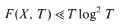
uniformly in X, and Montgomery [12], see also Goldston-Montgomery [7], proved that under the Riemann Hypothesis (RH)

uniformly for X ≤ T ≤ XA, for any fixed A > 1. He also conjectured, under RH, that (1) holds uniformly for Xε ≤ T ≤ X, for every fixed ε > 0. We denote by MC the above conjecture.
Volumes of projection bodies
- Part of
-
- Journal:
- Mathematika / Volume 43 / Issue 2 / December 1996
- Published online by Cambridge University Press:
- 26 February 2010, pp. 255-264
- Print publication:
- December 1996
-
- Article
- Export citation
5 - Geometric Applications of Spherical Harmonics
-
- Book:
- Geometric Applications of Fourier Series and Spherical Harmonics
- Published online:
- 11 September 2009
- Print publication:
- 13 September 1996, pp 181-310
-
- Chapter
- Export citation
IV - The Theory of Riemann Integration
-
- Book:
- A Course of Modern Analysis
- Published online:
- 05 September 2013
- Print publication:
- 13 September 1996, pp 61-81
-
- Chapter
- Export citation
XVII - Bessel Functions
-
- Book:
- A Course of Modern Analysis
- Published online:
- 05 September 2013
- Print publication:
- 13 September 1996, pp 355-385
-
- Chapter
- Export citation
Author Index
-
- Book:
- Geometric Applications of Fourier Series and Spherical Harmonics
- Published online:
- 11 September 2009
- Print publication:
- 13 September 1996, pp 323-325
-
- Chapter
- Export citation
Contents
-
- Book:
- A Course of Modern Analysis
- Published online:
- 05 September 2013
- Print publication:
- 13 September 1996, pp vii-viii
-
- Chapter
- Export citation
List of Symbols
-
- Book:
- Geometric Applications of Fourier Series and Spherical Harmonics
- Published online:
- 11 September 2009
- Print publication:
- 13 September 1996, pp 319-322
-
- Chapter
- Export citation
References
-
- Book:
- Geometric Applications of Fourier Series and Spherical Harmonics
- Published online:
- 11 September 2009
- Print publication:
- 13 September 1996, pp 311-318
-
- Chapter
- Export citation
XX - Elliptic Functions. General theorems and the Weierstrassian Functions
-
- Book:
- A Course of Modern Analysis
- Published online:
- 05 September 2013
- Print publication:
- 13 September 1996, pp 429-461
-
- Chapter
- Export citation
XXIII - Ellipsoidal Harmonics and Lame's Equation
-
- Book:
- A Course of Modern Analysis
- Published online:
- 05 September 2013
- Print publication:
- 13 September 1996, pp 536-578
-
- Chapter
- Export citation
Preface
-
- Book:
- Geometric Applications of Fourier Series and Spherical Harmonics
- Published online:
- 11 September 2009
- Print publication:
- 13 September 1996, pp ix-xii
-
- Chapter
- Export citation
Contents
-
- Book:
- Geometric Applications of Fourier Series and Spherical Harmonics
- Published online:
- 11 September 2009
- Print publication:
- 13 September 1996, pp vii-viii
-
- Chapter
- Export citation
XVIII - The Equations of Mathematical Physics
-
- Book:
- A Course of Modern Analysis
- Published online:
- 05 September 2013
- Print publication:
- 13 September 1996, pp 386-403
-
- Chapter
- Export citation
APPENDIX
-
- Book:
- A Course of Modern Analysis
- Published online:
- 05 September 2013
- Print publication:
- 13 September 1996, pp 579-590
-
- Chapter
- Export citation
LIST OF AUTHORS QUOTED
-
- Book:
- A Course of Modern Analysis
- Published online:
- 05 September 2013
- Print publication:
- 13 September 1996, pp 591-594
-
- Chapter
- Export citation
