Refine search
Actions for selected content:
26076 results in Abstract analysis
On the initial growth of interfaces in reaction–diffusion equations with strong absorption
-
- Journal:
- Proceedings of the Royal Society of Edinburgh. Section A: Mathematics / Volume 123 / Issue 5 / 1993
- Published online by Cambridge University Press:
- 14 November 2011, pp. 803-817
- Print publication:
- 1993
-
- Article
- Export citation
-
We study the initial growth of the interfaces of non-negative local solutions of the equation ut = (um)xx−λuq when m ≧ 1 and 0<q <1. We show that if
 with C < C0, for some explicit C0 = C0(λ, m, q), then the free boundary Ϛ(t) = sup {x:u(x, t) > 0} is a ‘heating front’. More precisely Ϛ(t) ≧at(m−q)/2(1−q) for any t small enough and for some a>0. If on the contrary,
  with C<C0, then Ϛ(t) is a ‘cooling front’ and in fact Ϛ(t) ≧ −atm−q)/2(1−q) for any t small enough and for some a > 0. Applications to solutions of the associated Cauchy and Dirichlet problems are also given.
 with C < C
 with C<C
Index to Volume 123
-
- Journal:
- Proceedings of the Royal Society of Edinburgh. Section A: Mathematics / Volume 123 / Issue 6 / 1993
- Published online by Cambridge University Press:
- 14 November 2011, pp. 1213-1216
- Print publication:
- 1993
-
- Article
- Export citation
Left orders in strongly regular rings
-
- Journal:
- Proceedings of the Royal Society of Edinburgh. Section A: Mathematics / Volume 123 / Issue 2 / 1993
- Published online by Cambridge University Press:
- 14 November 2011, pp. 303-310
- Print publication:
- 1993
-
- Article
- Export citation
Asymptotic expansions and Stokes multipliers of the confluent hypergeometric function Φ2, I
-
- Journal:
- Proceedings of the Royal Society of Edinburgh. Section A: Mathematics / Volume 123 / Issue 6 / 1993
- Published online by Cambridge University Press:
- 14 November 2011, pp. 1165-1177
- Print publication:
- 1993
-
- Article
- Export citation
Exact controllability for a model of a multidimensional flexible structure
-
- Journal:
- Proceedings of the Royal Society of Edinburgh. Section A: Mathematics / Volume 123 / Issue 2 / 1993
- Published online by Cambridge University Press:
- 14 November 2011, pp. 323-344
- Print publication:
- 1993
-
- Article
- Export citation
Strong asymptotic stability for a beam equation with weak damping
-
- Journal:
- Proceedings of the Royal Society of Edinburgh. Section A: Mathematics / Volume 123 / Issue 2 / 1993
- Published online by Cambridge University Press:
- 14 November 2011, pp. 365-371
- Print publication:
- 1993
-
- Article
- Export citation
-
Any solution to the problem
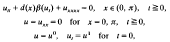
is shown to decay to zero in the strong topology of the energy space as t→ ∞. The function β is allowed to be nonmonotone and d is a nonnegative function strictly positive on a nonvoid subset of (0, л).
On an elliptic equation related to the blow-up phenomenon in the nonlinear Schrödinger equation*
-
- Journal:
- Proceedings of the Royal Society of Edinburgh. Section A: Mathematics / Volume 123 / Issue 4 / 1993
- Published online by Cambridge University Press:
- 14 November 2011, pp. 763-782
- Print publication:
- 1993
-
- Article
- Export citation
Some interior and exterior boundary-value problems for the Helmholtz equation in a quadrant
-
- Journal:
- Proceedings of the Royal Society of Edinburgh. Section A: Mathematics / Volume 123 / Issue 2 / 1993
- Published online by Cambridge University Press:
- 14 November 2011, pp. 275-294
- Print publication:
- 1993
-
- Article
- Export citation
On the commutativity of certain quasi-differential expressions II
-
- Journal:
- Proceedings of the Royal Society of Edinburgh. Section A: Mathematics / Volume 123 / Issue 1 / 1993
- Published online by Cambridge University Press:
- 14 November 2011, pp. 27-43
- Print publication:
- 1993
-
- Article
- Export citation
On the relation between distinct particular solutions of equation

-
- Journal:
- Proceedings of the Royal Society of Edinburgh. Section A: Mathematics / Volume 123 / Issue 5 / 1993
- Published online by Cambridge University Press:
- 14 November 2011, pp. 917-926
- Print publication:
- 1993
-
- Article
- Export citation
-
There exists a relation (1.5) between any n + 2 distinct particular solutions of the differential equation

In this paper, we show that when and only when n = 0, 1 and 2, this relation can be represented by the following form:

provided the form of this relation function Φn depends only on n and is independent of the coefficients of the equation. This result reveals interesting properties of these non-linear differential equations.


The global Hölder-continuous solution of isentropic gas dynamics
-
- Journal:
- Proceedings of the Royal Society of Edinburgh. Section A: Mathematics / Volume 123 / Issue 2 / 1993
- Published online by Cambridge University Press:
- 14 November 2011, pp. 231-238
- Print publication:
- 1993
-
- Article
- Export citation
Inequalities for non-decreasing sequences
-
- Journal:
- Proceedings of the Royal Society of Edinburgh. Section A: Mathematics / Volume 123 / Issue 6 / 1993
- Published online by Cambridge University Press:
- 14 November 2011, pp. 1017-1020
- Print publication:
- 1993
-
- Article
- Export citation
The Stefan problem: continuity of the interfaces for solutions with finite lapnumber
-
- Journal:
- Proceedings of the Royal Society of Edinburgh. Section A: Mathematics / Volume 123 / Issue 1 / 1993
- Published online by Cambridge University Press:
- 14 November 2011, pp. 1-26
- Print publication:
- 1993
-
- Article
- Export citation
Remarks on the equilibrium shape of a Tokamak plasma
-
- Journal:
- Proceedings of the Royal Society of Edinburgh. Section A: Mathematics / Volume 123 / Issue 6 / 1993
- Published online by Cambridge University Press:
- 14 November 2011, pp. 1059-1070
- Print publication:
- 1993
-
- Article
- Export citation
PRM volume 123 issue 1 Cover and Back matter
-
- Journal:
- Proceedings of the Royal Society of Edinburgh. Section A: Mathematics / Volume 123 / Issue 1 / 1993
- Published online by Cambridge University Press:
- 14 November 2011, pp. b1-b2
- Print publication:
- 1993
-
- Article
-
- You have access
- Export citation
Convergence in Lotka–Volterra-type delay systems without instantaneous feedbacks
-
- Journal:
- Proceedings of the Royal Society of Edinburgh. Section A: Mathematics / Volume 123 / Issue 1 / 1993
- Published online by Cambridge University Press:
- 14 November 2011, pp. 45-58
- Print publication:
- 1993
-
- Article
- Export citation
Generic hyperbolicity for scalar parabolic equations
-
- Journal:
- Proceedings of the Royal Society of Edinburgh. Section A: Mathematics / Volume 123 / Issue 6 / 1993
- Published online by Cambridge University Press:
- 14 November 2011, pp. 1031-1040
- Print publication:
- 1993
-
- Article
- Export citation
-
For the reaction diffusion equation

with homogeneous Neumann boundary conditions, we give results on the generic hyperbolicity of equilibria with respect to a for fixed f and with respect to f for fixed a.
Uniformly monotone dynamical systems
-
- Journal:
- Proceedings of the Royal Society of Edinburgh. Section A: Mathematics / Volume 123 / Issue 1 / 1993
- Published online by Cambridge University Press:
- 14 November 2011, pp. 59-74
- Print publication:
- 1993
-
- Article
- Export citation
Weak lower semicontinuity of polyconvex integrals
-
- Journal:
- Proceedings of the Royal Society of Edinburgh. Section A: Mathematics / Volume 123 / Issue 4 / 1993
- Published online by Cambridge University Press:
- 14 November 2011, pp. 681-691
- Print publication:
- 1993
-
- Article
- Export citation
Spectral properties of a two parameter nonlinear Sturm-Liouville problem
-
- Journal:
- Proceedings of the Royal Society of Edinburgh. Section A: Mathematics / Volume 123 / Issue 6 / 1993
- Published online by Cambridge University Press:
- 14 November 2011, pp. 1041-1058
- Print publication:
- 1993
-
- Article
- Export citation
-
We consider the nonlinear Sturm–Liouville problem with two parameters on the general level set
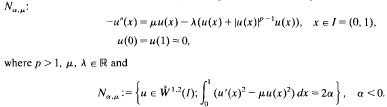
We establish asymptotic formulae of the n-th variational eigenvalue λ = λn(μ, α) as α→∞ and α↓(nπ)2.
