Refine search
Actions for selected content:
26076 results in Abstract analysis
Measures in banach spaces are determined by their values on balls
- Part of
-
- Journal:
- Mathematika / Volume 38 / Issue 2 / December 1991
- Published online by Cambridge University Press:
- 26 February 2010, pp. 391-397
- Print publication:
- December 1991
-
- Article
- Export citation
Coefficient functions for an inhomogeneous turning-point problem
- Part of
-
- Journal:
- Mathematika / Volume 38 / Issue 2 / December 1991
- Published online by Cambridge University Press:
- 26 February 2010, pp. 217-238
- Print publication:
- December 1991
-
- Article
- Export citation
-
Solutions of the differential equation
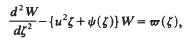
for large positive values of the parameter u, are considered for ζ in some domain Δ which includes the turning-point ζ = 0. The functions ψ(ζ) and ω(ζ) are holomorphic for ζ є Δ
Upper and lower bound results on the convex hull of integer points in polyhedra
- Part of
-
- Journal:
- Mathematika / Volume 38 / Issue 2 / December 1991
- Published online by Cambridge University Press:
- 26 February 2010, pp. 321-328
- Print publication:
- December 1991
-
- Article
- Export citation
-
In typical linear programming problems, we are concerned with finding non-negative integers {x1,…, xn} that maximize a linear form c1x1 + … + cnxn, subject to a number of linear inequalities,
 for
for  The maximum is necessarily attained at one of the vertices of the convex hull of integer points defined by the inequalities, so we have an interest in estimating the number M of these vertices. We give two results; one improving an upper bound result for M of Hayes and Larman concerning the Knapsack polytope, the other an example showing that, in 3-dimensions, it is possible to choose the coefficients aij to obtain a lower bound for M.
 for
for  The maximum is necessarily attained at one of the vertices of the convex hull of integer points defined by the inequalities, so we have an interest in estimating the number M of these vertices. We give two results; one improving an upper bound result for M of Hayes and Larman concerning the Knapsack polytope, the other an example showing that, in 3-dimensions, it is possible to choose the coefficients a
Covering squares with independent squares
- Part of
-
- Journal:
- Mathematika / Volume 38 / Issue 2 / December 1991
- Published online by Cambridge University Press:
- 26 February 2010, pp. 329-333
- Print publication:
- December 1991
-
- Article
- Export citation
Lonely knots and tangles: Identifying knots with no companions
- Part of
-
- Journal:
- Mathematika / Volume 38 / Issue 2 / December 1991
- Published online by Cambridge University Press:
- 26 February 2010, pp. 334-347
- Print publication:
- December 1991
-
- Article
- Export citation
Index to volume 38
-
- Journal:
- Mathematika / Volume 38 / Issue 2 / December 1991
- Published online by Cambridge University Press:
- 26 February 2010, p. 405
- Print publication:
- December 1991
-
- Article
- Export citation
Limit points of partial sums of Taylor series
- Part of
-
- Journal:
- Mathematika / Volume 38 / Issue 2 / December 1991
- Published online by Cambridge University Press:
- 26 February 2010, pp. 239-249
- Print publication:
- December 1991
-
- Article
- Export citation
-
Fifty years ago Marcinkiewicz and Zygmund studied the circular structure of the limit points of the partial sums for (C, 1) summable Taylor series. More specifically, let

be a power series with complex coefficients, let

be the partial sums, and let
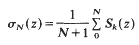
be the Cesàro averages. When the sequence σn(z) converges to a finite limit σ(Z), we say that the Taylor series is (C, 1) summable and σ(z) is the (C, 1) sum of the series. Concerning (C, 1) summable Taylor series Marcinkiewicz and Zygmund ([5], [6] Vol. II, p. 178) established the following theorem.


The problem of illumination of the boundary of a convex body by affine subspaces
- Part of
-
- Journal:
- Mathematika / Volume 38 / Issue 2 / December 1991
- Published online by Cambridge University Press:
- 26 February 2010, pp. 362-375
- Print publication:
- December 1991
-
- Article
- Export citation
Value groups and simple transcendental extensions
- Part of
-
- Journal:
- Mathematika / Volume 38 / Issue 2 / December 1991
- Published online by Cambridge University Press:
- 26 February 2010, pp. 381-385
- Print publication:
- December 1991
-
- Article
- Export citation
Contact structures on 1-connected 5-manifolds
- Part of
-
- Journal:
- Mathematika / Volume 38 / Issue 2 / December 1991
- Published online by Cambridge University Press:
- 26 February 2010, pp. 303-311
- Print publication:
- December 1991
-
- Article
- Export citation
An ellipsoid packing in E3 of unexpected high density
- Part of
-
- Journal:
- Mathematika / Volume 38 / Issue 2 / December 1991
- Published online by Cambridge University Press:
- 26 February 2010, pp. 318-320
- Print publication:
- December 1991
-
- Article
- Export citation
Constructive packings of cross polytopes
- Part of
-
- Journal:
- Mathematika / Volume 38 / Issue 2 / December 1991
- Published online by Cambridge University Press:
- 26 February 2010, pp. 376-380
- Print publication:
- December 1991
-
- Article
- Export citation
-
The n-dimensional cross polytope, |x|+|x2|+…+|xn≤1, can be lattice packed with density δ satisfying

but proofs of this, such as the Minkowski-Hlawka theorem, do not actually provide such packings. That is, they are nonconstructive. Here we exhibit lattice packings whose density satisfies only

but by a highly constructive method. These are the densest constructive lattice packings of cross polytopes obtained so far.
The asymptotics of random sieves
- Part of
-
- Journal:
- Mathematika / Volume 38 / Issue 2 / December 1991
- Published online by Cambridge University Press:
- 26 February 2010, pp. 285-302
- Print publication:
- December 1991
-
- Article
- Export citation
LP-Chen forms on loop spaces
-
-
- Book:
- Stochastic Analysis
- Published online:
- 31 March 2010
- Print publication:
- 25 October 1991, pp 103-162
-
- Chapter
- Export citation
Some caricatures of multiple contact diffusion-limited aggregation and the η-model
-
-
- Book:
- Stochastic Analysis
- Published online:
- 31 March 2010
- Print publication:
- 25 October 1991, pp 179-228
-
- Chapter
- Export citation
Characterizing the weak convergence of stochastic integrals
-
-
- Book:
- Stochastic Analysis
- Published online:
- 31 March 2010
- Print publication:
- 25 October 1991, pp 255-260
-
- Chapter
- Export citation
On long excursions of Brownian motion among Poissonian obstacles
-
-
- Book:
- Stochastic Analysis
- Published online:
- 31 March 2010
- Print publication:
- 25 October 1991, pp 353-375
-
- Chapter
- Export citation
Contents
-
- Book:
- Stochastic Analysis
- Published online:
- 31 March 2010
- Print publication:
- 25 October 1991, pp v-vi
-
- Chapter
- Export citation
Statistics of local time and excursions for the Ornstein–Uhlenbeck process
-
-
- Book:
- Stochastic Analysis
- Published online:
- 31 March 2010
- Print publication:
- 25 October 1991, pp 91-102
-
- Chapter
- Export citation
Harmonic morphisms and the resurrection of Markov processes
-
-
- Book:
- Stochastic Analysis
- Published online:
- 31 March 2010
- Print publication:
- 25 October 1991, pp 71-90
-
- Chapter
- Export citation
