Refine search
Actions for selected content:
26071 results in Abstract analysis
On the asymptotic decay of L2-solutions of one-body Schrödinger equations in unbounded domains*
-
- Journal:
- Proceedings of the Royal Society of Edinburgh. Section A: Mathematics / Volume 115 / Issue 1-2 / 1990
- Published online by Cambridge University Press:
- 14 November 2011, pp. 65-86
- Print publication:
- 1990
-
- Article
- Export citation
Nonexistence of radial solutions of two elliptic boundary value problems
-
- Journal:
- Proceedings of the Royal Society of Edinburgh. Section A: Mathematics / Volume 114 / Issue 1-2 / 1990
- Published online by Cambridge University Press:
- 14 November 2011, pp. 27-31
- Print publication:
- 1990
-
- Article
- Export citation
-
We consider two boundary value problems (of Neumann or related type) associated with the equation
 in Ω. The existence of a solution was previously established assuming that p < N/(N −s2). (N dimension of Ω.) We prove that this exponent is critical for these problems, at least in the radially symmetric case when Ω is a ball. This is understood in the sense that the existence result does not hold when p ≧ N/(N − 2).
 in Ω. The existence of a solution was previously established assuming that p < N/(N −s2). (N dimension of Ω.) We prove that this exponent is critical for these problems, at least in the radially symmetric case when Ω is a ball. This is understood in the sense that the existence result does not hold when p ≧ N/(N − 2).
Idempotent rank in finite full transformation semigroups
-
- Journal:
- Proceedings of the Royal Society of Edinburgh. Section A: Mathematics / Volume 114 / Issue 3-4 / 1990
- Published online by Cambridge University Press:
- 14 November 2011, pp. 161-167
- Print publication:
- 1990
-
- Article
- Export citation
Saint-Venant's principle on unbounded regions
-
- Journal:
- Proceedings of the Royal Society of Edinburgh. Section A: Mathematics / Volume 115 / Issue 3-4 / 1990
- Published online by Cambridge University Press:
- 14 November 2011, pp. 319-336
- Print publication:
- 1990
-
- Article
- Export citation
PRM volume 114 issue 3-4 Cover and Front matter
-
- Journal:
- Proceedings of the Royal Society of Edinburgh. Section A: Mathematics / Volume 114 / Issue 3-4 / 1990
- Published online by Cambridge University Press:
- 14 November 2011, pp. f1-f2
- Print publication:
- 1990
-
- Article
-
- You have access
- Export citation
A rigorous proof of an exponentially small estimate for a boundary value arising from an ordinary differential equation
-
- Journal:
- Proceedings of the Royal Society of Edinburgh. Section A: Mathematics / Volume 114 / Issue 3-4 / 1990
- Published online by Cambridge University Press:
- 14 November 2011, pp. 243-258
- Print publication:
- 1990
-
- Article
- Export citation
-
The equation

has a solution y(t) which is non-oscillating on the interval (0, ∞) and has the asymptotic expansion

Each term of this expansion is even in t so that formally
 is zero to all orders of ɛ. The estimate of has been obtained by Byatt-Smith [3] who corrects (2) in the complex plane near t = i where the series ceases to be valid. This requires asolution of the equation
the equation for the first Painlevé transcedent. Here we prove rigorously that this method gives the correct asymptotic estimate

where

The proof involves converting (1) and (3) to integral equations. The existence and uniqueness of these integral equations are established by use of the contraction mapping theorem. We also prove that the appropriate solution to (3) provides a uniformly valid approximation to (2) over a suitably defined region of the complex plane.
We also consider the connection problem for the oscillatory solutions of (1) which have asymptotic expansions

where Ã+, Ã− φ+, and φ− are constants. The connection problem is to determine the asymptotic expansion at +∞ of a solution which has a given asymptotic expansion at −∞. In other words, we wish to find (Ã+,φ+) as a function of Ã−and φ−. We prove that there is a unique solution to the connection problem, provided Ã− is small enough, and obtain bounds on the estimate of Ã+
 is zero to all orders of ɛ. The estimate of
On the topological properties of symplectic maps
-
- Journal:
- Proceedings of the Royal Society of Edinburgh. Section A: Mathematics / Volume 115 / Issue 1-2 / 1990
- Published online by Cambridge University Press:
- 14 November 2011, pp. 25-38
- Print publication:
- 1990
-
- Article
- Export citation
Lower semicontinuity of multiple integrals and the Biting Lemma
-
- Journal:
- Proceedings of the Royal Society of Edinburgh. Section A: Mathematics / Volume 114 / Issue 3-4 / 1990
- Published online by Cambridge University Press:
- 14 November 2011, pp. 367-379
- Print publication:
- 1990
-
- Article
- Export citation
Transformation and canonical forms of functional-differential equations
-
- Journal:
- Proceedings of the Royal Society of Edinburgh. Section A: Mathematics / Volume 115 / Issue 3-4 / 1990
- Published online by Cambridge University Press:
- 14 November 2011, pp. 349-357
- Print publication:
- 1990
-
- Article
- Export citation
On blow-up and degeneracy for the semilinear heat equation with source
-
- Journal:
- Proceedings of the Royal Society of Edinburgh. Section A: Mathematics / Volume 115 / Issue 1-2 / 1990
- Published online by Cambridge University Press:
- 14 November 2011, pp. 19-24
- Print publication:
- 1990
-
- Article
- Export citation
On the Gegenbauer transformation
-
- Journal:
- Proceedings of the Royal Society of Edinburgh. Section A: Mathematics / Volume 115 / Issue 1-2 / 1990
- Published online by Cambridge University Press:
- 14 November 2011, pp. 151-166
- Print publication:
- 1990
-
- Article
- Export citation
-
The Gegenbauer transformation Gλk is defined for λ > −1/2, k = 0, 1, 2, …, by

where, if
 being the Gegenbauer polynomial of index λ and degree k, and L0k is the Tchebichef polynomial of degree k. The transformation is studied on the spaces Lµ, p denned by the norm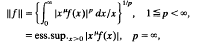
and its boundedness and range on these spaces is determined and inversion formulae are found.
 being the Gegenbauer polynomial of index λ and degree k, and L
Existence and stability of travelling wave solutions for an evolutionary ecology model
-
- Journal:
- Proceedings of the Royal Society of Edinburgh. Section A: Mathematics / Volume 115 / Issue 1-2 / 1990
- Published online by Cambridge University Press:
- 14 November 2011, pp. 1-18
- Print publication:
- 1990
-
- Article
- Export citation
Hopf bifurcation for equivariant conservative and time-reversible systems
-
- Journal:
- Proceedings of the Royal Society of Edinburgh. Section A: Mathematics / Volume 116 / Issue 1-2 / 1990
- Published online by Cambridge University Press:
- 14 November 2011, pp. 103-128
- Print publication:
- 1990
-
- Article
- Export citation
A variational approach to a nonlinear Steklov problem
-
- Journal:
- Proceedings of the Royal Society of Edinburgh. Section A: Mathematics / Volume 115 / Issue 1-2 / 1990
- Published online by Cambridge University Press:
- 14 November 2011, pp. 139-149
- Print publication:
- 1990
-
- Article
- Export citation
PRM volume 114 issue 3-4 Cover and Back matter
-
- Journal:
- Proceedings of the Royal Society of Edinburgh. Section A: Mathematics / Volume 114 / Issue 3-4 / 1990
- Published online by Cambridge University Press:
- 14 November 2011, pp. b1-b2
- Print publication:
- 1990
-
- Article
-
- You have access
- Export citation
On a linear, partly hyperbolic model of viscoelastic flow past a plate
-
- Journal:
- Proceedings of the Royal Society of Edinburgh. Section A: Mathematics / Volume 114 / Issue 3-4 / 1990
- Published online by Cambridge University Press:
- 14 November 2011, pp. 299-354
- Print publication:
- 1990
-
- Article
- Export citation
PRM volume 115 issue 3-4 Cover and Back matter
-
- Journal:
- Proceedings of the Royal Society of Edinburgh. Section A: Mathematics / Volume 115 / Issue 3-4 / 1990
- Published online by Cambridge University Press:
- 14 November 2011, pp. b1-b2
- Print publication:
- 1990
-
- Article
-
- You have access
- Export citation
Darcy's law for slow viscous flow past a stationary array of bubbles
-
- Journal:
- Proceedings of the Royal Society of Edinburgh. Section A: Mathematics / Volume 114 / Issue 1-2 / 1990
- Published online by Cambridge University Press:
- 14 November 2011, pp. 71-79
- Print publication:
- 1990
-
- Article
- Export citation
Corrigendum: Spectral properties of two parameter eigenvalue problems II
-
- Journal:
- Proceedings of the Royal Society of Edinburgh. Section A: Mathematics / Volume 115 / Issue 1-2 / 1990
- Published online by Cambridge University Press:
- 14 November 2011, pp. 87-90
- Print publication:
- 1990
-
- Article
- Export citation
Some examples of rank one convex functions in dimension two
-
- Journal:
- Proceedings of the Royal Society of Edinburgh. Section A: Mathematics / Volume 114 / Issue 1-2 / 1990
- Published online by Cambridge University Press:
- 14 November 2011, pp. 135-150
- Print publication:
- 1990
-
- Article
- Export citation
-
We study the rank one convexity of some functions f(ξ) where ξ is a 2 × 2 matrix. Examples such as |ξ|2α + h(detξ) and | ξ |2α (| ξ |2 − γdet ξ) are investigated. Numerical computations are done on the example of Dacorogna and Marcellini,
 indicating that this function is quasiconvex.
 indicating that this function is quasiconvex.