Refine search
Actions for selected content:
26071 results in Abstract analysis
A factorisation procedure for two by two matrix functions on the circle with two rationally independent entries
-
- Journal:
- Proceedings of the Royal Society of Edinburgh. Section A: Mathematics / Volume 115 / Issue 1-2 / 1990
- Published online by Cambridge University Press:
- 14 November 2011, pp. 119-138
- Print publication:
- 1990
-
- Article
- Export citation
Examples of rank-one convex functions
-
- Journal:
- Proceedings of the Royal Society of Edinburgh. Section A: Mathematics / Volume 114 / Issue 3-4 / 1990
- Published online by Cambridge University Press:
- 14 November 2011, pp. 237-242
- Print publication:
- 1990
-
- Article
- Export citation
Whitney-sums (fibre-joins) in over space theory and obstruction theory for cohomology with local coefficients*
-
- Journal:
- Proceedings of the Royal Society of Edinburgh. Section A: Mathematics / Volume 115 / Issue 3-4 / 1990
- Published online by Cambridge University Press:
- 14 November 2011, pp. 359-365
- Print publication:
- 1990
-
- Article
- Export citation
Periodic solutions of a planar delay equation
-
- Journal:
- Proceedings of the Royal Society of Edinburgh. Section A: Mathematics / Volume 116 / Issue 1-2 / 1990
- Published online by Cambridge University Press:
- 14 November 2011, pp. 85-101
- Print publication:
- 1990
-
- Article
- Export citation
Homoclinic orbits for a class of Hamiltonian systems
-
- Journal:
- Proceedings of the Royal Society of Edinburgh. Section A: Mathematics / Volume 114 / Issue 1-2 / 1990
- Published online by Cambridge University Press:
- 14 November 2011, pp. 33-38
- Print publication:
- 1990
-
- Article
- Export citation
-
Consider the second order Hamiltonian system:

where q ∊ ℝn and V ∊ C1 (ℝ ×ℝn ℝ) is T periodic in t. Suppose Vq (t, 0) = 0, 0 is a local maximum for V(t,.) and V(t, x) | x| → ∞ Under these and some additional technical assumptions we prove that (HS) has a homoclinic orbit q emanating from 0. The orbit q is obtained as the limit as k → ∞ of 2kT periodic solutions (i.e. subharmonics) qk of (HS). The subharmonics qk are obtained in turn via the Mountain Pass Theorem.
Compact boundedness in periodic functional differential equations with infinite delay
-
- Journal:
- Proceedings of the Royal Society of Edinburgh. Section A: Mathematics / Volume 114 / Issue 3-4 / 1990
- Published online by Cambridge University Press:
- 14 November 2011, pp. 291-297
- Print publication:
- 1990
-
- Article
- Export citation
-
It is the aim of this article to consider some problems arising from the non local-compactness of the phase space for functional differential equations. The compact boundedness, that is, the boundedness depending on each compact set involving the initial values, is proved to be implied from the ultimate boundedness for periodic systems of functional differential equations on Cγ: = {φ ∊ C((–∞,0])
 Note that it is known that the compactness cannot be dropped in the above. An example is also given to show that the asymptotic stability is not necessarily uniform even for periodic functional differential equations on Co.
 Note that it is known that the compactness cannot be dropped in the above. An example is also given to show that the asymptotic stability is not necessarily uniform even for periodic functional differential equations on C
PRM volume 116 issue 3-4 Cover and Back matter
-
- Journal:
- Proceedings of the Royal Society of Edinburgh. Section A: Mathematics / Volume 116 / Issue 3-4 / 1990
- Published online by Cambridge University Press:
- 14 November 2011, pp. b1-b2
- Print publication:
- 1990
-
- Article
-
- You have access
- Export citation
Diffusion processes with non-smooth diffusion coefficients and their density functions
-
- Journal:
- Proceedings of the Royal Society of Edinburgh. Section A: Mathematics / Volume 115 / Issue 3-4 / 1990
- Published online by Cambridge University Press:
- 14 November 2011, pp. 231-242
- Print publication:
- 1990
-
- Article
- Export citation
-
Denote by Xt an n-dimensional symmetric Markov process associated with an elliptic operator

where (aij) is a bounded measurable uniformly positive definite matrix-valued function of x. Let f(x, t) be a measurable function defined on Rn × [0, 1]. In this paper, we prove that f(Xt, t) is a regular Dirichlet process if and only if the following two conditions are satisfied:
(i) For almost every
 and
and 
(ii) Let
 be a sequence of subdivisions of [0,1] so that
Then

As an application of the above result, we prove the following fact: Let p(y, t) be the probability density of the diffusion process Yt, associated with the elliptic operator

where (bi) are bounded measurable functions of x and we suppose that
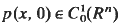 . Then, p(Yt, t) is a regular Dirichlet process and therefore p(.,.) satisfies (i) and (ii).
 and
and 
 be a sequence of subdivisions of [0,1] so that
 . Then, p(Y
A two-parameter eigenvalue problem involving complex potentials
-
- Journal:
- Proceedings of the Royal Society of Edinburgh. Section A: Mathematics / Volume 116 / Issue 1-2 / 1990
- Published online by Cambridge University Press:
- 14 November 2011, pp. 177-191
- Print publication:
- 1990
-
- Article
- Export citation
Real roots of polynomials and right inverses for partial differential operators in the space of tempered distributions
-
- Journal:
- Proceedings of the Royal Society of Edinburgh. Section A: Mathematics / Volume 114 / Issue 3-4 / 1990
- Published online by Cambridge University Press:
- 14 November 2011, pp. 169-179
- Print publication:
- 1990
-
- Article
- Export citation
Stability of discontinuous steady states in shearing motions of a non-Newtonian fluid
-
- Journal:
- Proceedings of the Royal Society of Edinburgh. Section A: Mathematics / Volume 115 / Issue 1-2 / 1990
- Published online by Cambridge University Press:
- 14 November 2011, pp. 39-59
- Print publication:
- 1990
-
- Article
- Export citation
A functional-analytic framework for the study of elliptic equations on variable domains
-
- Journal:
- Proceedings of the Royal Society of Edinburgh. Section A: Mathematics / Volume 116 / Issue 3-4 / 1990
- Published online by Cambridge University Press:
- 14 November 2011, pp. 367-380
- Print publication:
- 1990
-
- Article
- Export citation
PRM volume 116 issue 1-2 Cover and Front matter
-
- Journal:
- Proceedings of the Royal Society of Edinburgh. Section A: Mathematics / Volume 116 / Issue 1-2 / 1990
- Published online by Cambridge University Press:
- 14 November 2011, pp. f1-f2
- Print publication:
- 1990
-
- Article
-
- You have access
- Export citation
SL(n + 1)-invariant equations which reduce to equations of Korteweg-de Vries type
-
- Journal:
- Proceedings of the Royal Society of Edinburgh. Section A: Mathematics / Volume 115 / Issue 3-4 / 1990
- Published online by Cambridge University Press:
- 14 November 2011, pp. 367-381
- Print publication:
- 1990
-
- Article
- Export citation
Boundary conditions for general ordinary differential operators and their adjoints
-
- Journal:
- Proceedings of the Royal Society of Edinburgh. Section A: Mathematics / Volume 114 / Issue 1-2 / 1990
- Published online by Cambridge University Press:
- 14 November 2011, pp. 99-117
- Print publication:
- 1990
-
- Article
- Export citation
-
A characterisation is obtained of all the regularly solvable operators and their adjoints generated by a general differential expression in
 . The domains of these operators are described in terms of boundary conditions involving the solutions of Mu = λwu and the adjoint equation
  . The results include those of Sun Jiong [15] concerning self-adjoint realisations of a symmetric M when the minimal operator has equal deficiency indices: if the deficiency indices are unequal the maximal symmetric operators are determined by the results herein. Another special case concerns the J -self-adjoint operators, where J denotes complex conjugation, and for this we recover the results of Zai-jiu Shang in [16].
 . The domains of these operators are described in terms of boundary conditions involving the
  . The results include those of Sun Jiong [15] concerning self-adjoint realisations of a symmetric M when the minimal operator has equal deficiency indices: if the deficiency indices are unequal the maximal symmetric operators are determined by the results herein. Another special case concerns the J -self-adjoint operators, where J denotes complex conjugation, and for this we recover the results of Zai-jiu Shang in [16].
H-measures, a new approach for studying homogenisation, oscillations and concentration effects in partial differential equations*
-
- Journal:
- Proceedings of the Royal Society of Edinburgh. Section A: Mathematics / Volume 115 / Issue 3-4 / 1990
- Published online by Cambridge University Press:
- 14 November 2011, pp. 193-230
- Print publication:
- 1990
-
- Article
- Export citation
Existence of multiple positive solutions of inhomogeneous semilinear elliptic problems in unbounded domains
-
- Journal:
- Proceedings of the Royal Society of Edinburgh. Section A: Mathematics / Volume 115 / Issue 3-4 / 1990
- Published online by Cambridge University Press:
- 14 November 2011, pp. 301-318
- Print publication:
- 1990
-
- Article
- Export citation
-
By using the concentration-compactness method of Lions [14, 16] and the mountain pass theorem of Ambrosetti and Rabinowitz [3], through a careful inspection of the energy balance for some sequence of approximated solutions, we show that under suitable conditions on f and h, the inhomogeneous problem. −Δu + c2u = λ(f(u) + h(x)) for x ∈ Ω (Ω is an exterior domain in ℝN, N≧ 3) and
 has at least two positive solutions.
 has at least two positive solutions.
Compact attractor for a nonlinear wave equation with critical exponent
-
- Journal:
- Proceedings of the Royal Society of Edinburgh. Section A: Mathematics / Volume 115 / Issue 1-2 / 1990
- Published online by Cambridge University Press:
- 14 November 2011, pp. 61-64
- Print publication:
- 1990
-
- Article
- Export citation
On the Titchmarsh-Weyl M(λ)-coefficient and spectral density for a Dirac system
-
- Journal:
- Proceedings of the Royal Society of Edinburgh. Section A: Mathematics / Volume 114 / Issue 3-4 / 1990
- Published online by Cambridge University Press:
- 14 November 2011, pp. 259-277
- Print publication:
- 1990
-
- Article
- Export citation
Solvability of boundary value problems for vector differential systems*
-
- Journal:
- Proceedings of the Royal Society of Edinburgh. Section A: Mathematics / Volume 114 / Issue 3-4 / 1990
- Published online by Cambridge University Press:
- 14 November 2011, pp. 181-193
- Print publication:
- 1990
-
- Article
- Export citation
-
Brouwer topological degree theory, the shooting type method, the disconjugacy theory of Hamiltonian systems and the Liapunov-Razumikhin technique of Volterra integrodifferential equations are employed to establish some solvability results for the 2n-dimensional differential system

subject to one of the following boundary conditions:
(i) x(0) = Qx(l), Qg(l x(1), qy(1)= g(0, x(0), y(0)),
(ii) Blx(O) = B2g(O, x(O), y(O)), C1x(l) = −C2g(l, x(l), y(l)),
where Q, Bi, Ci, i = 1, 2, are n x n real matrices. An application is given to the second order equation xn = h(t, x, x') subject to certain nonlinear boundary conditions.

