Refine search
Actions for selected content:
26076 results in Abstract analysis
PRM volume 112 issue 1-2 Cover and Back matter
-
- Journal:
- Proceedings of the Royal Society of Edinburgh. Section A: Mathematics / Volume 112 / Issue 1-2 / 1989
- Published online by Cambridge University Press:
- 14 November 2011, pp. b1-b2
- Print publication:
- 1989
-
- Article
-
- You have access
- Export citation
Weak solutions to the initial-boundary value problem for the shearing of non-homogeneous thermoviscoplastic materials
-
- Journal:
- Proceedings of the Royal Society of Edinburgh. Section A: Mathematics / Volume 113 / Issue 3-4 / 1989
- Published online by Cambridge University Press:
- 14 November 2011, pp. 257-265
- Print publication:
- 1989
-
- Article
- Export citation
PRM volume 112 issue 3-4 Cover and Back matter
-
- Journal:
- Proceedings of the Royal Society of Edinburgh. Section A: Mathematics / Volume 112 / Issue 3-4 / 1989
- Published online by Cambridge University Press:
- 14 November 2011, pp. b1-b4
- Print publication:
- 1989
-
- Article
-
- You have access
- Export citation
Unstable atomicity of ΩSpin(r)
-
- Journal:
- Proceedings of the Royal Society of Edinburgh. Section A: Mathematics / Volume 112 / Issue 1-2 / 1989
- Published online by Cambridge University Press:
- 14 November 2011, pp. 53-69
- Print publication:
- 1989
-
- Article
- Export citation
The approximation of exterior Neumann problems in a halfspace by means of problems with compact boundary
-
- Journal:
- Proceedings of the Royal Society of Edinburgh. Section A: Mathematics / Volume 111 / Issue 3-4 / 1989
- Published online by Cambridge University Press:
- 14 November 2011, pp. 285-300
- Print publication:
- 1989
-
- Article
- Export citation
-
This paper describes a proof that the solutions of Neumann problems for the exterior of spheres {x ∊ ℝ3∣
 converge to the solutions of the exterior problem for the halfspace {x ∊ ℝ3 } x1 ≧ 0} as b → ∞ provided that the boundary data converge in a certain sense. The method requires that there be some dissipation which can be arbitrarily small. Fredholm integral equations are set up for the boundary data, and these are solved by means of Neumann series for large b. Estimates on the terms of the series (which involve singular integrals), in terms of b, allow the convergence proof to be carried through.
The procedure of expressing problems with infinite boundaries in terms of problems with finite boundaries allows the implementation of an effective numerical procedure for determining, for example, the entire near-field of a baffled piston, a problem whose solution has proved elusive for many years.
 converge to the solutions of the exterior problem for the halfspace {x ∊ ℝ
On subordinacy and analysis of the spectrum of Schrödinger operators with two singular endpoints
-
- Journal:
- Proceedings of the Royal Society of Edinburgh. Section A: Mathematics / Volume 112 / Issue 3-4 / 1989
- Published online by Cambridge University Press:
- 14 November 2011, pp. 213-229
- Print publication:
- 1989
-
- Article
- Export citation
The perturbed test function method for viscosity solutions of nonlinear PDE
-
- Journal:
- Proceedings of the Royal Society of Edinburgh. Section A: Mathematics / Volume 111 / Issue 3-4 / 1989
- Published online by Cambridge University Press:
- 14 November 2011, pp. 359-375
- Print publication:
- 1989
-
- Article
- Export citation
PRM volume 113 issue 1-2 Cover and Front matter
-
- Journal:
- Proceedings of the Royal Society of Edinburgh. Section A: Mathematics / Volume 113 / Issue 1-2 / 1989
- Published online by Cambridge University Press:
- 14 November 2011, pp. f1-f2
- Print publication:
- 1989
-
- Article
-
- You have access
- Export citation
Tight stable surfaces, II
-
- Journal:
- Proceedings of the Royal Society of Edinburgh. Section A: Mathematics / Volume 111 / Issue 3-4 / 1989
- Published online by Cambridge University Press:
- 14 November 2011, pp. 213-229
- Print publication:
- 1989
-
- Article
- Export citation
Maps between p-completed classifying spaces
-
- Journal:
- Proceedings of the Royal Society of Edinburgh. Section A: Mathematics / Volume 112 / Issue 3-4 / 1989
- Published online by Cambridge University Press:
- 14 November 2011, pp. 231-235
- Print publication:
- 1989
-
- Article
- Export citation
The gradient theory of phase transitions for systems with two potential wells
-
- Journal:
- Proceedings of the Royal Society of Edinburgh. Section A: Mathematics / Volume 111 / Issue 1-2 / 1989
- Published online by Cambridge University Press:
- 14 November 2011, pp. 89-102
- Print publication:
- 1989
-
- Article
- Export citation
-
In this paper we generalise the gradient theory of phase transitions to the vector valued case. We consider the family of perturbations

of the nonconvex functional
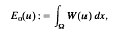
where W:RN→R supports two phases and N ≧1. We obtain the Γ(L1(Ω))-limit of the sequence

Moreover, we improve a compactness result ensuring the existence of a subsequence of minimisers of Eε(·) converging in L1(Ω) to a minimiser of E0(·) with minimal interfacial area.

Regularity of solutions and interfaces of the porous medium equation via local estimates*
-
- Journal:
- Proceedings of the Royal Society of Edinburgh. Section A: Mathematics / Volume 112 / Issue 1-2 / 1989
- Published online by Cambridge University Press:
- 14 November 2011, pp. 1-13
- Print publication:
- 1989
-
- Article
- Export citation
Heteroclinic cycles involving periodic solutions in mode interactions with O(2) symmetry
-
- Journal:
- Proceedings of the Royal Society of Edinburgh. Section A: Mathematics / Volume 113 / Issue 3-4 / 1989
- Published online by Cambridge University Press:
- 14 November 2011, pp. 315-345
- Print publication:
- 1989
-
- Article
- Export citation
Index to Volume 113
-
- Journal:
- Proceedings of the Royal Society of Edinburgh. Section A: Mathematics / Volume 113 / Issue 3-4 / 1989
- Published online by Cambridge University Press:
- 14 November 2011, pp. i-ii
- Print publication:
- 1989
-
- Article
- Export citation
Periodic trajectories in static space-times
-
- Journal:
- Proceedings of the Royal Society of Edinburgh. Section A: Mathematics / Volume 113 / Issue 1-2 / 1989
- Published online by Cambridge University Press:
- 14 November 2011, pp. 99-103
- Print publication:
- 1989
-
- Article
- Export citation
Stability and regularity in bifurcations of planar vector fields
-
- Journal:
- Proceedings of the Royal Society of Edinburgh. Section A: Mathematics / Volume 113 / Issue 3-4 / 1989
- Published online by Cambridge University Press:
- 14 November 2011, pp. 243-256
- Print publication:
- 1989
-
- Article
- Export citation
Multiple solutions of a nonlinear boundary value problem
-
- Journal:
- Proceedings of the Royal Society of Edinburgh. Section A: Mathematics / Volume 113 / Issue 3-4 / 1989
- Published online by Cambridge University Press:
- 14 November 2011, pp. 191-209
- Print publication:
- 1989
-
- Article
- Export citation
PRM volume 113 issue 3-4 Cover and Front matter
-
- Journal:
- Proceedings of the Royal Society of Edinburgh. Section A: Mathematics / Volume 113 / Issue 3-4 / 1989
- Published online by Cambridge University Press:
- 14 November 2011, pp. f1-f2
- Print publication:
- 1989
-
- Article
-
- You have access
- Export citation
Illuminating sets of constant width
- Part of
-
- Journal:
- Mathematika / Volume 35 / Issue 2 / December 1988
- Published online by Cambridge University Press:
- 26 February 2010, pp. 180-189
- Print publication:
- December 1988
-
- Article
- Export citation
The two-ball property: transitivity and examples
- Part of
-
- Journal:
- Mathematika / Volume 35 / Issue 2 / December 1988
- Published online by Cambridge University Press:
- 26 February 2010, pp. 190-197
- Print publication:
- December 1988
-
- Article
- Export citation
